Accidents Don’t Happen by Chance. They Happen by Design Gaps.

The 3-Year Danger Zone: Why Your Outdated Safety System is a Liability
February 6, 2026
Your Annual Safety Partner — Not Just an Auditor: The Safety Master
February 9, 2026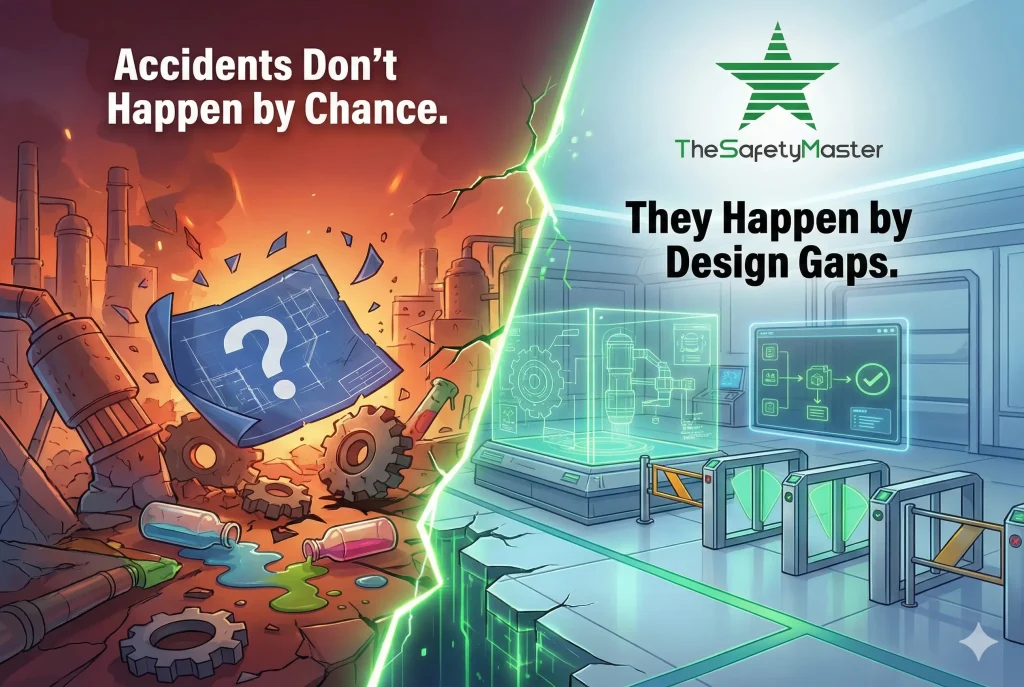
In the high-stakes world of industrial manufacturing, chemical processing, and heavy engineering, the word “accident” is often a misnomer. The term implies an event occurring by chance, a stroke of bad luck, or an unforeseen act of God. However, when we peel back the layers of catastrophic failures—from the leaking gas valve to the electrical short circuit that sparks an inferno—we rarely find “chance.” Instead, we find a trail of overlooked decisions, unaddressed risks, and systemic flaws.
We find Design Gaps.
At The Safety Master, we believe that safety is not merely the absence of accidents; it is the presence of robust defenses. When incidents occur, they are almost always the result of a failure in design—not just the engineering design of a machine, but the design of processes, the design of management systems, and the design of the safety culture itself.
This article explores the anatomy of these design gaps, why they persist, and how organizations can systematically identify and close them before they turn into headlines.
The Illusion of the “Freak Accident”
For decades, the safety industry has relied on models like the “Swiss Cheese Model” of accident causation. This model suggests that hazards are prevented from causing losses by a series of barriers (slices of cheese). Each barrier has unintended weaknesses or holes. When these holes align momentarily, a hazard passes through, resulting in an accident.
While this model is accurate, the “holes” are often dismissed as isolated errors. A worker forgot to wear gloves. A sensor failed. A supervisor missed a check.
However, if we look closer, we see that these holes are not random. They are structural.
- Why did the worker forget gloves? Because the PPE station was designed too far from the workspace (a Layout Design Gap).
- Why did the sensor fail? Because the maintenance schedule did not account for the sensor’s degradation rate (a Procedural Design Gap).
- Why did the supervisor miss the check? Because the workload was improperly balanced, causing fatigue (a Management Design Gap).
Accidents are the mathematical inevitability of leaving these gaps open. Understanding this shifts the focus from “blaming the individual” to “fixing the system.”
1. Engineering Design Gaps: The Silent Killers
The most obvious design gaps exist in the physical hardware of a facility. In the rush to commission a plant or expand production capacity, “Inherently Safer Design” (ISD) principles are sometimes compromised.
An engineering design gap might look like a pressure relief valve vented toward a walkway rather than a safe discharge area. It might be the use of incompatible materials in piping that corrode faster than anticipated. These are latent defects waiting for a trigger.
Identifying Hidden Flaws with HAZOP
One of the most effective tools for closing engineering gaps is the Hazard and Operability Study. A HAZOP is not just a checklist; it is a creative brainstorming session conducted by a multidisciplinary team. It systematically questions every part of a process: “What happens if there is no flow? What happens if there is reverse flow? What if the temperature spikes?”
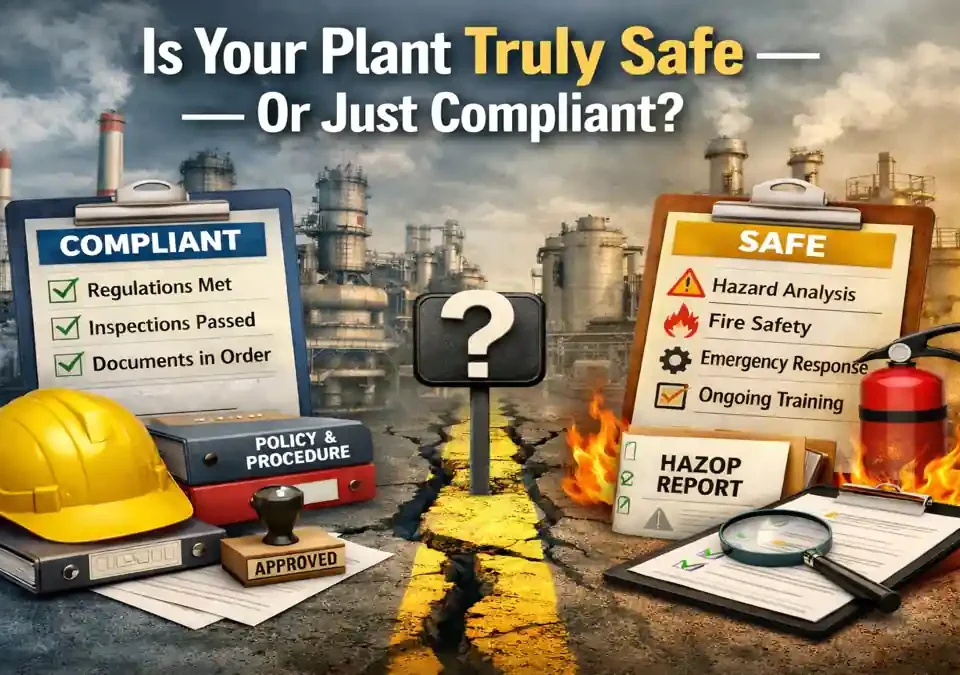
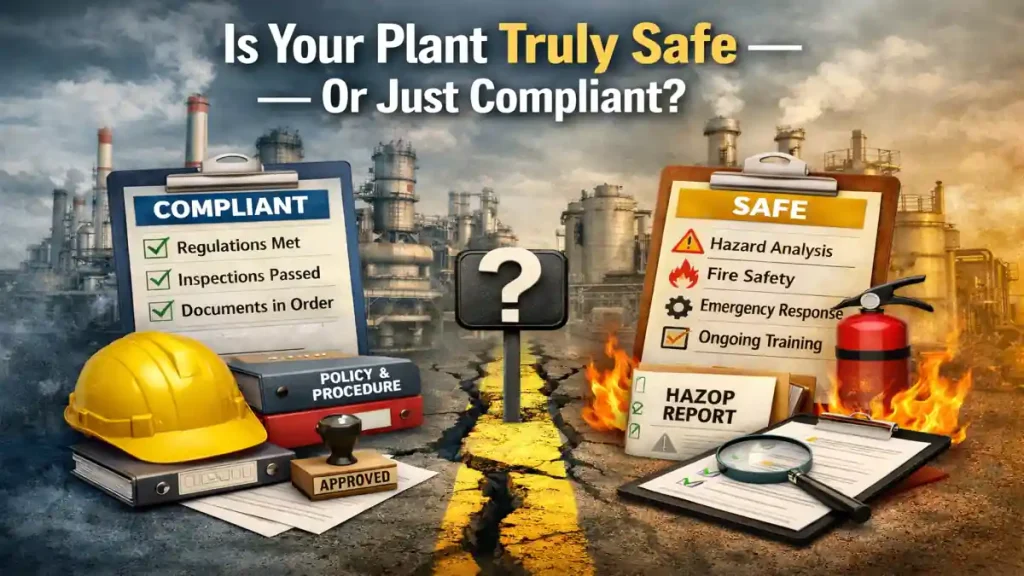
By simulating deviations from the design intent, we can predict failures before they occur physically. For example, a chemical plant might realize that a pump failure could lead to a dangerous backflow—a gap that standard operating procedures missed. To truly secure a facility, organizations must move beyond basic checks and conduct a comprehensive Hazop Study to scrutinize every node of their operation for potential deviation and disaster.
2. The Infrastructure Gap: Fire and Emergency Readiness
Design gaps are frequently found in the auxiliary systems meant to protect us, specifically fire safety infrastructure. It is a tragedy when the very systems designed to mitigate a disaster fail to perform because of poor design or maintenance.
We often see facilities where the fire hydrant system is technically “compliant” with local codes but operationally defunct. Perhaps the pumps are not auto-start enabled, or the hydrants are blocked by raw material storage. These are gaps in the “Design of Defense.”
The Passive vs. Active Gap
Fire safety is two-fold:
- Passive Protection: Fire walls, fire doors, and compartmentalization.
- Active Protection: Sprinklers, detectors, and suppression systems.
A common design gap occurs when a facility undergoes expansion. A warehouse designed for non-combustible metal parts is suddenly used to store cardboard packaging or flammable liquids. The original fire suppression design is now inadequate for the new fire load. The sprinklers may activate, but they won’t control the fire.
To identify these disparities between the current facility usage and its safety capabilities, a rigorous Fire Audit is essential. This audit assesses not just the equipment, but the “design logic” of the fire safety plan against the actual hazards present on the floor today.
3. The Management System Gap
If engineering is the hardware of safety, management systems are the software. This is where the most insidious design gaps lie.
A management gap exists when safety is treated as a separate department rather than an integrated business value. It manifests when “Production First” is the unspoken rule, regardless of the safety policy hanging on the wall.
Management of Change (MOC)
The single biggest generator of design gaps is change. When a chemical formula is tweaked, a vendor is changed, or a veteran operator retires, the risk profile of the facility changes. Without a robust system to manage this change, new gaps open up.
For instance, replacing a manual valve with an automatic one seems like an upgrade. But if the software controlling that valve hasn’t been vetted for cybersecurity risks or fail-safe modes, you have introduced a new design gap.
This is where Process Safety Management (PSM) becomes the backbone of a safe organization. PSM is not a single activity; it is a design for how the organization runs. It connects the dots between operating procedures, mechanical integrity, training, and emergency planning. A strong PSM framework ensures that when one part of the system changes, the rest of the system adapts to maintain safety.
4. The Human Factor: Designing for Real People
Humans are fallible. We get tired, we get distracted, and we take shortcuts. A safety system that requires human perfection to function is a system designed to fail.
A “Human Factors Design Gap” occurs when we design equipment or procedures that fight against human nature.
- The Ergonomic Gap: If a safety switch is placed 8 feet high, operators will eventually ignore it or use unsafe climbing methods to reach it.
- The Cognitive Gap: If an alarm panel flashes 50 different red lights during an upset, the operator will experience cognitive overload and likely freeze. This is a design flaw in the interface, not the operator.
Closing this gap requires designing for the user. It means simplifying procedures, automating critical shutdowns, and creating a culture where reporting near-misses is encouraged, not punished.
5. The Verification Gap: The Necessity of Audit
Even with the best engineering, the best fire protection, and the best management systems, entropy sets in. Systems degrade over time. Procedures become outdated. Complacency creeps in like rust.
The “Verification Gap” is the difference between what you think is happening on your shop floor and what is actually happening.
Management often sits in boardrooms looking at green KPIs, unaware that on the ground, operators have bypassed a safety interlock to meet a production quota. This disconnect is a massive design gap in information flow.
To bridge this gap, you need an external set of eyes. You cannot grade your own homework. A third-party Safety Audit serves as a reality check. It pierces through the internal biases and “normalization of deviance” that occurs in every organization. It validates whether the design intent is still being met and highlights gaps that internal teams have become blind to.
Moving From Reactive to Predictive
The traditional approach to safety has been reactive: wait for an accident, investigate it, and fix the cause. In a world of high-consequence industries, this approach is no longer acceptable. The moral and financial costs are simply too high.
We must move to a predictive model. This means viewing safety as a design challenge.
The Lifecycle of Safety Design
- Concept Phase: Using Inherently Safer Design (ISD) to eliminate hazards (e.g., using a non-toxic solvent instead of a toxic one).
- Design Phase: Using HAZOP and risk assessment to engineer out potential failures.
- Operational Phase: Using PSM to manage the integrity of the system and the competence of the people.
- Review Phase: Using Safety and Fire Audits to verify and correct the inevitable drift.
The ROI of Closing Design Gaps
Critics often argue that closing these gaps—upgrading fire systems, conducting deep-dive studies, implementing PSM—is too expensive. But let’s look at the alternative.
The cost of a single major industrial accident includes:
- Direct Costs: Medical expenses, equipment replacement, legal fines.
- Indirect Costs: Production downtime, loss of market share, increased insurance premiums.
- Intangible Costs: Reputational damage, loss of employee morale, and the heavy burden of knowing a life was lost or ruined.
Investing in closing design gaps is an investment in business continuity. A plant that is safe by design is also more reliable, more efficient, and more profitable.
Conclusion: Safety is a Choice
Accidents are not mysteries. They are the logical conclusion of unaddressed flaws in our systems. Every time we walk past a corroded pipe without tagging it, every time we skip a safety drill, and every time we prioritize speed over protocol, we are widening a design gap.
The good news is that these gaps can be closed. We have the tools, the methodologies, and the expertise to design accidents out of the system.
At The Safety Master, we partner with industries to find these invisible gaps before they become visible tragedies. Whether it is through a rigorous study of your chemical processes, a detailed audit of your fire defenses, or a holistic review of your safety management systems, our goal is to help you design a safer future.