
PSSR Study: Pre-Startup Safety Review for Safe Plant Start-Up
A PSSR Study (Pre-Startup Safety Review) is a systematic safety review conducted before starting a new process, plant, equipment, or a significantly modified facility. The main purpose of a PSSR Study is to verify that the facility has been constructed according to the approved design, safety systems are ready, procedures are available, employees are trained, and identified safety actions have been completed before start-up.
The Safety Master provides professional process safety support to help industries conduct effective PSSR Studies and identify potential gaps before commissioning or restarting operations.
What Is a PSSR Study?
A PSSR Study, or Pre-Startup Safety Review, is the final safety verification before a new or modified process is put into operation. It checks both the physical condition of the facility and the readiness of people, procedures, documentation, and safety systems.
A proper PSSR confirms that the installation matches the approved design and that operating, maintenance, emergency and safety procedures are available and adequate. Indian process-safety guidance also emphasizes resolving relevant HAZOP, HIRA, QRA and other safety recommendations before start-up.
Why Is PSSR Important?
Start-up and restart activities can introduce significant process-safety risks. Equipment may not exactly match the original design, safeguards may not have been tested, procedures may be incomplete, or employees may not yet be adequately prepared.
A PSSR provides a structured opportunity to identify and close these gaps before hazardous materials or operating conditions are introduced. CCPS guidance describes PSSR as a defined work process involving preparation, review, action-item follow-up and approval.
Objectives of a PSSR Study
The major objectives of a PSSR Study include:
- Verify that construction and equipment meet approved design specifications.
- Confirm that safety-critical equipment and systems are functional.
- Check that operating, maintenance and emergency procedures are available.
- Verify completion of relevant HAZOP, HIRA, QRA and PHA recommendations.
- Confirm that Management of Change requirements have been addressed.
- Verify employee training and competency.
- Identify outstanding punch points before start-up.
- Ensure that the facility is ready for safe commissioning or restart.
- Reduce the possibility of incidents during start-up.
When Is a PSSR Study Required?
A PSSR is generally performed before starting a new facility or process and before restarting a significantly modified process where process safety information has been affected. Under OSHA PSM, PSSR is specifically addressed for new facilities and qualifying modifications.
Common Situations Requiring PSSR
A PSSR Study may be required for:
- New plant commissioning
- New process units
- Major plant modifications
- Equipment replacement or significant changes
- Process changes
- Management of Change (MOC) activities
- Major shutdown and turnaround activities
- Restart after significant maintenance
- Installation of new safety-critical systems
- Changes involving hazardous chemicals or processes
Key Elements of a PSSR Study
An effective PSSR should cover the technical, operational and human aspects of readiness.
1. Design and Construction Verification
The PSSR team verifies that the installed facility matches the approved engineering design.
Items to Check
- Piping and equipment
- P&IDs
- Equipment specifications
- Electrical systems
- Instrumentation
- Pressure-relief systems
- Safety systems
- Fire protection systems
- Utility connections
- Equipment tagging and identification
2. Safety System Verification
Safety systems should be inspected and, where applicable, functionally tested before start-up.
This can include:
- Emergency shutdown systems
- Fire and gas detection
- Alarms
- Interlocks
- Pressure protection
- Emergency equipment
- Safety instrumented functions
- Fire protection equipment
3. Procedure Verification
The PSSR team checks whether required procedures are complete and suitable for the operation.
Important Procedures
- Operating procedures
- Start-up procedures
- Shutdown procedures
- Emergency procedures
- Maintenance procedures
- Permit-to-work procedures
- Isolation and LOTO procedures
- Inspection and testing procedures
4. HAZOP, HIRA and Risk Assessment Actions
PSSR should verify that relevant recommendations and action items from safety studies have been addressed before start-up.
Depending on the facility, this may include:
- HAZOP recommendations
- HIRA findings
- QRA recommendations
- PHA recommendations
- Fire-risk assessment actions
- Environmental-risk actions
- Internal audit findings
5. Management of Change Verification
For modified facilities, the PSSR should verify that applicable Management of Change (MOC) requirements have been completed.
The review should confirm that:
- The change has been properly approved.
- Hazards associated with the change have been assessed.
- Relevant documents have been updated.
- Procedures have been revised.
- Employees have received necessary training.
- Required safety recommendations have been implemented.
6. Training and Competency
Personnel responsible for operating and maintaining the process should receive appropriate training before start-up.
The PSSR team can verify:
- Operator training
- Maintenance training
- Emergency response training
- Safety training
- Updated operating procedures
- Competency records
- Roles and responsibilities
PSSR Study Process
A systematic PSSR process helps organizations identify gaps before commissioning.
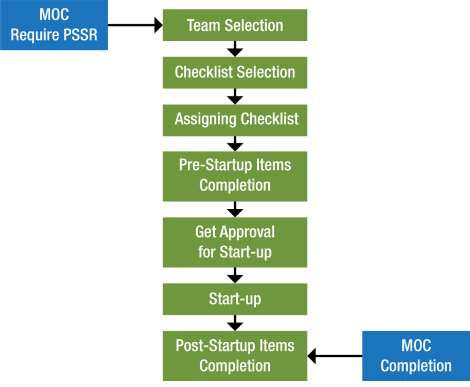
Step 1: Define PSSR Scope
Determine the equipment, process, unit or facility covered by the review.
Step 2: Assemble the PSSR Team
A multidisciplinary team should be formed with appropriate representation from operations, engineering, maintenance and safety/process-safety functions. Indian process-safety guidance also recommends a multidisciplinary approach.
Step 3: Review Documents
The team reviews relevant engineering and safety documentation, such as:
- P&IDs
- Process descriptions
- Equipment specifications
- HAZOP reports
- HIRA reports
- QRA reports
- MOC documents
- Operating procedures
- Emergency procedures
- Training records
Step 4: Conduct Field Verification
The team performs a physical inspection to compare the actual installation with approved drawings and specifications.
Step 5: Verify Safety Systems
Safety-critical equipment, alarms, interlocks, emergency systems and other safeguards are checked and tested as applicable.
Step 6: Identify and Record Punch Points
Any gaps or deficiencies are documented and assigned to responsible persons for corrective action.
Step 7: Close Critical Actions
Critical issues that could compromise safe start-up should be resolved before authorization to start.
Step 8: Approve Start-Up
Once the required conditions are satisfied, the responsible management team can authorize the facility for start-up according to the organization's procedures.
PSSR Checklist
A PSSR checklist provides a structured method for reviewing start-up readiness. CCPS guidance includes dedicated approaches for developing and using PSSR checklists.
Typical PSSR Checklist Items
| Area | Example Verification |
|---|---|
| Design | Installation matches approved design |
| Equipment | Equipment installed and inspected |
| Piping | Piping and connections verified |
| Instrumentation | Instruments calibrated and functional |
| Electrical | Electrical systems ready |
| Safety Systems | Alarms, trips and interlocks tested |
| Fire Protection | Fire protection systems available |
| Procedures | Operating and emergency procedures complete |
| HAZOP/HIRA | Relevant recommendations addressed |
| MOC | Change-management requirements completed |
| Training | Employees trained and competent |
| Documentation | Required records updated |
| Punch Points | Critical actions closed |
| Authorization | Start-up approval completed |
Benefits of PSSR Study
A properly conducted PSSR Study can provide several important benefits.
Improved Process Safety
PSSR helps identify gaps before they become incidents during commissioning or start-up.
Reduced Start-Up Risk
The review provides a final opportunity to identify unsafe conditions before the process becomes operational.
Better Compliance
A documented PSSR process can help organizations demonstrate that required safety checks and approvals were completed.
Improved Operational Readiness
PSSR does not only inspect equipment. It also verifies procedures, training, documentation and personnel readiness.
Fewer Delays and Rework
Finding problems before start-up can prevent unexpected shutdowns, rework and costly corrective actions.
Why Choose The Safety Master for PSSR Study?
The Safety Master can support organizations with structured process-safety reviews focused on identifying gaps before commissioning and start-up.
Our approach can include:
- PSSR planning and scope definition
- Multidisciplinary PSSR facilitation
- Field verification and walkdowns
- PSSR checklist development
- HAZOP/HIRA recommendation verification
- MOC review
- Safety-system verification
- Procedure and document review
- Punch-point identification
- Corrective-action tracking
- Final PSSR documentation
The objective is to provide organizations with a practical and systematic review that supports safer start-up and improved process-safety performance.
Industries Where PSSR Study Is Used
PSSR can be applied across industries where new or modified processes, equipment or hazardous operations require a structured readiness review.
Common Industries
- Oil and gas
- Petrochemical
- Chemical manufacturing
- Pharmaceutical
- Refineries
- Power plants
- Fertilizer plants
- Specialty chemicals
- Manufacturing
- LNG and gas processing
- Bulk storage facilities
PSSR Study vs HAZOP
PSSR and HAZOP are related but serve different purposes.
HAZOP is a structured hazard-identification and risk-analysis technique used to examine process deviations and identify potential hazards.
PSSR, on the other hand, focuses on whether a new or modified facility is actually ready for safe start-up. It verifies installation, procedures, safeguards, training and closure of relevant safety actions.
Therefore, a PSSR should not be treated as a replacement for HAZOP. Instead, it can verify that applicable recommendations and requirements identified during earlier safety studies have been properly addressed.
Common PSSR Findings
Some common findings identified during PSSR activities may include:
- Incomplete documentation
- Incorrect equipment installation
- Unresolved punch points
- Missing safety labels
- Incomplete operating procedures
- Untested alarms or interlocks
- Incomplete emergency arrangements
- Open HAZOP recommendations
- Incomplete MOC documentation
- Insufficient employee training
- Incomplete inspection or testing records
Best Practices for an Effective PSSR
Start PSSR Planning Early
PSSR should not be treated as a last-minute inspection. Planning should begin early enough to allow deficiencies to be corrected before the planned start-up.
Use a Structured Checklist
A checklist helps ensure important technical, operational and safety requirements are not overlooked.
Conduct a Physical Walkdown
Documentation alone cannot confirm actual site readiness. Physical verification is an important part of the review.
Involve Multiple Functions
Operations, engineering, maintenance and safety personnel can identify different types of deficiencies.
Track Action Items
Every significant finding should have an owner, priority and target completion date.
Do Not Ignore Critical Findings
Critical safety gaps should be resolved before start-up authorization.