End-to-End Safety Management: The Power of Single-Source Accountability

Safety Governance That Works Even When Consultants Leave
February 13, 2026
Annual Safety Programs Built for Zero-Disruption Operations
February 16, 2026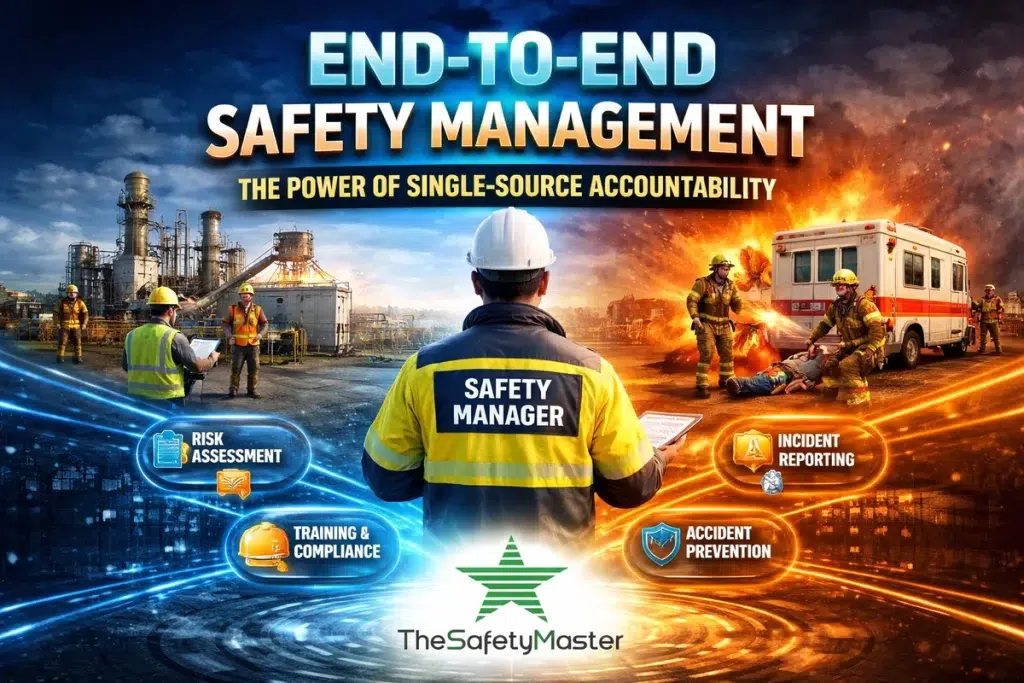
In the complex world of industrial operations, safety is often treated as a checklist of disconnected tasks. A factory manager might hire one consultant for fire compliance, another for machinery risk assessment, and a third for environmental protocols. While this fragmented approach might seem practical in the short term, it often creates dangerous “blind spots” in an organization’s safety culture.
True safety is not about checking boxes; it is about creating a seamless ecosystem of protection. This is where the concept of End-to-End Safety Management comes into play. By consolidating your safety requirements with a single, dedicated partner, you move from a model of “blame shifting” to a model of Single-Source Accountability.
This article explores why an integrated approach to safety is the future of industrial risk management and how combining critical elements—from general audits to specialized hazard studies—under one roof can save lives and protect your bottom line.
The Hidden Dangers of Fragmented Safety
Imagine a scenario in a chemical processing plant. You have a vendor who handles your fire suppression systems and another who manages your chemical process safety.
One day, a minor leak occurs. The process safety protocols suggest venting the gas, but the fire safety protocols (designed by a different vendor) interpret the venting as a fire hazard and shut down the ventilation. The two systems, designed in isolation, conflict with each other. This is the “Gap of Fragmentation.”
When you utilize multiple vendors, you face several inherent risks:
- Inconsistent Standards: Vendor A might use OSHA standards, while Vendor B relies on local municipal codes, creating compliance friction.
- Communication Silos: Vital data about a structural weakness found during a building inspection might not be communicated to the team designing the evacuation routes.
- The Accountability Void: When an accident happens, multiple vendors often point fingers at one another. The electrical auditor blames the maintenance team; the maintenance team blames the process designers.
Single-Source Accountability eliminates these gaps. When one partner is responsible for the entire safety lifecycle, they view your facility as a holistic organism, not a series of unrelated parts. They are responsible for the inputs, the outputs, and everything in between.
Pillar 1: The Diagnostic Foundation
An effective end-to-end safety strategy begins with a broad, diagnostic view of the current landscape. Before specialized studies can be conducted, an organization must understand its baseline compliance and risk levels.
This is primarily achieved through a comprehensive Safety Audit.
Why the General Audit Matters
A Safety Audit is the “health checkup” of your organization. It is not looking for one specific thing; it is looking at everything. A single-source partner uses this audit to map out the entire terrain of your operation. They examine your documentation, your physical site conditions, your worker behaviors, and your management systems.
Unlike a fragmented vendor who might only look at specific machinery, a holistic partner conducting a safety audit looks for the ripple effects. For example, they might notice that while your machinery guards are compliant, the lighting in the area is poor, leading to worker fatigue and an increased risk of accidents.
This holistic audit serves as the roadmap for all future safety interventions. It identifies the “symptoms” of poor safety culture so that the specialized treatments can cure the “disease.”
Pillar 2: Mastering Process Risks
Once the baseline is established, the focus shifts to the heart of the operation: the processes themselves. In industries like oil and gas, pharmaceuticals, and chemical manufacturing, the danger lies not just in the equipment, but in what the equipment is doing. High pressures, volatile temperatures, and toxic substances require a highly technical approach to safety.
This is where Process Safety Management (PSM) becomes the central nervous system of your safety strategy.
The Complexity of PSM
PSM is not about preventing slips and falls; it is about preventing catastrophic failures—explosions, major leaks, and structural collapses. When you work with a single-source partner, your PSM strategy is integrated directly into your general safety policies.
For example, a fragmented approach might have a PSM consultant design a high-pressure relief system that vents outside. However, they might not realize that the vent output is located near a smoking area or a high-traffic pedestrian path. An integrated partner sees the whole picture. They ensure that the process safety measures align with occupational health standards.
The Role of Hazard and Operability Studies
Within the framework of Process Safety Management, specific tools are required to identify invisible risks. The most rigorous of these is the Hazop Study.
A Hazop (Hazard and Operability) study is a systematic, qualitative examination of a process. It asks the “What If?” questions that keep safety managers up at night.
- What if the pump fails?
- What if the valve gets stuck halfway?
- What if the temperature sensor gives a false reading?
In a single-source model, the team conducting the Hazop study has direct access to the data from the initial Safety Audit. They don’t have to start from scratch. They already know the competency level of the workforce and the condition of the maintenance logs. This allows them to make recommendations that are not only technically sound but also practically implementable for your specific team.
Pillar 3: Emergency and Infrastructure Integrity
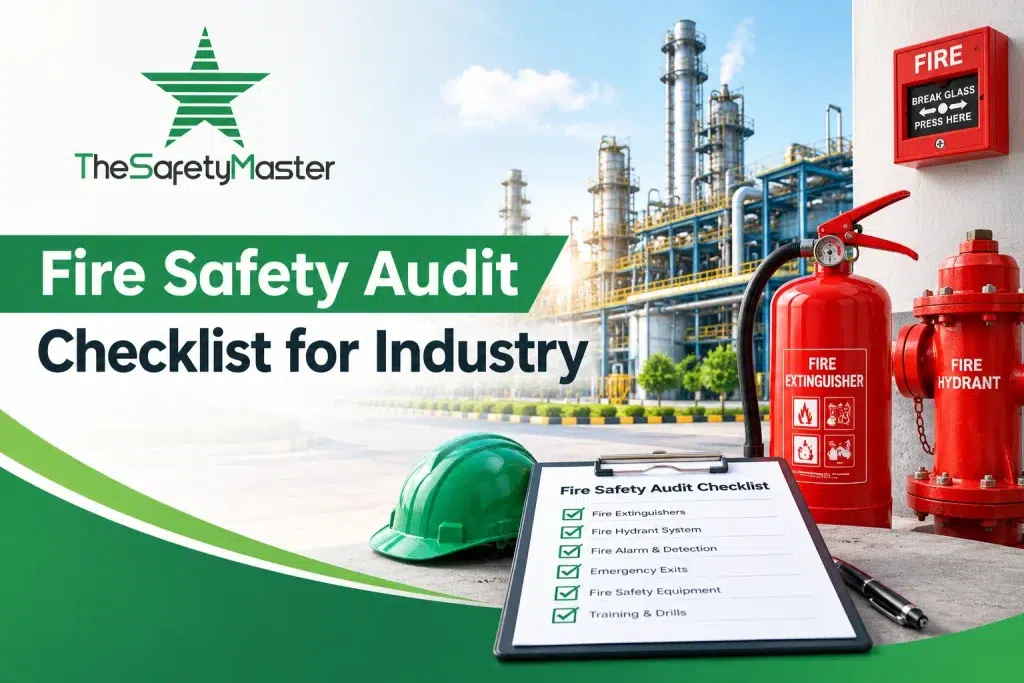
Even with the best process management and the most detailed audits, physical emergencies can still occur. Fire remains one of the most pervasive threats to industrial and commercial facilities. A robust safety strategy must include a dedicated focus on fire prevention and suppression.
This is ensured through a specialized Fire Audit.
Beyond Fire Extinguishers
A Fire Audit provided by a single-source partner goes far beyond checking the expiration dates on fire extinguishers. It evaluates the “Fire Load” of the building based on the materials stored there—data they likely gathered during the PSM or general safety phases.
An integrated partner understands the relationship between your process hazards and your fire risks. For instance, if your Hazop study identified a new chemical being introduced to the production line, your safety partner immediately knows that this chemical might require a different type of fire suppression agent (e.g., foam instead of water).
If you were using separate vendors, the “Fire Guy” might never talk to the “Chemical Guy.” You might end up with a water sprinkler system installed over a chemical storage area where water would actually cause a violent reaction. This is the lifesaving difference of having One Partner with One Accountability.
The Business Case: Efficiency and ROI
Beyond the clear safety benefits, there is a compelling business case for End-to-End Safety Management. Companies are increasingly realizing that safety is not just a cost center; it is an operational asset.
1. Cost Efficiency
Hiring three different consulting firms means paying for three different sets of administrative costs, three different travel budgets, and three different report-writing fees. A single partner offers economies of scale. You bundle your Safety Audit, Fire Audit, and Hazop Study into a cohesive package, often reducing the overall spend while increasing the value delivered.
2. Streamlined Compliance
Regulatory bodies often require documentation that overlaps. The data required for an environmental permit often overlaps with the data required for a Process Safety Management audit. A single partner maintains a centralized repository of your safety data. When an inspector knocks on the door, you don’t have to chase down three different consultants to find the paperwork; you have one phone number to call.
3. Continuous Improvement
When you hire a vendor for a one-off audit, they give you a report and leave. They have no stake in your long-term success. A single-source partner is invested in your journey. They track your progress from the initial audit through the implementation of the Hazop recommendations. They can show you year-over-year trends, helping you demonstrate ROI to your stakeholders.
Conclusion: One Partner, One Accountability
The era of fragmented safety management is coming to an end. The risks of modern industry are too interconnected to be managed in silos. A fire risk is a chemical risk; a chemical risk is an occupational risk; an occupational risk is a legal risk.
By choosing a partner capable of delivering End-to-End Safety Management, you are choosing clarity over confusion. You are ensuring that every aspect of your operation—from the foundational Safety Audit to the highly technical Hazop Study, and from the strategic Process Safety Management to the critical Fire Audit—is synchronized.
At The Safety Master, we believe in the power of “One.” One cohesive strategy. One dedicated team. One unwavering commitment to your safety. When you have one partner, you have total accountability, ensuring that nothing falls through the cracks and everyone goes home safe at the end of the day.