Electrical Safety Regulations in India: Complete Guide to Rules, Standards & CEA Regulations

Comprehensive Guide to Conducting Laboratory Safety Audit: Best Practices and Common Pitfalls
October 13, 2025
The Importance of Developing an Emergency Response and Disaster Management Plan (ERDMP) in Todays World
October 15, 2025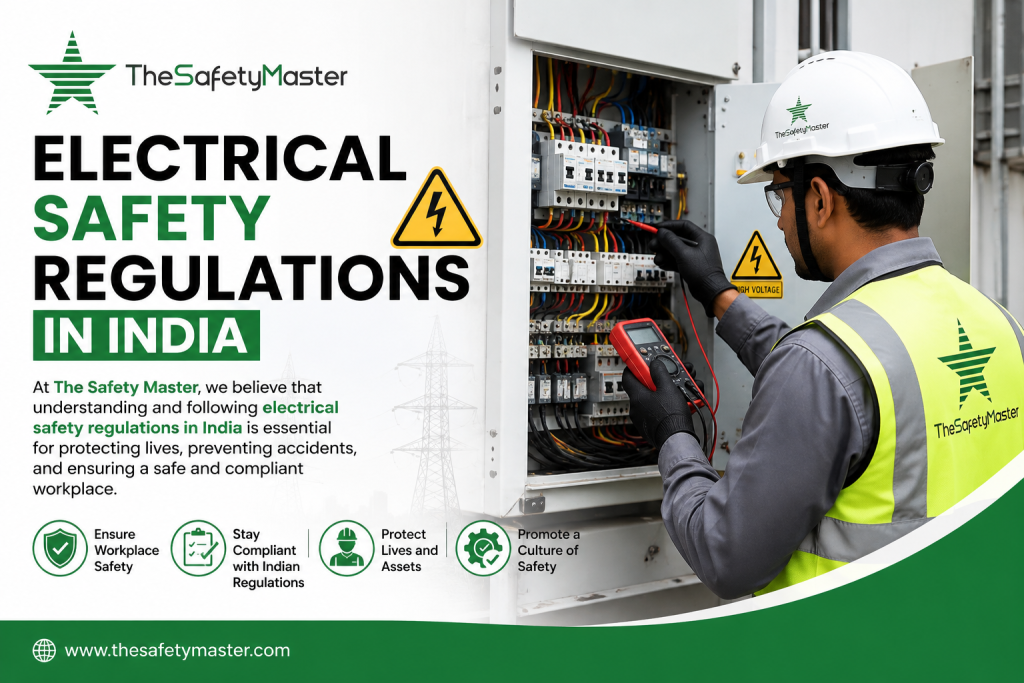
Electrical safety regulations in India are essential for protecting people, property, electrical installations, and industrial operations from hazards such as electric shock, short circuits, fires, equipment failures, and electrical accidents. The Safety Master helps organizations understand and implement effective electrical safety practices in line with applicable Indian regulations, standards, and safety requirements.
India’s electrical safety framework has evolved through legislation, Central Electricity Authority (CEA) regulations, Bureau of Indian Standards (BIS) standards, building codes, and industry-specific requirements. The current CEA framework includes the Central Electricity Authority (Measures relating to Safety and Electric Supply) Regulations, 2023, while CEA also lists a 2026 amendment to these regulations.
What Are Electrical Safety Regulations in India?
Electrical safety regulations define the minimum requirements for the safe generation, transmission, distribution, installation, operation, maintenance, and use of electricity. These requirements are intended to reduce electrical accidents and ensure that electrical systems are properly designed, installed, inspected, protected, and maintained.
The framework includes requirements relating to electrical installations, earthing, protective devices, wiring, clearances, safety procedures, inspections, and electrical equipment.
Major Electrical Safety Regulations and Laws in India
Electricity Act, 2003
The Electricity Act, 2003 provides the broader legal framework governing electricity generation, transmission, distribution, trading, and use in India. It also provides the basis for safety-related regulations issued by the Central Electricity Authority.
Central Electricity Authority Safety Regulations
The CEA is responsible for framing regulations and measures relating to safety and electric supply under the Electricity Act, 2003. The current principal safety regulation is the CEA (Measures relating to Safety and Electric Supply) Regulations, 2023.
Indian Electricity Rules, 1956
The Indian Electricity Rules, 1956 historically established detailed requirements for electrical safety, including construction, installation, protection, operation, maintenance, earthing, danger notices, and handling of electrical equipment. The rules contain a dedicated chapter covering general safety requirements.
Bureau of Indian Standards (BIS)
BIS standards provide technical requirements for electrical products, equipment, installations, and safety practices. Relevant Indian Standards should be considered when designing, selecting, installing, testing, and maintaining electrical systems.
Key Electrical Safety Requirements in India
Proper Earthing and Grounding
Effective earthing provides a safe path for fault current and helps reduce the risk of electric shock and equipment damage. Earthing systems should be designed, installed, tested, and maintained according to applicable requirements.
Protection Against Electric Shock
Electrical installations should incorporate suitable insulation, enclosures, barriers, protective devices, and safe working procedures to minimize the possibility of contact with energized parts.
Circuit Breakers and Protective Devices
Appropriate circuit breakers, fuses, residual-current protection, overload protection, and short-circuit protection should be provided based on the characteristics of the electrical installation.
Electrical Equipment and Installation Standards
Electrical equipment and materials should meet applicable standards and be suitable for the voltage, current, environmental conditions, fault levels, and intended application.
Electrical Inspection and Testing
Electrical installations should undergo appropriate inspection and testing before energization and periodically where required. CEA’s Chief Electrical Inspectorate Division is responsible for statutory inspection activities for applicable installations and electrical accident inquiries.
Central Electricity Authority (CEA) Electrical Safety Regulations
The CEA’s safety regulations establish requirements covering the construction, installation, protection, operation, and maintenance of electrical supply lines and apparatus.
CEA Regulations 2023
The CEA (Measures relating to Safety and Electric Supply) Regulations, 2023 were notified on 8 June 2023. They include general safety requirements for electrical supply lines and apparatus and require relevant standards, including applicable electrical and building codes, to be followed.
Latest CEA Regulations PDF
For the most reliable and current information, users should obtain the Latest CEA Regulations PDF from the official Central Electricity Authority website rather than relying on outdated third-party copies. CEA’s regulations archive currently lists the 2023 safety regulations and a 2026 amendment.
Electrical Safety Regulations in India 2022
What Was the 2022 CEA Regulation?
The Electrical Safety Regulations in India 2022 search term commonly refers to the draft CEA (Measures relating to Safety and Electric Supply) Regulations, 2022. CEA published the draft in June 2022 for public and stakeholder comments.
2022 vs 2023 CEA Safety Regulations
The 2022 document should be treated as a draft/historical version. The CEA subsequently notified the 2023 regulations, making the 2023 framework the more appropriate reference for current electrical safety requirements.
Electrical Safety Regulations in India 2021
The Electrical Safety Regulations in India 2021 keyword generally relates to the regulatory framework and safety requirements applicable before the 2023 CEA regulations were notified.
When researching older compliance requirements, organizations should verify the applicable regulations for the specific date, installation, state, and type of electrical system rather than assuming that a 2021 document represents today’s requirements.
Electrical Safety Standards in India
Electrical safety compliance involves more than one regulation. Depending on the installation and application, organizations may need to consider applicable CEA regulations, BIS/Indian Standards, the National Electrical Code, the National Building Code, state electrical inspectorate requirements, and other applicable legal requirements.
Important Areas Covered by Electrical Safety Standards
- Electrical installation safety
- Earthing and bonding
- Electrical protection systems
- Insulation and isolation
- Short-circuit and overload protection
- Lightning and surge protection
- Electrical equipment selection
- Cable and wiring requirements
- Safety clearances
- Inspection and testing
- Preventive maintenance
- Electrical work permits and safe work procedures
Electrical Safety Standards PDF – What Should You Check?
When searching for an Electrical Safety Standards PDF, verify the document’s issuing authority, publication date, revision number, and applicability.
How to Verify an Electrical Safety PDF
- Check whether it is published by an official authority.
- Verify the publication and revision date.
- Confirm whether it is a regulation, standard, guideline, or draft.
- Check whether amendments have been issued.
- Confirm its applicability to your electrical installation.
- Avoid using outdated documents for current compliance decisions.
Electrical Safety Regulations in India PPT
An Electrical Safety Regulations in India PPT can be useful for employee training, awareness programs, toolbox talks, and management presentations.
Recommended PPT Topics
An electrical safety presentation can include:
- Electrical hazards
- Electric shock prevention
- Electrical fires
- Earthing
- Circuit breakers and protective devices
- PPE
- Lockout/Tagout
- Electrical inspection
- Safe electrical work practices
- Emergency response
- Applicable Indian regulations
- CEA safety requirements
Electrical Safety Regulations in India PDF
An Electrical Safety Regulations in India PDF can be useful as a reference document for safety professionals, electrical engineers, facility managers, and industrial organizations.
However, users should always verify whether a PDF represents the latest regulation or an older version. The official CEA website should be preferred when downloading current CEA regulations.
Electrical Safety Regulations in India Slideshare
An Electrical Safety Regulations in India Slideshare presentation may provide simplified educational information, but it should not automatically be treated as an official legal or regulatory document.
For compliance purposes, organizations should verify the information against official CEA publications, applicable BIS standards, the Electricity Act, and relevant state requirements.
Indian Electricity Rules PDF
The Indian Electricity Rules PDF is frequently searched by students, electrical engineers, safety professionals, and organizations looking for historical electrical safety requirements.
The Indian Electricity Rules, 1956 included provisions covering general safety requirements, electrical installations, danger notices, handling of electrical supply lines and equipment, and testing of consumer installations.
Electrical Safety Compliance Checklist for Industries
Electrical Installation
- Verify electrical installation design.
- Ensure appropriate earthing and bonding.
- Check cables, panels, and electrical equipment.
- Maintain required clearances.
- Provide appropriate protection against overload and short circuits.
Inspection and Maintenance
- Conduct periodic inspections.
- Test earthing systems.
- Inspect electrical panels and cables.
- Check protective devices.
- Record defects and corrective actions.
- Maintain electrical inspection records.
Employee Safety
- Provide electrical safety training.
- Use appropriate PPE.
- Authorize only competent persons for electrical work.
- Implement Lockout/Tagout procedures.
- Display appropriate danger and warning notices.
- Maintain emergency response procedures.
Why Electrical Safety Compliance Is Important
Effective electrical safety compliance can help organizations reduce accidents, equipment damage, electrical fires, production losses, and regulatory risks. It also supports safer workplaces and improves the reliability of electrical systems.
A structured electrical safety program should combine regulatory compliance with risk assessment, inspection, preventive maintenance, employee training, and continuous improvement.
How The Safety Master Can Help
Organizations can strengthen their electrical safety programs through professional safety audits, electrical safety assessments, training, risk assessments, compliance support, and other workplace safety services.
The goal should not simply be to meet minimum regulatory requirements but to create a workplace where electrical hazards are identified, controlled, monitored, and continuously improved.
Conclusion
Understanding electrical safety regulations in India is essential for organizations that operate electrical installations, machinery, buildings, commercial facilities, and industrial plants. From the Electricity Act and CEA safety regulations to applicable Indian Standards and historical Indian Electricity Rules, organizations should use verified and current regulatory information when making compliance decisions.
For businesses looking to improve electrical safety, The Safety Master can support organizations in developing stronger electrical safety practices, assessments, training, and compliance-focused safety programs.
Frequently Asked Questions
Q-What are the electrical safety regulations in India?
Electrical safety in India is governed through the Electricity Act, CEA safety regulations, applicable BIS/Indian Standards, building and electrical codes, and relevant state requirements. The current principal CEA safety framework is the Central Electricity Authority (Measures relating to Safety and Electric Supply) Regulations, 2023.
Q-What is the latest CEA electrical safety regulation?
The current principal regulation is the Central Electricity Authority (Measures relating to Safety and Electric Supply) Regulations, 2023. CEA’s official regulations archive also lists a 2026 amendment, so users should check the latest official CEA publication before relying on a PDF for compliance.
Q-Where can I find the Electrical Safety Regulations in India PDF?
The safest source is the official Central Electricity Authority website, where the CEA publishes its safety regulations and related documents. Users searching for an Electrical Safety Regulations in India PDF should verify the document’s date and amendments before using it.
Q-What is the difference between the Electrical Safety Regulations in India 2022 and 2023?
The 2022 CEA safety document was a draft released for public and stakeholder comments. The CEA subsequently notified the CEA (Measures relating to Safety and Electric Supply) Regulations, 2023 on 8 June 2023. Therefore, the 2022 document should not be confused with the current notified regulation.
Q-Are the Indian Electricity Rules, 1956 still the latest electrical safety regulations?
No. The Indian Electricity Rules, 1956 are an important historical reference and contain extensive safety provisions, but they should not be treated as the current standalone regulatory framework. For current compliance, organizations should check the applicable Electricity Act provisions, CEA regulations, amendments, BIS standards, and relevant state requirements.
Q-What topics should be included in an Electrical Safety Regulations in India PPT?
An electrical safety PPT can cover electrical hazards, electric shock prevention, earthing, circuit protection, PPE, Lockout/Tagout, safe work procedures, inspections, electrical fire prevention, emergency response, and applicable CEA and Indian safety requirements.
Q-Can I use an Electrical Safety Regulations in India Slideshare for compliance?
A Slideshare presentation can be useful for learning or employee awareness, but it should not be considered an official compliance document unless its information is verified against the applicable government regulations and standards.
Q-What are the main areas covered by electrical safety standards?
Common areas include electrical installation safety, earthing, insulation, protective devices, wiring, equipment selection, clearances, inspection, testing, maintenance, and protection against electric shock and electrical fires.