Engineering Out Risk Before Incidents Happen

Because Safety Needs Ownership, Not Visits
February 17, 2026
Because Real Safety Happens When No One Is Watching
February 18, 2026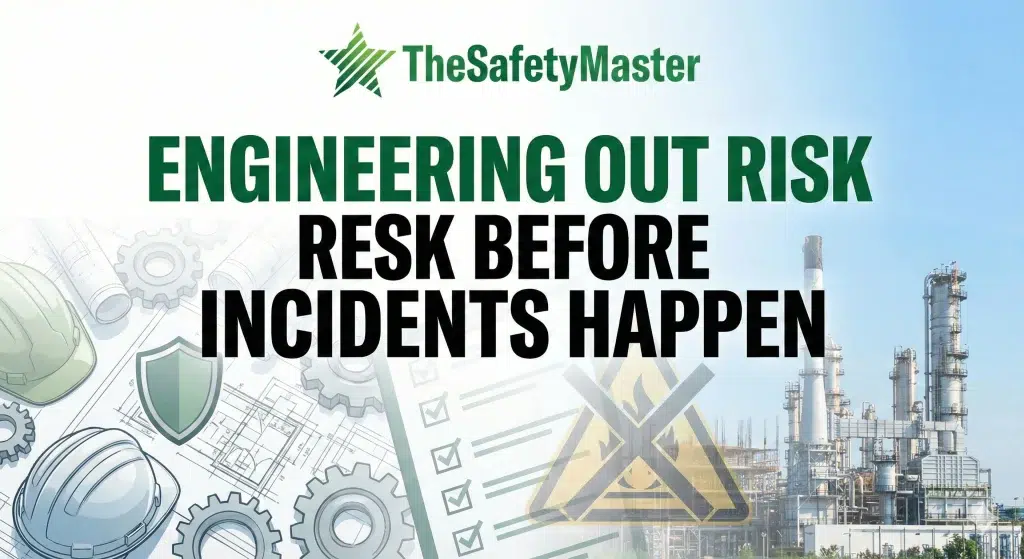
In the high-stakes world of industrial operations, manufacturing, and construction, the traditional approach to safety has often been reactive. An incident occurs, an investigation is launched, and new procedures are put in place to prevent a recurrence. While learning from mistakes is vital, it is arguably the least efficient way to manage safety. The most resilient organizations are those that shift their focus upstream, aiming to eliminate hazards during the design and planning phases rather than managing them during operations.
This philosophy is known as “Engineering Out Risk.” It is the art and science of designing systems, processes, and machinery so that safety is an intrinsic characteristic rather than an add-on feature. By prioritizing Inherently Safer Design (ISD) and robust engineering controls, organizations can move beyond relying on human compliance and Personal Protective Equipment (PPE) to a state where accidents are physically difficult, if not impossible, to trigger.
The Hierarchy of Controls: Why Engineering Matters
To understand the power of engineering out risk, one must look at the Hierarchy of Controls—the gold standard framework for occupational safety. The hierarchy ranks risk control measures from most effective to least effective:
- Elimination: Physically removing the hazard.
- Substitution: Replacing the hazard.
- Engineering Controls: Isolating people from the hazard.
- Administrative Controls: Changing the way people work.
- PPE: Protecting the worker with Personal Protective Equipment.
Many safety programs spend a disproportionate amount of energy on the bottom two tiers—training workers to be careful (Administrative) and asking them to wear gear (PPE). While necessary, these controls are fragile; they rely on human behavior, which is prone to fatigue, stress, and error.
Engineering controls, however, operate independently of worker behavior. A ventilation system that automatically removes toxic fumes works whether the operator remembers to turn it on or not (if interlocked correctly). A machine guard that prevents access to moving parts protects a tired worker just as well as an alert one. By focusing on the top three tiers, we stop managing risk and start eliminating it.
The Core Pillars of Inherently Safer Design (ISD)
Engineering out risk is often achieved through Inherently Safer Design. Developed by Trevor Kletz, the father of process safety, ISD focuses on four key strategies:
- Minimization: Using smaller quantities of hazardous substances. For example, rather than storing 10,000 gallons of a volatile chemical on-site, a continuous flow reactor might only require 100 gallons to be present at any one time.
- Substitution: Replacing a hazardous material with a less hazardous one. Using water-based paints instead of solvent-based paints eliminates the risk of fire and reduces toxicity.
- Moderation: Using less severe operating conditions. Designing a reaction to occur at room temperature and atmospheric pressure, rather than high heat and high pressure, significantly reduces the potential energy of a catastrophic failure.
- Simplification: Designing systems to be less complex and less prone to error. This means fewer valves, clearer piping routes, and controls that are intuitive to the human user.
The Role of Hazard Analysis in Design
You cannot engineer out a risk you do not see. This is where rigorous hazard identification techniques come into play during the design phase. One of the most critical tools in this arsenal is the Hazard and Operability (HAZOP) study.
A HAZOP is a structured, team-based examination of a process or operation in order to identify and evaluate problems that may represent risks to personnel or equipment. It involves breaking a process down into “nodes” and applying guide words (such as “No Flow,” “High Pressure,” or “Reverse Flow”) to brainstorm potential deviations from the design intent.
However, a HAZOP is only as good as the team leading it. It requires a deep understanding of engineering principles, fluid dynamics, chemistry, and human factors. This is why many organizations turn to a specialized Hazop Study Consultant. These experts bring an objective, methodical eye to the process, ensuring that no potential deviation is overlooked. They facilitate the brainstorming sessions that allow engineers to ask “What if?” before the first pipe is ever laid. By identifying that a valve failure could lead to a tank rupture, engineers can design a pressure relief system or a secondary containment unit immediately, effectively engineering out the catastrophic potential of that failure.
Systemic Safety: The Big Picture
Engineering out risk is not just about individual pieces of equipment; it is about the integrity of the entire system. This is the domain of Process Safety Management (PSM). PSM is an analytical tool focused on preventing releases of any substance defined as a “highly hazardous chemical.”
While standard occupational safety focuses on slips, trips, and falls, PSM focuses on the major incidents—fires, explosions, and toxic releases. A robust PSM framework ensures that the engineering controls implemented during the design phase are maintained throughout the lifecycle of the facility. It covers everything from the mechanical integrity of equipment to the management of change (MOC).
If a company decides to change a pump to a larger model to increase throughput, Process Safety Management protocols ensure that the implications of this change are fully engineered. Will the higher pressure exceed the pipe rating? Will the increased flow create static electricity risks? PSM ensures that “engineering out risk” is a continuous process, not a one-time event during the initial build.
Engineering Fire Safety: Prevention Over Reaction
Fire remains one of the most devastating risks in industrial environments. Engineering out fire risk involves much more than just hanging fire extinguishers on the wall. It involves a deep analysis of fuel loads, ignition sources, and airflow dynamics.
Fire safety engineering looks at:
- Compartmentation: Designing buildings with fire-resistant walls and doors that physically prevent fire from spreading from one section to another.
- Ventilation Design: Systems that automatically shut down to starve a fire of oxygen, or conversely, smoke control systems that keep escape routes clear.
- Detection and Suppression: Automated sprinkler systems, gas suppression systems for electrical rooms, and heat detection loops.
However, over time, facility layouts change. Warehouses get rearranged, and production lines move. A system designed five years ago may no longer be adequate for today’s layout. This is where a Fire Safety Audit Service becomes essential. An audit reviews the current engineering controls against the actual reality of the facility. It checks if the “engineered” safety measures are still valid. For example, did a new partition wall block a sprinkler head? Has the storage of flammable materials exceeded the design capacity of the suppression system? These audits ensure that the engineering controls remain effective.
The Human Factor: Engineering for People
One of the most common misconceptions is that engineering controls are solely about machines. In reality, engineering out risk is deeply tied to Human Factors Engineering (HFE).
People make mistakes. We get distracted, we misread dials, and we take shortcuts. Engineering out risk means designing systems that tolerate human error without leading to disaster. This concept is often called “Poka-Yoke” or mistake-proofing.
Examples include:
- Interlocks: A machine that will not start unless the safety guard is fully closed.
- Keyed Connectors: Gas lines with different shaped connectors so that a worker cannot accidentally plug a nitrogen line into an oxygen port.
- Ergonomic Design: Designing valve placements so operators don’t have to reach over moving machinery to access them.
By assuming that human error will occur, engineers can design systems that fail safely. If a driver falls asleep on a modern forklift, the “dead man’s switch” engages, and the vehicle stops. The risk was engineered out by removing the reliance on the driver’s constant vigilance.
Verification: The Importance of the Safety Audit
Even the best-engineered systems are subject to entropy. Sensors drift, bypasses are installed and forgotten, and corrosion weakens structural integrity. The assumption that “we designed it safely, so it is safe” is a dangerous trap.
Verification is the final step in the engineering loop. A comprehensive Safety Audit provides the necessary checks and balances. Unlike a simple inspection which might check if a light is working, a safety audit digs deeper into the management systems and the efficacy of engineering controls.
An audit asks the hard questions:
- Is the high-level alarm on the tank actually connected to the shut-off valve, or was it bypassed during maintenance last month?
- Are the pressure relief valves calibrated?
- Is the logic solver for the emergency shutdown system functioning correctly?
By regularly auditing the physical and procedural barriers, organizations verify that the risks they “engineered out” haven’t crept back in due to wear and tear or procedural drift.
The Business Case for Engineering Out Risk
There is a persistent myth that engineering controls are too expensive. It is true that the upfront capital cost of an automated, enclosed system is higher than a manual, open system. However, when looking at the Total Cost of Ownership (TCO), engineering out risk is almost always the more profitable route.
Consider the costs of not engineering out the risk:
- Downtime: Accidents stop production. Investigations, repairs, and regulatory halts can cost millions in lost revenue.
- Insurance and Legal: High-risk facilities pay higher premiums. Incidents lead to lawsuits and compensation payouts.
- Efficiency: Safe processes are usually efficient processes. A closed-loop system that recycles chemicals to prevent exposure also saves money on raw materials.
- Reputation: In the modern market, a company’s safety record influences investor confidence and customer loyalty.
When you engineer out risk, you are also engineering in reliability. A pump that is monitored by vibration sensors to prevent catastrophic failure is also a pump that won’t surprise you with unplanned downtime. Safety and operational excellence are two sides of the same coin.
Conclusion: A Call to Proactive Action
The journey to zero incidents does not begin with a safety poster or a morning toolbox talk; it begins on the drawing board. It begins with the courageous decision to question the process design, to challenge the necessity of hazardous materials, and to invest in controls that do not rely on human perfection.
“Engineering Out Risk” is a commitment to the highest level of stewardship. It requires collaboration between process engineers, safety professionals, and operations teams. It utilizes tools like HAZOP to foresee the future, PSM to manage the present, and audits to verify the integrity of our defenses.
At The Safety Master, we believe that every incident is preventable if the right questions are asked early enough. Whether you are in the conceptual design phase of a new plant or looking to retrofit an aging facility, the goal remains the same: remove the hazard, control the energy, and protect the people.
By leveraging expert consultancy in HAZOP studies, adhering to rigorous Process Safety Management standards, and verifying your defenses through Fire and Safety Audits, you are doing more than just complying with regulations. You are building a fortress of safety around your most valuable assets—your people.