Is Your Plant Truly Safe — Or Just Compliant?

Raising the Standard of Industrial Safety
April 6, 2026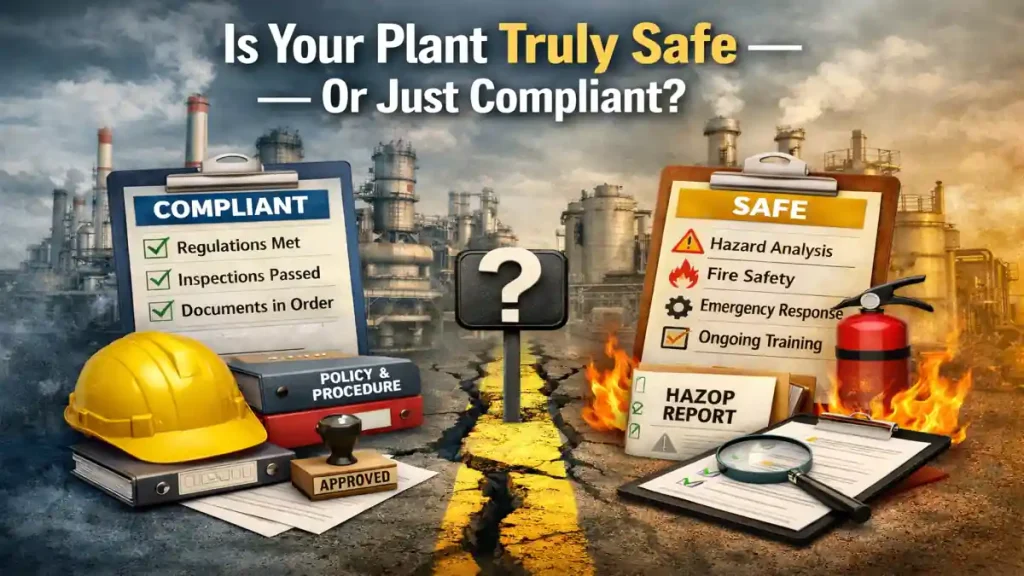
In many industries, “compliance” is often treated as the ultimate benchmark of safety. Boxes are checked, documents are filed, and audits are passed. But here’s the uncomfortable truth: compliance does not always equal safety. A plant can meet regulatory requirements and still carry hidden risks that threaten people, assets, and operations.
So the real question is not whether your plant is compliant — it’s whether it is genuinely safe.
Compliance vs. Real Safety: Understanding the Gap
Compliance means following rules set by regulatory authorities. These rules are essential, but they are often the minimum standard. Real safety goes beyond that. It involves actively identifying risks, understanding process hazards, and continuously improving systems.
A compliant plant might:
- Have updated documentation
- Meet statutory norms
- Pass inspections
But a truly safe plant will:
- Proactively identify potential hazards
- Encourage reporting of near-misses
- Continuously train employees
- Adapt to changing operational risks
If your organization is only focused on meeting legal requirements, you are playing defense. True safety requires a proactive mindset.
Why Compliance Alone Can Be Dangerous
Relying only on compliance can create a false sense of security. Teams assume everything is safe simply because standards are met. This mindset often leads to overlooked hazards, especially in complex industrial environments.
For example:
- Equipment may be compliant but poorly maintained
- Processes may follow guidelines but lack real-time monitoring
- Workers may be trained once but not regularly refreshed
This is where risks quietly build up.
A structured Safety Audit helps uncover these hidden gaps by evaluating actual on-ground practices rather than just paperwork. It goes beyond compliance and focuses on how safety is implemented in real scenarios.
The Role of Hazard Identification in True Safety
One of the biggest differences between compliance and real safety is hazard identification. Regulations may not cover every possible risk in your plant, especially unique process conditions.
This is where advanced methodologies like HAZOP (Hazard and Operability Study) come into play. Through proper HAZOP Training, teams learn how to systematically identify deviations, analyze consequences, and implement safeguards.
Without such detailed analysis, many process risks remain invisible until an incident occurs.
Fire Risks: A Commonly Underestimated Threat
Fire hazards are one of the most overlooked areas in many compliant plants. Just because fire extinguishers are installed and marked does not mean the plant is fire-safe.
Questions you should ask:
- Are fire loads properly calculated?
- Are emergency exits accessible during peak operations?
- Is firefighting equipment functional and regularly tested?
- Are employees trained for emergency response?
A professional Fire Audit evaluates these factors in depth, ensuring that your facility is not just equipped but prepared.
Culture: The Invisible Factor in Plant Safety
You can have the best systems, tools, and audits in place, but if your safety culture is weak, risks will persist.
A strong safety culture means:
- Employees feel responsible for safety
- Workers are encouraged to report unsafe conditions
- Management takes immediate corrective action
- Safety is integrated into daily operations, not treated as a separate task
Compliance is driven by rules. Safety is driven by behavior.
Signs Your Plant Is Only Compliant (Not Truly Safe)
If you’re serious about improving, take a hard look at your operations. Here are some red flags:
- Safety discussions happen only during audits
- Near-misses are ignored or underreported
- Training is treated as a one-time activity
- Maintenance is reactive instead of preventive
- Documentation is prioritized over actual implementation
If any of these sound familiar, your plant may be compliant — but not safe.
Moving from Compliance to Real Safety
Making this shift requires a change in mindset and strategy. Here’s how you can start:
1. Go Beyond Checklists
Stop treating safety as a checklist exercise. Focus on real-world implementation.
2. Invest in Training
Regular, practical training ensures your team can identify and handle risks effectively.
3. Conduct Detailed Audits
Periodic audits should evaluate actual practices, not just documents.
4. Use Advanced Risk Assessment Tools
Techniques like HAZOP help uncover risks that standard inspections may miss.
5. Build a Safety-First Culture
Encourage accountability at every level of the organization.
Final Thought: Safety Is a Continuous Process
Compliance is a milestone. Safety is a journey.
If your plant is only focused on passing inspections, you are always one step away from an incident. But if you focus on understanding risks, improving systems, and building a strong safety culture, you create an environment where safety becomes a natural outcome.
So ask yourself honestly — is your plant truly safe, or just compliant?