
HIRA Services - Hazard Identification and Risk Assessment
Hazard Identification and Risk Assessment (HIRA) is a systematic approach used to identify workplace and process hazards, evaluate associated risks, and determine effective control measures. A properly conducted HIRA helps organizations understand what can go wrong, how serious the consequences could be, and which controls should be implemented to prevent incidents.
The Safety Master provides industry-focused HIRA services to help organizations identify significant hazards, assess risk levels, evaluate existing safeguards, and develop practical recommendations for risk reduction. Our HIRA approach can be applied across manufacturing, chemical, petrochemical, oil and gas, pharmaceutical, construction, power, infrastructure, logistics and other high-risk industries.
What Is HIRA in Safety?
HIRA stands for Hazard Identification and Risk Assessment. It is a structured risk management process used to identify hazards associated with workplace activities, equipment, materials, processes and operating conditions.
A HIRA assessment goes beyond simply creating a list of hazards. It evaluates the possible causes, consequences, likelihood and severity of hazardous events and determines whether existing controls are adequate.
A typical HIRA study answers three important questions:
- What can go wrong?
- How likely is it to happen?
- How severe could the consequences be?
The findings are then used to prioritize risks and establish additional controls.
Hazard vs Risk
A hazard is a source or situation that has the potential to cause harm.
Risk considers the likelihood of the hazardous event occurring and the severity of its consequences.
For example:
| HIRA Element | Example |
|---|---|
| Hazard | Flammable chemical |
| Cause | Loss of containment |
| Event | Vapour release and ignition |
| Consequence | Fire, explosion or injury |
| Risk | Combination of likelihood and severity |
This distinction is important because an effective HIRA should explain not only what the hazard is, but also how the hazard can result in an unwanted event and how that event can be controlled.
Why Is HIRA Important for Workplace Safety?
HIRA is an important part of proactive safety management because it allows organizations to identify significant hazards before they result in injuries, property damage, environmental impact or process incidents.
A systematic HIRA assessment can help organizations:
- Identify existing and potential workplace hazards
- Prioritize high-risk activities
- Evaluate existing safety controls
- Determine additional control measures
- Reduce exposure to significant risks
- Improve operational safety
- Support safety decision-making
- Assign corrective and preventive actions
- Strengthen safety management systems
- Support applicable compliance requirements
- Review risks when processes or conditions change
The National Safety Council of India also describes HIRA as a method for addressing foreseeable significant health and safety hazards and assessing existing precautions before recommending additional safety measures.
HIRA Process – Step-by-Step Methodology
A robust HIRA process should be systematic, documented and based on the actual operating conditions of the workplace.
1. Define the Scope of Assessment
The first step is to establish what will be assessed.
The scope may include:
- Plant or facility
- Department
- Process
- Equipment
- Job or activity
- Raw materials
- Utilities
- Maintenance activities
- Non-routine operations
- Emergency situations
Clearly defining the scope helps ensure that important activities are not missed.
2. Identify Hazards
The HIRA team identifies hazards associated with the selected activity or process.
Common hazard categories include:
- Physical hazards
- Chemical hazards
- Biological hazards
- Mechanical hazards
- Electrical hazards
- Fire and explosion hazards
- Ergonomic hazards
- Environmental hazards
- Occupational health hazards
- Work-at-height hazards
- Confined-space hazards
- Material-handling hazards
Hazard identification should consider both routine and non-routine activities.
3. Identify Causes and Consequences
After identifying a hazard, the team determines:
- What could cause the event?
- What could happen if the event occurs?
- Who or what could be affected?
- What could be the worst credible consequence?
For example:
Hazard: Flammable material
Cause: Leakage from equipment
Event: Vapour release
Consequence: Fire/explosion
Affected: Workers, equipment and environment
This approach makes the HIRA more useful than a simple hazard checklist.
4. Assess the Risk
Risk is commonly evaluated using factors such as:
Risk = Likelihood × Severity
Depending on the organization's methodology, exposure or frequency may also be considered.
The assessment should determine:
- Likelihood of occurrence
- Severity of consequence
- Existing controls
- Initial risk rating
- Additional controls required
- Residual risk after controls
HIRA Risk Matrix
A HIRA risk matrix is commonly used to evaluate and prioritize identified risks.
A basic matrix compares likelihood against severity.
| Severity / Likelihood | Low | Medium | High |
|---|---|---|---|
| Low | Low | Low | Medium |
| Medium | Low | Medium | High |
| High | Medium | High | Extreme |
Organizations may use different 3×3, 4×4 or 5×5 risk matrices depending on their risk assessment methodology. The National Safety Council of India notes the use of 3×3 or 5×5 matrices based on severity and frequency.
Risk Rating Levels
A typical risk classification can include:
- Low Risk: Routine controls may be sufficient.
- Medium Risk: Additional controls and monitoring may be required.
- High Risk: Prompt corrective action is required.
- Extreme/Critical Risk: Work may need to stop until adequate controls are established.
The exact rating criteria should always be defined in the organization's approved risk assessment procedure.
Risk Control Measures in HIRA
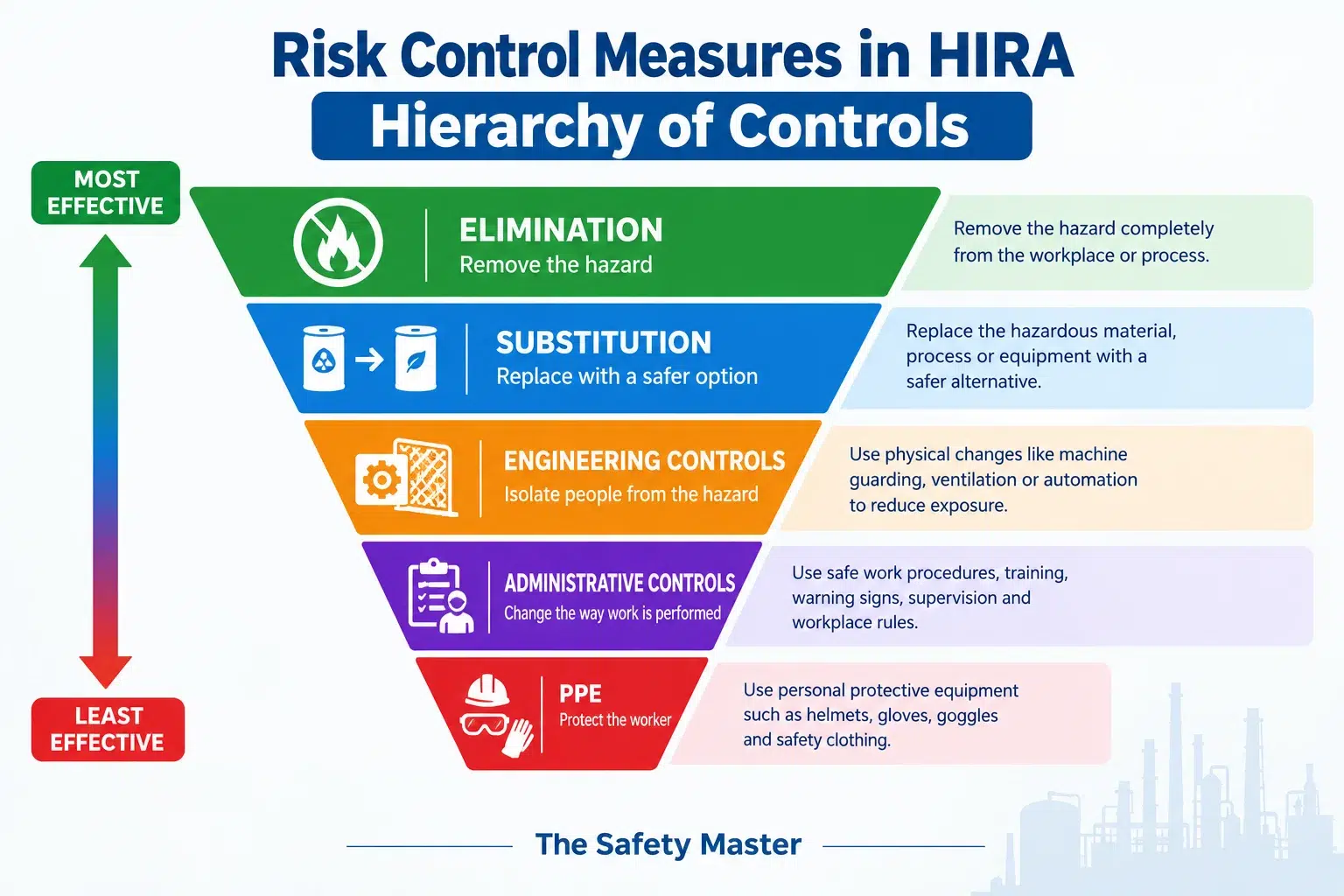
Once risks have been assessed, suitable controls should be selected using the Hierarchy of Controls.
Elimination
Remove the hazard completely whenever reasonably practicable.
Substitution
Replace the hazardous material, process or activity with a safer alternative.
Engineering Controls
Use physical or engineered safeguards such as:
- Machine guarding
- Interlocks
- Ventilation
- Isolation systems
- Automatic shutdown systems
- Containment systems
Administrative Controls
Administrative measures may include:
- SOPs
- Work instructions
- Training
- Warning signs
- Permit-to-work systems
- Job rotation
- Inspection programs
- Emergency procedures
Personal Protective Equipment
PPE should be selected according to the identified hazards and exposure conditions.
A strong HIRA should prioritize higher-level controls wherever reasonably practicable rather than depending only on PPE.
What Does a HIRA Assessment Include?
A professional HIRA assessment may include:
- Activity/process identification
- Hazard identification
- Hazard category
- Causes
- Potential consequences
- Persons exposed
- Existing controls
- Likelihood rating
- Severity rating
- Initial risk rating
- Recommended controls
- Responsible person
- Target completion date
- Residual risk
- Verification of controls
- Review requirements
This converts the HIRA from a simple document into an action-oriented risk management tool.
HIRA Report and Deliverables
The final HIRA report should clearly communicate the identified risks and recommended actions.
Depending on the scope of the assignment, deliverables may include:
HIRA Register
A structured register containing identified hazards, risk ratings, controls and action requirements.
Risk Matrix
The applicable risk-rating methodology used to evaluate hazards.
Control Recommendations
Practical recommendations based on the hierarchy of controls.
Action Plan
Clearly defined actions with responsibility and target completion dates.
Residual Risk Assessment
Evaluation of the remaining risk after proposed or implemented controls.
Management Summary
A concise summary of significant risks and priority improvement areas for management.
Types of HIRA Studies
The scope of HIRA can be adapted to different workplace and operational requirements.
Workplace HIRA
Assessment of hazards associated with workplace conditions, equipment and activities.
Process HIRA
Assessment of hazards associated with industrial processes and operations.
Activity-Based HIRA
Focused assessment of specific activities such as lifting, maintenance, welding or material handling.
Construction HIRA
Assessment of construction activities including excavation, scaffolding, lifting, work at height and temporary works.
Chemical HIRA
Assessment of chemical handling, storage, transfer and process hazards.
Maintenance HIRA
Assessment of hazards associated with inspection, maintenance, isolation and repair activities.
Emergency HIRA
Evaluation of hazards and risks associated with foreseeable emergency scenarios.
What Does a HIRA Assessment Include?
A professional HIRA assessment may include:
- Activity/process identification
- Hazard identification
- Hazard category
- Causes
- Potential consequences
- Persons exposed
- Existing controls
- Likelihood rating
- Severity rating
- Initial risk rating
- Recommended controls
- Responsible person
- Target completion date
- Residual risk
- Verification of controls
- Review requirements
This converts the HIRA from a simple document into an action-oriented risk management tool.
HIRA Report and Deliverables
The final HIRA report should clearly communicate the identified risks and recommended actions.
Depending on the scope of the assignment, deliverables may include:
HIRA Register
A structured register containing identified hazards, risk ratings, controls and action requirements.
Risk Matrix
The applicable risk-rating methodology used to evaluate hazards.
Control Recommendations
Practical recommendations based on the hierarchy of controls.
Action Plan
Clearly defined actions with responsibility and target completion dates.
Residual Risk Assessment
Evaluation of the remaining risk after proposed or implemented controls.
Management Summary
A concise summary of significant risks and priority improvement areas for management.
Types of HIRA Studies
The scope of HIRA can be adapted to different workplace and operational requirements.
Workplace HIRA
Assessment of hazards associated with workplace conditions, equipment and activities.
Process HIRA
Assessment of hazards associated with industrial processes and operations.
Activity-Based HIRA
Focused assessment of specific activities such as lifting, maintenance, welding or material handling.
Construction HIRA
Assessment of construction activities including excavation, scaffolding, lifting, work at height and temporary works.
Chemical HIRA
Assessment of chemical handling, storage, transfer and process hazards.
Maintenance HIRA
Assessment of hazards associated with inspection, maintenance, isolation and repair activities.
Emergency HIRA
Evaluation of hazards and risks associated with foreseeable emergency scenarios.
HIRA for Different Industries
HIRA methodology can be customized according to the hazards, processes and regulatory environment of each industry.
The Safety Master provides risk assessment support for sectors including:
- Oil & Gas
- Chemical and Petrochemical
- Manufacturing
- Pharmaceutical
- Construction
- Power and Energy
- Infrastructure
- Logistics and Warehousing
- Engineering
- Process Industries
- Other high-risk operations
Different industries require different assessment approaches because the hazards associated with a chemical process, construction project and warehouse operation are not the same.
HIRA vs JSA vs HAZOP
HIRA, JSA and HAZOP are related but serve different purposes.
| Method | Primary Focus | Typical Application |
|---|---|---|
| HIRA | Broad hazard and risk assessment | Workplace, activity, process |
| JSA/JHA | Task-level hazards | Specific job/task |
| HAZOP | Process deviations and process hazards | Process design/operation |
| QRA | Quantitative risk estimation | Major accident/high-hazard facilities |
HIRA vs JSA
HIRA generally provides a broader assessment of workplace, activity or process risks, while JSA/JHA breaks a particular job into individual steps and evaluates hazards and controls for each step.
HIRA vs HAZOP
HIRA is commonly used for broader workplace and activity risk assessment. HAZOP is a structured process hazard analysis technique that examines process deviations using guidewords.
For complex process industries, HIRA may therefore form part of a broader process safety risk-management framework alongside techniques such as HAZOP and QRA.
HIRA and ISO 45001
HIRA is closely connected with occupational health and safety risk management.
ISO 45001 requires organizations to establish processes for hazard identification and assessment of OH&S risks. The exact methodology used by an organization should be appropriate to its operations, risks and applicable requirements.
A properly maintained HIRA can support organizations in:
- Identifying OH&S hazards
- Assessing risks
- Establishing controls
- Reviewing changes
- Supporting continual improvement
- Maintaining documented information
Consultivo's current HIRA service page similarly positions HIRA around ISO 45001 hazard identification and risk assessment requirements.
When Should a HIRA Be Reviewed?
HIRA should not be treated as a one-time document.
A review may be required when:
- A new process is introduced
- New equipment is installed
- Raw materials change
- Process parameters change
- There is a workplace incident
- An unsafe condition is identified
- New legislation or requirements apply
- Existing controls are found ineffective
- A major organizational or operational change occurs
- Periodic review requirements are reached
Regular review helps ensure that the HIRA reflects the current workplace rather than historical conditions.
Common HIRA Mistakes to Avoid
Poor-quality HIRA assessments may fail to identify important risks.
Common mistakes include:
Using Generic Hazard Lists
Copying a standard hazard list without physically evaluating the workplace can result in missed hazards.
Focusing Only on Routine Activities
Non-routine operations, maintenance, startups, shutdowns and emergencies should also be considered.
Treating PPE as the Main Control
PPE is important, but higher-level controls should be considered first wherever practicable.
Incorrect Risk Ratings
Likelihood and severity criteria should be clearly defined and consistently applied.
Not Evaluating Existing Controls
A HIRA should assess whether current safeguards actually reduce the risk.
No Action Tracking
Recommendations are ineffective if responsibilities and completion dates are not assigned.
Not Assessing Residual Risk
After additional controls are proposed or implemented, the remaining risk should be reassessed.
Our HIRA Services at The Safety Master
The Safety Master provides practical and industry-specific HIRA services designed to help organizations move from hazard identification to effective risk control.
Our approach may include:
- Site/workplace assessment
- Activity and process review
- Hazard identification
- Risk assessment
- Risk matrix development/application
- Existing control evaluation
- Hierarchy of Controls review
- Additional control recommendations
- Residual risk assessment
- HIRA register preparation
- Action-plan development
- Management-level reporting
- HIRA review and update support
Our current service page already emphasizes practical workplace assessment, industry-specific risk identification, structured risk evaluation, control recommendations, HIRA registers and residual-risk assessment.
Why Choose The Safety Master for HIRA?
A useful HIRA should be more than a professionally formatted spreadsheet.
The value comes from understanding the actual process, equipment, activities, people and controls involved.
Practical Risk Assessment
Our approach focuses on actual workplace conditions and operational activities.
Industry-Specific Methodology
Risk assessment methodology can be adapted to the organization's industry and operational hazards.
Action-Oriented Recommendations
The objective is not simply to identify problems but to recommend practical measures for risk reduction.
Structured Documentation
Findings can be organized into a clear HIRA register and action plan for easier implementation and monitoring.
Support for High-Risk Industries
HIRA can be applied across complex industrial and high-risk operating environments.
Who Should Conduct a HIRA?
A HIRA should be conducted by competent personnel with suitable knowledge of:
- Workplace hazards
- Industrial processes
- Risk assessment methodology
- Existing safeguards
- Applicable requirements
- Control measures
- Emergency scenarios
For complex or high-hazard operations, organizations may benefit from engaging experienced HIRA consultants who can bring independent technical knowledge and practical risk-assessment experience.
Improve Your Workplace Risk Management With The Safety Master
Effective HIRA is not just about identifying hazards—it is about understanding the risk, prioritizing what matters most and implementing controls that reduce the possibility and consequences of unwanted events.
The Safety Master can support organizations with structured Hazard Identification and Risk Assessment, practical control recommendations, HIRA registers and risk-reduction action plans tailored to their operational requirements.
Looking for professional HIRA Services? Contact The Safety Master to discuss your workplace, process or activity and determine the right risk assessment approach for your organization.
Frequently Asked Questions About HIRA - Risk Assessment
Hazard Identification and Risk Assessment (HIRA) is a systematic process used to identify hazards in a workplace or activity and evaluate the risks associated with them. It considers the likelihood of an incident and the potential severity of its consequences. HIRA also reviews existing controls and identifies additional measures required to reduce risk to an acceptable level.
The 7 steps of HIRA (Hazard Identification and Risk Assessment) are:
- Define the scope – Identify the activity, process, workplace, or operation to be assessed.
- Identify hazards – Find potential sources of injury, illness, damage, fire, environmental impact, or other loss.
- Identify causes and consequences – Determine how an incident could occur and what could happen.
- Assess the risk – Evaluate the likelihood and severity of each identified hazard.
- Evaluate existing controls – Check whether current safeguards are adequate and effective.
- Recommend additional controls – Apply the hierarchy of controls to reduce the risk.
- Record, implement, and review – Document findings, assign actions, monitor completion, and review HIRA when conditions change.
HIRA requirements depend on the country, industry, workplace, applicable legislation, and specific activity. In India, different occupational safety and industrial regulations may require employers to identify hazards, assess risks, and implement appropriate safety measures. Therefore, organizations should check the legislation and regulatory requirements applicable to their particular operation rather than assuming that one HIRA requirement applies to every workplace.
A HIRA assessment is a documented evaluation of hazards and risks associated with a workplace, process, equipment, task, or activity. It normally records the identified hazard, cause, potential consequence, existing controls, likelihood, severity, risk rating, recommended controls, and residual risk. The purpose is to help organizations prioritize risks and implement practical preventive measures.
The commonly recognized 7 types of workplace hazards are:
- Physical hazards – Noise, vibration, heat, radiation, slips, trips, and falls.
- Chemical hazards – Toxic, corrosive, flammable, or reactive substances.
- Biological hazards – Bacteria, viruses, fungi, and other biological agents.
- Ergonomic hazards – Poor posture, repetitive work, manual handling, and workstation-related risks.
- Mechanical hazards – Moving machinery, rotating parts, crushing, cutting, and entanglement.
- Electrical hazards – Electric shock, arc flash, short circuits, and electrical fires.
- Psychosocial hazards – Work-related stress, excessive workload, workplace violence, harassment, and other factors affecting psychological well-being.
The exact hazard categories can vary between organizations and risk assessment methodologies.
The 5 basic steps of risk assessment are:
- Identify the hazards – Determine what could cause harm.
- Identify who may be harmed and how – Consider employees, contractors, visitors, and others who may be exposed.
- Evaluate the risks and decide on controls – Assess likelihood and severity and determine suitable control measures.
- Record findings and implement controls – Document significant risks, assign responsibilities, and put controls into practice.
- Review and update the assessment – Reassess the risks when conditions change, after incidents, or as part of periodic review.