
LOPA & SIL - Layer of Protection Analysis and Safety Integrity Level
Introduction to LOPA & SIL
LOPA & SIL are important process safety methods used to understand hazards, evaluate protection layers, and determine the required risk reduction for safety instrumented functions. Layer of Protection Analysis (LOPA) uses a structured and semi-quantitative approach to review initiating events, consequences, and independent protection layers.
A LOPA study is commonly developed from the information identified during a HAZOP or another process hazard analysis. LOPA focuses on selected scenarios and checks whether the available independent protection layers provide enough risk reduction. Where a Safety Instrumented Function (SIF) is required, the analysis can be used to help determine the required Safety Integrity Level (SIL).
The Safety Master provides LOPA & SIL consultancy support for industries that need a structured approach to process risk assessment, functional safety, and safety instrumented systems.
What is LOPA?
LOPA stands for Layer of Protection Analysis.
It is a risk assessment technique used to examine a hazardous scenario and determine whether sufficient independent protection layers are available to prevent or reduce the consequence.
A typical LOPA considers:
- Initiating event
- Initiating event frequency
- Hazardous consequence
- Existing safeguards
- Independent Protection Layers (IPLs)
- Probability of failure of protection layers
- Residual risk
- Required risk reduction
- Safety Instrumented Function, where applicable
- Target SIL, where applicable
LOPA does not replace HAZOP. Instead, it can use information from HAZOP and provide a more focused assessment of selected scenarios.
LOPA Study: How It Works
A LOPA study normally follows a structured process.
1. Identify the Hazard Scenario
The team identifies a hazardous event, its initiating cause, and its potential consequence.
Examples include:
- High pressure
- High temperature
- Loss of cooling
- Overfilling
- Toxic gas release
- Flammable material release
- Loss of containment
2. Identify Initiating Events
The initiating event is the cause that starts the hazardous scenario.
Examples may include:
- Equipment failure
- Instrument failure
- Human error
- Utility failure
- Control system failure
- Process deviation
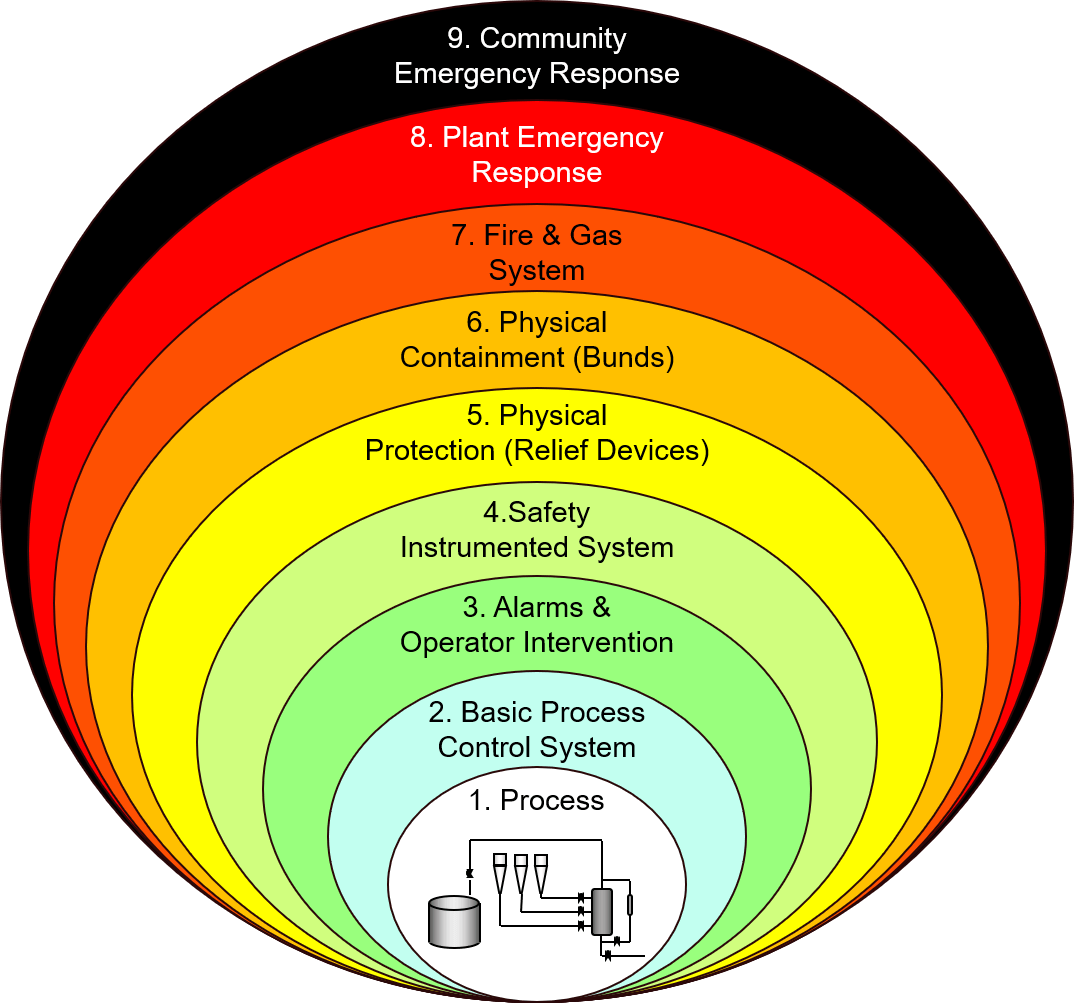
3. Identify Protection Layers
The team reviews existing safeguards and determines whether they can qualify as independent protection layers.
Examples can include:
- Basic Process Control System
- Alarm with operator response
- Mechanical relief device
- Physical protection
- Fire and gas system
- Safety Instrumented Function
The independence and effectiveness of a protection layer are important considerations in LOPA.
4. Calculate Risk Reduction
The initiating event frequency and protection-layer performance are considered to estimate the remaining event frequency.
The objective is to determine whether the existing protection is sufficient to meet the defined risk criteria.
5. Determine Additional Risk Reduction
If the existing protection layers do not provide adequate risk reduction, an additional safety function may be required.
This can lead to the identification of a required Safety Integrity Level (SIL) for a Safety Instrumented Function.
LOPA vs HAZOP
LOPA vs HAZOP is a common question in process safety.
HAZOP is primarily used to systematically identify process deviations, causes, consequences, and safeguards. LOPA takes selected hazardous scenarios and evaluates the frequency and effectiveness of independent protection layers.
| LOPA | HAZOP |
|---|---|
| Layer of Protection Analysis | Hazard and Operability Study |
| Focuses on selected scenarios | Systematically examines process deviations |
| Uses initiating-event frequency | Identifies causes and consequences |
| Evaluates independent protection layers | Reviews safeguards |
| Semi-quantitative approach | Mainly qualitative/structured analysis |
| Can help determine required SIL | Can provide information used by LOPA |
HAZOP and LOPA therefore serve different but connected purposes. A HAZOP may identify a scenario, while LOPA can further evaluate whether the protection layers are adequate.
What is SIL?
SIL means Safety Integrity Level.
SIL is a measure used to specify the required level of risk reduction associated with a safety instrumented function. Under the IEC 61508 framework, SIL levels range from SIL 1 to SIL 4, with higher levels representing greater required risk reduction.
For process industry applications, IEC 61511 is commonly associated with the safety lifecycle for safety instrumented systems.
SIL Levels
| SIL Level | General Meaning |
|---|---|
| SIL 1 | Lower level of risk reduction |
| SIL 2 | Higher risk reduction than SIL 1 |
| SIL 3 | Higher risk reduction than SIL 2 |
| SIL 4 | Highest level in the IEC 61508 four-level scale |
The required SIL should not simply be selected because a higher number appears safer. It should be determined from the risk assessment and applicable requirements for the specific safety function.
SIL Study
A SIL study is performed to determine the required Safety Integrity Level for applicable Safety Instrumented Functions.
A SIL study may use:
- HAZOP information
- LOPA methodology
- Risk criteria
- Initiating-event frequencies
- Consequence information
- Existing independent protection layers
- Required risk reduction
- Safety Instrumented Function requirements
The result can support development of safety requirements and subsequent SIS design, verification, validation, testing, and maintenance activities.
SIL Assessment
A SIL assessment helps determine whether a Safety Instrumented Function meets its required integrity level.
The assessment may consider factors such as:
- Probability of Failure on Demand
- Probability of dangerous failure
- Hardware architecture
- Hardware fault tolerance
- Systematic capability
- Proof testing
- Diagnostic coverage
- Maintenance requirements
- Safety lifecycle requirements
Meeting a numerical probability target alone is not necessarily sufficient; functional-safety requirements also involve architectural and systematic considerations.
LOPA SIL Assessment
A LOPA SIL assessment connects process hazard scenarios with the required risk reduction from a Safety Instrumented Function.
A simplified approach is:
Initiating Event → Consequence → Existing IPLs → Residual Risk → Required Risk Reduction → Target SIL
LOPA can therefore help identify whether an additional SIF is needed and what target SIL may be required.
The analysis should use appropriate risk criteria, reliable initiating-event data, and carefully evaluated independent protection layers.
LOPA SIL Example
Consider a process vessel where excessive pressure could result in a hazardous release.
A simplified scenario may look like this:
Initiating Event: Pressure control failure
Potential Consequence: Vessel overpressure and hazardous release
Existing Protection:
- Process control system
- High-pressure alarm
- Operator response
- Pressure relief device
The LOPA team reviews each protection layer for independence and effectiveness. If the resulting risk remains above the acceptable target, an additional Safety Instrumented Function may be considered.
For example:
High Pressure → Pressure Transmitter → Logic Solver → Shutdown Valve → Safe State
The required SIL for the SIF would be determined from the risk reduction required by the assessment rather than being assumed in advance.
ISA guidance describes LOPA as a method that can be linked with HAZOP information to support SIL determination for a safety instrumented system.
LOPA SIL PDF, PPT and Assessment Documents
Professionals often search for LOPA SIL PDF, LOPA SIL PPT, and LOPA SIL assessment PDF to understand the methodology, worksheets, calculations, and reporting structure.
A typical LOPA/SIL report may include:
- Study objective
- Plant or process description
- Study methodology
- Risk criteria
- HAZOP reference
- LOPA worksheets
- Initiating events
- Consequences
- Existing safeguards
- Independent Protection Layers
- Risk calculations
- Required risk reduction
- Safety Instrumented Functions
- Target SIL
- Recommendations
- Action items
- Study conclusions
The exact format should be developed according to the project's process, risk criteria, applicable standards, and company procedures.
Benefits of LOPA & SIL Study
A properly conducted LOPA & SIL study can help organizations:
- Identify gaps in process protection
- Review the effectiveness of safeguards
- Understand residual process risk
- Identify the need for Safety Instrumented Functions
- Determine required risk reduction
- Support SIL target selection
- Improve SIS design requirements
- Support functional safety lifecycle activities
- Strengthen process safety management
- Improve documentation and traceability
LOPA is particularly useful because it provides a structured way to examine protection layers and determine whether they provide sufficient risk reduction.
LOPA & SIL Services by The Safety Master
The Safety Master provides process safety and risk management support for LOPA and SIL studies.
Our approach can include:
- Review of process information
- HAZOP study review
- LOPA workshop
- Initiating-event assessment
- Independent Protection Layer evaluation
- Risk reduction assessment
- SIL target determination
- Safety Instrumented Function identification
- SIL assessment
- Documentation and reporting
- Recommendations for additional protection
The Safety Master follows a structured process safety approach and supports clients in applying recognized functional-safety practices, including IEC 61508 and IEC 61511 requirements where applicable.
Why Choose The Safety Master for LOPA & SIL?
The quality of a LOPA or SIL study depends on good process information, suitable risk criteria, competent facilitation, and careful evaluation of protection layers.
The Safety Master focuses on:
- Practical process safety engineering
- Structured LOPA methodology
- Clear documentation
- Risk-based decision making
- Safety instrumented system requirements
- Functional safety lifecycle support
- Industry-focused consultancy
Our objective is to help organizations understand process risks and establish appropriate protection measures based on a structured technical assessment.
Conclusion LOPA & SIL are important tools for managing risk in process industries. HAZOP can identify hazardous scenarios, while LOPA provides a structured assessment of initiating events and independent protection layers. Where a Safety Instrumented Function is required, the analysis can support determination of the required SIL. A well-planned LOPA study and SIL study can help organizations identify protection gaps, define safety requirements, and strengthen the functional safety lifecycle. The Safety Master supports organizations with LOPA, SIL assessment, and process safety consultancy for practical and structured risk management.