Safety Governance That Works Even When Consultants Leave

Future-Proofing Your Workforce: Why Culture Trumps Compliance
February 11, 2026
End-to-End Safety Management: The Power of Single-Source Accountability
February 14, 2026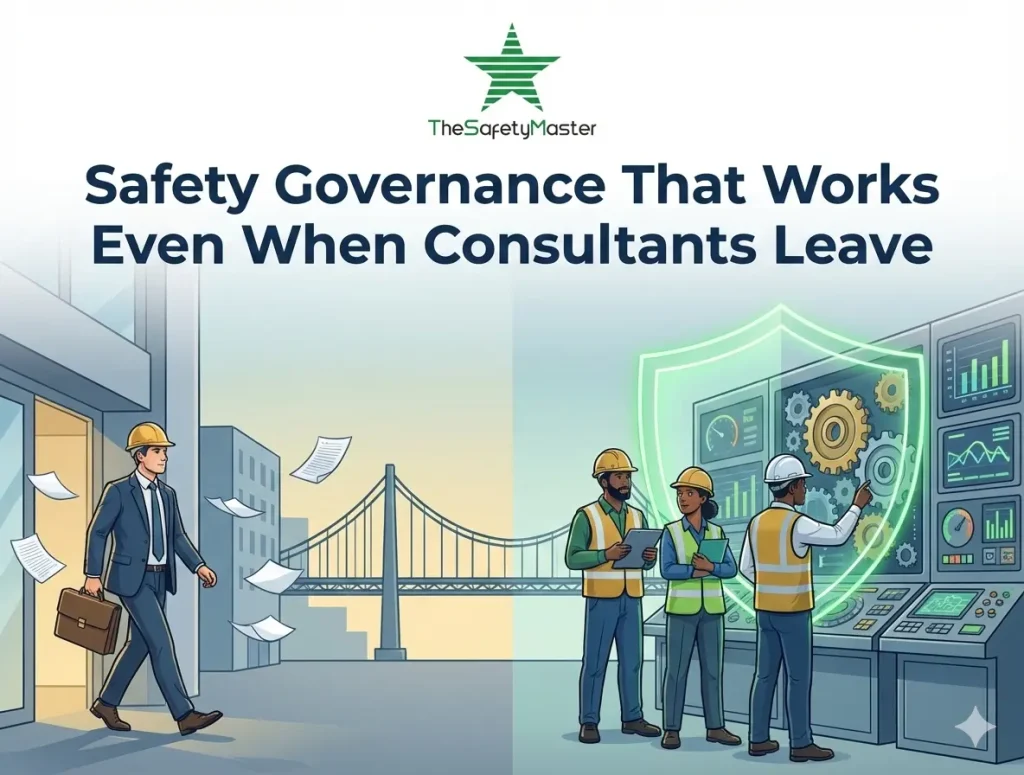
External consultants are often the catalysts for positive change in industrial safety. They bring expertise, fresh eyes, and rigorous frameworks. However, a common pitfall occurs when the contract ends: the “knowledge vacuum.” Without a strategy for sustainability, the robust systems built by consultants can slowly degrade, reverting the organization to old, unsafe habits.
True safety governance isn’t about renting expertise; it is about building an internal culture that thrives independently. Here is how organizations can construct a safety framework that remains resilient long after the consultants have packed up.
1. Move From “Done For You” to “Done With You”
The most fragile safety systems are those where the consultant does all the heavy lifting. To ensure longevity, the engagement must focus on knowledge transfer.
For example, during a risk assessment, your internal team shouldn’t just receive a final report; they should be trained to understand the methodology. Take the Hazop Study. This is a systematic method for identifying hazards in process plants. If only the consultant understands the nodes and deviations, the document becomes a static artifact. However, if your internal engineers are trained to facilitate or actively participate in the study, that knowledge becomes a permanent organizational asset.
2. Institutionalize the Audit Cycle
Consultants often perform the initial deep-dive audits to set a baseline. The governance challenge lies in maintaining that standard. You must transition from ad-hoc “inspection panic” to a routine, self-regulating audit cycle.
- Routine Verification: Don’t wait for a regulatory notice to check your fire suppression systems. Schedule a recurring internal Fire Audit to ensure pumps, sprinklers, and alarms are functional year-round.
- Broad Compliance: similarly, a general Safety Audit should be codified into your annual calendar. These internal checks act as the “heartbeat” of your governance system, ensuring that the gap between procedure and practice doesn’t widen over time.
3. Implement Systemic Frameworks, Not Just Rules
Rules tell people what to do; frameworks explain how and why things fit together. When consultants leave, rules are easily forgotten, but frameworks tend to stick because they are integrated into operations.
Adopting a holistic approach like Process Safety Management (PSM) is essential. PSM is not a checklist; it is a management system that connects technology, facilities, and personnel. By embedding PSM elements—such as management of change (MOC) and mechanical integrity—into your daily ERP and maintenance workflows, safety becomes part of the “business as usual” rather than an external imposition.
4. Leadership Ownership and Accountability
Finally, governance fails when leadership views safety as the safety department’s job. Sustainable governance requires:
- Executive KPIs: Safety metrics must sit alongside financial metrics in board reviews.
- Line Management Responsibility: Production managers must own the safety of their lines, utilizing the tools left behind by consultants.
- Continuous Learning: Establish an internal training academy to onboard new hires into the safety culture, preventing knowledge dilution over time.
Summary
The goal of hiring consultants should be obsolescence—they should work themselves out of a job by empowering you. By focusing on knowledge transfer in satechnical studies, institutionalizing your audit cycles, and adopting robust management systems, you ensure that safety governance remains airtight, regardless of who is in the building.