
Safety Perception Survey for Building a Strong Safety Culture
A strong safety culture starts with understanding how employees see safety in their workplace. A Safety Perception Survey helps organizations understand employee opinions, attitudes, experiences, and perceptions related to workplace safety.
The survey provides valuable information about how employees view safety leadership, communication, procedures, training, reporting systems, risk management, and management commitment. The Safety Master provides Safety Perception Survey services to help organizations identify gaps and develop practical actions for improving their safety culture.
What Is a Safety Perception Survey?
A Safety Perception Survey is a structured survey used to understand how employees perceive safety within an organization. It collects feedback from employees at different levels and across different departments.
The survey can help identify differences between the organization's safety policies and how those policies are experienced in day-to-day work.
A well-designed survey can provide information about:
- Employee views about workplace safety
- Management commitment to safety
- Safety communication
- Employee involvement in safety
- Safety training effectiveness
- Reporting of unsafe conditions and near misses
- Availability and use of safety procedures
- Trust in the safety management system
- Safety leadership
- Workplace safety culture
The Safety Master also provides safety culture transformation and behavior-based safety services as part of a broader approach to improving workplace safety.
Why Is a Safety Perception Survey Important?
Safety performance is influenced not only by equipment, procedures, and rules but also by employee behavior, leadership, communication, and workplace culture.
A Safety Perception Survey gives employees an opportunity to share their views about safety. The collected information can help management understand areas that require attention.
Identify Safety Culture Gaps
The survey can highlight areas where employees feel that safety practices are not working effectively or where there is a difference between written procedures and actual workplace practices.
Understand Employee Feedback
Employees work directly with processes, equipment, contractors, and workplace conditions. Their feedback can provide useful information about practical safety challenges.
Evaluate Safety Leadership
The survey can examine how employees perceive management involvement, leadership behavior, communication, and commitment toward safety.
Improve Safety Communication
Open and structured feedback can help identify communication gaps between management, supervisors, safety teams, and workers.
Support Continuous Improvement
Survey results can be used as a baseline for developing improvement plans and monitoring changes in safety culture over time.
What Does a Safety Perception Survey Cover?
The exact survey areas can be customized according to the organization's industry, workforce, risk profile, and objectives.
Safety Leadership
Questions can examine how employees perceive the commitment of senior management and supervisors toward workplace safety.
Safety Communication
This area looks at whether employees receive clear and timely information about hazards, procedures, incidents, and safety expectations.
Employee Involvement
The survey can evaluate whether employees feel involved in safety activities and whether their suggestions and concerns are considered.
Safety Training
Employees can provide feedback about the relevance, frequency, quality, and practical value of safety training.
Hazard Reporting
The survey can examine whether employees feel comfortable reporting unsafe acts, unsafe conditions, near misses, and other safety concerns.
Safety Procedures
Employees can provide feedback about whether safety procedures are available, understandable, practical, and followed during routine work.
Management Commitment
Management commitment is an important part of safety culture. Survey questions can examine whether employees believe safety receives appropriate attention during operational decision-making.
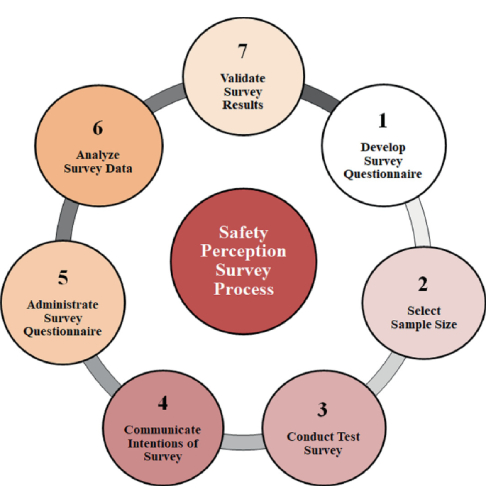
Safety Perception Survey Process
The survey process can be structured according to the requirements of the organization.
Step 1: Define Survey Objectives
The first step is to understand why the organization wants to conduct the survey. Objectives may include measuring safety culture, identifying gaps, evaluating leadership, or supporting a BBS implementation program.
Step 2: Develop the Survey
Questions are prepared according to the organization's activities, workforce, safety risks, and survey objectives.
Step 3: Conduct the Survey
Employees across selected departments, locations, or organizational levels participate in the survey. Digital or other suitable survey methods can be used depending on the project requirements.
Step 4: Analyze the Results
The collected responses are reviewed to identify important trends, strengths, concerns, and areas requiring improvement.
Step 5: Prepare the Report
A structured report can present the findings in a clear and practical format. The report may include survey results, key observations, identified gaps, and improvement areas.
Step 6: Develop Improvement Actions
The findings can be converted into practical action plans covering leadership, communication, training, employee involvement, behavior, and safety management practices.
Benefits of Safety Perception Survey
A Safety Perception Survey can support organizations in several ways:
- Understand employee safety perceptions
- Identify safety culture gaps
- Strengthen safety leadership
- Improve employee engagement
- Improve safety communication
- Identify training requirements
- Encourage hazard and near-miss reporting
- Support behavior-based safety programs
- Establish a safety culture baseline
- Monitor safety culture improvement
- Support continuous safety improvement
Safety Perception Survey and Behavior-Based Safety
A Safety Perception Survey can be used as an important input for a Behavior-Based Safety (BBS) program.
The survey helps an organization understand employee perceptions before implementing or improving behavioral safety initiatives. The findings can then be considered while developing safe behavior observation programs, employee engagement activities, leadership initiatives, and safety training.
The Safety Master provides Safety Perception Surveys, Behavior-Based Safety Training, Safe Behavior Observation Programs, and Safety Culture Transformation Implementation services.
Who Can Use a Safety Perception Survey?
Safety Perception Surveys can be useful for organizations across different industries, including:
- Manufacturing
- Chemical and petrochemical
- Oil and gas
- Pharmaceutical
- Construction
- Power and energy
- FMCG
- Metals and mining
- Logistics and warehousing
- Healthcare
- Hospitality
- Infrastructure
The survey can be customized for different workforce sizes, locations, departments, and operational environments.
Safety Perception Survey Report
A Safety Perception Survey report can provide management with a structured view of employee feedback and key safety culture indicators.
Depending on the project requirements, the report may include:
- Survey methodology
- Survey participation
- Key findings
- Department-wise observations
- Safety culture indicators
- Strength areas
- Improvement areas
- Employee perception trends
- Management and leadership observations
- Recommended improvement actions
The report can help management prioritize safety culture improvement activities based on the survey findings.
Why Choose The Safety Master for Safety Perception Survey?
The Safety Master provides safety consulting, safety culture, behavior-based safety, training, audit, and process safety services for organizations across different industries. Its current service portfolio includes Safety Perception Surveys alongside BBS training, leadership safety programs, and safety culture transformation initiatives.
A Safety Perception Survey can be designed around the organization's specific objectives rather than using the same approach for every workplace. The results can then support practical safety improvement activities.
The Safety Master can support organizations in understanding employee safety perceptions and using those insights to strengthen workplace safety culture.