Safety Governance That Works Even When Consultants Leave

Annual Safety Programs Built for Zero-Disruption Operations
February 16, 2026
Because Safety Needs Ownership, Not Visits
February 17, 2026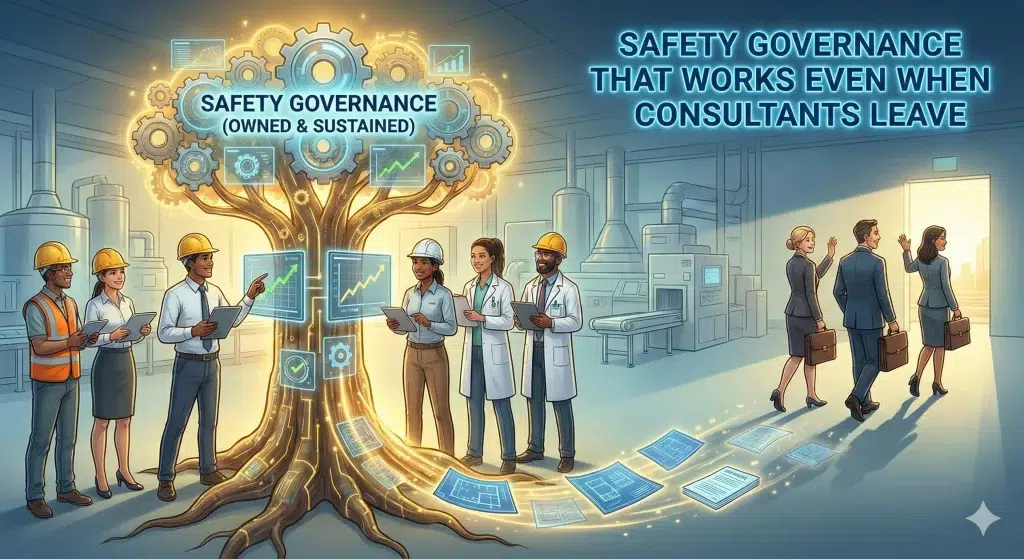
It is a common cycle in the industrial world: a high-profile consultancy firm is brought in to overhaul safety protocols. For six months, the facility is buzzing with energy. New manuals are written, colorful posters are hung, and compliance scores skyrocket. But then, the contract ends. The consultants pack their bags, and within ninety days, the “new” system begins to gather dust. Near-misses creep back up, and the vibrant safety culture reverts to a “check-the-box” mentality.
At The Safety Master, we believe that true safety isn’t a product you buy; it’s a muscle you build. To achieve safety governance that survives the departure of external experts, an organization must shift from compliance-driven safety to competency-driven governance.
The “Consultant Trap”: Why Systems Fail Post-Exit
Most external interventions fail to stick because they focus on outputs (reports and certifications) rather than ownership. When a consultant leads every meeting and identifies every hazard, the internal team stops looking for risks themselves. They become “safety tourists” in their own plant.
To break this cycle, safety governance must be embedded into the DNA of daily operations. It requires a framework where the expertise is transferred, not just documented.
1. Establishing the Foundation: Risk-Based Thinking
Effective governance starts with understanding exactly where the “monsters” are hiding in your process. This isn’t a one-time exercise; it’s a continuous loop.
Process Safety Management (PSM)
For industries dealing with hazardous chemicals or high-energy transitions, Process Safety Management is the bedrock. Unlike general occupational safety, PSM focuses on preventing catastrophic releases. When consultants leave, the internal team must be capable of maintaining the “Mechanical Integrity” and “Management of Change” pillars of PSM. Without an internal owner for these elements, the technical memory of the plant begins to fade.
The Role of Rigorous Analysis
A cornerstone of this foundation is the Hazop Study. While an external facilitator often leads the initial Hazard and Operability study, the governance model must ensure that the recommendations are tracked by internal stakeholders. If your team doesn’t understand the why behind a specific valve requirement identified during a HAZOP, they are likely to bypass it during a maintenance rush three years down the line.
2. Integrating Safety into the Business Operating System
Safety should not be a separate department that “polices” the workers. For governance to work long-term, it must be integrated into how the business measures success.
Key Performance Indicators (KPIs) Beyond LTI
If your only safety metric is Lost Time Injuries (LTI), you are looking in the rearview mirror. Robust governance tracks leading indicators, such as:
- Percentage of safety training completed on time.
- The closure rate of actions from a recent Safety Audit.
- The number of near-misses reported by floor-level operators.
Empowering the Frontline
Governance works when the person closest to the risk has the authority to stop the job. This “Stop Work Authority” must be protected by leadership. When consultants leave, the leadership’s reaction to a safety-related shutdown defines the future of the culture. If they complain about lost production, the safety system dies. If they celebrate the “good catch,” the system thrives.
3. The Continuous Verification Loop
Even the best-laid plans drift over time. This is known as “normalization of deviance”—where small shortcuts become the new standard because “nothing bad happened last time.”
Internal vs. External Audits
While internal teams should conduct regular walk-throughs, a periodic, formal Fire Audit or safety review provides a fresh set of eyes. However, the governance trick is to use these audits as coaching opportunities rather than “gotcha” sessions.
The Governance Rule: For every finding identified by an auditor, the internal department head should be able to explain the root cause and the systemic fix—not just the immediate patch.
4. Building Internal Competency
The goal of any consultant should be to work themselves out of a job. At The Safety Master, we focus on “Training the Trainers.”
| Level | Focus Area | Governance Responsibility |
| Executive | Resourcing & Culture | Provide the budget and “Safety-First” mandate. |
| Management | Systems & Compliance | Ensure Safety Audits are conducted and acted upon. |
| Supervisors | Behavioral Safety | Conduct daily tool-box talks and identify hazards. |
| Operators | Standard Operating Procedures | Follow protocols and report deviations immediately. |
5. Technology as a Bridge
In the absence of consultants, digital safety management systems (SMS) act as the “memory” of the organization.
- Automated Alerts: Ensures that a Fire Audit recommendation doesn’t sit in a PDF for six months.
- Data Centralization: Keeps all Hazop Study data accessible for future expansions.
- Transparency: Allows leadership to see real-time compliance levels across different shifts.
Summary: The Four Pillars of Lasting Governance
To ensure your safety protocols don’t vanish with the consultants, focus on these four pillars:
- Ownership: Every safety standard must have an internal “Process Owner” who is accountable for its health.
- Simplification: If a safety manual is 500 pages long, no one will read it once the consultant leaves. Use visual SOPs and clear checklists.
- Regular Cadence: Schedule your Process Safety Management reviews and audits on a recurring calendar that doesn’t depend on external triggers.
- Psychological Safety: Create an environment where employees feel safe reporting mistakes. A system that punishes honest errors will eventually be fed false data.
Conclusion
Consultants are catalysts—they provide the spark, the specialized knowledge, and the initial momentum. But the fuel for the fire must come from within the organization. By focusing on internal competency, integrating safety into daily operations, and maintaining a rigorous audit cycle, you create a self-sustaining ecosystem.
Safety governance isn’t about being perfect when someone is watching; it’s about having the systems in place to do the right thing when no one is.