
HIRA Training & Certification: Hazard Identification and Risk Assessment Course
HIRA Training teaches safety professionals, engineers, supervisors and managers how to identify workplace hazards, assess risk and select appropriate control measures before incidents occur. The Safety Master provides practical HIRA training and certification focused on workplace applications, risk assessment methodology, hazard identification techniques and real-world safety scenarios.
Unlike a generic safety awareness programme, HIRA training should help participants actually perform a risk assessment, understand a risk matrix, evaluate controls and prepare useful HIRA documentation.
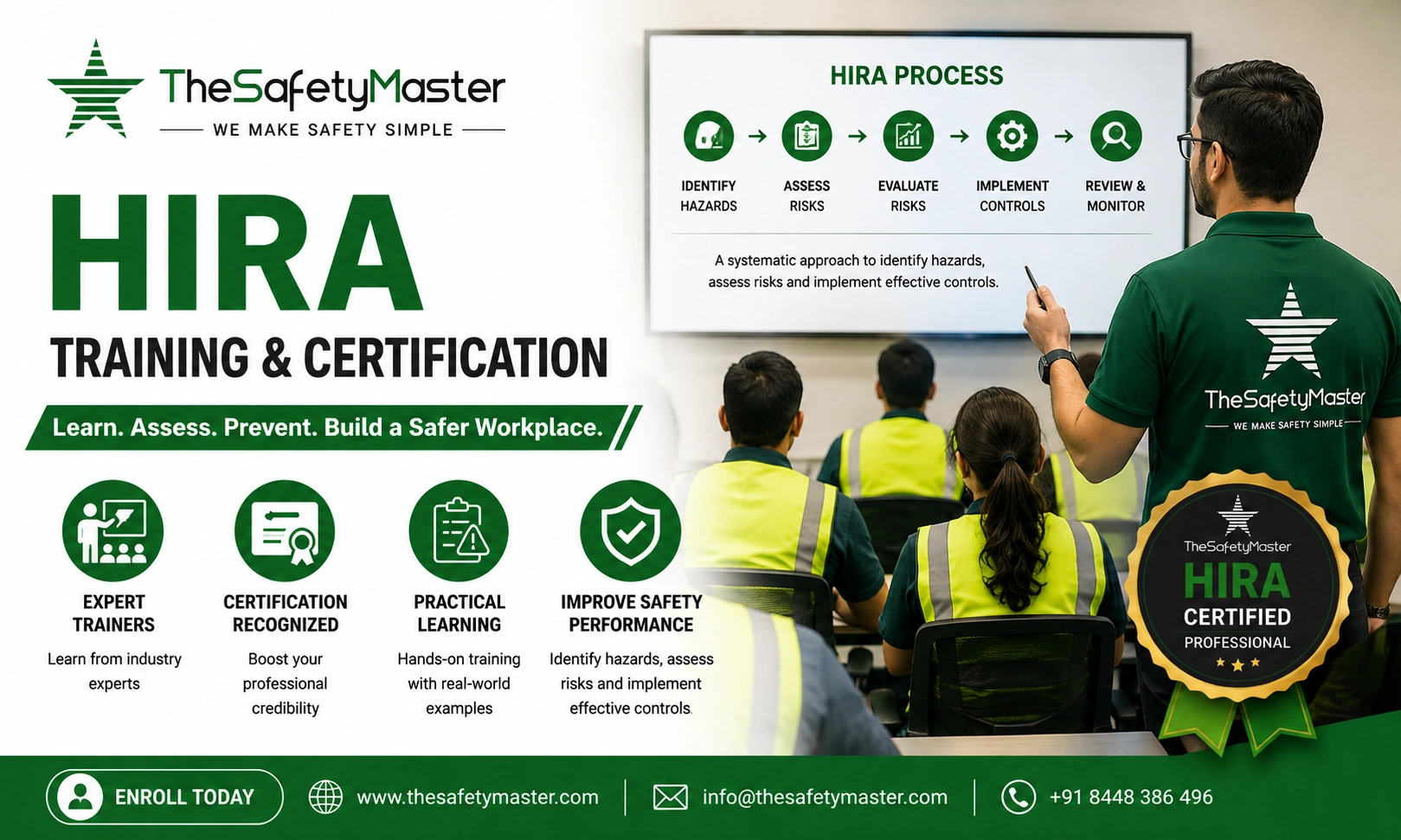
What Is HIRA Training?
HIRA training is a professional safety training programme covering Hazard Identification and Risk Assessment.
Participants learn how to:
- Identify workplace hazards
- Understand hazard and risk
- Evaluate likelihood and severity
- Use a HIRA risk matrix
- Identify existing controls
- Apply the hierarchy of controls
- Recommend additional controls
- Assess residual risk
- Prepare HIRA documentation
- Review risk assessments
The Safety Master's existing programme is positioned as a practical 1–2 day certification training programme.
What Is the Full Form of HIRA?
The full form of HIRA is:
HIRA = Hazard Identification and Risk Assessment
Hazard Identification means identifying sources or situations that have the potential to cause harm.
Risk Assessment means evaluating the likelihood and potential severity of harm and determining suitable controls.
Together, these activities provide a structured approach to workplace risk management.
Why Should Safety Professionals Learn HIRA?
HIRA is an important skill for professionals involved in workplace safety and operational risk.
A trained professional should be able to look beyond obvious hazards and ask:
- What could go wrong?
- Why could it happen?
- Who could be exposed?
- What could the consequence be?
- What controls already exist?
- Are those controls effective?
- What additional controls are needed?
- What is the remaining risk?
This practical thinking is one of the most valuable outcomes of HIRA training.
Benefits of HIRA Training and Certification
1. Develops Hazard Identification Skills
Participants learn structured techniques for recognizing physical, chemical, mechanical, electrical, ergonomic and other workplace hazards.
2. Improves Risk Assessment Skills
Training helps participants understand likelihood, severity, risk rating and prioritization.
3. Builds Practical Risk-Control Knowledge
Participants learn how to select controls using the hierarchy of controls instead of relying only on PPE.
4. Improves HIRA Documentation
Participants learn what information should be recorded in a HIRA register and how findings can be communicated clearly.
5. Supports Safety Career Development
HIRA knowledge can be valuable for safety officers, EHS professionals, engineers, supervisors and other professionals responsible for workplace risk.
6. Encourages Proactive Safety
Instead of waiting for an accident, participants learn to identify and manage hazards before work begins.
HIRA Training Course Curriculum
A practical HIRA course can cover the following modules.
Module 1: Introduction to HIRA
Participants learn:
- HIRA meaning
- HIRA full form
- Hazard definition
- Risk definition
- Difference between hazard and risk
- Purpose of HIRA
- Role of HIRA in safety management
Module 2: Types of Workplace Hazards
Training can include:
Physical Hazards
- Noise
- Vibration
- Temperature
- Radiation
- Slips and trips
- Falls
Mechanical Hazards
- Moving machinery
- Rotating equipment
- Crushing points
- Cutting equipment
- Material handling
Electrical Hazards
- Electric shock
- Arc flash
- Exposed conductors
- Electrical fire
- Improper isolation
Chemical Hazards
- Toxic exposure
- Flammable substances
- Chemical spills
- Leakage
- Incompatible chemicals
Fire and Explosion Hazards
- Ignition sources
- Combustible materials
- Flammable liquids
- Gas releases
- Dust hazards
Ergonomic Hazards
- Manual handling
- Repetitive movements
- Poor posture
- Awkward working positions
Work-at-Height Hazards
- Falls
- Unsafe ladders
- Scaffold hazards
- Unprotected edges
Confined-Space Hazards
- Oxygen deficiency
- Toxic gases
- Engulfment
- Restricted access
- Difficult rescue
The Safety Master's existing training page also covers these broad hazard categories as part of its HIRA curriculum.
HIRA Risk Assessment Methodology
One of the key parts of HIRA training is understanding how risk is evaluated.
A commonly used concept is:
Risk = Likelihood × Severity
For example, if:
- Likelihood = 4
- Severity = 5
Then:
Risk Score = 4 × 5 = 20
The exact risk-rating categories and acceptance criteria should be defined by the organization's approved methodology.
Understanding the HIRA Risk Matrix
A risk matrix helps participants prioritize hazards.
A typical 5×5 matrix considers:
Likelihood
- Rare
- Unlikely
- Possible
- Likely
- Almost Certain
Severity
- Minor
- First Aid
- Medical Treatment
- Major Injury
- Fatal/Catastrophic
Training should not only teach participants how to calculate a score but also how to interpret the result and decide what action is appropriate.
HIRA Process: Step-by-Step
Step 1: Select the Activity
Identify the job, task, process, equipment or operation being assessed.
Step 2: Break Down the Activity
Understand how the activity is performed, including routine and non-routine work.
Step 3: Identify Hazards
Identify potential sources of harm associated with each activity.
Step 4: Identify Consequences
Determine what could happen if the hazard is not adequately controlled.
Step 5: Assess Risk
Evaluate likelihood and severity using the approved risk matrix.
Step 6: Review Existing Controls
Identify the controls already available.
Step 7: Recommend Additional Controls
Determine what additional measures are required to reduce the risk.
Step 8: Determine Residual Risk
Reassess the risk after the proposed controls.
Step 9: Document the Assessment
Record the findings in the HIRA register.
Step 10: Review the HIRA
Update the assessment when activities, equipment, materials or operating conditions change.
Hierarchy of Controls in HIRA Training
Participants should understand that different controls have different levels of effectiveness.
Elimination
Remove the hazard.
Substitution
Replace the hazard with a safer alternative.
Engineering Control
Use physical or engineered protection.
Administrative Control
Use procedures, training, permits, instructions and supervision.
PPE
Use appropriate personal protective equipment for residual hazards.
A strong HIRA course should teach participants to consider higher-level controls before depending on administrative controls or PPE. This is also a prominent element in competitor HIRA training/service content.
Practical HIRA Case Studies
Theory alone is not enough to develop HIRA competency.
A practical course should use examples such as:
Case Study 1: Working at Height
Activity: Roof maintenance
Hazard: Fall from height
Potential consequence: Serious injury or fatality
Possible controls:
- Guardrails
- Safe access
- Fall-protection system
- Work-at-height procedure
- Inspection
- Competent supervision
Case Study 2: Confined Space
Activity: Tank entry
Hazards:
- Oxygen deficiency
- Toxic gases
- Restricted access
Controls:
- Gas testing
- Ventilation
- Entry permit
- Standby person
- Rescue arrangements
Case Study 3: Electrical Maintenance
Activity: Electrical panel maintenance
Hazard: Electric shock/arc flash
Controls:
- Isolation
- LOTO
- Verification of zero energy
- Suitable tools
- Qualified personnel
- Appropriate PPE
HIRA Training for Different Industries
HIRA training can be customized for:
- Manufacturing
- Construction
- Oil and gas
- Chemical
- Petrochemical
- Pharmaceutical
- Power
- Infrastructure
- Logistics
- Warehousing
- Engineering
- Maintenance
Industry-specific examples make the training more relevant because hazards and control strategies vary between workplaces.
Who Should Attend HIRA Training?
HIRA training is suitable for:
- Safety Officers
- Safety Engineers
- EHS Managers
- HSE Professionals
- Site Safety Managers
- Engineers
- Supervisors
- Maintenance Professionals
- Project Managers
- Operations Managers
- Plant Managers
- Construction Professionals
- Risk Management Professionals
It can also benefit professionals who are building a career in occupational health and safety.
Competitor training content similarly targets safety officers, managers, engineers, supervisors and professionals working in high-risk industries.
HIRA Certification Course in India
A HIRA Certification Course can demonstrate that a participant has completed structured training in hazard identification and risk assessment.
However, certification should be viewed as evidence of training—not as a substitute for workplace competence or relevant professional experience.
When choosing a HIRA certification programme, consider:
- Course syllabus
- Trainer experience
- Practical exercises
- Industry case studies
- Risk assessment methodology
- HIRA documentation
- Certification process
- Course duration
- Delivery mode
- Customization options
HIRA Training Online vs Classroom Training
Online HIRA Training
Online learning can be useful for professionals who need flexible access to training.
Benefits may include:
- Flexible learning
- Remote participation
- Reduced travel
- Convenient access for distributed teams
Classroom or Instructor-Led HIRA Training
Instructor-led training can provide greater opportunity for:
- Live discussion
- Group exercises
- Case studies
- Questions and answers
- Practical risk assessment exercises
Which One Should You Choose?
The best option depends on the participant's learning requirements, workplace responsibilities and desired level of practical interaction.
For organizations, customized in-company HIRA training can be particularly useful because examples can be based on actual workplace activities.
What Participants Learn After HIRA Training
After successful training, participants should be able to:
- Explain HIRA principles.
- Identify workplace hazards.
- Distinguish between hazards and risks.
- Evaluate likelihood and severity.
- Use a risk matrix.
- Identify existing controls.
- Recommend additional controls.
- Apply the hierarchy of controls.
- Assess residual risk.
- Prepare HIRA documentation.
- Review risk assessments.
- Communicate significant risks to relevant personnel.
These objectives align closely with the practical skills described in The Safety Master's current HIRA training content.
HIRA Training by The Safety Master
The Safety Master's HIRA training is designed around practical application rather than theory alone.
The programme includes:
- Expert-led instruction
- Practical workplace examples
- Hazard identification techniques
- Risk assessment methodology
- Risk ranking
- Risk control
- HIRA documentation
- Industry-specific case studies
- Interactive learning
- Certification after successful completion
The programme can also be customized around an organization's activities, equipment, processes and operational hazards.
HIRA vs HAZOP Training
HIRA and HAZOP should not be treated as identical techniques.
HIRA generally focuses on workplace hazards, activities and associated risks.
HAZOP is a structured process hazard analysis technique used to examine deviations from design intent, particularly in complex process systems.
Professionals working in process industries may benefit from understanding both approaches, depending on their role.
HIRA vs JSA
HIRA and JSA have related but different applications.
|
HIRA |
JSA |
|
Broader risk assessment |
Job/task-focused assessment |
|
Can cover workplace/process activities |
Breaks a job into steps |
|
Identifies hazards and evaluates risk |
Identifies hazards at each job step |
|
Supports broader risk management |
Supports safe execution of specific tasks |
Understanding the difference helps safety professionals select the right risk assessment technique for a particular situation.
Enroll in HIRA Training with The Safety Master
Effective HIRA Training should give professionals more than theoretical knowledge. It should develop the ability to identify real workplace hazards, evaluate risk, select effective controls and document practical risk assessments. The Safety Master provides practical HIRA training and certification designed for safety professionals, engineers, supervisors and organizations seeking stronger workplace risk-management capabilities.
Frequently Asked Questions About HIRA Training
The seven commonly used steps of HIRA are: define the scope and activities, identify hazards, identify people at risk, assess the risk, determine control measures, implement the controls, and monitor/review the assessment. The exact sequence can vary by organisation and HIRA methodology. The core purpose is to identify hazards, evaluate risk and establish effective controls.
The seven common workplace hazard categories are physical, chemical, biological, ergonomic, electrical, mechanical, and psychosocial hazards. Examples include excessive noise, hazardous chemicals, infectious agents, poor manual handling, electrical shock, moving machinery and workplace stress. Organisations may classify hazards differently depending on their industry and risk-assessment system.
The seven commonly used steps of HIRA are: define the scope and activities, identify hazards, identify people at risk, assess the risk, determine control measures, implement the controls, and monitor/review the assessment. The exact sequence can vary by organisation and HIRA methodology. The core purpose is to identify hazards, evaluate risk and establish effective controls.
There is no universally defined official “Big 5” list of safety courses. However, five popular qualifications/training areas for safety professionals are NEBOSH, IOSH, OSHA training, HIRA, and Fire Safety training. The best combination depends on your job role, industry and career goals.
There is no single best safety course for everyone. For professionals seeking a strong general health and safety qualification with international relevance, NEBOSH IGC is often a strong choice. For practical risk-assessment skills, HIRA training is useful, while OSHA-focused training can be valuable for roles involving US safety requirements. Choose the course according to your target job, industry and country.
For someone looking for broad international recognition and a professional health and safety qualification, NEBOSH IGC is generally the stronger choice. SAMTRAC is more focused on safety management and is particularly relevant in the South African context. The right option depends on your career location and target role. A current comparison also notes that NEBOSH IGC has broader international recognition, while SAMTRAC is particularly suited to safety-management roles.