From Compliance to Control: How Modern Factories in Delhi NCR Are Rethinking Safety

ISO 45001 Safety Management Consultants – The Safety Master
December 31, 2025
Safety Is Not a Cost. It’s Business Continuity.
January 5, 2026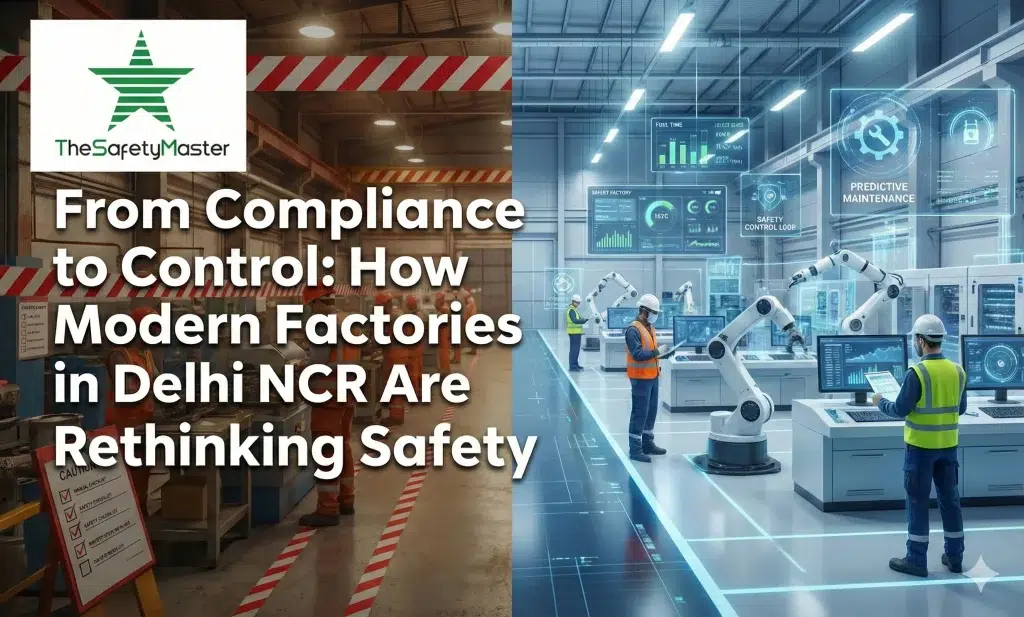
For years, factory safety in Delhi NCR followed a predictable pattern. A notice from the department arrives. Files come out. Audits are rushed. Gaps are temporarily patched. Once the inspection is over, things slowly drift back to old habits. On paper, compliance looks fine. On the shop floor, risks quietly build up.
That approach no longer works.
Manufacturing hubs across Gurugram, Noida, and Faridabad are facing tighter enforcement, higher production pressures, complex machinery, and a workforce that often includes contractors, third-party operators, and rotating shifts. One incident is now enough to trigger shutdowns, legal exposure, insurance scrutiny, and long-term brand damage. As a result, forward-looking factories are moving away from checklist-driven compliance and toward something far more practical: control.
At The Safety Master, we see this shift every day. Safety is no longer about satisfying auditors. It is about owning risk, managing human behavior, and building systems that work even when supervision is not present.
Why Compliance Alone Is Failing Modern Factories
Compliance focuses on minimum requirements. Control focuses on real conditions.
In many NCR factories, statutory registers are updated on time, permits exist, and SOPs are displayed. Yet incidents still happen. Machines are bypassed for speed. Electrical panels remain overloaded. Fire exits are blocked during peak production. Contractors follow their own methods. These are not documentation problems. They are operational blind spots.
The core issue is that compliance checks outcomes, while control manages inputs. Control asks harder questions. Who is actually operating this machine? What happens when production targets clash with safety rules? How does behavior change during night shifts or seasonal demand spikes?
Factories that rely only on compliance respond after something goes wrong. Factories that move toward control prevent those situations from forming in the first place.
The Rise of Risk Ownership in Delhi NCR Manufacturing
One noticeable trend across auto and machinery plants in Delhi NCR is the shift of safety responsibility upward. Earlier, safety was seen as the job of the EHS officer alone. Today, plant heads, production managers, and maintenance leaders are being pulled directly into safety decision-making.
This is not idealism. It is necessity.
When leadership owns risk, safety stops being an interruption and becomes part of operational planning. Maintenance shutdowns are scheduled before failures. Permit-to-work systems are enforced because supervisors are accountable, not because forms exist. Contractor onboarding includes safety expectations, not just commercial terms.
This mindset shift is what separates factories that manage safety from those that merely document it.
From Reactive Audits to Continuous Oversight
Traditional audits are periodic. Risk is continuous.
Factories that depend only on annual or pre-inspection audits often discover the same gaps repeatedly. Machine guarding removed. Lockout procedures ignored. Fire systems maintained on paper but not tested under load. These issues resurface because no one is tracking them beyond the audit date.
Modern factories are now using audits as diagnostic tools, not finish lines. A well-structured Safety Audit Service becomes the starting point for corrective action plans, ownership matrices, and follow-up reviews tied to production leadership.
Instead of asking “Are we compliant today?”, they ask “Are we safer this quarter than the last one?”
That question changes behavior across departments.
Human Behavior: The Hardest Risk to Control
Machines fail in predictable ways. People do not.
One of the most underestimated risks in manufacturing is normalized deviation. Workers take shortcuts not because they are careless, but because unsafe practices slowly become routine. When shortcuts do not immediately cause harm, they start to feel acceptable.
This is where behavior-focused safety becomes critical. Structured Behavior-Based Safety Training helps factories identify unsafe acts, understand why they occur, and correct them without blame or punishment.
In Delhi NCR plants, we often find that accidents are not caused by lack of knowledge. They are caused by pressure, fatigue, incentives, and weak supervision. Behavior-based programs bring these factors into the open and align safety with real working conditions, not ideal ones.
Factories that invest here see fewer repeat incidents and stronger safety ownership at the shop-floor level.
Process Safety Is No Longer Optional
As machinery becomes more automated and production volumes increase, process-related risks grow in complexity. Chemical usage, energy isolation, pressure systems, and material handling introduce hazards that cannot be managed through experience alone.
Leading manufacturers are now investing in structured process risk studies. HAZOP Training equips engineering and operations teams to systematically identify deviations, assess consequences, and design safeguards before incidents occur.
This is especially relevant for machinery-intensive plants where one failure can cascade across multiple systems. Process safety thinking moves factories from reactive troubleshooting to proactive design control.
It also strengthens regulatory confidence, because risks are addressed at the system level, not just through procedural fixes.
Fire Safety: The Risk Most Factories Underestimate
Fire risk in NCR factories is often misunderstood. Many assume that having extinguishers and hydrants is enough. In reality, fire incidents escalate due to poor layout planning, blocked access, inadequate detection, or electrical overloads that go unnoticed.
A comprehensive Fire Safety Audit goes far beyond equipment presence. It evaluates evacuation routes, fire load, emergency response readiness, electrical segregation, and coordination with local response agencies.
Factories that take fire risk seriously do not wait for an incident to test their systems. They test them under realistic conditions, identify failure points, and correct them before lives and assets are at stake.
Emergency Preparedness as an Operational Capability
Emergency response plans are often created to satisfy regulations. Control-driven factories treat them as operational capabilities.
This means regular drills, clear role assignments, communication protocols that work under stress, and coordination with external responders. In NCR’s dense industrial clusters, one incident can affect neighboring units within minutes. Preparedness is not just internal. It is collective.
Factories that practice response scenarios are faster, calmer, and more effective when real emergencies occur. That confidence alone reduces panic-driven errors.
Technology as an Enabler, Not a Replacement
Digital tools are increasingly used for permits, incident reporting, and contractor tracking. But technology only works when processes are clear and discipline is enforced.
Modern factories in Delhi NCR are careful not to treat software as a shortcut. They use it to strengthen accountability, visibility, and follow-up. Data highlights trends. Leadership acts on them. That loop is what creates control.
Without ownership, even the best systems fail.
How The Safety Master Supports This Shift
At The Safety Master, our work with manufacturing clients is built around one principle: safety must function under real production pressure. We do not design systems that look good only during audits. We design systems that hold up on busy shop floors, during peak demand, and across multiple shifts.
Our approach integrates audits, training, behavioral programs, process safety, and emergency preparedness into a single control framework. This allows factories to move beyond reactive compliance and toward sustained risk management.
The factories that succeed in this transition share one trait. They stop asking what the law requires and start asking what reality demands.
The Way Forward for NCR Manufacturers
Delhi NCR’s manufacturing landscape is evolving fast. Regulatory scrutiny is increasing. Skilled labor is harder to retain. Customers expect uninterrupted supply. In this environment, safety cannot remain a background function.
Factories that treat safety as control gain stability, credibility, and resilience. Those that cling to compliance-only thinking will continue to firefight incidents and explanations.
The choice is no longer theoretical. It is operational.
Control is not more paperwork. It is clarity, ownership, and discipline applied where it matters most. That is the future of manufacturing safety in Delhi NCR.