Compliance Is Easy. Consistency Is Hard — Why Most Safety Systems Fail After the Audit

Built for Real Operations, Not Just Audits
May 4, 2026
Hazard Identification vs Risk Assessment: Key Differences Explained Clearly
May 8, 2026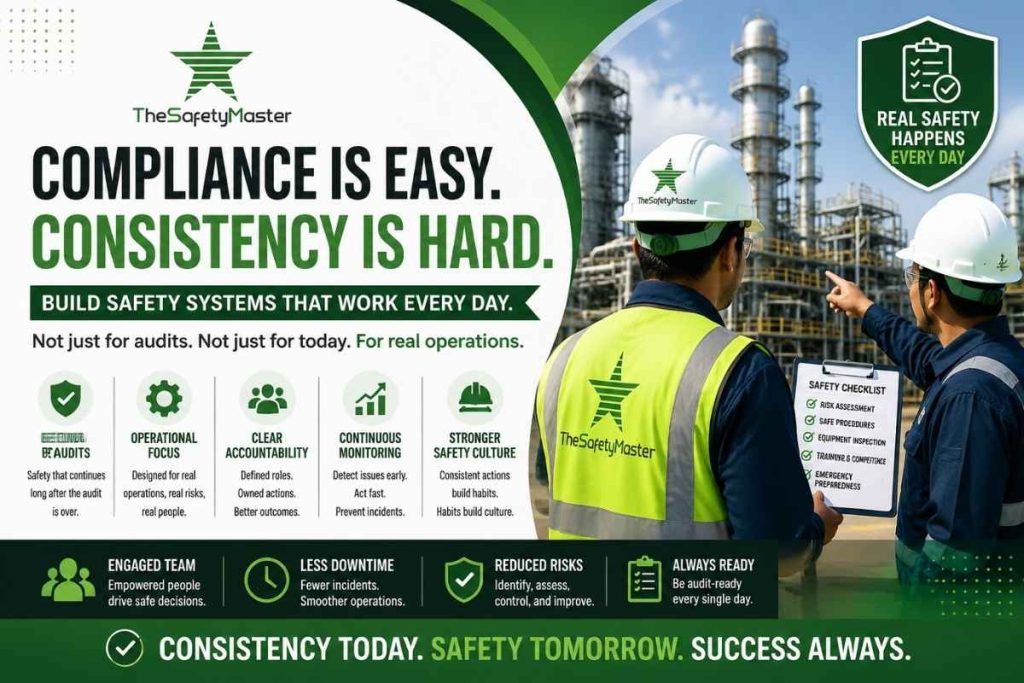
Most organizations can achieve compliance for a day.
The real challenge is staying compliant every day.
That’s the difference between temporary safety and operational safety. One works during inspections. The other works during actual operations, under pressure, across shifts, and without constant reminders.
And this is where most companies struggle.
They invest heavily before audits, fix visible gaps, update documents, and train teams temporarily. But after the audit is over, things slowly start slipping:
- Procedures stop being followed consistently
- Risk controls weaken over time
- Unsafe shortcuts become normal
- Monitoring becomes irregular
Compliance is easy because it is event-based.
Consistency is difficult because it requires systems.
Why Audit-Driven Safety Never Lasts
Many companies unknowingly build safety systems around inspections instead of operations.
The pattern is common:
- Audit date approaches
- Teams rush to prepare documents
- Corrective actions are implemented quickly
- Compliance improves temporarily
- Everything slows down again after the audit
This creates a false sense of safety.
The problem is that risks don’t operate according to audit schedules. Machines continue running. Processes continue changing. Human error continues happening.
If your safety system becomes weak the moment external pressure disappears, then it was never strong to begin with.
Real Safety Is About Daily Control
A strong safety system is not dependent on inspections or reminders.
It works because:
- Processes are clear
- Responsibilities are defined
- Monitoring is continuous
- Teams understand the importance of controls
That’s what consistency looks like.
Consistency means safety is built into operations, not added before audits.
The Gap Between Documentation and Ground Reality
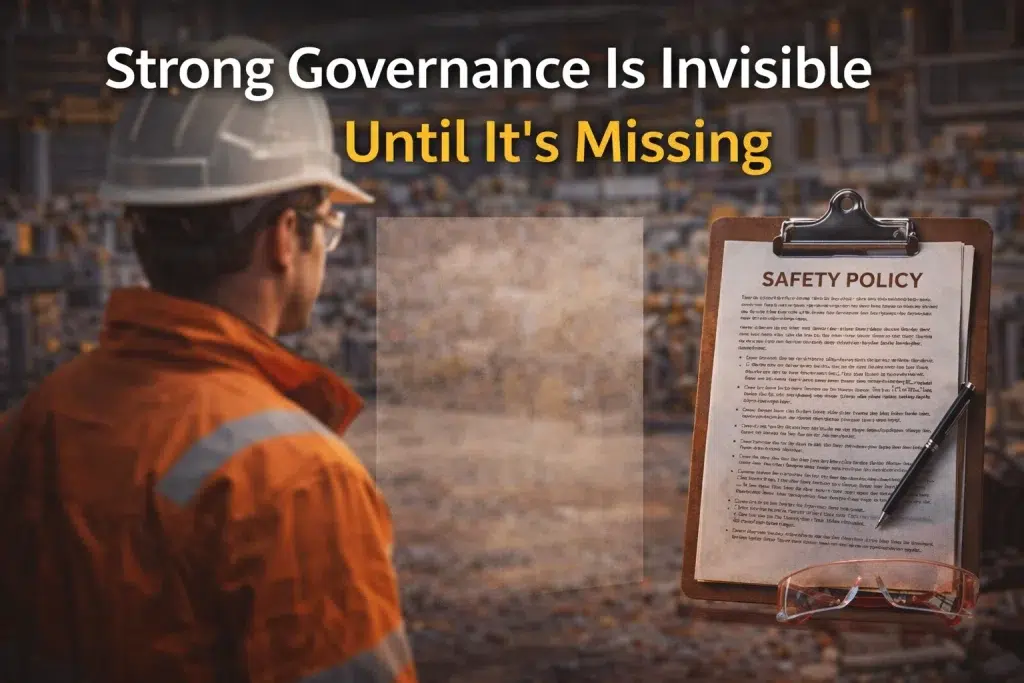
One of the biggest issues in industrial safety is the disconnect between what is documented and what actually happens on the ground.
On paper:
- SOPs look complete
- Safety procedures are approved
- Risk assessments are available
But in reality:
- Teams skip steps to save time
- Unsafe workarounds become common
- Controls are bypassed during operational pressure
This gap is dangerous because incidents usually happen in the space between written procedures and real behavior.
A practical safety system closes that gap.
Why Systems Matter More Than Effort
Most organizations rely too much on manual effort:
- Repeated follow-ups
- Constant supervision
- Continuous reminders
That approach is exhausting and unsustainable.
Strong systems reduce dependency on supervision by creating structured workflows that teams naturally follow.
This includes:
- Clear operational procedures
- Defined accountability
- Real-time reporting
- Consistent monitoring mechanisms
When systems are strong, safety becomes predictable instead of reactive.
Identifying Risks Before They Become Incidents
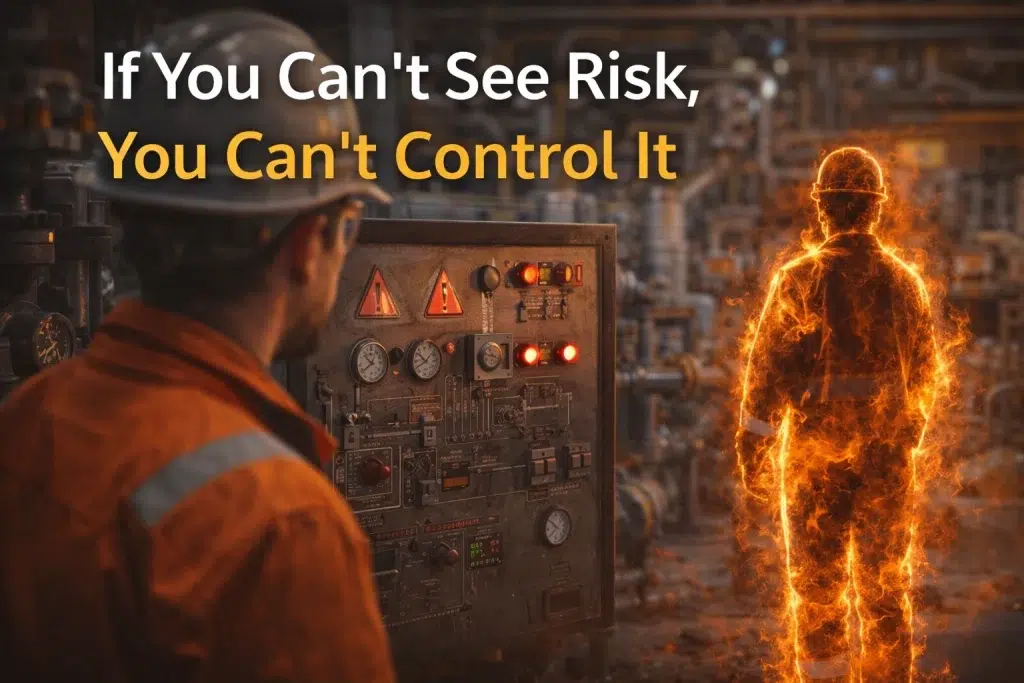
You cannot maintain consistency if risks are not identified properly.
That’s why structured frameworks like HIRA are critical. They help organizations systematically identify hazards, assess risks, and prioritize controls before incidents occur.
But many companies make one major mistake.
They conduct risk assessments once and never revisit them.
Real operations change constantly:
- New equipment gets added
- Teams change
- Processes evolve
- Production pressure increases
Risk assessments must evolve too.
Consistency comes from continuous evaluation, not one-time analysis.
Process-Level Safety Is Often Ignored
Most organizations focus heavily on visible safety issues:
- PPE compliance
- Housekeeping
- Signage
- General inspections
These are important, but they are not enough.
Major industrial incidents often come from process failures, not surface-level issues.
That’s where advanced approaches like HAZOP Training become essential. They help teams understand process deviations, hidden hazards, and operational vulnerabilities that are often missed during routine inspections.
Without deeper process understanding, companies remain exposed to serious risks even when basic compliance looks strong.
Fire Safety Requires Consistency Too
Fire safety is another area where companies often focus only on compliance.
Fire extinguishers are installed.
Emergency exits are marked.
Basic documentation is maintained.
But during an actual emergency, weaknesses become visible:
- Equipment is not maintained properly
- Teams are unprepared
- Evacuation procedures are unclear
- Response times are delayed
A proper Fire Audit evaluates whether fire protection systems actually work under real conditions.
But again, audits alone are not enough.
The real value comes from:
- Continuous maintenance
- Regular drills
- Ongoing monitoring
- Immediate corrective actions
Consistency is what keeps systems functional.
Why Accountability Is the Missing Link
Here’s the uncomfortable truth.
Most safety systems fail because accountability is weak.
When safety responsibilities are vague:
- Tasks get delayed
- Issues remain unresolved
- Teams assume someone else will handle it
Strong systems define:
- Who is responsible
- What actions are required
- How performance is measured
This creates ownership instead of dependency.
Without accountability, consistency disappears quickly.
Safety Culture Is Built Through Repetition
Many organizations talk about safety culture, but very few understand how it is actually built.
Culture is not created through posters or slogans.
It is created when:
- Teams repeatedly follow safe practices
- Leaders consistently enforce standards
- Systems support correct behavior every day
Consistency creates habits.
Habits create culture.
If safety standards change depending on pressure, deadlines, or audits, the culture will never become stable.
The Operational Benefits of Consistent Safety
Consistency does more than improve compliance.
It improves operations.
Reduced Incidents
Risks are identified and controlled early.
Less Downtime
Fewer disruptions mean smoother production.
Better Productivity
Structured systems improve operational flow.
Stronger Workforce Confidence
Employees work better when systems are reliable and predictable.
Audit Readiness at All Times
You stop preparing for audits because your systems stay prepared.
Common Reasons Consistency Fails
Even companies with strong intentions struggle because of:
- Overcomplicated procedures
- Poor implementation
- Lack of follow-through
- Inconsistent supervision
- Weak communication between departments
These gaps slowly weaken the system over time.
And the dangerous part is that deterioration often happens quietly.
What Real Safety Leadership Looks Like
Real safety leadership is not about reacting after incidents.
It’s about creating systems that prevent issues before they happen.
This requires:
- Long-term commitment
- Operational involvement
- Clear accountability
- Continuous monitoring
Most importantly, it requires consistency even when no one is watching.
The Bottom Line
Compliance is temporary.
Consistency is operational.
Any company can prepare for an audit. The real challenge is maintaining the same standards every single day, across every team, under every condition.
That’s what separates paper safety from real safety.
If you want a system that actually works, focus less on passing inspections and more on building operational consistency.
Because safety failures rarely happen during audits.
They happen during normal working days when systems stop being followed consistently.