Process Safety Management Implementation Guide

Fire Safety Audit Checklist: Key Areas Every Facility Must Inspect
June 29, 2026
How a Behavior-Based Safety Consultant Can Reduce Unsafe Actions and Create a Stronger Safety Culture at Work
July 3, 2026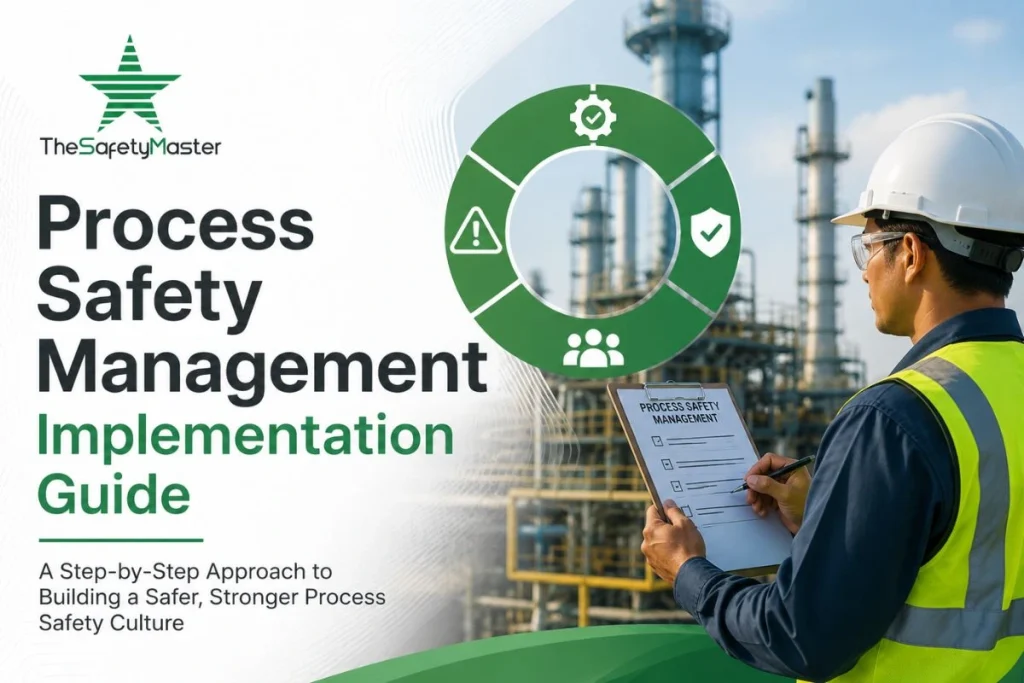
Process Safety Management Implementation is one of the most important steps for industries that work with hazardous chemicals, high-pressure systems, flammable materials, or complex manufacturing processes. A well-planned implementation strategy helps organizations prevent accidents, protect employees, reduce financial losses, and meet regulatory requirements. Industries such as oil & gas, chemicals, pharmaceuticals, power plants, manufacturing, and food processing all benefit from an effective Process Safety Management (PSM) system.
A successful Process Safety Management Implementation is more than preparing documents or following legal requirements. It requires strong leadership, employee participation, hazard identification, risk assessment, continuous monitoring, and regular improvement. Organizations that adopt a structured PSM program build a safer workplace while improving operational efficiency and business continuity. International frameworks such as OSHA’s PSM standard and CCPS’s Risk Based Process Safety provide widely accepted guidance for implementing comprehensive process safety systems.
What is Process Safety Management?
Process Safety Management (PSM) is a systematic approach to managing hazards associated with industrial processes involving hazardous substances. Unlike occupational safety, which focuses on individual worker injuries, PSM focuses on preventing catastrophic incidents that could affect entire facilities, nearby communities, and the environment.
A Process Safety Management system aims to:
- Prevent chemical releases
- Reduce fire and explosion risks
- Control hazardous energy
- Improve operational reliability
- Protect employees and surrounding communities
- Ensure regulatory compliance
Industries implementing PSM experience fewer incidents, lower operational risks, and improved productivity through better control of critical processes.
Why is Process Safety Management Implementation Important?
Implementing Process Safety Management provides several long-term benefits.
Improved Employee Safety
Employees work in a safer environment where hazards are identified before they become serious incidents.
Reduced Operational Risks
Risk identification and preventive maintenance reduce unexpected failures and costly shutdowns.
Regulatory Compliance
Many countries require organizations handling hazardous chemicals to comply with process safety regulations.
Better Asset Protection
Proper maintenance and monitoring increase equipment life and reduce repair costs.
Enhanced Business Reputation
Organizations with strong safety records earn greater trust from customers, regulators, investors, and employees.
Industries That Need Process Safety Management
Process Safety Management is essential for industries handling hazardous processes, including:
- Oil & Gas
- Petrochemical Plants
- Chemical Manufacturing
- Pharmaceutical Industries
- Fertilizer Plants
- Food Processing
- Power Generation
- LNG Facilities
- Refineries
- Steel Plants
- Paper Mills
- Paint Manufacturing
- Mining Operations
Core Elements of Process Safety Management Implementation
1. Leadership Commitment
Senior management must actively support safety initiatives.
Leadership should:
- Allocate safety budgets
- Define safety objectives
- Promote accountability
- Encourage reporting of hazards
- Monitor implementation progress
Without management commitment, even the best-designed PSM program cannot succeed.
2. Process Safety Information (PSI)
Every organization should maintain complete and updated documentation regarding:
- Process flow diagrams
- Piping and Instrumentation Diagrams (P&IDs)
- Equipment specifications
- Chemical properties
- Material Safety Data Sheets
- Operating limits
- Design basis documents
Accurate information becomes the foundation of every safety decision.
3. Hazard Identification and Risk Assessment (HIRA)
Before implementing controls, organizations must understand potential hazards.
Common techniques include:
HAZOP Study
Used to identify deviations in process operations.
What-If Analysis
Examines possible failure scenarios.
FMEA
Analyzes equipment failure modes.
Bow Tie Analysis
Visualizes causes, controls, and consequences.
Layer of Protection Analysis (LOPA)
Evaluates the effectiveness of existing safety barriers.
Risk assessments help prioritize corrective actions based on severity and likelihood.
4. Standard Operating Procedures
Clear operating procedures ensure employees perform tasks safely and consistently.
Procedures should include:
- Startup
- Normal operation
- Emergency shutdown
- Emergency response
- Maintenance
- Isolation procedures
- Temporary operations
These procedures should be reviewed regularly and updated whenever changes occur.
5. Employee Training
Training plays a major role in Process Safety Management Implementation.
Employees should receive training on:
- Process hazards
- Emergency response
- Safe operating procedures
- Lockout/Tagout
- Permit to Work
- Incident reporting
- Management of Change
Regular refresher programs help maintain competency.
6. Mechanical Integrity
Equipment failures often lead to major industrial accidents.
Mechanical integrity programs include:
- Preventive maintenance
- Predictive maintenance
- Inspection schedules
- Equipment testing
- Calibration
- Corrosion monitoring
Reliable equipment improves both safety and production efficiency.
7. Management of Change (MOC)
Industrial processes constantly evolve.
Changes may involve:
- Equipment
- Raw materials
- Operating conditions
- Software
- Personnel
- Procedures
Every change should undergo a structured review before implementation to prevent introducing new hazards.
8. Contractor Safety Management
Contractors often perform high-risk activities inside industrial facilities.
Organizations should ensure:
- Contractor qualification
- Safety induction
- Competency verification
- Permit compliance
- Performance monitoring
Effective contractor management significantly reduces incident risks.
9. Emergency Preparedness
Despite preventive measures, emergencies may still occur.
Emergency planning should include:
- Fire response
- Chemical spill response
- Gas leak management
- Evacuation plans
- Emergency communication
- Mock drills
- Medical response
Regular drills improve readiness and reduce panic during actual emergencies.
10. Incident Investigation
Every incident—even near misses—provides valuable learning opportunities.
Investigation should identify:
- Root causes
- Immediate causes
- Human factors
- System failures
- Corrective actions
- Preventive measures
Organizations that learn from incidents continuously improve their safety performance.
Step-by-Step Process Safety Management Implementation Guide
Step 1: Assess Current Safety Performance
Evaluate:
- Existing policies
- Incident history
- Compliance status
- Documentation
- Employee competency
This establishes a baseline for improvement.
Step 2: Identify Process Hazards
Perform comprehensive risk assessments using appropriate methodologies.
Step 3: Develop PSM Documentation
Prepare:
- SOPs
- Emergency plans
- Inspection procedures
- Risk registers
- Safety manuals
- Training records
Step 4: Train Employees
Ensure everyone understands:
- Process hazards
- Operating procedures
- Emergency actions
- Reporting requirements
Step 5: Implement Engineering Controls
Install or improve:
- Safety Instrumented Systems (SIS)
- Pressure relief systems
- Gas detection systems
- Fire protection systems
- Alarm systems
Step 6: Conduct Audits
Regular audits verify compliance and identify improvement opportunities.
Audits should review:
- Documentation
- Equipment
- Employee practices
- Maintenance records
- Emergency preparedness
Step 7: Continuous Improvement
A PSM program should evolve continuously through:
- Performance indicators
- Incident reviews
- Audit findings
- Employee feedback
- Technology upgrades
Common Challenges During Process Safety Management Implementation
Organizations often face several obstacles.
Lack of Management Support
Without leadership commitment, implementation becomes difficult.
Poor Documentation
Incomplete process information weakens hazard analysis.
Employee Resistance
Workers may resist new procedures without proper communication.
Inadequate Training
Insufficient competency leads to operational errors.
Budget Constraints
Safety investments are sometimes delayed despite long-term benefits.
Weak Safety Culture
Employees may hesitate to report hazards or near misses.
Recognizing these challenges early helps organizations create practical solutions.
Best Practices for Successful Process Safety Management Implementation
Successful organizations typically follow these practices:
- Build a strong safety culture
- Involve employees at every level
- Conduct regular HAZOP studies
- Maintain updated documentation
- Perform periodic audits
- Review Management of Change procedures
- Encourage near-miss reporting
- Monitor key performance indicators
- Invest in employee competency
- Continuously improve the system
Role of Digital Technologies in Process Safety Management
Modern industries increasingly use digital tools for PSM.
Examples include:
- Digital inspection systems
- Risk management software
- Predictive maintenance
- IoT sensors
- AI-based monitoring
- Cloud documentation
- Mobile inspection apps
- Real-time dashboards
These technologies improve visibility and support faster decision-making.
How Professional Consultants Help
Experienced Process Safety consultants provide:
- Gap assessments
- HAZOP facilitation
- Risk assessment
- Compliance audits
- Training programs
- Emergency planning
- Documentation support
- Safety culture development
Working with experienced specialists helps organizations implement internationally accepted best practices while reducing implementation time.
Conclusion
A successful Process Safety Management Implementation protects people, equipment, the environment, and business operations. It is not a one-time project but an ongoing management system that requires leadership commitment, employee involvement, continuous monitoring, regular audits, and continuous improvement. Organizations that invest in effective Process Safety Management Implementation reduce operational risks, improve regulatory compliance, strengthen business resilience, and create a safer workplace for everyone. Following recognized Process Safety Management frameworks and partnering with experienced safety professionals can help industries build sustainable safety systems that support long-term operational excellence.