Hazard Identification vs Risk Assessment: Key Differences Explained Clearly

Compliance Is Easy. Consistency Is Hard — Why Most Safety Systems Fail After the Audit
May 6, 2026
Types of Hazards Identified During HIRA Studies
May 11, 2026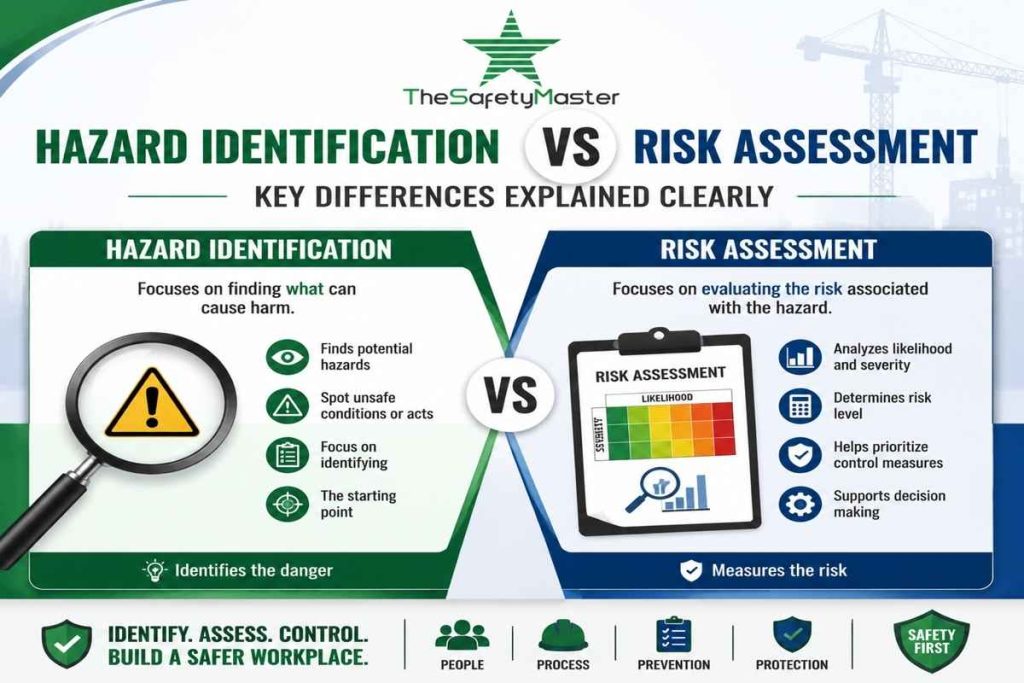
In workplace safety discussions, the terms hazard identification and risk assessment are often used together. While they are closely connected, they are not the same thing. Many people assume both terms mean identifying dangers at work, but each process serves a different purpose. Understanding the difference is important because confusion between the two can lead to incomplete safety planning and ineffective control measures.
In simple terms, hazard identification focuses on finding what can cause harm, while risk assessment evaluates how serious that harm could be and how likely it is to happen. Both are essential parts of an effective safety management system and work best when used together.
What is Hazard Identification?
Hazard identification is the process of recognizing anything in the workplace that has the potential to cause injury, illness, damage, or environmental impact. The main objective is to detect unsafe conditions, unsafe acts, or dangerous situations before they lead to incidents.
Hazards can exist in almost every industry. In manufacturing plants, hazards may include moving machinery, electrical exposure, or chemical handling. In construction, working at heights, falling objects, and heavy equipment are common hazards. Office environments may also contain hazards such as poor ergonomics, electrical overloads, or fire risks.
The key point is that hazard identification only focuses on spotting the source of danger. At this stage, the process does not evaluate how severe the danger is or how likely it is to occur.
For example:
- A wet floor is a hazard.
- Exposed wiring is a hazard.
- A leaking chemical container is a hazard.
- Lack of emergency exits is a hazard.
Identifying these conditions early allows organizations to take preventive action before accidents happen.
What is Risk Assessment?
Risk assessment begins after hazards have been identified. It is the process of analyzing the identified hazards to determine the level of risk associated with them.
This involves evaluating two major factors:
- The likelihood of the hazard causing harm
- The severity of the consequences if the incident occurs
Risk assessment helps organizations prioritize which hazards require immediate attention and which can be managed with standard controls.
For example, a wet floor in a low-traffic storage room may present a lower risk compared to a wet floor near a busy staircase. The hazard is the same, but the risk level changes depending on exposure, frequency, and possible consequences.
Similarly, exposed wiring in an isolated area may be categorized differently from exposed wiring in a public workspace where multiple workers are present daily.
The purpose of risk assessment is not just to identify danger but to understand the impact of that danger in real working conditions.
The Main Difference Between Hazard Identification and Risk Assessment
The easiest way to understand the difference is this:
- Hazard identification asks: “What can cause harm?”
- Risk assessment asks: “How serious is the harm, and how likely is it to happen?”
Hazard identification is the starting point. Risk assessment is the evaluation stage that follows.
Without hazard identification, there is nothing to assess. Without risk assessment, organizations cannot determine which hazards require urgent control measures.
Both processes depend on each other and form the foundation of structured workplace safety practices such as HIRA.
Why Both Processes Matter Together
Many workplaces make the mistake of focusing only on identifying hazards without properly assessing the associated risks. This often leads to long hazard lists without clear priorities.
For instance, a facility may identify dozens of workplace hazards during inspections, but unless those hazards are evaluated based on risk level, resources may be wasted on low-priority issues while critical dangers remain uncontrolled.
On the other hand, attempting risk assessment without proper hazard identification creates gaps because some hazards may never be evaluated at all.
An effective safety system combines both approaches to ensure that hazards are identified systematically and risks are managed practically.
Common Techniques Used for Hazard Identification
Several methods are commonly used to identify hazards in workplaces:
Workplace Inspections
Regular inspections help detect unsafe conditions such as damaged equipment, blocked exits, poor housekeeping, or missing guards.
Safety Observations
Monitoring worker behavior and operational practices helps identify unsafe acts or procedural gaps.
Incident Investigation
Past incidents and near-misses provide valuable information about hazards that may already exist in the system.
Checklists
Industry-specific safety checklists help ensure that critical hazards are not overlooked during inspections.
Process Reviews
In industries like oil and gas or chemical processing, structured methods taught during HAZOP Training are used to identify deviations and process hazards that may not be visible during normal operations.
Common Techniques Used for Risk Assessment
Once hazards are identified, different tools are used to evaluate the level of risk.
Risk Matrix
A risk matrix evaluates hazards based on likelihood and severity. It helps categorize risks into low, medium, high, or critical levels.
Job Safety Analysis (JSA)
JSA breaks tasks into steps and evaluates risks associated with each stage of the job.
Failure Mode and Effects Analysis (FMEA)
FMEA focuses on possible equipment or process failures and assesses their impact on operations and safety.
Quantitative Risk Assessment
This method uses numerical data and probability calculations to estimate potential consequences in high-risk industries.
These tools help organizations make informed decisions rather than relying on assumptions.
Real-World Example to Understand the Difference
Imagine a warehouse operation.
During inspection, the safety team notices that forklift operators are driving in pedestrian walkways. This is hazard identification because the unsafe condition has been recognized.
The next step is risk assessment. The team evaluates:
- How often forklifts operate in that area
- How many workers use the walkway
- The likelihood of collision
- The possible severity of injuries
If the assessment shows a high probability of serious injury, immediate controls such as barricades, designated pathways, warning signs, or traffic management systems may be introduced.
This example shows how hazard identification detects the issue, while risk assessment determines its seriousness.
The Role of Fire Risk Evaluation
Fire safety is another area where both processes work together. Identifying hazards such as overloaded circuits, combustible materials, or blocked exits is only the first step.
A structured Fire Audit helps evaluate the level of fire risk, effectiveness of existing controls, emergency preparedness, and evacuation capabilities. This allows organizations to understand whether identified fire hazards can realistically lead to severe consequences.
Why Clear Understanding Improves Workplace Safety
Confusion between hazard identification and risk assessment often results in incomplete safety planning. When organizations clearly separate these processes, they build stronger control systems and make better safety decisions.
Hazard identification improves awareness by detecting dangerous conditions early. Risk assessment improves decision-making by evaluating which hazards pose the greatest threat.
Together, these processes help reduce incidents, improve operational reliability, and create safer working environments across industries.
Conclusion
Hazard identification and risk assessment are connected but fundamentally different processes. Hazard identification focuses on finding potential sources of harm, while risk assessment evaluates the likelihood and severity of those hazards. One identifies the danger, and the other measures its impact.
Organizations that understand this distinction are better equipped to prioritize safety actions, allocate resources effectively, and build more reliable risk management systems. Rather than treating safety as a checklist activity, combining both approaches creates a more practical and proactive way to manage workplace risks.