Integrating BBS Implementation with Process Safety Programs for Better Risk Control and Operational Excellence

HAZOP Study: Step-by-Step Process, Examples, Guide Words & Real Industry Applications
July 6, 2026
Ammonia Storage Safety Case Study: Preventing a Major Leak Through Early Detection and Emergency Response
July 10, 2026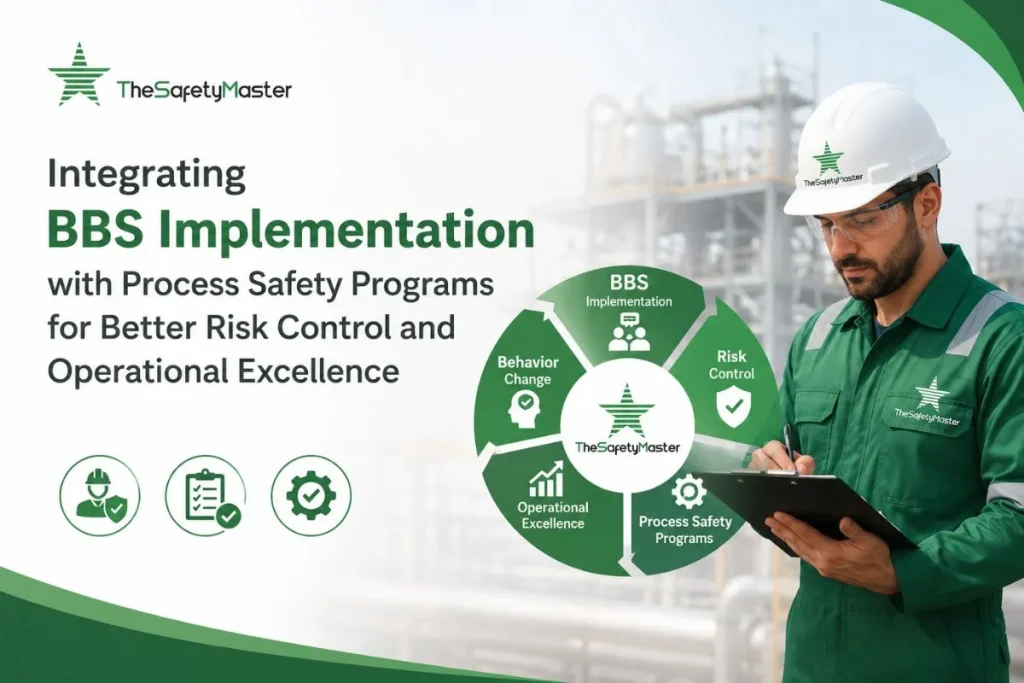
Organizations operating in high-risk industries such as oil & gas, chemicals, pharmaceuticals, manufacturing, power plants, and infrastructure projects face complex safety challenges every day. While traditional safety programs focus on procedures, systems, and engineering controls, many incidents still occur due to human behavior. This is where BBS Implementation becomes a critical component of an effective safety management strategy.
A successful BBS Implementation helps organizations identify unsafe behaviors, encourage positive safety practices, and create a proactive safety culture. However, behavior-based safety alone cannot eliminate major accident hazards. To achieve long-term safety excellence, companies must integrate BBS with Process Safety Management (PSM) programs.
When both systems work together, organizations gain stronger risk control, improved workforce engagement, reduced incidents, and enhanced operational reliability. This integrated approach not only protects people but also safeguards assets, the environment, and business continuity.
What is BBS Implementation?
Understanding Behavior-Based Safety
BBS Implementation refers to the structured process of applying Behavior-Based Safety principles within an organization. It involves observing workplace behaviors, identifying unsafe actions, providing constructive feedback, and reinforcing safe practices.
The primary goal of BBS is to prevent incidents before they occur by addressing behaviors that may lead to accidents.
A well-planned BBS Implementation includes:
- Safety observations
- Employee participation
- Feedback mechanisms
- Behavioral data analysis
- Recognition of safe behaviors
- Continuous improvement initiatives
Unlike traditional safety programs that focus mainly on incidents after they occur, BBS encourages proactive intervention before an accident happens.
Why Organizations Need Both BBS and Process Safety
Many companies have excellent process safety systems but still experience incidents due to human errors. Similarly, some organizations focus heavily on behavior-based safety while overlooking critical process hazards.
The Missing Link
Process Safety Management focuses on:
- Hazard identification
- Risk assessment
- Engineering controls
- Equipment integrity
- Emergency planning
- Management of Change (MOC)
Behavior-Based Safety focuses on:
- Employee actions
- Safety habits
- Risk perception
- Compliance with procedures
- Workplace decision-making
The combination of these two approaches creates a stronger safety culture and significantly improves risk reduction.
Behaviour Based Safety is Most Effective When Combined With Process Safety Programs
Why Integration Matters
Behaviour based safety is most effective when combined with process safety programs
One of the most important principles in modern safety management is that behaviour based safety is most effective when combined with process safety programs.
Organizations often make the mistake of treating behavioral safety and process safety as separate initiatives. In reality, both are interconnected.
For example:
- Operators may bypass safety procedures.
- Maintenance personnel may ignore lockout-tagout requirements.
- Supervisors may overlook critical safety deviations.
Even the best engineering controls can fail when unsafe behaviors are present.
When organizations integrate BBS observations into process safety activities, they gain valuable insights into how employees interact with critical systems and procedures.
Key Benefits of Integration
Improved Risk Visibility
Behavioral observations help identify hidden risks before they become incidents.
Stronger Safety Culture
Employees become active participants in risk management.
Better Compliance
Workers are more likely to follow safety procedures consistently.
Reduced Human Error
Early intervention prevents unsafe actions from escalating into major incidents.
Behavior Based Safety Focuses on Observing and Intervening in Both Safe and Unsafe Behaviors
Understanding the Core Principle
Behavior based safety focuses on observing and intervening in both safe and unsafe behaviors
A common misconception is that BBS only identifies unsafe actions. In reality, behavior based safety focuses on observing and intervening in both safe and unsafe behaviors.
The objective is not to blame workers but to understand why behaviors occur and how they can be improved.
Safe Behaviors Include
- Wearing PPE correctly
- Following operating procedures
- Conducting pre-job safety checks
- Reporting near misses
- Participating in toolbox talks
Unsafe Behaviors Include
- Bypassing safety systems
- Ignoring warning signs
- Taking shortcuts
- Improper equipment handling
- Failure to report hazards
By observing both categories, organizations can reinforce positive behaviors while correcting unsafe practices before they result in incidents.
Role of BBS in Process Hazard Control
Connecting Human Behavior with Process Safety
Major incidents rarely occur because of equipment failure alone. Most catastrophic events involve some form of human error.
Examples include:
- Incorrect valve operation
- Unauthorized maintenance activities
- Failure to follow permit-to-work procedures
- Improper chemical handling
BBS observations help organizations identify behavioral factors contributing to process risks.
Real-World Impact
When behavioral observations are linked to process safety metrics, management gains a clearer understanding of:
- High-risk tasks
- Compliance gaps
- Training deficiencies
- Leadership effectiveness
This enables proactive risk management and continuous improvement.
A Behaviour Based Safety Program is Designed to Improve Workplace Safety Culture
Purpose of a BBS Program
A behaviour based safety program is designed to create proactive safety behaviors
Simply put, a behaviour based safety program is designed to identify, measure, and improve workplace behaviors that influence safety performance.
The program encourages employees to:
- Observe work activities
- Identify at-risk behaviors
- Provide positive feedback
- Recommend corrective actions
- Promote accountability
The ultimate objective is creating a workplace where safety becomes a shared responsibility.
Essential Components of a Successful BBS Program
Leadership Commitment
Without management support, BBS programs often fail to achieve lasting results.
Leaders must:
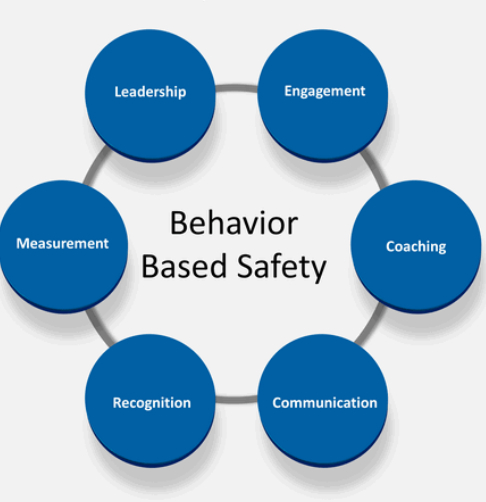
- Participate in observations
- Encourage reporting
- Recognize safe behaviors
- Remove barriers to safety
Employee Engagement
Employees should be active participants rather than passive recipients of safety rules.
Data Collection and Analysis
Observation data helps identify trends and prioritize corrective actions.
Continuous Feedback
Timely feedback encourages behavioral improvement and strengthens safety awareness.
In Behaviour Based Safety ABC Stands for Antecedent, Behavior, and Consequence
Understanding the ABC Model
In behaviour based safety ABC stands for Antecedent, Behavior, and Consequence
The ABC model is the foundation of Behavior-Based Safety.
In behaviour based safety ABC stands for:
| Element | Meaning |
|---|---|
| Antecedent | What triggers the behavior |
| Behavior | The action performed |
| Consequence | The result of that behavior |
Example
Antecedent
A worker receives instructions to perform maintenance.
Behavior
The worker skips the permit-to-work process.
Consequence
The task is completed faster, creating a perception that shortcuts save time.
This positive consequence may encourage future unsafe behaviors.
BBS programs analyze these patterns and introduce interventions that promote safe actions instead.
Integrating ABC Analysis into Process Safety
Organizations can use ABC analysis to identify behaviors affecting critical process safety barriers.
Examples include:
Permit-to-Work Compliance
Understanding why workers bypass permits.
Lockout-Tagout Procedures
Identifying factors leading to procedural violations.
Confined Space Entry
Analyzing behavioral drivers behind unsafe entries.
Chemical Handling
Understanding why employees may ignore handling protocols.
Integrating ABC analysis into process safety reviews helps organizations strengthen risk controls.
Steps for Effective BBS Implementation in Process Safety Programs
Step 1 – Define Critical Behaviors
Identify behaviors that directly impact process safety.
Examples:
- Isolation verification
- Equipment inspection
- Permit compliance
- Alarm response procedures
Step 2 – Develop Observation Checklists
Create standardized observation forms aligned with process safety requirements.
Step 3 – Train Observers
Train supervisors and employees to conduct objective observations.
Step 4 – Collect and Analyze Data
Track trends and identify recurring behavioral risks.
Step 5 – Implement Corrective Actions
Address root causes rather than blaming individuals.
Step 6 – Monitor Performance
Measure improvements using:
- Observation scores
- Near-miss reports
- Incident rates
- Process safety indicators
Common Challenges During BBS Implementation
Resistance to Change
Employees may initially view observations negatively.
Lack of Management Support
Without leadership involvement, participation declines.
Poor Data Utilization
Collecting observations without analysis reduces effectiveness.
Focus on Blame
Successful BBS programs emphasize learning and improvement rather than punishment.
Organizations that overcome these challenges achieve stronger safety performance and operational excellence.
Measuring Success of Integrated Safety Programs
Leading Indicators
- Number of safety observations
- Participation rates
- Corrective actions completed
- Training completion rates
Lagging Indicators
- Recordable incidents
- Lost-time injuries
- Process safety events
- Equipment damage incidents
Combining leading and lagging indicators provides a complete picture of safety performance.
Benefits of Integrating BBS and Process Safety
Reduced Incident Rates
Proactive behavioral interventions prevent accidents before they occur.
Enhanced Operational Reliability
Employees follow procedures more consistently.
Improved Employee Engagement
Workers become active contributors to safety improvement.
Better Regulatory Compliance
Organizations demonstrate stronger safety management systems.
Stronger Safety Culture
Safety becomes embedded in daily operations rather than being viewed as a separate program.
Conclusion
Modern organizations can no longer rely solely on engineering controls or compliance-based safety systems. Sustainable safety performance requires addressing both technical and human factors. A successful BBS Implementation provides the behavioral insights needed to strengthen process safety performance and reduce risk exposure.
Remember that behaviour based safety is most effective when combined with process safety programs, because it bridges the gap between safety systems and human actions. Since behavior based safety focuses on observing and intervening in both safe and unsafe behaviors, organizations gain a deeper understanding of workplace risks and opportunities for improvement.
Furthermore, a behaviour based safety program is designed to create positive behavioral change, enhance employee engagement, and build a proactive safety culture. Understanding that in behaviour based safety ABC stands for Antecedent, Behavior, and Consequence enables organizations to identify behavioral drivers and implement targeted interventions.
By integrating BBS with Process Safety Management, companies can achieve better risk control, operational excellence, workforce engagement, and long-term business sustainability.