HAZOP Study: Step-by-Step Process, Examples, Guide Words & Real Industry Applications

How a Behavior-Based Safety Consultant Can Reduce Unsafe Actions and Create a Stronger Safety Culture at Work
July 3, 2026
Integrating BBS Implementation with Process Safety Programs for Better Risk Control and Operational Excellence
July 8, 2026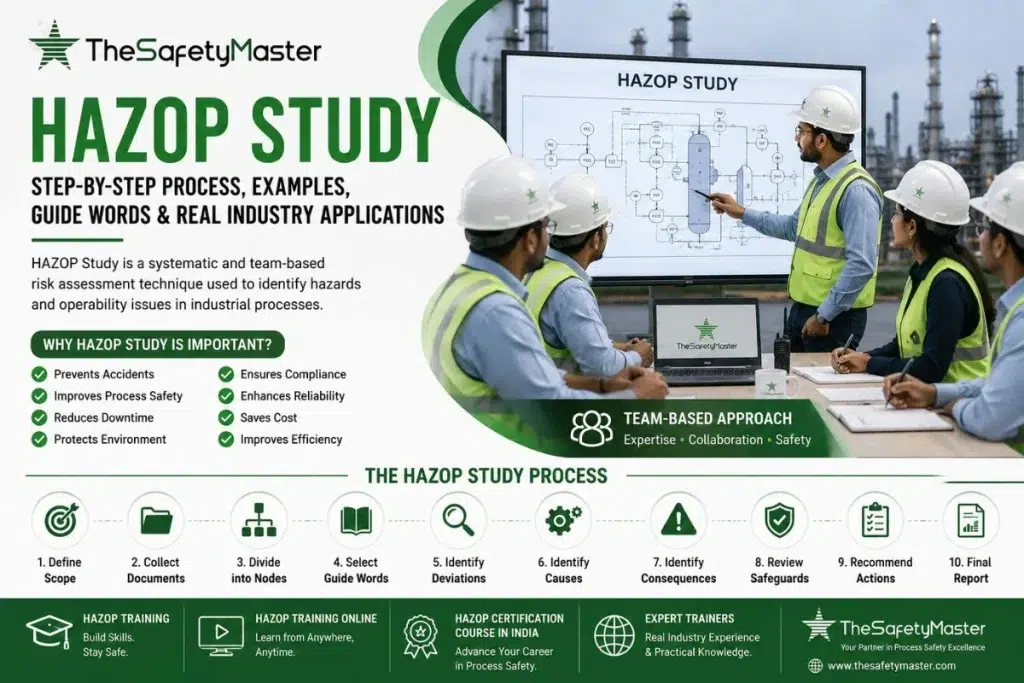
Process industries operate with complex equipment, hazardous chemicals, high temperatures, and high-pressure systems. Even a small deviation in operating conditions can lead to equipment failure, environmental damage, production losses, or serious accidents. This is why organizations across the oil and gas, chemical, pharmaceutical, power generation, and manufacturing sectors rely on the HAZOP study as one of the most effective risk assessment techniques.
A HAZOP study helps identify process hazards before incidents occur. It provides a systematic approach to evaluating process deviations, understanding their consequences, and implementing safeguards to reduce risks. Organizations worldwide use HAZOP to improve safety, reliability, and operational efficiency.
For safety professionals and engineers, gaining expertise through HAZOP Training is becoming increasingly important. With growing regulatory requirements and industry expectations, professionals are actively pursuing certification programs and specialized training courses to strengthen their process safety skills.
HAZOP Full Form and Meaning
The HAZOP full form is Hazard and Operability Study.
HAZOP is a structured and systematic risk assessment methodology developed to identify hazards and operational problems within industrial processes. The technique examines how deviations from intended operating conditions may occur and evaluates their potential consequences.
The methodology was originally developed by the chemical industry and is now widely applied across various sectors where process safety is critical.
The primary objective of a HAZOP study is to answer three key questions:
- What could go wrong?
- Why could it happen?
- What are the possible consequences and safeguards?
What is a HAZOP Study?
A HAZOP study is a team-based process hazard analysis technique used to identify potential risks associated with industrial processes.
The study involves a multidisciplinary team that systematically reviews process flow diagrams, piping and instrumentation diagrams, operating procedures, and process design information. Using predefined guide words, the team evaluates every part of the process to identify potential deviations from normal operation.
Unlike simple inspections, HAZOP follows a structured methodology that ensures no critical scenario is overlooked.
Industries commonly using HAZOP include:
- Chemical Processing
- Oil and Gas
- Petrochemical Plants
- Pharmaceutical Manufacturing
- Food Processing
- Water Treatment Facilities
- Power Plants
Why is HAZOP Important?
Industrial accidents often result from process deviations that were not identified during the design or operational phases.
A HAZOP study helps organizations:
- Prevent accidents and major incidents
- Improve process reliability
- Enhance worker safety
- Meet regulatory compliance requirements
- Reduce operational downtime
- Protect assets and the environment
Organizations implementing regular HAZOP reviews often experience improved process performance and reduced incident rates.
Step-by-Step HAZOP Study Process
Step 1: Define the Scope
The first step is determining the process area, system, or operation that will be reviewed.
The scope may include:
- New process designs
- Existing plant modifications
- Operational changes
- Entire production units
Clearly defining the scope ensures the study remains focused and effective.
Step 2: Assemble the HAZOP Team
A successful HAZOP requires a multidisciplinary team that may include:
- Process Engineers
- Operations Personnel
- Maintenance Engineers
- Instrumentation Specialists
- Safety Professionals
- HAZOP Facilitator
Each team member contributes unique expertise to identify potential hazards.
Step 3: Divide the Process into Nodes
The process is divided into manageable sections known as nodes.
Examples include:
- Storage Tanks
- Pumps
- Reactors
- Heat Exchangers
- Pipelines
Each node is reviewed separately.
Step 4: Apply Guide Words
Guide words are used to identify deviations from intended operating conditions.
Examples include:
- No
- More
- Less
- Reverse
- As Well As
- Other Than
These guide words stimulate discussion and help uncover hidden risks.
Step 5: Identify Causes and Consequences
The team determines:
- Possible causes
- Potential consequences
- Existing safeguards
This allows a complete understanding of risk scenarios.
Step 6: Recommend Actions
Additional safeguards may be recommended to reduce risk.
Examples include:
- Alarm Systems
- Interlocks
- Procedure Updates
- Operator Training
- Equipment Modifications
Step 7: Document and Follow Up
All findings, recommendations, and responsibilities are documented and tracked until completion.
HAZOP Guide Words Explained
Guide words are the foundation of every HAZOP study.
No
Complete absence of a parameter.
Example:
No flow in a transfer line due to pump failure.
More
Higher than intended value.
Example:
More pressure inside a reactor vessel.
Less
Lower than intended value.
Example:
Less cooling water flow.
Reverse
Opposite direction of intended operation.
Example:
Reverse flow in a pipeline.
Other Than
Unexpected material or condition.
Example:
Contamination entering a process stream.
Guide words encourage systematic thinking and improve hazard identification accuracy.
HAZOP Study Example
Consider a chemical reactor operating at a design temperature of 120°C.
The team applies the guide word “More” to temperature.
Deviation:
More Temperature
Cause:
Cooling system failure
Consequence:
Runaway reaction, pressure increase, equipment damage
Existing Safeguards:
Temperature alarms and emergency shutdown system
Recommendation:
Install redundant cooling pumps and enhance monitoring.
This example demonstrates how HAZOP helps identify hazards before incidents occur.
Real Industry Applications of HAZOP
Oil and Gas Industry
HAZOP is extensively used during refinery design, pipeline operations, and offshore platform projects.
Chemical Manufacturing
Chemical plants use HAZOP to identify reaction hazards and process deviations.
Pharmaceutical Industry
Manufacturers apply HAZOP to maintain product quality and process safety.
Power Generation
Power plants use HAZOP to evaluate boiler systems, fuel handling, and turbine operations.
Water Treatment Facilities
HAZOP helps identify risks associated with chemical dosing systems and treatment processes.
Benefits of HAZOP Study
Organizations implementing HAZOP experience several advantages.
These include:
- Better risk management
- Improved operational safety
- Reduced equipment failures
- Increased productivity
- Regulatory compliance
- Enhanced decision-making
HAZOP also strengthens an organization’s overall process safety culture.
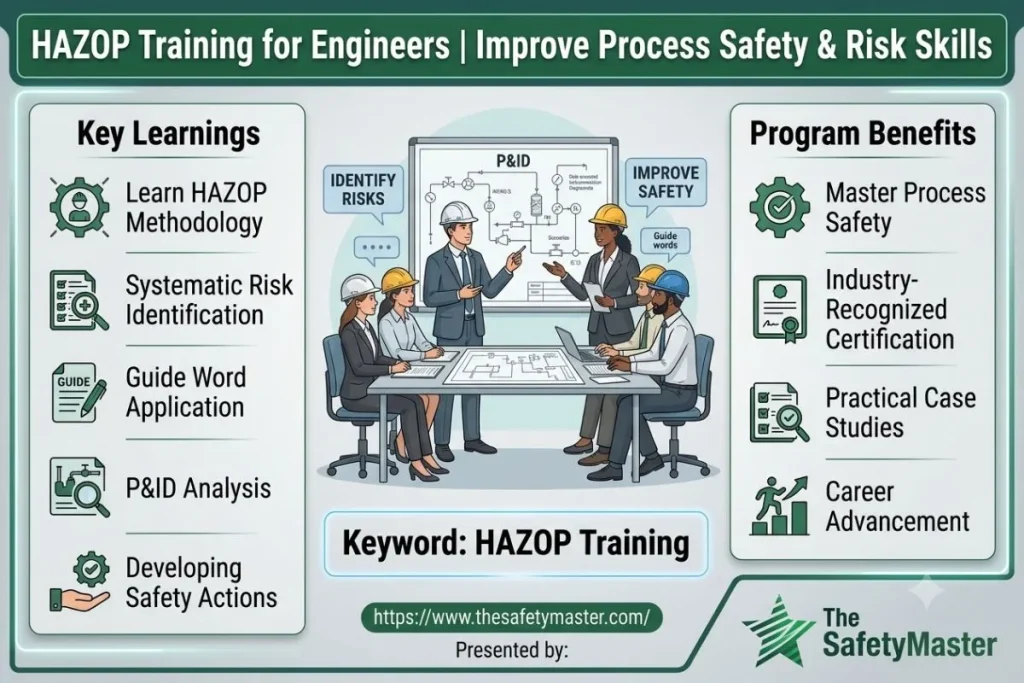
HAZOP Training for Safety Professionals
As process industries continue to grow, the demand for qualified HAZOP professionals is increasing.
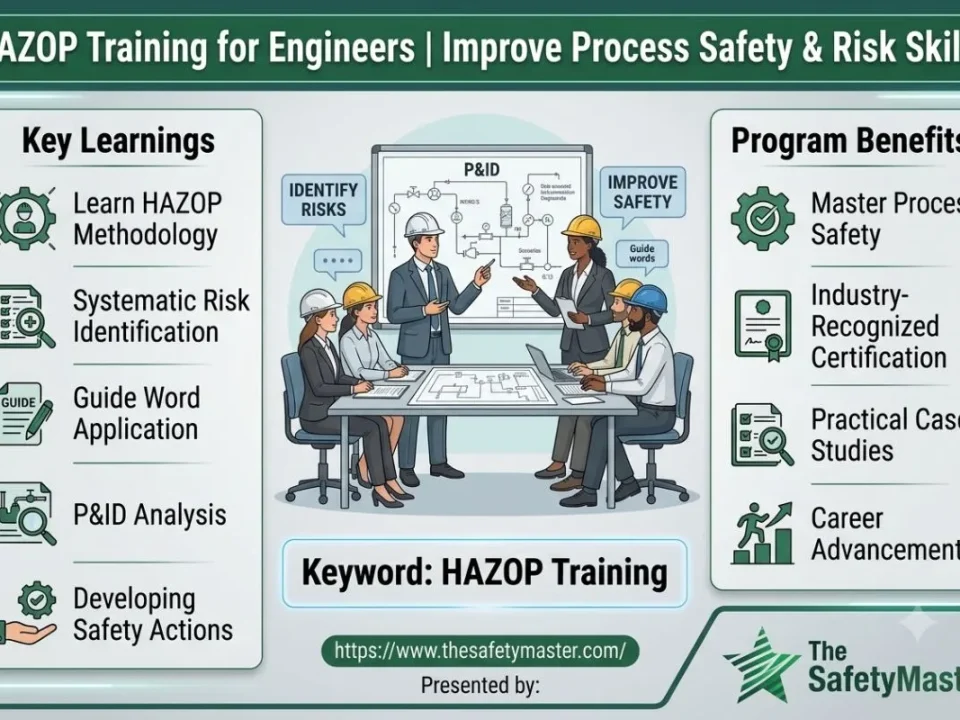
Professional HAZOP Training provides practical knowledge of:
- HAZOP methodology
- Guide words
- Risk assessment techniques
- Process safety principles
- Team facilitation skills
Training enables professionals to participate effectively in hazard studies and improve workplace safety.
HAZOP Training Online
Many professionals now prefer Hazop training online because it offers flexibility and accessibility.
Online programs allow participants to learn from industry experts without traveling. Interactive case studies, live sessions, and practical exercises help learners understand real-world applications of HAZOP methodology.
Online learning is particularly beneficial for working professionals seeking career advancement while managing their job responsibilities.
Hazop Training Online Free
Several organizations offer introductory Hazop training online free through webinars, safety awareness sessions, and educational platforms.
These programs provide basic knowledge about:
- HAZOP concepts
- Guide words
- Process deviations
- Industry applications
While free courses are useful for beginners, advanced certifications provide deeper technical understanding and industry recognition.
HAZOP Certification Course in India
Demand for the HAZOP Certification course in India has grown significantly due to increasing process safety requirements.
Certification programs typically cover:
- HAZOP fundamentals
- Risk assessment techniques
- Process safety management
- Case studies
- Practical exercises
Professionals from chemical, oil and gas, pharmaceutical, and manufacturing sectors often pursue certification to enhance their career opportunities.
HAZOP Certification Cost
The HAZOP certification cost depends on several factors, including:
- Course duration
- Training provider
- Certification level
- Online or classroom format
- International accreditation
Basic programs may cost a few thousand rupees, while advanced internationally recognized certifications can cost significantly more.
Professionals should evaluate course content, instructor expertise, and certification credibility before enrolling.
HAZOP Training PPT Resources
Many trainers and organizations use HAZOP training PPT presentations to explain complex concepts in a simple and visual format.
A good training presentation typically includes:
- HAZOP methodology
- Guide words
- Process examples
- Case studies
- Risk assessment worksheets
Visual learning materials improve understanding and retention of HAZOP principles.
IChemE HAZOP Training
The globally recognized IChemE HAZOP training programs are developed by the Institution of Chemical Engineers.
These programs focus on:
- Advanced HAZOP methodology
- Facilitation skills
- Risk analysis techniques
- Industry best practices
IChemE courses are respected worldwide and are often preferred by process safety professionals seeking advanced expertise.
Common Mistakes During HAZOP Studies
Many organizations reduce the effectiveness of HAZOP by making common mistakes.
These include:
- Inadequate preparation
- Missing key stakeholders
- Poor documentation
- Lack of experienced facilitators
- Ignoring recommendations
- Insufficient follow-up actions
Avoiding these mistakes improves the quality and value of the study.
Future of HAZOP in Process Safety
The future of HAZOP is evolving with digital technologies, advanced simulation tools, and artificial intelligence.
Organizations are increasingly integrating HAZOP findings with:
- Digital Twins
- Process Safety Management Systems
- Risk-Based Inspection Programs
- Asset Integrity Management
These advancements enhance hazard identification and support proactive risk management.
Conclusion
A HAZOP study remains one of the most effective and widely accepted methods for identifying hazards and improving operational safety in process industries. By systematically analyzing deviations, evaluating consequences, and implementing safeguards, organizations can prevent accidents and enhance reliability.
For engineers, safety professionals, and plant operators, investing in HAZOP Training is a valuable step toward building expertise in process safety and risk management. Whether through Hazop training online, Hazop training online free resources, a HAZOP Certification course in India, or advanced IChemE HAZOP training, developing HAZOP skills can significantly improve both professional growth and workplace safety.
As industries continue to prioritize process safety, HAZOP will remain a critical tool for achieving safer and more reliable operations.