HIRA vs. HAZOP: Understanding the Right Risk Assessment for Your Industry

Top 10 Fire Safety Audit Findings That Put Industries at Risk
August 3, 2026
Process Safety Consultants in India: Why The Safety Master Is the Best Process Safety Consultant
August 7, 2026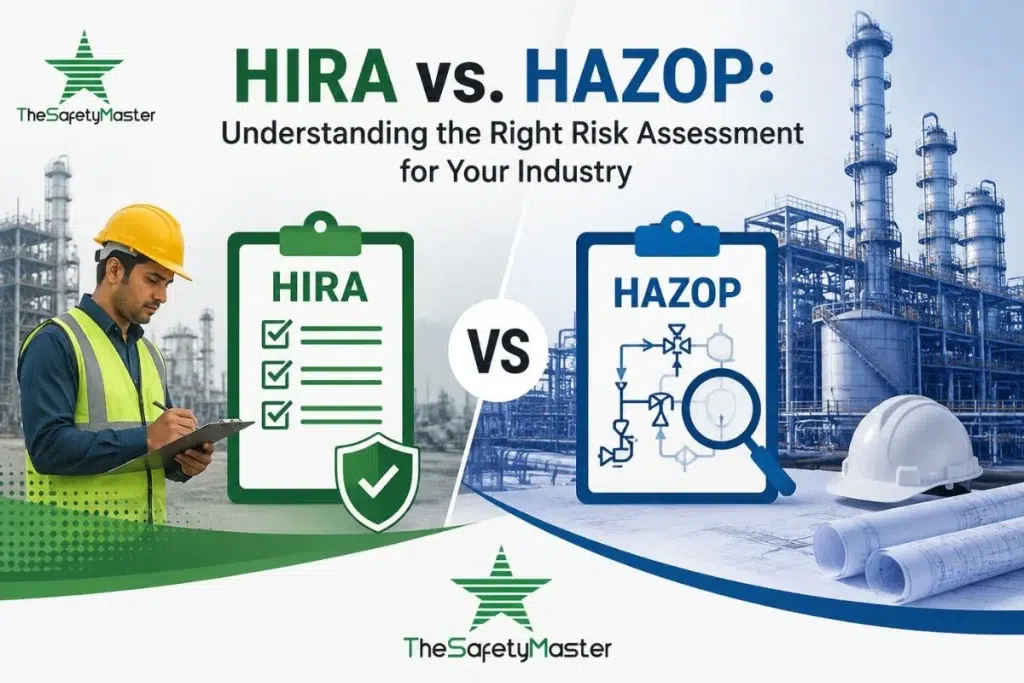
In industrial safety management, selecting the correct risk assessment method can make the difference between proactive prevention and reactive response. HIRA, HAZOP, and The Safety Master together represent essential tools and expertise that help organizations identify hazards, evaluate risks, and implement effective controls across diverse sectors.
What Is HIRA?
Hazard Identification and Risk Assessment (HIRA) is a systematic process used to identify workplace hazards and evaluate the risks they pose to people, equipment, and the environment. It applies broadly across industries—construction, manufacturing, pharmaceuticals, logistics, and general workplaces—covering routine and non-routine activities such as working at height, electrical maintenance, chemical handling, and equipment operation.
HIRA focuses on real-world operational risks rather than deep process design details. Teams identify hazards, rate them using likelihood and severity matrices, and determine control measures following the hierarchy of controls (elimination, substitution, engineering, administrative, and PPE).
The 4 Steps of HIRA
What is the 4 Step of HIRA? The standard four-step process provides a clear, repeatable framework:
- Hazard Identification Systematically list all potential sources of harm. This includes physical, chemical, biological, ergonomic, and psychosocial hazards. Methods include workplace inspections, review of past incidents, employee consultations, and examination of procedures and equipment.
- Risk Assessment Evaluate each identified hazard by combining likelihood (how probable the event is) and severity (how serious the consequence would be). A risk matrix typically converts these into a risk rating (low, medium, high, or extreme) so priorities become clear.
- Risk Control Apply appropriate control measures ranked by effectiveness. Higher-level controls such as eliminating the hazard or engineering solutions are preferred over relying solely on PPE or procedures.
- Monitoring and Review Continuously check that controls remain effective, identify new hazards that appear due to changes in process or equipment, and update the assessment. HIRA is a living process, not a one-time document.
These four steps form the backbone of many occupational health and safety management systems, including those aligned with ISO 45001.
What Is HAZOP?
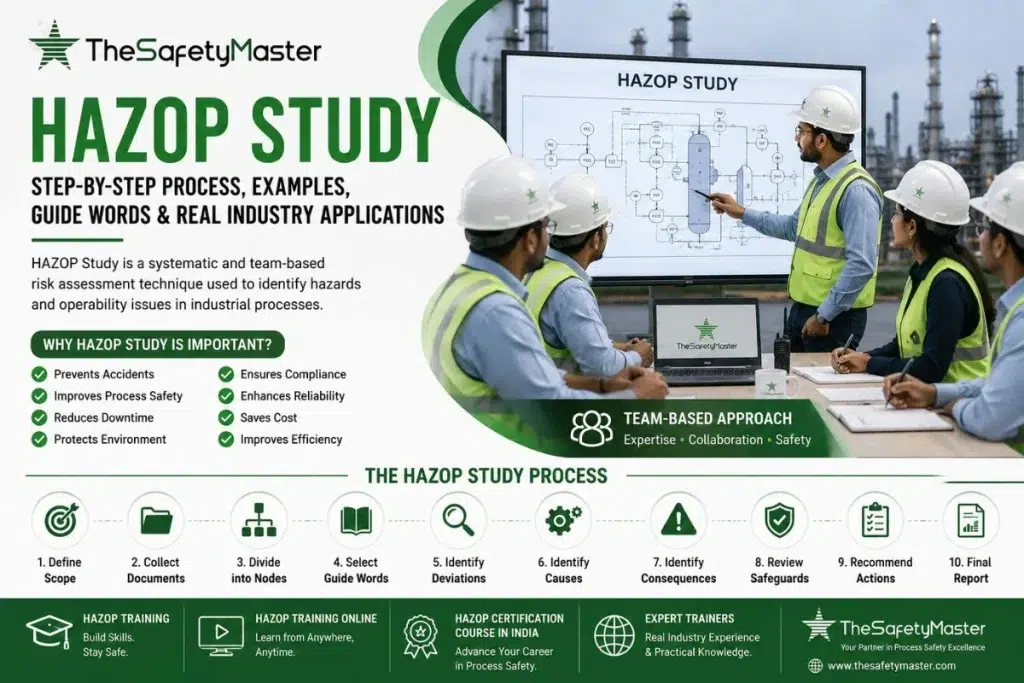
HAZOP full form is Hazard and Operability Study. It is a structured, systematic technique originally developed in the chemical industry in the 1960s and now widely used in process industries such as oil and gas, petrochemicals, pharmaceuticals, and power generation.
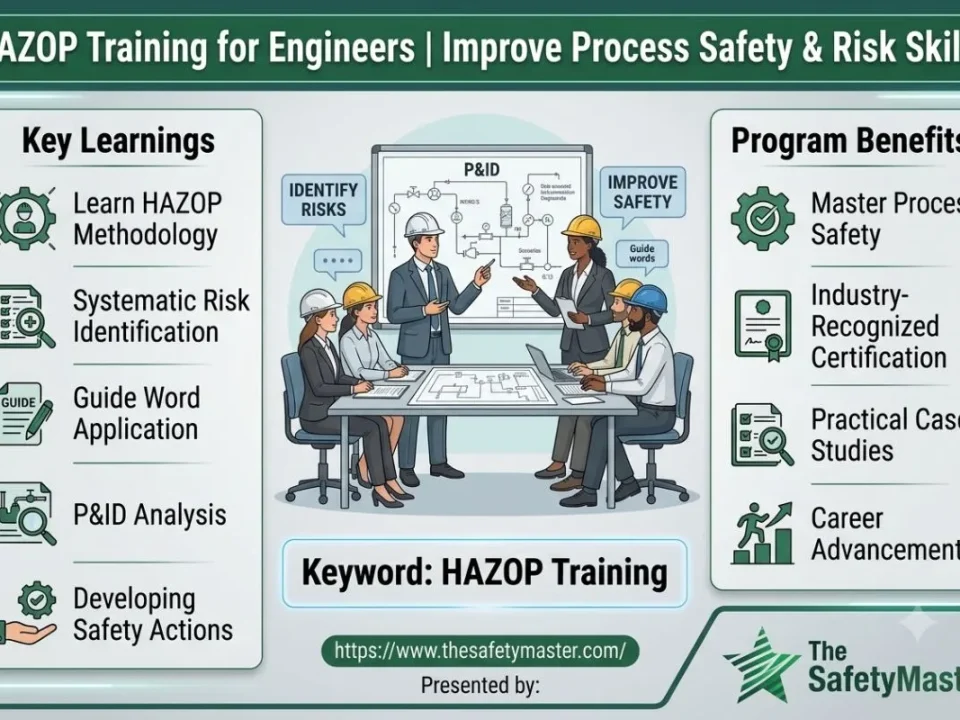
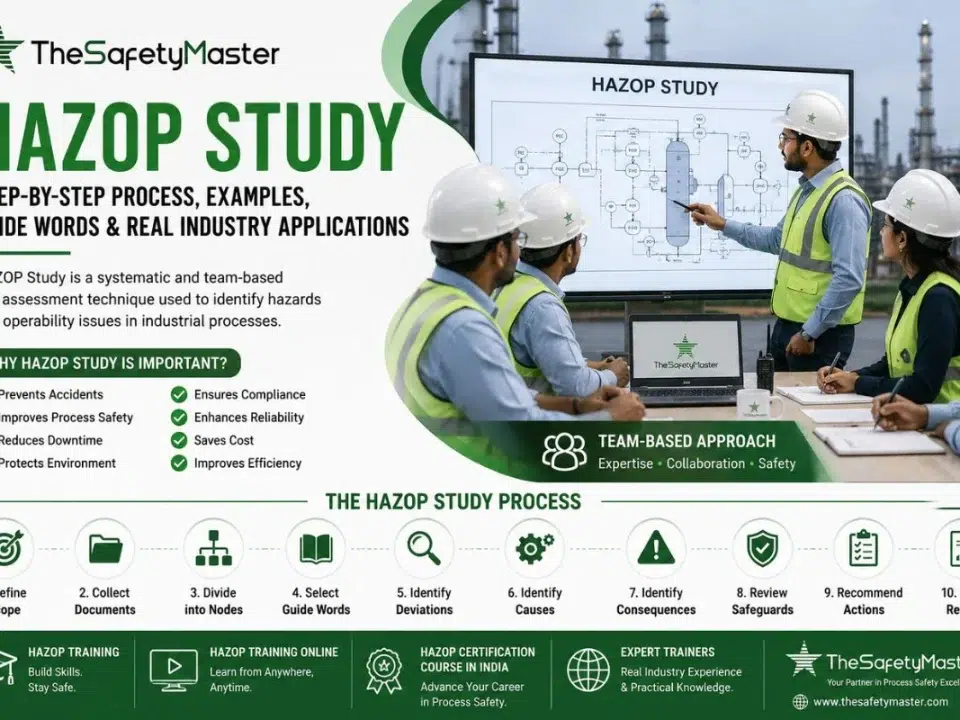
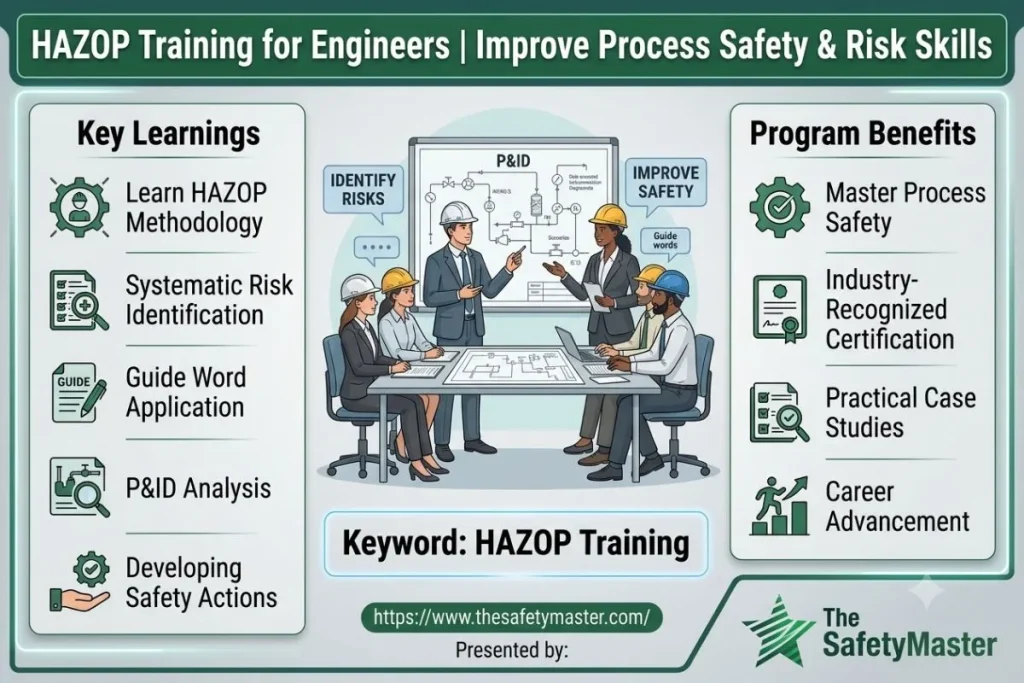
A HAZOP study examines a process design (usually through Piping and Instrumentation Diagrams or P&IDs) by dividing it into nodes. A multidisciplinary team applies guide words (No, More, Less, Reverse, Part of, As well as, etc.) to process parameters (flow, temperature, pressure, level, composition) to identify possible deviations from design intent. For each deviation the team records causes, consequences, existing safeguards, and recommended actions.
HAZOP is primarily qualitative and focuses on process deviations that could lead to hazardous events or operability problems. It is most valuable during design, major modifications, or periodic revalidation of complex process systems.
How a HAZOP Study Works
A typical HAZOP study follows these stages:
- Define the scope and select nodes
- Assemble a multidisciplinary team (process engineers, operators, safety specialists, instrumentation experts)
- Apply guide words systematically to each parameter at every node
- Identify causes, consequences, and safeguards
- Recommend actions and track them to closure
The output is a detailed deviation log that supports safer design and operations.
HIRA and HAZOP Difference
Understanding the HIRA and HAZOP difference is essential for choosing the right tool.
| Aspect | HIRA | HAZOP |
|---|---|---|
| Full Form | Hazard Identification and Risk Assessment | Hazard and Operability Study |
| Scope | Broad – workplace activities, tasks, general hazards | Narrow – process deviations in defined systems |
| Approach | Semi-quantitative (risk matrix) | Qualitative, guide-word driven |
| Focus | Likelihood × severity of workplace hazards | Deviations from design intent |
| Typical Industries | All industries, construction, manufacturing | Process industries (chemical, oil & gas, pharma) |
| Team | Safety officers + relevant workers | Multidisciplinary expert team |
| Output | Risk register with ranked hazards and controls | Deviation log with causes, consequences, recommendations |
| Timing | Routine operations, new tasks, continuous | Design stage, modifications, revalidation |
HIRA is broader and more flexible for everyday operational safety. HAZOP is deeper and more rigorous for complex process systems where deviations can have major consequences.
HAZOP and HIRA – Complementary Tools
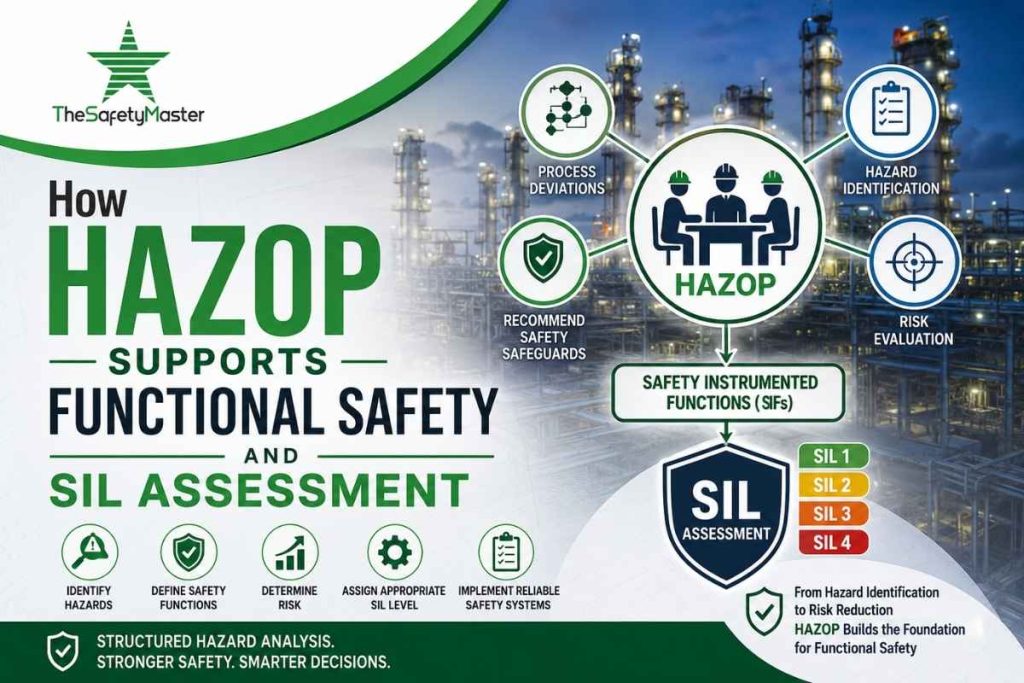
HAZOP and HIRA are not competing methods; they complement each other. Many process plants use both. HIRA covers the wider workplace and activity-based risks, while a HAZOP study drills into the process design itself. Using them together provides layered protection: broad hazard visibility plus detailed process-deviation analysis.
Organizations that treat them as interchangeable often leave gaps. The right approach is to match the method to the risk profile—HIRA for general and task-based risks, HAZOP for process systems involving hazardous materials, high pressures, or complex reactions.
Choosing the Right Method for Your Industry
- Construction, general manufacturing, logistics, and service industries → HIRA is usually the primary tool.
- Chemical, petrochemical, pharmaceutical, oil & gas, and power plants → Both are needed; HAZOP for process units and HIRA for supporting activities and workplace hazards.
- New plant design or major modifications → Start with HAZOP (and often HAZID) then support with HIRA.
- Routine safety management and compliance → HIRA forms the core living document.
Regulations and standards (OSHA PSM, ISO 45001, local process safety rules) often require or strongly recommend these assessments. Choosing incorrectly can lead to incomplete risk registers, audit findings, or worse—uncontrolled incidents.
Why Expert Support Matters
Conducting high-quality HIRA or HAZOP requires trained facilitators, experienced teams, and consistent methodology. Poorly facilitated studies produce documents that sit on shelves rather than drive real risk reduction.
The Safety Master specializes in both HIRA and HAZOP studies, training, and process safety management. Their teams help industries select the appropriate method, facilitate effective workshops, develop practical control measures, and keep assessments current. Whether you need a workplace HIRA, a full HAZOP study for a process unit, or training for your internal team, working with specialists ensures the assessment delivers actionable safety improvements rather than mere compliance paperwork.
Conclusion
Selecting between HIRA and HAZOP—or deciding to use both—depends on the nature of your operations, the complexity of your processes, and the regulatory environment. HIRA provides a practical, broad framework for identifying and ranking workplace hazards through its clear four-step process. HAZOP offers a rigorous, guide-word-driven examination of process deviations that is indispensable in high-hazard process industries.
When applied correctly and kept alive through regular review, these methods significantly reduce the likelihood and severity of incidents. Partnering with experienced providers such as The Safety Master ensures that your risk assessments are thorough, relevant, and effective—helping you protect people, assets, and the environment while meeting compliance requirements.
By understanding the strengths of each approach and applying them where they fit best, organizations move from reactive safety management to a truly proactive culture.
FAQs
1. What is the main difference between HIRA and HAZOP?
HIRA is a broad workplace hazard identification and risk ranking method suitable for most industries. HAZOP is a detailed, structured study focused on process deviations in complex systems, primarily used in process industries.
2. What is the HAZOP full form?
HAZOP stands for Hazard and Operability Study.
3. What are the 4 steps of HIRA?
(1) Hazard Identification, (2) Risk Assessment (likelihood × severity), (3) Risk Control using the hierarchy of controls, and (4) Monitoring and Review.
4. Can I use both HIRA and HAZOP?
Yes. They complement each other. Many process facilities use HAZOP for the core process systems and HIRA for broader workplace and activity-based risks.
5. When should a HAZOP study be conducted?
During detailed design, before major process modifications, after significant incidents, and periodically for revalidation of existing plants.
6. Is HIRA mandatory?
HIRA or equivalent hazard identification and risk assessment processes are required or strongly expected under many occupational safety regulations and standards such as ISO 45001.
7. Who should facilitate a HAZOP study?
An experienced, independent facilitator leading a multidisciplinary team that includes process, operations, maintenance, and safety expertise.