How to Choose the Right HIRA Consultant for Your Industry

Types of Hazards Identified During HIRA Studies
May 11, 2026
Risk Control Measures Commonly Recommended After HIRA
May 16, 2026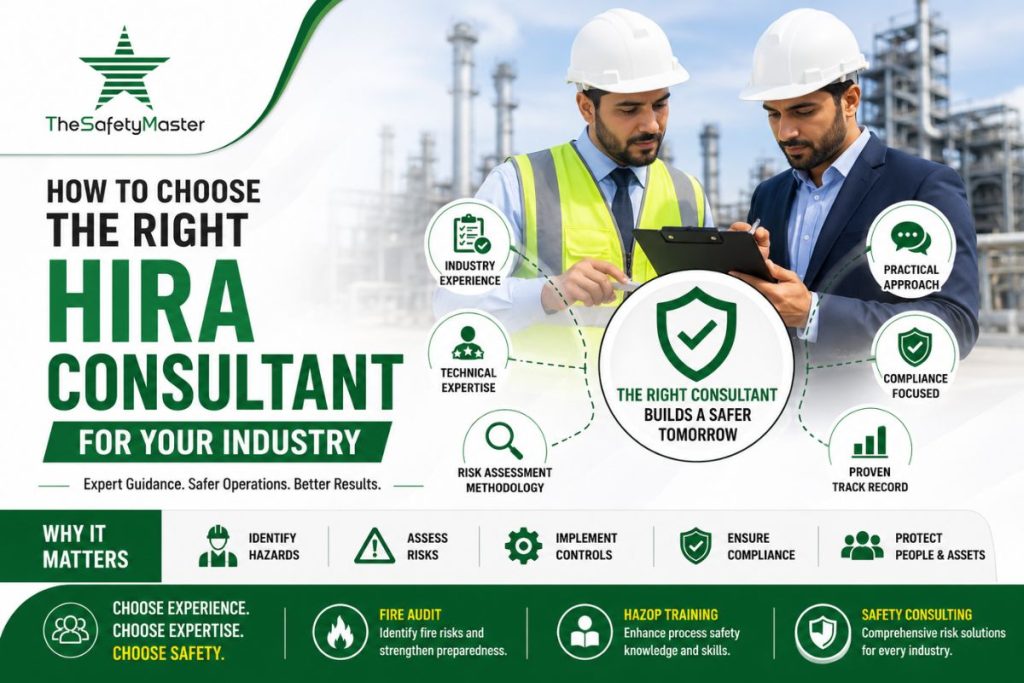
Selecting the right safety consultant is one of the most important decisions for organizations operating in high-risk environments. A poorly conducted risk assessment can leave critical hazards unidentified, create compliance gaps, and increase the possibility of workplace incidents. On the other hand, a knowledgeable and experienced consultant can help organizations identify operational risks, improve workplace safety, and build stronger control systems.
Many companies make the mistake of choosing consultants based only on pricing or generic service claims. However, hazard identification and risk assessment require industry-specific knowledge, technical understanding, and practical experience. Every industry has different operational risks, and the approach used in a manufacturing facility may not work effectively in a chemical plant, construction project, or warehouse environment.
Choosing the right consultant is not just about hiring someone to complete documentation. It is about selecting a professional who understands your operations, identifies practical risks, and provides realistic recommendations.
Understand What a HIRA Consultant Actually Does
Before selecting a consultant, it is important to understand their role clearly.
A professional HIRA consultant helps organizations:
- Identify workplace hazards
- Evaluate operational risks
- Analyze the likelihood and severity of incidents
- Recommend preventive and corrective controls
- Improve safety compliance
- Support incident prevention strategies
- Assist in developing safer work practices
The objective is not only to identify visible dangers but also to uncover hidden operational risks that may lead to injuries, equipment failure, environmental impact, or production loss.
An experienced consultant focuses on practical risk reduction rather than simply creating reports.
Look for Industry-Specific Experience
One of the biggest mistakes companies make is hiring a consultant with general safety knowledge but no experience in their industry.
Different industries face different hazards:
- Construction sites deal with falls, lifting operations, and temporary structures
- Manufacturing plants handle machinery and mechanical hazards
- Chemical industries face process safety and toxic exposure risks
- Warehouses manage vehicle movement and material handling hazards
- Oil and gas facilities deal with fire, explosion, and pressure-related risks
A consultant familiar with your industry understands these operational realities better and can identify risks more effectively.
For example, a consultant experienced in process industries will better understand chemical reactions, process deviations, and shutdown risks compared to someone with only office safety experience.
Always ask about previous projects, industry exposure, and practical field experience before making a decision.
Evaluate Technical Knowledge and Methodology
A good consultant should follow a structured risk assessment methodology rather than relying only on observations.
Ask questions such as:
- What assessment techniques do they use?
- How do they prioritize risks?
- Do they use risk matrices?
- How do they categorize hazard severity?
- What standards or frameworks do they follow?
A professional consultant should be able to explain their process clearly without using vague or overly technical language.
Industries involving complex processes often require advanced analytical methods. Professionals who have undergone structured HAZOP Training are generally better equipped to evaluate process-related hazards, system deviations, and operational failures in high-risk environments.
The ability to apply structured methodologies is often what separates experienced consultants from basic checklist-based auditors.
Check Their Ability to Understand Practical Operations
Some consultants focus heavily on documentation while ignoring how work is actually performed on-site. This creates unrealistic recommendations that are difficult for workers to follow.
An effective consultant spends time understanding:
- Actual work practices
- Worker behavior
- Operational challenges
- Equipment usage
- Maintenance activities
- Emergency preparedness
- Environmental conditions
The goal should be to recommend controls that are practical, achievable, and operationally effective.
For example, recommending excessive PPE without addressing the root hazard may not solve the real problem. Similarly, suggesting unrealistic procedures can reduce worker compliance instead of improving safety.
Practical understanding is often more valuable than theoretical knowledge alone.
Review Communication and Reporting Skills
Hazard identification reports should be easy to understand, organized, and actionable.
A good consultant should provide:
- Clear hazard descriptions
- Practical control measures
- Risk prioritization
- Supporting observations
- Visual evidence where necessary
- Compliance references
- Action-oriented recommendations
Poorly written reports create confusion and reduce implementation effectiveness.
The consultant should also communicate findings clearly to both management and workers. Safety recommendations are only effective when people understand them properly.
Avoid consultants who rely heavily on copied templates without tailoring reports to actual site conditions.
Assess Their Approach Toward Compliance
Compliance is an important part of workplace safety, but it should not become the only objective.
Some consultants focus only on meeting minimum regulatory requirements instead of improving actual risk control. This approach may satisfy documentation needs temporarily but does not necessarily reduce operational hazards.
A strong consultant balances:
- Regulatory compliance
- Operational practicality
- Worker safety
- Long-term risk reduction
The objective should be creating safer workplaces, not just passing inspections.
Verify Experience with Fire and Emergency Risk Assessment
Fire hazards exist in almost every industry, especially where electrical systems, flammable materials, fuels, or hot work activities are involved.
A qualified consultant should understand:
- Fire load assessment
- Ignition source identification
- Emergency response systems
- Evacuation planning
- Fire suppression systems
- Storage risks
A structured Fire Audit often becomes an important part of broader workplace risk assessment because fire incidents can quickly escalate into major operational emergencies.
Organizations should ensure that consultants understand both preventive and emergency response aspects of fire safety.
Ask About Field Involvement
Some consultants conduct assessments remotely or rely mainly on management discussions. This often results in incomplete hazard identification because many operational risks are visible only during actual field observation.
A reliable consultant should physically inspect:
- Work areas
- Machinery
- Worker activities
- Storage systems
- Maintenance practices
- Emergency equipment
- Site conditions
Direct observation allows consultants to identify unsafe behaviors, hidden hazards, and operational gaps that may not appear in documentation.
Field involvement is essential for realistic risk evaluation.
Evaluate Their Problem-Solving Approach
Good consultants do more than identify problems. They help organizations understand why those problems exist.
For example:
- Why are workers bypassing safety procedures?
- Why are incidents repeatedly occurring in the same area?
- Why are control measures failing?
- Why are unsafe conditions becoming normalized?
This deeper analysis helps organizations address root causes instead of only fixing surface-level issues.
Consultants who only point out visible problems without analyzing underlying causes provide limited long-term value.
Check References and Past Work
Before finalizing a consultant, review their previous work wherever possible.
Important things to evaluate include:
- Industry reputation
- Client feedback
- Quality of reports
- Experience level
- Types of projects handled
- Long-term client relationships
Consistent experience across similar industries often indicates stronger practical capability.
Do not rely only on certifications or marketing claims. Real-world experience matters significantly more in risk assessment work.
Avoid Choosing Based Only on Cost
Low-cost consulting services may appear attractive initially, but poor-quality assessments can create much larger financial and operational losses later.
An incomplete hazard assessment may lead to:
- Workplace accidents
- Equipment damage
- Compliance penalties
- Production downtime
- Insurance complications
- Legal consequences
The cost of inadequate risk assessment is often much higher than the cost of hiring a competent consultant.
The focus should always remain on quality, experience, and practical understanding rather than price alone.
Conclusion
Choosing the right HIRA consultant requires careful evaluation of industry experience, technical expertise, field involvement, communication ability, and practical understanding of workplace operations. A good consultant does more than create reports. They help organizations identify hidden hazards, prioritize risks, improve operational safety, and strengthen long-term risk management practices.
Organizations that invest time in selecting qualified consultants are better positioned to reduce incidents, improve compliance, and create safer working environments. The right consultant not only understands regulations but also understands how real workplaces operate and where real risks exist.