HAZOP Study Consultants in India: Improving Industrial Safety with The Safety Master

Enhance Workplace Safety with TheSafetyMaster, the Best Safety Consultant near Me
July 5, 2023
Unlocking Construction Site Safety: A Comprehensive Audit Approach
July 5, 2023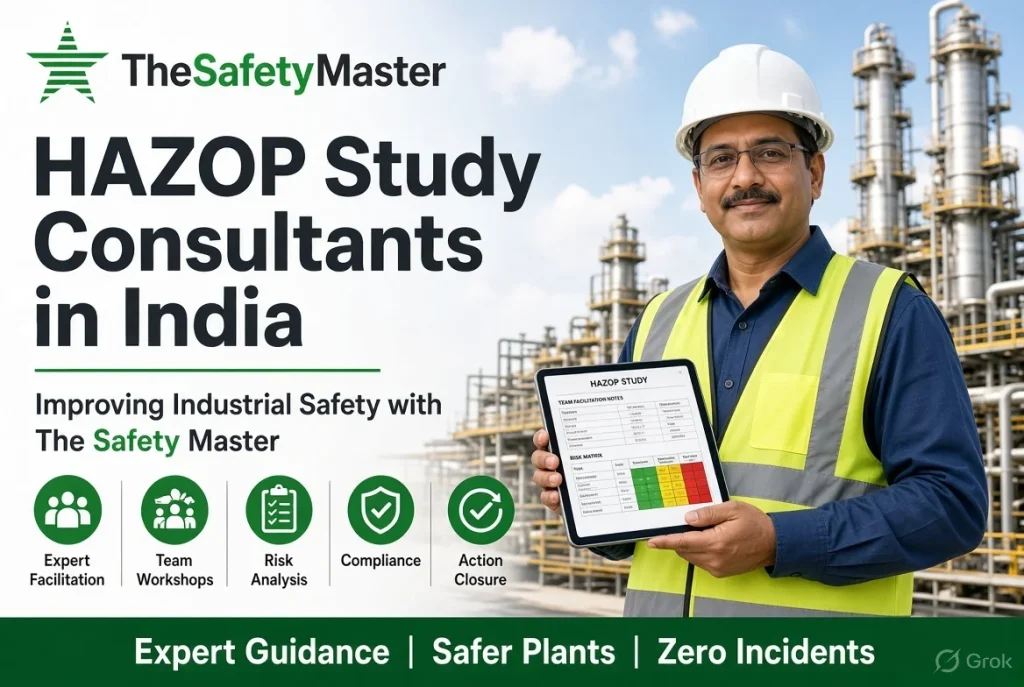
Industrial plants use complex processes, machines, chemicals, and equipment. Even a small change in pressure, temperature, flow, or equipment performance can create serious safety risks. These risks can lead to workplace accidents, production losses, equipment damage, and environmental harm.
A Hazard and Operability Study (HAZOP) helps organizations identify potential hazards before they become major problems. Professional HAZOP Study Consultants in India support businesses in reviewing their processes, understanding possible failures, and developing effective risk control measures.
The Safety Master provides industrial safety and process risk management solutions to help organizations improve workplace safety and operational reliability. A systematic HAZOP study can help businesses identify process deviations, review existing safeguards, and develop practical recommendations for safer operations.
What Is a HAZOP Study?
HAZOP stands for Hazard and Operability Study. It is a structured method used to identify potential hazards and operational problems in industrial processes.
During a HAZOP study, a team examines the design and operation of a process to identify deviations from its intended operating conditions. The team investigates the possible causes, consequences, existing safeguards, and additional actions required to control the risks.
For example, excessive pressure inside a chemical reactor may result from a blocked outlet, a control valve failure, or an incorrect operating condition. A HAZOP study helps the team examine these possibilities and recommend suitable preventive measures.
A HAZOP study is useful for:
- Identifying potential process hazards.
- Reviewing equipment and operating procedures.
- Evaluating existing safety systems.
- Reducing the possibility of process-related accidents.
- Improving operational reliability.
- Supporting process safety management.
- Developing practical recommendations for risk reduction.
Why Businesses Need HAZOP Study Consultants in India
Industrial safety requires more than installing safety equipment or following standard operating procedures. Organizations must understand how their processes can fail and what could happen if safety controls do not work as expected.
Experienced HAZOP study consultants help businesses examine these risks through a systematic and structured process.
Early Identification of Process Hazards
Early hazard identification helps organizations address potential problems before they cause accidents. Consultants examine process conditions, equipment, materials, and operating methods to identify possible deviations.
These findings help businesses prioritize safety improvements and reduce unnecessary exposure to risk.
Better Process Safety Management
A HAZOP study supports process safety management by providing a structured record of hazards, possible causes, consequences, and recommended actions.
Organizations can use this information to improve operating procedures, maintenance planning, emergency preparedness, and risk management practices.
Improved Equipment and Operational Reliability
Process deviations can affect production quality, equipment performance, and plant availability. Identifying these problems early helps organizations improve equipment reliability and reduce unplanned shutdowns.
Support for Safety Compliance
A properly documented HAZOP study can support an organization’s safety management and risk assessment activities. The applicable legal and technical requirements depend on the industry, process, facility, and project.
Businesses should confirm the specific regulatory obligations that apply to their operations rather than assuming that one HAZOP report meets every compliance requirement.
Industries That Benefit from HAZOP Study Services
HAZOP studies are particularly useful in industries where process deviations can create significant safety, environmental, or operational consequences.
Chemical and Petrochemical Industries
Chemical plants handle reactive materials, flammable liquids, toxic substances, and high-pressure processes. A HAZOP study helps identify potential problems involving chemical reactions, pressure changes, temperature variations, and material transfer.
The study can also examine storage systems, pipelines, reactors, and associated control systems.
Oil and Gas Industry
Oil and gas facilities may involve combustible gases, flammable liquids, high-pressure equipment, and complex process systems.
HAZOP studies help examine possible leakage, abnormal pressure, flow interruption, equipment failure, and other process deviations that could affect plant safety.
Pharmaceutical Industry
Pharmaceutical production requires controlled operating conditions, accurate material handling, and reliable equipment performance.
HAZOP studies can help identify risks related to mixing, heating, cooling, chemical transfer, storage, and process control.
Fertilizer and Manufacturing Industries
Fertilizer plants and other manufacturing facilities may handle hazardous chemicals, pressurized systems, steam, and specialized production equipment.
A structured HAZOP study helps review process risks and identify suitable safeguards for workers, equipment, and the surrounding environment.
Power and Energy Facilities
Power plants and energy facilities rely on interconnected equipment and process systems. A HAZOP study can help identify potential operating deviations involving pressure, temperature, flow, utilities, and control systems.
The scope should be designed around the specific process and its credible hazards.
How The Safety Master Supports HAZOP Studies
The Safety Master supports industrial organizations through process safety consulting, hazard identification, and risk management services. Its process safety offerings include HAZOP, Layers of Protection Analysis (LOPA), Safety Integrity Level (SIL), and other risk assessment solutions.
The objective of a HAZOP study is to give organizations a structured understanding of process risks and the measures that may help control them.
Understanding the Client’s Process
The first step is to understand the facility, process design, operating conditions, production objectives, and safety concerns.
The study team reviews the available technical information to define the scope and identify the systems that require assessment.
Identifying Process Deviations
The team examines the selected process nodes using guidewords and process parameters. This helps identify deviations from the intended design or operating conditions.
Examples include no flow, high pressure, low temperature, reverse flow, and incorrect material composition.
Evaluating Causes and Consequences
Each credible deviation is reviewed to determine its possible causes and consequences.
The analysis may consider equipment failure, human error, control system malfunction, utility failure, and operating procedure weaknesses.
Reviewing Existing Safeguards
The team identifies the safeguards already in place, such as alarms, interlocks, relief systems, automatic shutdowns, and operating procedures.
The adequacy of each safeguard must be evaluated in the context of the specific hazard. The presence of a safety device alone does not prove that the risk is adequately controlled.
Developing Practical Recommendations
Where additional risk reduction is required, the team develops recommendations suited to the identified hazards.
These actions may involve equipment modifications, improved procedures, additional alarms, maintenance changes, or further technical assessments.
Preparing the HAZOP Study Report
The findings are documented in a HAZOP study report. The report provides a record of the analysis and helps the organization assign responsibility for follow-up actions.
The Safety Master can support organizations in identifying process risks and strengthening their industrial safety practices through its process safety consulting services.
Step-by-Step HAZOP Study Process
A well-planned HAZOP study follows a systematic process. The exact approach depends on the facility, process complexity, and scope of the assessment.
Step 1: Define the Scope
Identify the process, equipment, systems, and operating conditions to be examined.
The scope should clearly state the objectives, boundaries, assumptions, and expected outputs of the study.
Step 2: Collect Technical Documents
Gather the documents needed to understand the process.
These may include:
- Process Flow Diagrams (PFDs).
- Piping and Instrumentation Diagrams (P&IDs).
- Process descriptions and design specifications.
- Equipment data sheets.
- Operating and maintenance procedures.
- Control system information.
- Relevant incident and risk assessment records.
The study team should verify that the documents are suitable for the stage of the project being assessed.
Step 3: Form a Multidisciplinary Team
A HAZOP study generally requires input from professionals with different areas of expertise.
Depending on the process, the team may include process engineers, operations personnel, instrumentation engineers, maintenance specialists, and safety professionals.
A competent facilitator helps the team follow a consistent methodology and record its findings.
Step 4: Divide the Process into Nodes
The process is divided into manageable sections called nodes. Each node represents a specific part of the system, such as a reactor, pipeline, pump, storage vessel, or heat exchanger.
Defining suitable nodes makes it easier to examine individual process conditions in detail.
Step 5: Apply HAZOP Guidewords
Guidewords are used with process parameters to identify potential deviations.
Common examples include:
- No: Complete absence of a required condition, such as no flow.
- More: A higher-than-intended condition, such as high pressure.
- Less: A lower-than-intended condition, such as low flow.
- Reverse: Flow or movement in the opposite direction.
- Other than: A different material, composition, or operating condition than intended.
The team considers the relevant guidewords for each process parameter and node.
Step 6: Analyze Causes and Consequences
For each meaningful deviation, the team identifies credible causes and possible outcomes.
For example, low flow in a cooling system could result from a blocked line, pump failure, or closed valve. If the cooling function is essential, the loss of flow may cause overheating or an unsafe reaction.
The team evaluates the potential consequences and the adequacy of existing protection measures.
Step 7: Record Actions and Recommendations
The team records the findings and identifies any additional actions required to manage the risks.
Each action should have a clear description, assigned responsibility, and suitable completion target. Organizations should track these actions until they are completed and verified.
Important Elements of a HAZOP Study Report
A useful HAZOP study report should clearly document the analysis and allow the organization to follow up on identified risks.
Basic Study Information
The report should identify the facility, process, study date, scope, participants, and relevant document revisions.
Process Nodes and Deviations
Each entry should identify the process node, parameter, guideword, and deviation being examined.
Causes and Consequences
The report should document credible causes and potential consequences associated with each deviation.
Existing Safeguards
Relevant safeguards should be recorded and evaluated according to their intended function and suitability.
Recommendations and Action Tracking
The report should identify additional actions, responsible persons, target dates, and current status.
Final Review and Approval
The study records should be reviewed by appropriate personnel. Recommendations should be evaluated, approved where necessary, and tracked through the organization’s action management process.
Common Challenges During HAZOP Studies
Organizations may face several challenges when conducting HAZOP studies. Addressing these issues improves the quality and usefulness of the assessment.
Incomplete Technical Information
Missing or outdated drawings can make it difficult to understand the process accurately.
Recommended approach: Review the available documents before the study and resolve important information gaps with the responsible engineering team.
Limited Team Participation
A study may miss important hazards if experienced operators, engineers, or maintenance personnel do not participate.
Recommended approach: Include relevant technical and operational experts who understand the process and its practical challenges.
Poorly Defined Recommendations
General recommendations can be difficult to implement because they do not clearly explain the required action.
Recommended approach: Write specific, practical recommendations with clear ownership and completion targets.
Failure to Close Action Items
Even a well-conducted HAZOP study may have limited value if its recommendations remain unresolved.
Recommended approach: Maintain an action register, monitor progress, verify completed actions, and reassess outstanding risks.
Treating HAZOP as a One-Time Activity
Processes and equipment may change after the original study. New risks can emerge as operating conditions, materials, and plant configurations change.
Recommended approach: Review the need for HAZOP revalidation following significant changes and at appropriate intervals based on the facility’s risk management requirements.
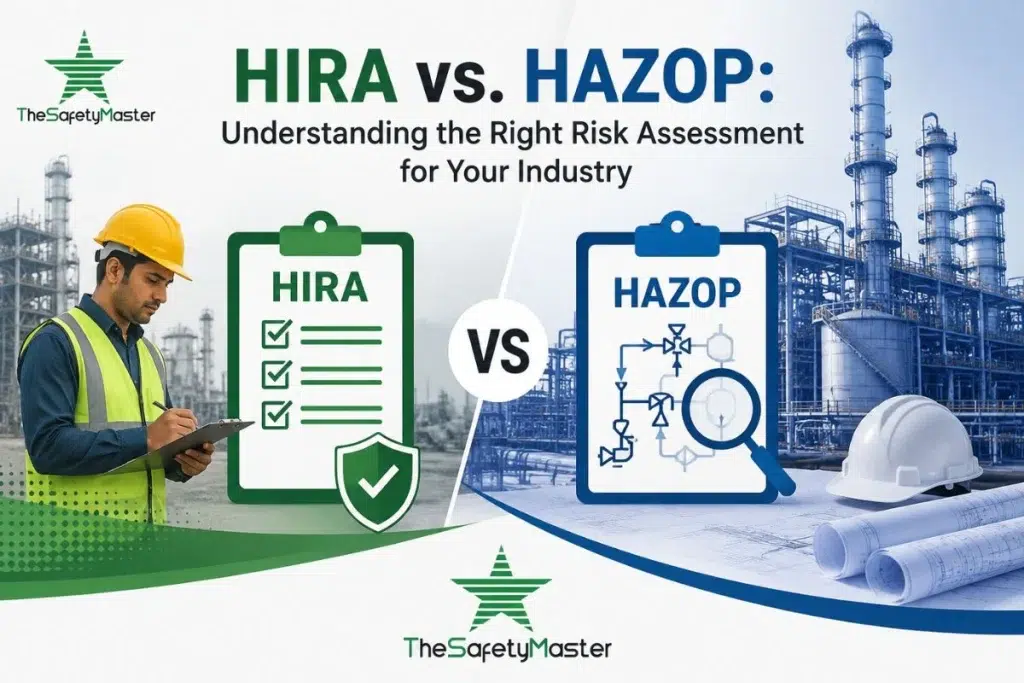
HAZOP Study vs. HIRA: Understanding the Difference
HAZOP and Hazard Identification and Risk Assessment (HIRA) both support workplace safety, but their applications and methods differ.
HAZOP is a structured technique that examines deviations from the design intent of a process. It is commonly used for complex process systems, including chemical production, oil and gas facilities, and other high-hazard operations.
HIRA is a broader hazard identification and risk assessment approach that can be applied to different workplace activities, tasks, equipment, and operating conditions.
For example, a HIRA may identify slip hazards during routine maintenance, while a HAZOP study may investigate the consequences of excessive pressure in a chemical reactor.
Organizations should select the assessment method based on the nature of the hazard and the purpose of the evaluation. In some facilities, both methods may be needed.
Benefits of Choosing The Safety Master
Selecting suitable HAZOP Study Consultants in India can help organizations improve the quality of their process safety assessments.
The Safety Master offers process safety and industrial risk management services that can support businesses in reviewing hazards and strengthening safety controls.
Key benefits of a well-managed HAZOP study include:
- Systematic hazard identification: Helps identify credible process deviations and their possible causes.
- Improved risk control: Supports the selection of practical measures to reduce identified risks.
- Better safety documentation: Creates a structured record of hazards, safeguards, and recommendations.
- Stronger operational planning: Helps teams understand potential failures and their consequences.
- Improved follow-up: Supports the tracking and closure of safety recommendations.
- Informed decision-making: Gives management a clearer basis for prioritizing process safety improvements.
The actual benefits depend on the study scope, the quality of available information, the competence of the team, and the effective implementation of recommendations.
Best Practices for an Effective HAZOP Study
Organizations can improve HAZOP study outcomes by following several important practices.
- Define the scope and objectives before starting the study.
- Use current and verified process documentation.
- Include professionals with relevant technical and operational knowledge.
- Apply guidewords systematically to suitable process parameters.
- Evaluate the credibility of causes and consequences.
- Assess the effectiveness of existing safeguards.
- Develop clear and actionable recommendations.
- Assign responsibility and track action closure.
- Review changes that may introduce new process risks.
- Revalidate the study when required by changes or risk management procedures.
These practices help organizations use HAZOP findings as part of an ongoing process safety management system rather than treating the report as a standalone document.
Conclusion
Industrial process safety requires a clear understanding of potential hazards, credible process deviations, and effective safeguards. A HAZOP study provides a structured method for examining these issues and developing practical recommendations to improve operational safety.
Choosing suitable HAZOP Study Consultants in India can help businesses assess complex processes, improve risk management, and strengthen their safety practices. The Safety Master provides process safety consulting solutions designed to support industrial organizations in identifying hazards and managing operational risks.
By combining a systematic study process with competent teamwork and timely action closure, organizations can build stronger process safety systems, protect their workforce, and support more reliable operations.
For HAZOP study and process safety consulting requirements, visit The Safety Master to explore the available services.