The Importance of Fire Risk Assessments for Business Owners Fire Safety Audit

The Power of Behavior Based Safety: Creating a Culture of Prevention
May 5, 2023
Chlorine Safety: Safe Handling, Storage, PPE and Emergency Response
May 6, 2023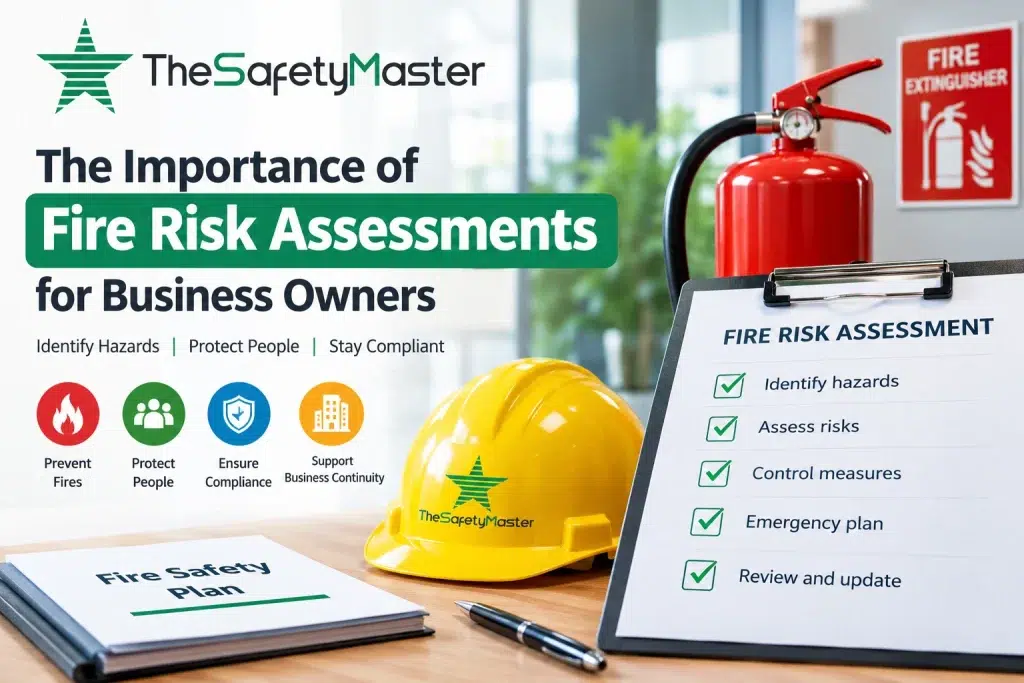
Fire safety is an essential responsibility for every business owner, landlord and person responsible for a workplace or building. Fire Risk Assessments help identify potential fire hazards, determine who may be at risk and establish suitable measures to prevent fires and protect people.
A proper assessment is more than completing a checklist. It should consider the actual building, activities, people, fire protection systems, emergency arrangements and escape routes. The Safety Master helps businesses improve fire safety through professional fire safety audits, risk assessments and safety consulting services.
What Is a Fire Risk Assessment?
A fire risk assessment is a structured examination of a premises to identify fire hazards, people who could be harmed, existing controls and additional measures needed to reduce risk.
A typical assessment considers:
- Sources of ignition such as electrical equipment and heating systems
- Combustible materials and sources of fuel
- Fire detection and alarm systems
- Fire extinguishers and firefighting equipment
- Emergency exits and escape routes
- Emergency lighting
- Fire doors and compartmentation
- Storage of flammable materials
- Evacuation procedures
- Employees, visitors and vulnerable persons
- Fire safety training and emergency drills
The objective is to reduce the likelihood of fire and ensure that people can escape safely if a fire occurs.
Why Are Fire Risk Assessments Important for Businesses?
A fire can cause injuries, fatalities, property damage, business interruption and financial loss. Regular Fire Risk Assessments help business owners identify problems before they become serious.
Protect Employees, Customers and Visitors
The first priority of a fire risk assessment is protecting people. It identifies who could be exposed to fire and whether additional arrangements are required for people who may need assistance during an evacuation.
Identify Fire Hazards
Electrical faults, overloaded sockets, combustible waste, cooking equipment, hot work, flammable liquids and poor housekeeping can increase fire risk. An assessment helps identify and control these hazards.
Improve Emergency Preparedness
A good assessment should lead to practical emergency arrangements, including evacuation procedures, alarm systems, emergency exits, fire-fighting equipment and employee training.
Support Legal Compliance
For premises covered by UK fire-safety legislation, the Responsible Person must carry out a suitable and sufficient fire risk assessment, keep it under review and maintain appropriate fire precautions. GOV.UK guidance also states that the completed assessment must be recorded.
What Is the Legal Requirement for Fire Risk Assessments?
The legal requirement depends on the jurisdiction and type of premises. In England, the Regulatory Reform (Fire Safety) Order 2005 applies to workplaces and the common parts of buildings containing two or more domestic premises. The Responsible Person has duties to carry out and record a fire risk assessment and maintain appropriate fire precautions.
The Responsible Person may be an employer, owner, landlord, occupier or another person with control of the premises. Where several people have responsibilities, they may need to cooperate and coordinate their fire-safety arrangements.
Businesses should therefore check the legislation and guidance applicable to their specific premises rather than relying on a generic template.
HSE Fire Risk Assessment Guidance
The HSE fire risk assessment approach provides useful guidance for identifying hazards, assessing people at risk, implementing controls and reviewing the assessment.
HSE explains that common fire hazards include sources of ignition, combustible materials and oxygen. Examples of ignition sources include heaters, lighting, electrical equipment and naked flames.
For workplace risk management, HSE also recommends recording who may be harmed, existing controls, further actions, responsible persons and deadlines.
Five Key Steps of a Fire Risk Assessment
1. Identify Fire Hazards
Look for ignition sources, fuel sources and circumstances that could allow a fire to start or spread.
2. Identify People at Risk
Consider employees, contractors, customers, visitors and people who may require additional assistance during evacuation.
3. Evaluate and Reduce the Risk
Determine how likely a fire is to occur and what could happen if one starts. Remove hazards where possible and introduce suitable controls.
4. Record, Plan and Train
Record significant findings, establish emergency procedures and ensure employees understand their responsibilities.
5. Review the Assessment
Review the assessment regularly and whenever there are significant changes to the building, work activities, occupancy or fire protection arrangements. GOV.UK identifies these five stages as the core workplace fire-risk assessment process.
Fire Risk Assessment Template
A fire risk assessment template can help organise information and provide a consistent format for documenting hazards, people at risk, existing controls, recommended actions and review dates.
However, a template should be treated as a starting point—not as a substitute for an assessment of the actual premises.
A useful template can include:
| Assessment Area | Information to Record |
|---|---|
| Premises | Building name, address and use |
| Fire hazards | Ignition sources and combustible materials |
| People at risk | Employees, visitors, contractors and vulnerable persons |
| Existing controls | Alarms, extinguishers, fire doors and emergency lighting |
| Escape | Routes, exits and evacuation arrangements |
| Risk level | Likelihood and potential consequences |
| Additional actions | Improvements required |
| Responsible person | Person assigned to complete each action |
| Review | Date and reason for review |
HSE provides a general risk-assessment template, but specifically warns that businesses should not simply copy an example because assessments need to address the actual hazards and controls of the workplace.
Fire Risk Assessment PDF Free Download
Businesses often search for a fire risk assessment PDF free download to use as a checklist or starting point. Free templates can be useful for understanding the information normally recorded during an assessment.
However, downloading a generic PDF does not automatically make a business compliant. The assessment needs to reflect the specific building, activities, occupants, hazards and existing fire precautions.
For this reason, businesses should use free templates as guidance and obtain competent professional support where the premises or risks are complex.
Fire Risk Assessment Online
A fire risk assessment online can be useful for preliminary reviews, documentation and managing assessment records. Online tools may help businesses organise hazards, assign corrective actions and track review dates.
However, an online questionnaire cannot always identify physical conditions that require an on-site inspection. For example, blocked escape routes, defective fire doors, poor housekeeping or unsuitable fire-extinguisher locations may require physical verification.
For higher-risk or complex premises, an appropriately competent person should assess whether an on-site inspection is necessary.
Office Fire Risk Assessment
An office fire risk assessment should consider the specific hazards associated with office environments.
Important areas include:
Electrical Equipment
Computers, printers, chargers, extension leads and other electrical equipment should be properly maintained and safely used.
Escape Routes
Corridors, stairways and emergency exits must remain accessible and free from unnecessary obstruction.
Kitchen and Break Areas
Microwave ovens, refrigerators, kettles, cooking equipment and other appliances can introduce ignition sources.
Fire Detection and Alarm Systems
The office should have appropriate detection and warning arrangements, with testing and maintenance carried out as required.
Emergency Evacuation
Employees should understand alarm procedures, assembly arrangements and their responsibilities during an emergency.
HSE Fire Risk Assessment Template Word
People also search for an HSE fire risk assessment template (Word) because Word documents are convenient for editing and maintaining records.
HSE provides a general workplace risk assessment template in Word format, along with examples for different types of businesses. However, this is not necessarily a complete fire-specific assessment for every type of premises. HSE states that examples should be used to help businesses consider their own hazards rather than simply copied.
For a professional fire assessment, the document should be customised to the building and its actual risks.
Fire Risk Assessment for Flats
A fire risk assessment for flats requires particular attention to common areas, escape routes, fire doors, compartmentation and the responsibilities of those managing the building.
In England, fire-safety requirements apply to the common parts of buildings containing two or more domestic premises. The Fire Safety Act 2021 also clarified that certain external walls, flat entrance doors and the structure of buildings need to be considered within the relevant fire-safety framework.
Fire Risk Assessment for Small Blocks of Flats
For small blocks of flats, responsible persons should assess the common parts and relevant building features, maintain fire precautions and keep the assessment under regular review.
Government guidance for small blocks of flats covers buildings up to three storeys and provides advice on the common parts, building structure, external walls and doors between flats and common areas.
Common Fire Hazards Found During Assessments
Some of the most frequently identified hazards include:
- Overloaded electrical sockets
- Damaged electrical cables
- Poor housekeeping
- Accumulation of combustible waste
- Blocked emergency exits
- Poorly maintained fire doors
- Inadequate emergency lighting
- Improper storage of flammable materials
- Uncontrolled hot work
- Inadequate fire detection
- Missing or poorly maintained fire extinguishers
- Lack of employee fire-safety training
Identifying these issues early allows businesses to take corrective action before an incident occurs.
Consequences of Failing to Conduct a Fire Risk Assessment
Failing to properly manage fire safety can expose people and businesses to significant risks. Depending on the applicable law and circumstances, enforcement action, financial penalties and other legal consequences may follow.
More importantly, inadequate fire safety can result in injury, loss of life, property damage and prolonged business interruption.
UK government guidance warns that businesses can face fines or imprisonment for failing to comply with applicable fire-safety regulations.
How The Safety Master Can Help
The Safety Master provides professional safety consultancy and fire-safety services designed to help organisations identify hazards, improve controls and strengthen workplace safety.
Our services can include:
Fire Safety Audit
A systematic review of fire-safety arrangements, equipment, emergency systems and building conditions.
Fire Risk Assessment
Identification of fire hazards, people at risk, existing controls and recommended corrective actions.
Fire Audit Including Fire Load
Assessment of combustible materials and fire-load considerations to support appropriate fire-protection planning.
Fire Protection Engineering
Technical support for fire-protection systems and engineering requirements.
Fire Safety Documentation
Support with reports, checklists, corrective-action plans and other fire-safety documentation.
A professional assessment can help businesses move beyond simply completing a form and focus on practical risk reduction.
Best Practices for Effective Fire Risk Assessments
To make Fire Risk Assessments more effective:
- Use a competent person for the assessment.
- Inspect the premises rather than relying only on paperwork.
- Identify all significant ignition and fuel sources.
- Consider employees, visitors and vulnerable people.
- Check emergency exits and evacuation arrangements.
- Verify fire alarms and firefighting equipment.
- Record significant findings and corrective actions.
- Assign responsibility for completing improvements.
- Provide suitable fire-safety information and training.
- Review the assessment after significant changes and at appropriate intervals.
FAQs About Fire Risk Assessments
Q-What is the purpose of a fire risk assessment?
The purpose is to identify fire hazards, determine who may be at risk, evaluate the level of risk and establish measures to prevent fire and protect people if a fire occurs.
Q-Is a fire risk assessment a legal requirement?
For premises covered by applicable UK fire-safety legislation, the Responsible Person is required to carry out a suitable and sufficient fire risk assessment and keep it under review. Specific requirements depend on the type and location of the premises.
Q-Can I use a free fire risk assessment template?
Yes. A free template can help structure your assessment, but it should not simply be copied. The assessment must address the actual hazards and conditions of your premises. HSE specifically advises businesses to consider their own circumstances rather than simply copying examples.
Q-Is there an HSE fire risk assessment template in Word?
HSE provides a general workplace risk assessment template in Word format. It can be adapted to document relevant workplace risks, but it should not automatically be treated as a complete fire-risk assessment for every premises.
Q-Can I complete a fire risk assessment online?
An online assessment tool can help with documentation and preliminary risk identification. However, an online form may not identify physical problems that require an inspection of the premises. Complex or higher-risk premises may require a competent person to conduct an on-site assessment.
Q-What should an office fire risk assessment include?
It should consider electrical equipment, ignition sources, combustible materials, escape routes, fire doors, alarms, emergency lighting, firefighting equipment, evacuation procedures, vulnerable people and employee training.
Q-Do flats need a fire risk assessment?
Relevant residential buildings in England have fire-safety requirements, particularly concerning common parts and the building features covered by applicable legislation. Responsible persons should carry out and document the appropriate fire risk assessment.
Q-How often should a fire risk assessment be reviewed?
There is no single universal review interval suitable for every premises. It should be reviewed regularly and whenever significant changes occur, such as changes to the building, occupancy, processes, equipment or fire-protection arrangements. GOV.UK specifically requires responsible persons to regularly review workplace fire risk assessments.
Q-Who can carry out a fire risk assessment?
A Responsible Person can carry out the assessment if they are competent to do so. They may also appoint a competent fire risk assessor to assist.
Conclusion
Fire Risk Assessments are an important part of effective fire-safety management. They help business owners identify hazards, protect employees and visitors, improve emergency preparedness and maintain appropriate fire precautions.
Whether you operate an office, commercial property, industrial facility or residential building, a generic checklist alone is not enough. The assessment should reflect the actual risks and conditions of the premises.
With professional support from The Safety Master, organisations can take a structured approach to fire risk identification, fire safety audits, corrective actions and ongoing safety improvement.