Global Safety Thinking. Local Regulatory Expertise.

World-Class Safety Solutions for World-Class Operations
March 26, 2026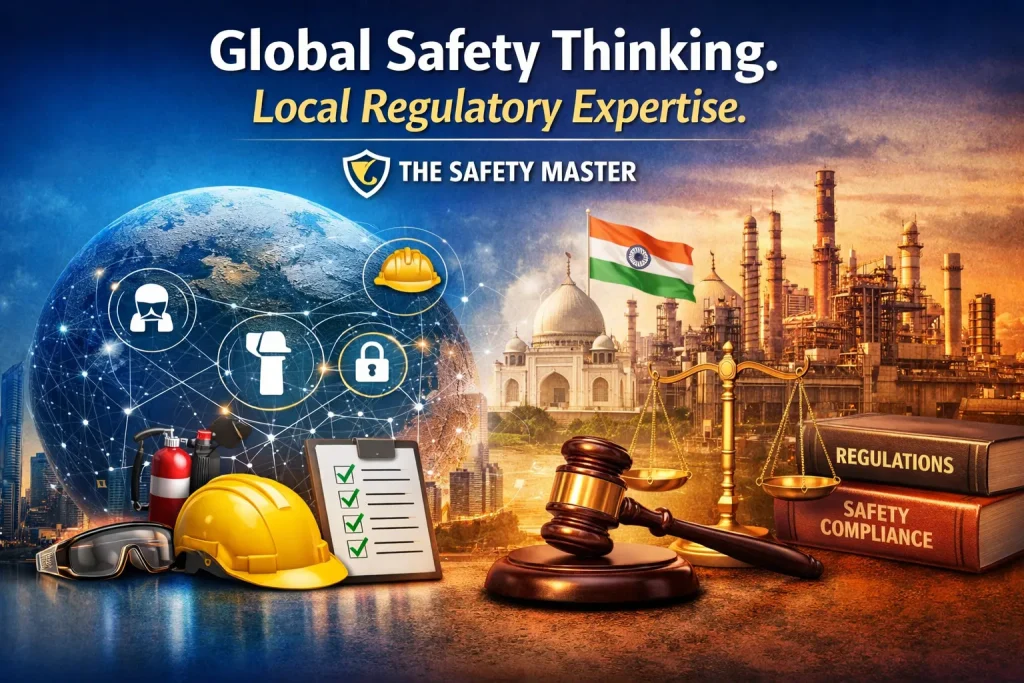
Safety is no longer a local concern confined within factory walls or office boundaries. In today’s interconnected industrial environment, businesses operate across geographies, supply chains span multiple regions, and global benchmarks shape safety expectations. At the same time, every country, state, and even municipality enforces its own set of regulations, compliance frameworks, and enforcement practices. This is where the balance between global safety thinking and local regulatory expertise becomes essential.
Organizations that rely only on global standards often miss critical local compliance requirements. On the other hand, those focused solely on local regulations may fail to adopt advanced safety practices that are already proven worldwide. A practical and effective safety approach lies in integrating both perspectives into a unified system.
Understanding Global Safety Thinking
Global safety thinking refers to adopting internationally recognized standards, methodologies, and best practices to manage risks. These include frameworks such as ISO standards, NFPA guidelines, and process safety principles widely used across industries.
The advantage of global safety thinking is consistency. It provides a structured approach to hazard identification, risk assessment, and mitigation that can be applied across different facilities and locations. It also ensures that organizations stay aligned with evolving safety trends, technologies, and methodologies.
For example, concepts like risk-based inspections, layered protection analysis, and behavior-based safety programs have gained global acceptance because they focus on prevention rather than reaction. These approaches go beyond compliance and aim to build resilient systems that can withstand unexpected events.
However, global standards are often broad in nature. They provide guidelines but may not address the specific legal and operational requirements of a particular region. This is where local expertise becomes critical.
Importance of Local Regulatory Expertise
Local regulatory expertise involves a deep understanding of the laws, codes, and enforcement practices applicable to a specific region. In India, for instance, fire safety, industrial safety, and environmental regulations are governed by multiple authorities, including state fire departments, pollution control boards, and labor departments.
Each authority has its own requirements related to approvals, inspections, documentation, and compliance timelines. Missing even a small detail can lead to penalties, operational delays, or legal complications.
Local expertise ensures that organizations not only meet these requirements but also interpret them correctly. Regulations are often subject to updates, amendments, and varying interpretations by authorities. Having a clear understanding of these nuances helps avoid compliance gaps.
It also enables smoother coordination with local authorities during inspections, audits, and approvals. This reduces uncertainty and ensures that safety measures are aligned with both legal expectations and practical implementation.
Bridging the Gap Between Global and Local
The real challenge lies in integrating global safety practices with local regulatory requirements. This is not a straightforward process, as it requires aligning two different perspectives.
Global standards focus on best practices and risk reduction, while local regulations emphasize compliance and legal accountability. A balanced approach involves adapting global methodologies to fit within the local regulatory framework.
For example, a global standard may recommend advanced fire detection systems based on risk levels. Local regulations may specify minimum requirements for installation and maintenance. By combining both, organizations can implement systems that not only meet legal standards but also provide enhanced protection.
This integration also helps in standardizing safety practices across multiple locations while ensuring that each facility remains compliant with its specific regulatory environment.
Role of Structured Safety Audits
Structured safety audits play a key role in bridging this gap. They provide a systematic way to evaluate existing safety measures, identify gaps, and recommend improvements.
A comprehensive Safety Audit Service typically includes both global best practices and local compliance checks. This ensures that organizations are not just meeting minimum requirements but are also adopting effective risk management strategies.
Audits assess various aspects such as fire safety systems, electrical installations, process hazards, and emergency preparedness. They also review documentation, training records, and maintenance practices to ensure consistency and accountability.
The findings from these audits help organizations prioritize actions, allocate resources efficiently, and continuously improve their safety systems.
Fire Safety as a Critical Focus Area
Fire safety is one of the most important areas where global thinking and local expertise must work together. Industrial and commercial facilities face diverse fire risks depending on their operations, materials, and infrastructure.
A detailed Fire Safety Audit evaluates these risks by considering both international standards and local regulations. It examines fire detection systems, suppression mechanisms, storage practices, and emergency response plans.
By combining global guidelines with local compliance requirements, organizations can ensure that their fire safety systems are both effective and legally compliant. This reduces the likelihood of incidents and minimizes potential damage.
Human Factors and Safety Culture
Safety is not only about systems and regulations; it also depends heavily on human behavior. Even the most advanced safety systems can fail if employees are not aware of risks or do not follow proper procedures.
Global safety thinking emphasizes the importance of building a strong safety culture, where employees actively participate in risk identification and prevention. Local expertise ensures that training programs are relevant to the specific working conditions and regulatory environment.
Programs such as Behavior-Based Safety Training focus on identifying unsafe behaviors and encouraging safer practices. These programs help bridge the gap between theoretical knowledge and practical application.
By aligning training initiatives with both global methodologies and local requirements, organizations can create a workforce that is not only compliant but also proactive in maintaining safety.
Adapting to Changing Risk Landscapes
Industrial environments are constantly evolving. New technologies, materials, and processes introduce new risks that may not be fully covered by existing regulations. At the same time, regulatory frameworks continue to evolve in response to emerging challenges.
Global safety thinking helps organizations stay ahead of these changes by adopting innovative practices and technologies. Local expertise ensures that these innovations are implemented in a way that remains compliant with current regulations.
This dynamic approach allows organizations to adapt quickly to changing conditions while maintaining a high level of safety and compliance.
Building Long-Term Resilience
The integration of global safety thinking and local regulatory expertise is not just about meeting current requirements. It is about building long-term resilience.
Organizations that adopt this approach are better prepared to handle emergencies, adapt to regulatory changes, and maintain operational continuity. They are also more likely to gain the trust of stakeholders, including employees, customers, and regulatory authorities.
Resilience comes from consistency, adaptability, and a commitment to continuous improvement. By combining global knowledge with local understanding, organizations can create safety systems that are both robust and flexible.
Conclusion
Global safety thinking and local regulatory expertise are not competing approaches; they are complementary elements of an effective safety strategy. While global standards provide direction and innovation, local expertise ensures compliance and practical implementation.
By integrating these perspectives, organizations can move beyond basic compliance and build safety systems that are comprehensive, reliable, and future-ready. This balanced approach not only reduces risks but also supports sustainable operations in an increasingly complex industrial landscape.