One Partner. Zero Excuses. Total Safety Ownership

Let’s Fix Safety Before It Fails You
April 17, 2026
Why Annual Safety Partnerships Are Replacing One-Time Audits
April 25, 2026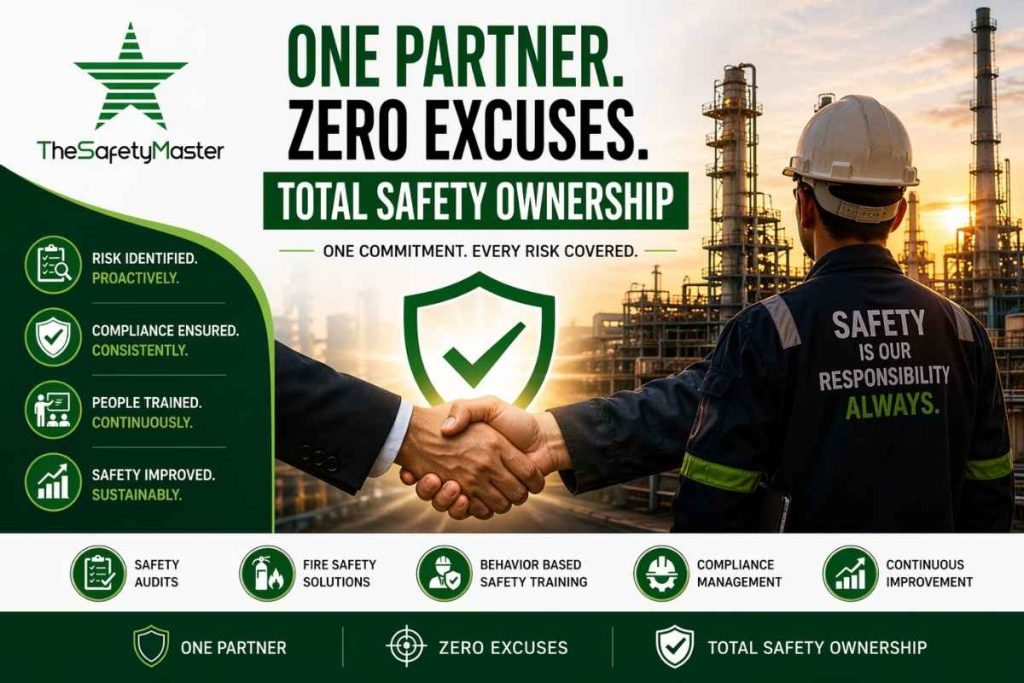
Industrial safety often fails not because systems are missing, but because ownership is unclear. Multiple vendors, fragmented responsibilities, and inconsistent follow-ups create gaps that eventually turn into risks. When safety is divided across departments or outsourced without accountability, it becomes reactive instead of reliable. This is where the concept of “one partner, zero excuses, total safety ownership” becomes critical.
Total safety ownership means having a unified, accountable approach where every aspect of safety—from risk identification to compliance and training—is managed with clarity and consistency. It removes ambiguity, eliminates delays, and ensures that safety is treated as a continuous responsibility rather than a periodic activity.
What Does Total Safety Ownership Really Mean?
Total safety ownership is not just about assigning responsibility. It is about creating a system where safety is managed end-to-end without gaps. This includes:
- Identifying and assessing risks
- Implementing preventive measures
- Monitoring systems and processes
- Ensuring compliance with regulations
- Training employees and improving behavior
- Continuously reviewing and improving safety performance
When one partner takes responsibility for all these aspects, there is no confusion about who is accountable for what. This clarity reduces delays and ensures faster decision-making.
The Problem with Fragmented Safety Management
Many organizations rely on multiple vendors or internal teams to manage different aspects of safety. While this may seem efficient, it often leads to serious challenges:
- Lack of coordination between teams
- Delayed response to identified risks
- Inconsistent documentation and reporting
- Overlapping responsibilities or missed tasks
For example, a risk identified during an audit may not be addressed promptly because it falls under another department. Similarly, training programs may not align with actual operational risks.
Fragmentation creates gaps, and in safety, gaps are where failures begin.
Why One Partner Makes a Difference
Having a single, accountable partner ensures that safety is managed holistically. It brings consistency, clarity, and continuity to safety processes.
A unified approach helps in:
- Streamlining communication and reporting
- Ensuring timely implementation of corrective actions
- Maintaining consistent documentation
- Aligning safety strategies with operational needs
This approach reduces dependency on multiple stakeholders and ensures that safety decisions are made efficiently.
Structured Risk Identification and Control
The foundation of total safety ownership lies in identifying risks before they become incidents. A comprehensive Safety Audit Service plays a key role in this process.
It evaluates:
- Workplace hazards
- Equipment conditions
- Operational practices
- Compliance with safety standards
More importantly, it provides actionable insights that help organizations address risks systematically. When audits are integrated into a broader safety framework, they become a tool for continuous improvement rather than a one-time activity.
Fire Safety Without Gaps
Fire hazards remain one of the most critical risks in industrial and commercial environments. In many cases, fire safety systems exist but are not properly maintained or tested.
A detailed Fire Safety Audit ensures that fire detection, suppression, and response systems are fully functional and aligned with risk levels. It evaluates:
- Fire load and storage practices
- Electrical safety and ignition sources
- Condition of fire protection systems
- Emergency response readiness
When fire safety is managed under a single accountable system, the chances of oversight are significantly reduced.
Eliminating Excuses Through Accountability
“Zero excuses” is not just a phrase—it is a mindset. In safety management, excuses often arise from unclear responsibilities, lack of follow-up, or poor communication.
Common excuses include:
- “This was not our responsibility”
- “The issue was already reported”
- “We were waiting for approval”
Total safety ownership eliminates these excuses by creating a clear chain of accountability. Every identified risk is tracked, assigned, and resolved within defined timelines.
This approach ensures that no issue is ignored or delayed, reducing the likelihood of incidents.
Role of Human Behavior in Safety Ownership
Even the most advanced systems can fail if human behavior is not aligned with safety practices. Employees play a crucial role in maintaining a safe work environment.
Unsafe behaviors such as ignoring procedures, skipping safety checks, or improper equipment handling can lead to serious incidents. Addressing these behaviors requires structured training and awareness programs.
Programs like Behavior-Based Safety Training focus on identifying unsafe actions and promoting safer practices. They help create a culture where employees take responsibility for their own safety and that of others.
When combined with a unified safety framework, behavioral improvements become more consistent and impactful.
Continuous Monitoring and Improvement
Safety is not a static process. It requires continuous monitoring and regular updates to address changing risks and operational conditions.
Total safety ownership ensures that:
- Safety systems are regularly evaluated
- New risks are identified and addressed
- Corrective actions are implemented without delay
- Performance is continuously improved
This ongoing process helps organizations stay ahead of potential risks and maintain a high level of safety.
Technology as an Enabler
Modern safety management relies heavily on technology to improve efficiency and accuracy. Digital tools help in tracking audits, monitoring compliance, and managing documentation.
Real-time data allows organizations to identify trends, predict risks, and take preventive action. Automated systems reduce manual errors and ensure that safety processes are followed consistently.
When integrated into a unified safety framework, technology enhances visibility and accountability across all levels.
Business Impact of Total Safety Ownership
Adopting a single-partner, accountable approach to safety has significant business benefits:
- Reduced incidents and downtime
- Improved compliance with regulations
- Better resource utilization
- Enhanced reputation and trust
More importantly, it creates a stable operational environment where risks are managed proactively.
Conclusion
One partner, zero excuses, total safety ownership is not just a concept—it is a practical approach to managing safety in complex industrial environments. By eliminating fragmentation, ensuring accountability, and integrating all aspects of safety into a single framework, organizations can significantly reduce risks and improve operational reliability.
In a landscape where safety failures can have serious consequences, clarity and accountability are essential. Total safety ownership provides both, ensuring that safety is not just implemented but sustained over time.