Annual Fire Safety Audit Services UAE: Complete Compliance and Safety Reviews

Leading Safety Consultants Malaysia for Process Safety, HIRA, and HAZOP Services
October 28, 2026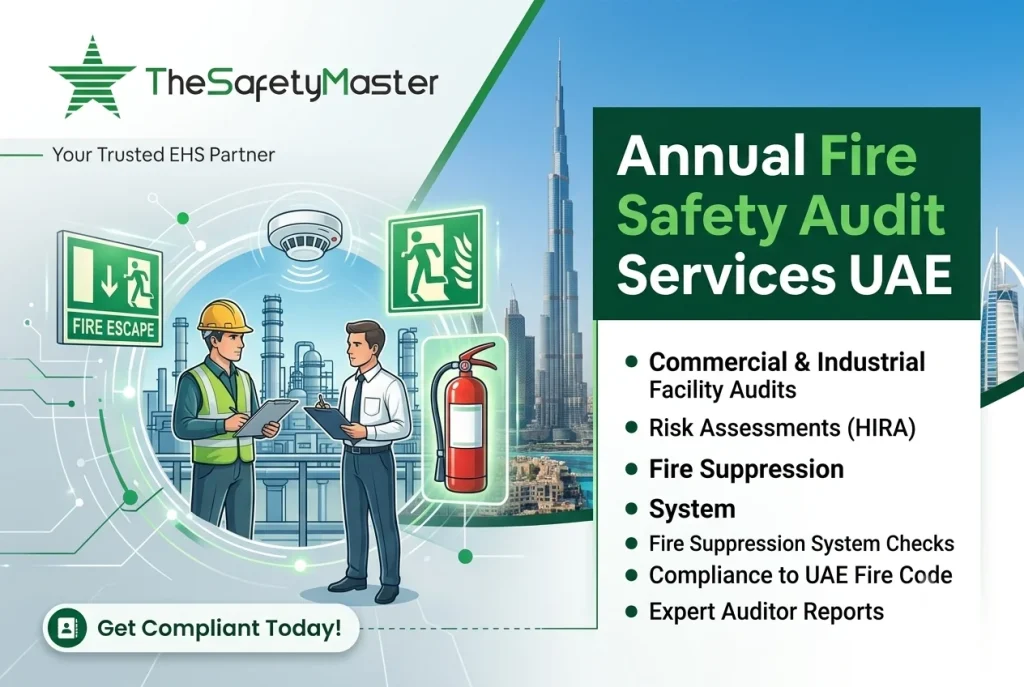
Fire safety is a primary operational requirement for commercial, industrial, and residential properties across the United United Arab Emirates. With stringent regulatory frameworks enforced by the UAE Civil Defence, maintaining compliant life safety systems is both a legal mandate and a top business priority. As a trusted leader in health, safety, and risk management solutions, The Safety Master delivers expert Annual Fire Safety Audit Services UAE tailored to help organizations satisfy all regulatory demands while protecting lives and critical infrastructure.
An annual fire safety audit evaluates property safety readiness, identifying risks before they lead to potential hazards, regulatory fines, or business operational disruptions. Comprehensive audit solutions ensure that active systems, passive barriers, and emergency protocols align perfectly with the latest UAE Fire and Life Safety Code of Practice.
The Critical Need for Fire Safety Audits in the UAE
The rapid development of high-rise towers, expansive logistics hubs, and complex industrial zones in Dubai, Abu Dhabi, and the Northern Emirates necessitates exceptionally high standards of life safety protection. Annual fire audits serve as a structured evaluation mechanism to verify that installed life safety systems remain fully operational throughout the year.
Regulatory Compliance and Civil Defence Mandates
In the UAE, property owners and operating companies must adhere strictly to guidelines set by municipal authorities and the Ministry of Interior’s Civil Defence General Command. Key compliance requirements include:
- Trade License Renewal: Valid Civil Defence approval and updated maintenance documentation are mandatory for business license renewals across the Emirates.
- Mandatory System Continuity: Fire alarm systems, active suppression installations, and 24/7 monitoring systems (e.g., Hassantuk or Direct Alarm Receiver systems) must be kept fully operational.
- Avoidance of Fines and Closure: Non-compliance can result in severe financial penalties ranging from AED 5,000 to AED 50,000+, along with potential operational shutdowns.
Mitigating Property Risks and Financial Liabilities
Beyond regulatory compliance, routine audits protect capital investments. Unchecked electrical overloads, unmaintained suppression pumps, or compromised fire barriers can transform minor incidents into catastrophic losses. Furthermore, insurance providers in the UAE strictly require documented evidence of valid Civil Defence certification and annual safety audits before approving fire damage claims.
Core Components of Comprehensive Fire Safety Audit Services
A detailed fire audit evaluates every layer of a facility’s fire defense architecture. Certified safety engineers inspect three primary domains: active protection, passive protection, and emergency management plans.
Active Fire Protection Systems Review
Active systems require regular physical and operational testing to ensure immediate activation during emergencies:
- Fire Detection & Alarm Systems: Testing smoke, heat, and flame detectors, control panels, manual call points, and notification sounders.
- Fire Suppression Equipment: Verifying automatic sprinkler systems, fire pumps, hose reels, hydrants, and clean-agent systems (FM-200, CO₂, or Novec 1230) in critical areas like server rooms.
- Portable Extinguishers: Confirming hydrostatic pressure, pressure gauge levels, accessibility, and annual inspection tags on all portable extinguishers.
Passive Fire Protection & Building Compartmentation
Passive measures slow the spread of fire and smoke, providing occupants ample time to evacuate safely:
- Fire-Rated Assemblies: Inspecting structural integrity, fire-rated walls, floors, and ceiling assemblies for unsealed penetrations.
- Fire Doors & Dampers: Testing automatic drop-down seals, self-closing mechanisms, latching action, and smoke seals on fire-rated doors and HVAC duct dampers.
- Cladding & Exterior Facades: Reviewing external wall assemblies for compliance with UAE flame-spread specifications.
Means of Egress & Evacuation Readiness
The safety of occupants during an emergency depends on unobstructed evacuation routes:
- Exit Corridors & Stairwells: Ensuring primary and secondary escape paths are free of storage obstructions or flammable hazards.
- Emergency Lighting & Illuminated Signage: Testing battery backup duration for illuminated exit signs and emergency lights.
- Assembly Points & Signage: Confirming designated assembly areas are clearly marked, accessible, and mapped on floor evacuation plans.
Key Audit Phases & Methodology
A systematic audit framework ensures all safety parameters are systematically reviewed and documented.
| Audit Phase | Focus Area | Key Deliverables / Actions |
| Phase 1: Pre-Audit Review | Documentation & Approvals | Review existing Civil Defence permits, annual maintenance contracts (AMCs), and previous testing records. |
| Phase 2: On-Site Inspection | Physical Infrastructure | Visual and functional testing of active equipment, passive barriers, and egress points. |
| Phase 3: Risk Assessment | Hazard Identification | Quantify life safety risks, operational gaps, and structural non-compliance points. |
| Phase 4: Comprehensive Report | Actionable Findings | Detailed report outlining non-conformities, priority levels, and corrective action plans. |
| Phase 5: Re-Inspection & Sign-Off | Verification | Follow-up site review to confirm all identified corrective actions are resolved. |
Industry-Specific Fire Safety Audit Considerations
Different facility types present unique fire risks and operational challenges that require specialized audit checks.
Commercial Real Estate & High-Rise Towers
High-rise structures demand specialized evaluation of stairwell pressurization systems, smoke extraction fans, voice evacuation systems, and phased evacuation procedures.
Industrial Plants, Warehouses & Storage Facilities
Industrial settings require detailed inspection of hazardous material storage (flammable liquids, compressed gas cylinders), high-rack sprinkler clearance, dust explosion risks, and specialized deluge systems.
Hospitality & Healthcare Facilities
Hospitals, hotels, and care facilities prioritize continuous monitoring, non-disruptive sounder testing, clear exit path lighting, and specialized evacuation protocols for non-ambulatory patients.
Selecting an Approved Safety Partner in the UAE
To ensure regulatory compliance, property managers must partner with certified fire safety audit providers. Key selection criteria include:
- Civil Defence Accreditation: Verify the auditing firm is fully licensed and accredited by the local Civil Defence authority (e.g., DCD in Dubai, ADCDA in Abu Dhabi).
- Certified Engineers: Ensure audit teams hold recognized international certifications (such as NFPA, IFE, or equivalent qualifications) alongside local UAE licenses.
- End-to-End Support: Select a partner capable of conducting thorough audits, assisting with Civil Defence submission portals, and overseeing corrective rectifications.
Frequently Asked Questions (FAQs)
1. Is an annual fire safety audit mandatory for all businesses in the UAE?
Yes. The UAE Fire and Life Safety Code requires commercial, industrial, residential, and public premises to undergo periodic fire safety inspections and maintain valid Civil Defence approvals to ensure continuous operation.
2. How does an annual fire safety audit differ from a routine maintenance service?
A routine maintenance service involves minor repairs and operational checks by maintenance contractors. In contrast, an annual fire safety audit is an independent, end-to-end review evaluating the facility’s total compliance, safety management, passive systems, egress routes, and regulatory documentation.
3. What happens if an audit identifies safety violations on my property?
The audit report categorizes non-conformities by risk level and provides a corrective action plan. Property owners must address these points through approved contractors before undergoing a final re-inspection for Civil Defence submission.
4. How long does a fire safety audit take to complete?
The duration depends on facility size and operational complexity. Small commercial units may take a few hours, while multi-story residential towers or large industrial plants can take several days for complete physical testing and report preparation.
5. What documents must be prepared prior to the auditor’s arrival?
Key documents include current Civil Defence building certificates, Annual Maintenance Contracts (AMCs) for active fire systems, previous inspection logs, structural floor plans, and emergency response/evacuation plans.