Fire Safety Audit Report Format: Step-by-Step Checklist for Industrial Facilities

Top-Rated Industrial PPE Supplier in Delhi NCR for Certified Safety Gear & Equipment
November 7, 2026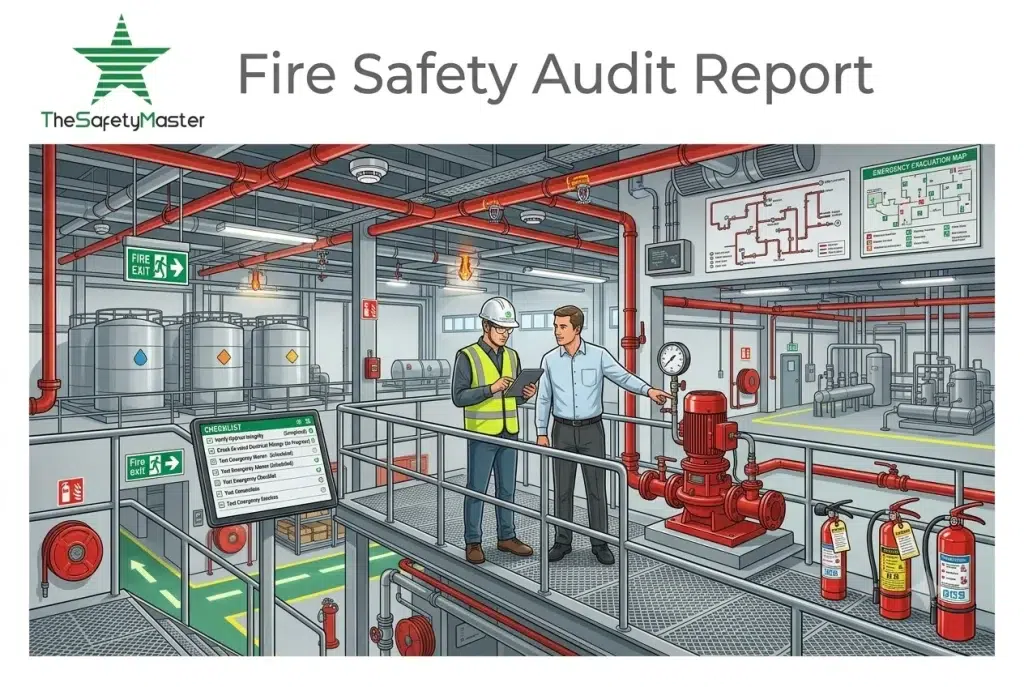
Industrial operations present high risks regarding fire hazards. Combustible dusts, flammable chemicals, high-voltage electrical infrastructure, and continuous hot work create complex hazard profiles. Conducting regular assessments and standardizing your Fire Safety Audit Report format is essential for regulatory compliance, life safety, and asset protection.
At The Safety Master, we help industrial organizations evaluate site risk profiles, comply with National Building Code (NBC) and IS standards, and establish proactive safety management systems. This operational guide provides a structured framework to build and execute a robust Fire Safety Audit Report.
2. Executive Summary & Facility Profile
Every Fire Safety Audit Report should open with an overview of the facility and the audit’s scope. This section provides management and regulatory authorities with an immediate summary of critical findings.
2.1 General Information Table
FieldDescription / ValueFacility Name [The Safety Master] Plant Location [Address / Plot Details] Audit Date [Date of Inspection] Auditor(s)The Safety Master Technical Audit Team Scope of Audit Process Areas, Warehouses, Utilities, & Administrative Blocks
2.2 Audit Objectives
- Identify potential fire and explosion hazards across operational zones.
- Verify compliance with local fire safety acts, NBC guidelines, and relevant IS/NFPA standards.
- Evaluate the readiness and integrity of active and passive fire protection systems.
- Recommend prioritized corrective and preventive actions (CAPA).
3. Pre-Audit Documentation Review
Before performing physical inspections on the shop floor, audit teams must review foundational documentation to verify engineering and administrative controls.
3.1 Essential Verification Items
- Fire No-Objection Certificate (NOC): Verify validity and state fire service renewals.
- Approved Building & Fire Layout Plans: Cross-reference egress routes, hydrant networks, and compartment walls.
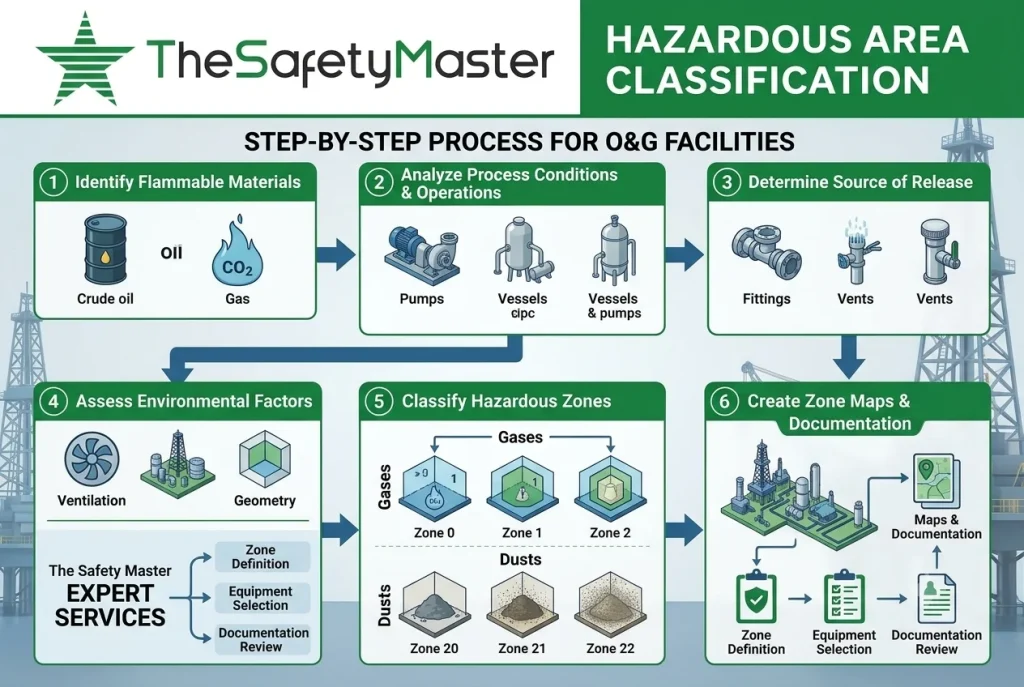
- Hazardous Area Classification (HAC) Drawings: Review zoning maps for explosive atmospheres (Zone 0, 1, 2 or Zone 20, 21, 22).
- Maintenance Logs: Examine testing history for fire pumps, alarms, and sprinkler systems.
4. Industrial Fire Safety Audit Checklist
A complete audit requires examining key structural, mechanical, electrical, and administrative safeguards.
[Fire Safety Audit Audit Domains] │ ┌───────────────────┼───────────────────┐ │ │ │ ▼ ▼ ▼ [Passive Controls] [Active Controls] [Electrical Safety] – Egress Routes – Hydrant Lines – Thermography – Compartmentation – Sprinklers – Flameproof Fixtures – Fire Doors – Detection – Grounding/Earthing
4.1 Section A: Passive Fire Protection Systems
- Means of Egress: Ensure exit doors open outward, remain unobstructed, and are equipped with panic hardware.
- Emergency Exit Signage: Verify illuminated and photoluminescent signs are visible along all evacuation paths.
- Fire Compartmentation: Confirm fire-stop seals exist around cable trays, duct penetrations, and wall openings.
- Fire Doors: Test automatic self-closing mechanisms and verify fire resistance ratings (e.g., 120-minute doors).
4.2 Section B: Active Fire Protection Systems
- Fire Water Storage & Pumps: Verify pump house readiness (Main, Diesel Standby, Jockey) and pressure maintenance.
- Hydrant & Hose Reel Systems: Inspect landing valves, hose boxes, nozzles, and conduct flow tests.
- Automatic Sprinkler Systems: Check control valve isolation switches, pressure gauges, and clearance beneath heads (minimum 18 inches).
- Fire Extinguishers: Confirm correct type selection (ABC, CO2, Foam) for specific hazard zones, pressure gauge status, and hydrostatic test dates.
4.3 Section C: Electrical Safety & Hazardous Areas
- Flameproof Electrical Equipment: Inspect Ex-rated enclosures, glands, and fittings in flammable storage and chemical handling areas.
- Thermal Imaging / Thermography: Check electrical distribution boards and control panels for localized overheating.
- Earthing & Bonding: Ensure static grounding equipment is functional for solvent transfer lines and bulk loading bays.
4.4 Section D: Emergency Preparedness & Human Resources
- Fire Alarm & Detection Systems: Test manual call points (MCPs), smoke detectors, and centralized alarm panels.
- Emergency Response Team (ERT): Verify trained ERT members are available across all operational shifts.
- Mock Drill Records: Confirm biannual or quarterly drill schedules, evacuation timing logs, and debrief notes.
5. Risk Assessment & Audit Findings Format
To make your Fire Safety Audit Report actionable, present physical observation data with risk ratings and structured corrective actions.
5.1 Observation & Corrective Action Matrix
Sr. Observation Location Hazard Category Risk Level Corrective Action Required Target Date Responsibility 1 Emergency exit door locked from inside during shift hours. Packing Bay 2 Life Safety High Remove padlocks immediately; install panic bars. Immediate EHS Manager 2 Non-flameproof junction box installed near solvent storage tank. Tank Farm Zone 1 Explosion High Replace with certified Ex-d enclosure. 15 Days Electrical Lead 3 Sprinkler head clearance blocked by stacked wooden pallets. Main Warehouse Suppression Medium Rearrange storage to maintain 36-inch clearance. 3 Days Store Manager 4 Fire pump diesel engine battery terminal corroded. Fire Pump House System Integrity Medium Clean terminals, apply petroleum jelly, test auto-start. 2 Days Maintenance Lead
Want to go deeper into this topic? Check out our detailed Blog
6. Action Plan & Management Recommendations
A successful audit concludes with a prioritized action plan that frames safety as an operational necessity.
6.1 Priority Implementation Phasing
- Immediate Risk Remediation (0 – 48 Hours): Clear blocked egress pathways, unlock exit doors, and restore fire pump auto-mode functionality.
- Short-Term Actions (1 – 3 Weeks): Repair fire dampers, replace damaged fire hoses, and complete overdue extinguisher maintenance.
- Long-Term Capital Upgrades (1 – 3 Months): Install localized gas detection systems, upgrade non-compliant electrical panels, and update compartmentation barriers.
6.2 How The Safety Master Supports Your Compliance Journey
The Safety Master provides comprehensive industrial safety consulting services, including:
- Third-Party Fire Safety Audits & Compliance Mapping
- Quantitative Risk Assessment (QRA) & Process Safety Management (PSM) Implementation
- Hazardous Area Classification (HAC) & Electrostatic Hazard Audits
- Customized Safety Training for Industrial Emergency Response Teams
7. Frequently Asked Questions (FAQs)
Q1: What is a Fire Safety Audit Report?
A Fire Safety Audit Report is an evaluation document that reviews a facility’s fire hazards, structural risks, life safety systems, and regulatory compliance. It outlines corrective action recommendations to reduce risk and meet statutory codes.
Q2: How often should an industrial facility conduct a Fire Safety Audit?
Industrial facilities should conduct a comprehensive third-party fire safety audit at least once a year. High-hazard facilities, such as chemical plants, refineries, and major hazard installations (MHI), should perform internal audits quarterly or semi-annually.
Q3: What national standards govern Fire Safety Audits in India?
Primary frameworks include the National Building Code (NBC) of India, IS 14489 (Code of Practice on Occupational Safety and Health Audit), state-specific Fire Prevention and Life Safety Measures Acts, and relevant NFPA guidelines for specialized hazards.
Q4: What is the difference between active and passive fire protection?
Active fire protection requires detection or manual/automatic initiation to fight fires (e.g., sprinklers, hydrants, alarm systems, fire extinguishers). Passive fire protection contains fire spread through structural design (e.g., fire-rated walls, fire doors, smoke dampers, and cable fireproofing).
Q5: How does The Safety Master assist with Fire Safety Audits?
The Safety Master provides specialized technical safety audits, site inspections, and customized safety reports. Our certified safety experts evaluate plant infrastructure, audit operational procedures, and help facilities achieve compliance with national and international standards.