The Role of Leadership in Driving Safety Culture Transformation

10 Essential Electrical Safety Training Topics for a Safer Workplace
June 6, 2023
The Ultimate Guide to Implementing BIS14489 Safety Audit Standards
June 6, 2023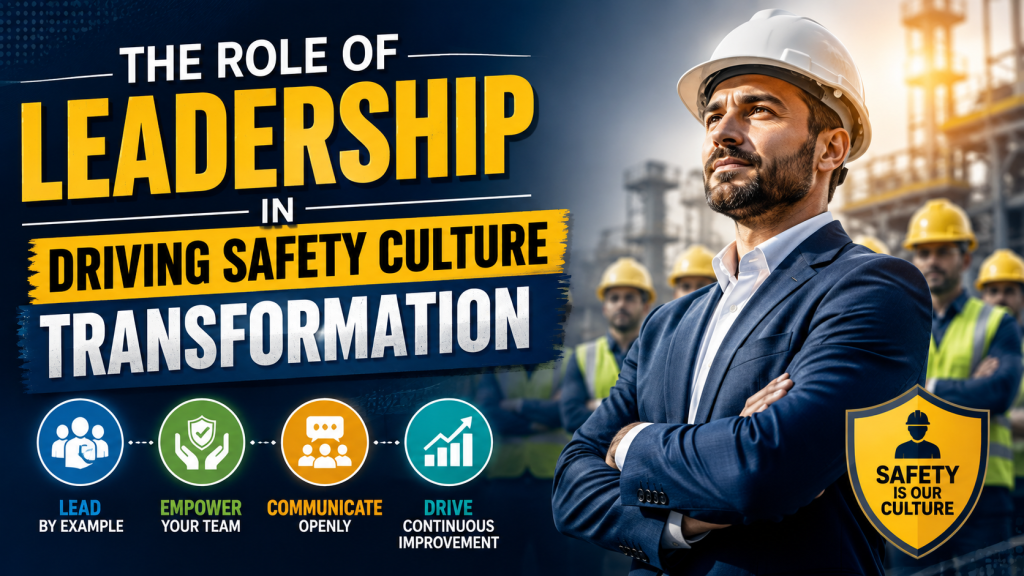
Every year, workplace accidents affect millions of people, many of which can be prevented through effective safety practices and a strong organizational culture. Leaders play a crucial role in creating an environment where employee well-being, risk prevention, and responsible behavior are treated as priorities. Organizations such as the safety master emphasize the importance of leadership, employee participation, and continuous improvement in developing safer workplaces.
Leadership is not simply about creating safety rules or procedures. It is about influencing behavior, setting clear expectations, encouraging communication, and demonstrating through actions that safety matters. Whether managing a small team or leading a large organization, effective leadership can help transform workplace safety from a set of instructions into a shared organizational value.
The Importance of Safety Culture Transformation
A strong safety culture is essential for protecting employees and supporting long-term organizational success. It means that safety is integrated into everyday decisions, workplace practices, employee behavior, and management processes.
Transforming a safety culture can help reduce workplace accidents, improve employee morale, strengthen productivity, and increase trust between employees and management. When workers understand that their health and safety genuinely matter, they are more likely to follow procedures, report hazards, and participate actively in safety initiatives.
Leadership is at the center of this transformation. Senior executives, managers, supervisors, and team leaders must demonstrate a consistent commitment to safety. When leaders follow safety procedures themselves, recognize safe behavior, and respond seriously to employee concerns, they establish a powerful example for the entire organization.
The First Step Toward a Strong Safety Culture
Before making improvements, leaders must understand the current state of workplace safety. An honest assessment can identify existing strengths, weaknesses, hazards, and behavioral challenges.
Employees should be encouraged to share their experiences and concerns because frontline workers often have valuable knowledge about risks that may not be visible to management. Safety inspections, employee surveys, incident reviews, near-miss reporting, and workplace observations can provide useful information.
After identifying areas for improvement, leaders should develop a clear safety vision. This vision needs to align with the organization’s broader goals and should be communicated consistently throughout the workplace. More importantly, employees should understand how their individual responsibilities contribute to achieving that vision.
Characteristics of a Transformational Safety Leader
A transformational safety leader inspires employees to take ownership of workplace safety rather than simply following instructions. Such leaders are proactive, approachable, strategic, and committed to continuous improvement.
Effective communication is one of their most important qualities. Leaders must be able to explain safety expectations clearly while also listening carefully to employees. Listening creates opportunities to identify hazards, understand workplace challenges, and discover practical solutions.
Transformational leaders also invest in employee development. Training, coaching, skill development, and regular safety discussions help employees build confidence and improve their ability to recognize and manage risks.
Collaboration is equally important. Safety should not be viewed as the responsibility of one department. Leaders should encourage cooperation between management, supervisors, safety professionals, and frontline workers so that everyone contributes to creating a safer workplace.
Creating a Vision for Safety Success
A successful safety transformation begins with a clear definition of what safety excellence means for the organization. Leaders should establish measurable and realistic goals, such as reducing injuries, increasing near-miss reporting, improving training participation, or strengthening compliance with safety procedures.
These goals should be communicated in simple and practical terms. Employees are more likely to support safety objectives when they understand why the goals matter and how their work contributes to achieving them.
Creating the vision should also involve employees. When workers participate in setting safety goals and identifying improvement opportunities, they are more likely to develop a sense of ownership and accountability. Shared responsibility can strengthen trust and encourage greater participation.
Inspiring Ownership and Accountability
A strong safety culture develops when employees believe that safety is everyone’s responsibility. Leaders can encourage ownership by involving workers in safety discussions, policy development, risk assessments, and improvement initiatives.
Clear expectations are essential. Employees should understand the required safety behaviors, procedures, and responsibilities. At the same time, accountability should be applied fairly and consistently.
Recognition also plays an important role. Employees who demonstrate safe behavior, report hazards, or contribute useful improvement ideas should receive appropriate appreciation. Positive recognition reinforces desirable behaviors and demonstrates that safety efforts are valued.
Encouraging Communication and Building Trust
Open communication is a foundation of an effective safety culture. Employees should feel comfortable reporting hazards, near misses, unsafe conditions, and incidents without fear of unfair retaliation.
Leaders can build trust by listening to concerns and responding appropriately. Simply asking employees to report problems is not enough; management must demonstrate that reports are taken seriously and followed by meaningful action.
Regular safety meetings, toolbox talks, feedback sessions, employee surveys, and workplace discussions can create opportunities for communication. Strong communication helps organizations identify potential problems before they develop into serious incidents.
Celebrating Safety Successes
Safety improvements deserve recognition. Celebrating achievements, whether large or small, can improve morale and encourage employees to continue supporting safety initiatives.
Recognition can include acknowledging employees who identify hazards, teams that complete training successfully, or departments that achieve measurable improvements. Celebrating these accomplishments reinforces the message that safety is an important organizational priority.
However, recognition should focus on meaningful safety behaviors and improvements rather than simply rewarding the absence of reported incidents. Employees must always feel encouraged to report problems honestly.
Maintaining Consistency in Safety Practices
Consistency is essential when building trust. Leaders must ensure that safety expectations apply across departments, positions, and levels of management.
For example, if personal protective equipment is required, managers and supervisors should follow the same requirements as employees. Leaders who ignore safety rules while expecting workers to follow them can quickly undermine organizational credibility.
Consistent communication, enforcement, training, and leadership behavior demonstrate that safety is a genuine value rather than a temporary initiative.
Empowering Employees to Challenge the Status Quo
Strong safety cultures encourage employees to question unsafe practices and suggest better solutions. Leaders should create an environment where employees feel comfortable proposing improvements.
Innovation can involve introducing better equipment, improving procedures, changing workflows, or developing more effective training methods. Leaders should provide employees with the necessary support, resources, and opportunities to test practical improvements.
When employees know their ideas are valued, they are more likely to participate actively in safety improvement efforts.
Continuous Improvement in Safety Culture
Safety culture transformation is an ongoing process rather than a one-time project. Workplace conditions, technologies, regulations, processes, and risks can change over time, making continuous evaluation essential.
Leaders should regularly review safety performance, investigate incidents, analyze near misses, gather employee feedback, and update procedures when necessary. Training should also evolve as new risks and working methods emerge.
Continuous improvement requires commitment from every level of the organization. Leaders must remain visible, communicate progress, recognize achievements, and address weaknesses without losing focus.
Conclusion
Leadership has a direct influence on how safety is understood and practiced within an organization. A strong safety culture cannot be created through policies alone. It requires leaders who communicate clearly, demonstrate safe behavior, encourage accountability, listen to employees, recognize achievements, and support continuous improvement.
By involving employees and making safety part of everyday decision-making, organizations can create workplaces where people actively look after their own safety and the safety of others. Strong leadership ultimately transforms safety from a compliance requirement into a shared value that supports employee well-being, operational performance, and long-term organizational success.
Safety Services
TSM TheSafetyMaster Private Limited offers services designed to support organizations in developing stronger workplace safety practices, including:
- Behavior-Based Safety Implementation
- Safety Perception Survey
- Behavior-Based Safety Training for Employees
- Behavior-Based Software
For more information, contact +91-7665231743 or email info@thesafetymaster.com.