The Hidden Threat: Understanding the Dangers of Dust Explosions

Electrostatic Discharge: A Hidden Enemy in the Workplace
June 8, 2023
The Role of Industrial Hygiene Audits in Achieving Safe Workplaces
June 9, 2023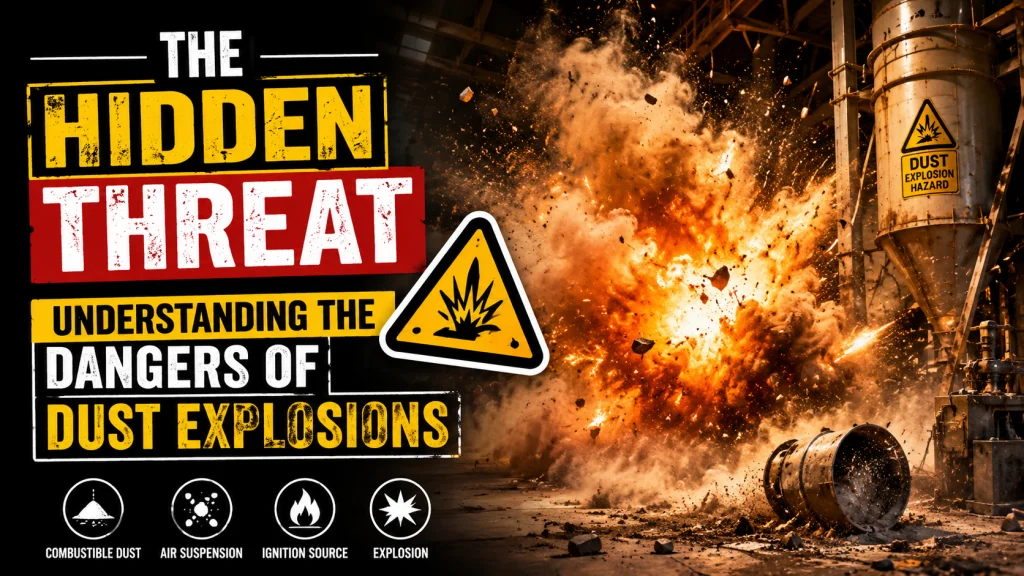
Dust explosions are a serious industrial hazard that can occur when combustible dust particles become suspended in the air and encounter an ignition source. Although they may seem like a minor workplace concern, accumulated dust can create conditions capable of causing fires, explosions, equipment damage, severe injuries, and fatalities. The Safety Master approach to industrial safety emphasizes identifying hazards early, controlling risks, and ensuring workers understand the dangers associated with combustible materials.
Introduction
Dust explosions are a hidden danger across several industries, including agriculture, food processing, manufacturing, woodworking, pharmaceuticals, chemicals, mining, and metal processing. Materials that appear harmless in their solid form can become highly hazardous when processed into fine particles.
A dust explosion can cause devastating consequences for workers, equipment, buildings, and business operations. Understanding how these incidents occur and implementing effective preventive measures are essential for maintaining a safe working environment.
What Are Dust Explosions?
A dust explosion occurs when fine combustible particles become dispersed in the air and are exposed to an ignition source. Under suitable conditions, the particles can burn rapidly, producing heat, expanding gases, and pressure.
Common combustible dusts include particles produced from materials such as:
- Flour and grains
- Sugar and food products
- Wood and sawdust
- Coal
- Certain plastics
- Pharmaceuticals
- Metals such as aluminum and magnesium
- Agricultural products
The danger increases when dust accumulates on floors, equipment, beams, ducts, ceilings, or other surfaces. A small initial explosion can disturb accumulated dust and send it into the air, potentially creating conditions for a much larger secondary explosion.
Understanding the Causes of Dust Explosions
Several conditions generally need to exist for a combustible dust explosion to occur. These include combustible material, oxygen, an ignition source, dust dispersion, and sufficient dust concentration.
Combustible Dust
Not every type of dust is explosive, but many materials can become combustible when reduced to fine particles. Smaller particles generally have a greater surface area relative to their volume, allowing them to burn rapidly when dispersed in air.
Ignition Sources
Potential ignition sources may include open flames, hot surfaces, sparks, electrical faults, friction, overheated machinery, welding activities, and electrostatic discharge. Controlling these sources is therefore an important part of dust explosion prevention.
Dust Accumulation
Poor housekeeping can allow combustible dust to accumulate over time. Even a thin layer of dust in the wrong location can become hazardous if it is disturbed and suspended in the air.
Poor Ventilation
Inadequate ventilation and dust extraction can allow airborne particles to reach dangerous concentrations. Properly designed extraction and ventilation systems can help control dust levels and reduce the likelihood of hazardous accumulation.
How Dust Explosions Impact Workers and Facilities
The consequences of a dust explosion can be severe. Workers may suffer burns, cuts, fractures, hearing damage, respiratory injuries, or other life-threatening injuries. In serious incidents, fatalities may occur.
Facilities can also experience extensive damage. Explosions may destroy machinery, electrical systems, storage areas, production equipment, walls, roofs, and other structural components. Fires following an explosion can further increase the extent of damage.
Business operations may also be interrupted because of equipment replacement, facility repairs, investigations, regulatory requirements, production downtime, and financial losses. Therefore, dust explosion prevention is not only a worker-safety responsibility but also an important part of business continuity and asset protection.
Preventive Measures for Dust Explosions
Effective prevention requires a combination of engineering controls, housekeeping, maintenance, safe work practices, and employee training.
Maintain Good Housekeeping
Regularly remove combustible dust from floors, machinery, ledges, beams, ducts, and other surfaces. Cleaning schedules should be established according to the type and quantity of dust generated.
Use Appropriate Dust Collection Systems
Proper dust extraction and collection systems can reduce airborne dust and prevent accumulation. These systems should be appropriately designed, maintained, and inspected for the materials and processes involved.
Control Ignition Sources
Identify and control potential ignition sources throughout the facility. Electrical equipment, machinery, hot surfaces, welding activities, and static electricity should be assessed as part of the overall hazard-control strategy.
Maintain Equipment
Regular inspection and preventive maintenance can help identify overheating equipment, worn components, damaged electrical systems, and mechanical problems before they create dangerous conditions.
Apply Safe Storage and Handling Practices
Combustible materials should be stored and handled according to appropriate safety procedures. Processes that generate excessive dust should be evaluated and controlled wherever reasonably possible.
Safety Training for Workers
Worker training is one of the most important components of dust explosion prevention. Employees should understand what combustible dust is, where it can accumulate, and how seemingly routine activities can introduce ignition sources.
Training should cover:
- Identification of combustible dust hazards
- Safe housekeeping practices
- Proper use of dust collection systems
- Identification of potential ignition sources
- Safe equipment operation
- Emergency response procedures
- Reporting of unsafe conditions
- Appropriate personal protective equipment
Workers should also understand that dust does not need to form a visibly large pile to represent a hazard. Small accumulations can become dangerous when disturbed and dispersed into the atmosphere.
Emergency preparedness is equally important. Employees should know evacuation routes, emergency alarms, assembly points, reporting procedures, and their responsibilities during an incident. Regular drills can help improve response and reduce confusion during an emergency.
Importance of Risk Assessment and Safety Management
A comprehensive risk assessment can help organizations identify combustible dust hazards before an incident occurs. The assessment should consider the materials used, production processes, dust-generating activities, equipment, ventilation, housekeeping practices, ignition sources, and emergency arrangements.
Organizations should also periodically review their safety procedures because changes in production processes, equipment, materials, or facility layouts can introduce new hazards.
Conclusion
Dust explosions pose a significant threat to workers, facilities, equipment, and business operations across many industries. However, the risk can be reduced through proper hazard identification, effective housekeeping, suitable dust collection, ignition-source control, equipment maintenance, worker training, and emergency preparedness.
Employers should treat combustible dust as a serious industrial safety concern rather than an ordinary housekeeping issue. A proactive safety management system can help organizations identify hazards early, strengthen workplace controls, and protect both people and valuable assets.
Safety Services
TSM TheSafetyMaster Private Limited provides a range of industrial safety and risk-management services, including:
- HAZID
- HAZOP Study
- SIL Study
- LOPA
- QRA Study
- Electrostatic Hazard Assessment
- PHSER Study
- ERDMP
- Escape, Evacuation and Rescue Analysis
- PSSR Study
TSM TheSafetyMaster Private Limited
Unit No. 221-451-452, SPL1/J, 2nd & 4th Floor, Sunsquare Plaza Complex, RIICO Chowk, Bhiwadi 301019, Rajasthan, India
Phone: +91 1493 22 0093
Mobile: +91 7665231743 / 9413882016
Email: info@thesafetymaster.com