The Importance of HAZOP Study in Preventing Accidents and Promoting Safe Operations in Indian Chemical Plants

Strategic Emergency Planning: The Crucial Connection Between Risk Assessment and Hazard Identification
October 27, 2023
Unleashing the Potential: How Behaviour Based Safety Implementation Transforms Employee Mind-sets
October 30, 2023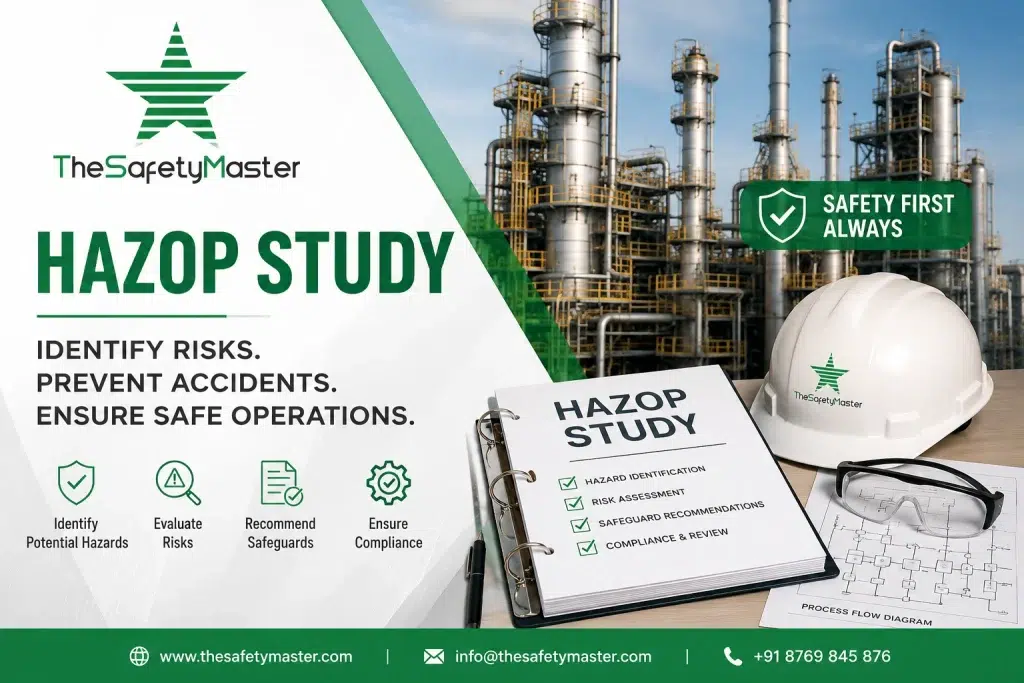
Chemical plants handle hazardous substances, high temperatures, high pressures, flammable materials, and complex process operations. Even a small deviation from normal operating conditions can result in fire, explosion, toxic release, equipment damage, or serious injuries. This is why a systematic risk assessment approach is essential for the Indian chemical industry.
A HAZOP Study (Hazard and Operability Study) is one of the most effective techniques used to identify process hazards, operational problems, and potential accident scenarios before they occur. By systematically examining process deviations and their consequences, HAZOP helps chemical plants strengthen safety controls, improve operating procedures, and promote safer operations.
What Is a HAZOP Study?
HAZOP is a structured and team-based process safety assessment technique. It examines a process by dividing it into manageable sections, commonly called nodes, and identifying possible deviations from the intended design or operating conditions.
The study uses guide words such as:
- No
- More
- Less
- Reverse
- As well as
- Other than
- Part of
These guide words are combined with process parameters such as flow, pressure, temperature, level, composition, and reaction conditions.
Example of HAZOP Analysis
Consider a chemical process where a reactor requires a controlled flow of a raw material.
A HAZOP team may consider the deviation:
Deviation: No Flow
The team can then examine:
- What could cause no flow?
- What happens if the flow stops?
- Could the reaction become unstable?
- What safeguards are available?
- Can an operator detect the problem?
- What additional recommendations are required?
This systematic approach helps identify risks that may otherwise remain unnoticed.
Why HAZOP Study Is Important for Indian Chemical Plants
Indian chemical manufacturing includes industries such as petrochemicals, pharmaceuticals, fertilizers, specialty chemicals, paints, polymers, and bulk chemicals. These facilities may involve significant quantities of hazardous substances.
A properly conducted HAZOP Study helps organizations identify weaknesses before they develop into incidents.
1. Identifies Hazards Before an Accident
One of the primary benefits of HAZOP is early hazard identification.
The study considers possible deviations from the intended process design and evaluates their causes and consequences. This allows the plant to take preventive action before an incident occurs.
Potential scenarios may include:
- Loss of cooling
- Excessive pressure
- High temperature
- Low or high flow
- Reverse flow
- Equipment failure
- Utility failure
- Instrument malfunction
- Human error
- Loss of containment
Early identification gives management an opportunity to introduce suitable safeguards.
2. Prevents Fire and Explosion Risks
Many chemical plants handle flammable liquids, gases, vapours, and combustible materials. Process deviations can create conditions that increase the possibility of fire or explosion.
HAZOP can help identify scenarios such as:
- Flammable material leakage
- Excess temperature
- Loss of inerting
- Overpressure
- Incorrect chemical addition
- Loss of cooling
- Ignition source exposure
The recommendations generated from the study can support improvements in alarms, interlocks, emergency shutdown systems, relief systems, operating procedures, and other safeguards.
3. Reduces the Risk of Toxic Releases
Chemical exposure can have severe consequences for workers and surrounding communities.
A HAZOP Study examines scenarios that could lead to the release of hazardous chemicals. The team can assess possible causes such as:
- Pipeline failure
- Valve failure
- Tank overfilling
- Seal failure
- Instrument malfunction
- Incorrect operating procedure
- Loss of containment
The analysis can then identify additional safeguards and emergency response requirements.
How HAZOP Helps Improve Process Safety
HAZOP is not only about identifying hazards. It also helps organizations understand whether existing safeguards are adequate.
HAZOP Examines Causes and Consequences
For every significant deviation, the HAZOP team considers:
Deviation → Causes → Consequences → Existing Safeguards → Recommendations
For example:
High Pressure
Possible causes may include:
- Blocked outlet
- Excessive reaction rate
- Cooling failure
- Control valve malfunction
Possible consequences may include:
- Equipment damage
- Pressure relief activation
- Loss of containment
- Fire or toxic exposure
Existing safeguards could include:
- Pressure alarms
- Relief valves
- Interlocks
- Emergency shutdown systems
If the safeguards are insufficient, the HAZOP team may recommend additional risk reduction measures.
Major Benefits of HAZOP Study
Improved Risk Identification
HAZOP provides a systematic method for identifying process hazards rather than depending only on individual experience or intuition.
Better Safety Systems
The recommendations can highlight where additional alarms, interlocks, emergency shutdown systems, detection systems, or engineering controls may be required.
Improved Operating Procedures
HAZOP findings can be used to improve startup, shutdown, emergency, maintenance, and normal operating procedures.
Reduced Human Error
Human error is an important consideration in process safety. HAZOP can identify situations where unclear procedures, poor interfaces, inadequate training, or incorrect actions could contribute to an incident.
Stronger Emergency Preparedness
HAZOP scenarios can help organizations understand potential emergency situations and improve emergency response planning.
HAZOP Study Process in Chemical Plants
A successful HAZOP generally follows a structured process.
1. Define the Scope
The study team first defines the process, plant area, equipment, operating conditions, and study boundaries.
2. Collect Process Information
Relevant information may include:
- Process Flow Diagrams (PFDs)
- Piping and Instrumentation Diagrams (P&IDs)
- Equipment specifications
- Operating procedures
- Design data
- Chemical information
- Control philosophy
- Safety system details
3. Divide the Process Into Nodes
The process is divided into logical sections so that each part can be examined systematically.
4. Apply HAZOP Guide Words
The team applies guide words to process parameters to identify deviations from design intent.
5. Identify Causes and Consequences
Each deviation is examined to determine its possible causes and potential consequences.
6. Review Existing Safeguards
The team identifies existing engineering and administrative safeguards and evaluates whether they adequately control the risk.
7. Develop Recommendations
Where additional controls are necessary, recommendations are recorded for further action.
8. Follow Up on Actions
A HAZOP is only effective when recommendations are properly reviewed, assigned, implemented, and closed.
Who Should Participate in a HAZOP Study?
HAZOP is most effective when conducted by a multidisciplinary team. Depending on the process, participants may include:
- Process engineers
- Chemical engineers
- Instrumentation engineers
- Mechanical engineers
- Electrical engineers
- Operations personnel
- Maintenance professionals
- Process safety specialists
- HAZOP facilitator
- Project or management representatives
Different perspectives help the team identify a wider range of credible scenarios.
Role of HAZOP in Indian Chemical Industry Safety
For Indian chemical plants, process safety requires more than simply complying with written procedures. Organizations need to understand how their processes can fail and what controls are required to prevent major incidents.
HAZOP can support a proactive safety culture by encouraging teams to ask:
- What can go wrong?
- Why can it happen?
- What could happen next?
- What safeguards already exist?
- Are those safeguards sufficient?
- What additional action is required?
This approach helps organizations move from reactive accident investigation toward proactive risk management.
HAZOP and Continuous Process Safety Improvement
HAZOP should not be considered a one-time activity that ends when the report is completed.
The findings should be reviewed when there are significant changes to:
- Process design
- Equipment
- Raw materials
- Production capacity
- Operating conditions
- Control systems
- Procedures
- Plant configuration
Management of Change (MOC) is therefore closely connected with maintaining process safety. A significant process modification may require the hazards and safeguards to be reassessed.
Common Mistakes to Avoid During HAZOP
Treating HAZOP as a Documentation Exercise
The objective is risk reduction, not simply producing a report.
Using an Inexperienced Team
The quality of the study depends heavily on the knowledge and experience of the participants.
Ignoring Human Factors
Operator actions, procedures, communication, alarms, and maintenance activities should be considered where relevant.
Failing to Close Recommendations
Open recommendations can leave identified risks unresolved. Every action should have an owner, priority, and appropriate follow-up.
Why Professional HAZOP Training Matters
A well-executed HAZOP requires knowledge of process safety, risk assessment methodology, guide words, process design, safeguards, and team facilitation.
Professional HAZOP training helps engineers, safety professionals, process specialists, and operations personnel understand how to participate effectively in HAZOP studies. Organizations such as The Safety Master can help safety professionals develop practical knowledge of HAZOP methodology and process safety concepts.
Conclusion
A HAZOP Study is a powerful tool for preventing accidents and improving safe operations in Indian chemical plants. It provides a structured way to identify process deviations, understand their causes and consequences, evaluate existing safeguards, and recommend additional risk controls.
The greatest value of HAZOP comes from converting identified hazards into practical safety improvements. When supported by competent teams, accurate process information, strong management commitment, and proper recommendation follow-up, HAZOP can significantly strengthen process safety and help protect workers, assets, the environment, and surrounding communities.
For organizations looking to build stronger process safety capabilities, The Safety Master can support professional learning and safety-focused development through structured training and process safety expertise.
Frequently Asked Questions (FAQs)
1. What is the main purpose of a HAZOP Study?
The main purpose of a HAZOP Study is to systematically identify process hazards and operational problems by examining deviations from the intended design and evaluating their causes, consequences, and safeguards.
2. Why is HAZOP important in chemical plants?
HAZOP is important because chemical plants may handle hazardous chemicals, high pressures, high temperatures, and flammable materials. The study helps identify potential accident scenarios and provides recommendations to reduce process risks.
3. Who should participate in a HAZOP Study?
A HAZOP team should generally include people from different disciplines, such as process engineering, operations, instrumentation, mechanical engineering, maintenance, and process safety, along with an experienced HAZOP facilitator.
4. When should a HAZOP Study be conducted?
HAZOP is commonly conducted during the design or modification stage of a process and may also be reviewed when significant changes are made to equipment, processes, operating conditions, or procedures.
5. How does HAZOP help prevent industrial accidents?
HAZOP identifies potential deviations before they result in an incident. By examining causes, consequences, and existing safeguards, the team can recommend additional controls to reduce the likelihood or severity of accidents.