How Process Hazard Analysis Elevates Safety Standards in Indian Process Industries

Bridging the Gap: Implementing Behaviour-Based Safety for a Safer Manufacturing Workplace
December 30, 2023
Enhancing Worker Competence and Safety through Behaviour based Safety Management Implementation
January 4, 2024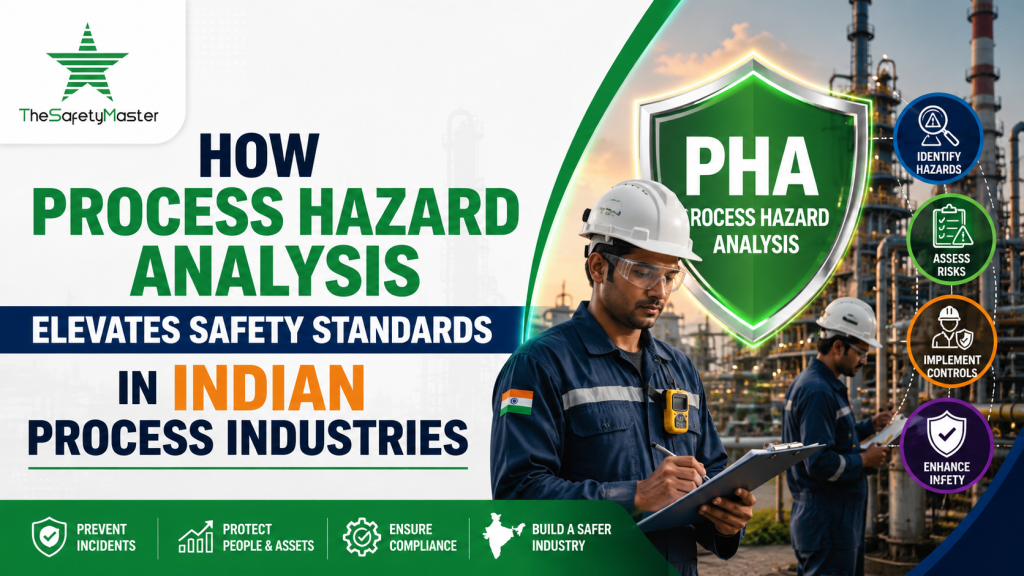
In this article, we delve into the critical topic of how Process Hazard Analysis (PHA) is revolutionizing safety standards within the Indian process industries. With a primary focus on enhancing workplace safety and averting potential catastrophes, PHA provides a systematic approach to identifying, evaluating, and mitigating hazards. As we explore this indispensable methodology, we will uncover its significance in preventing accidents, safeguarding industry workers, and fostering a culture of safety across various sectors. The Safety Master emphasizes the importance of structured safety practices, and PHA is one of the most effective approaches for achieving this objective.
Introduction
In the realm of safety, vigilance is paramount. In Indian process industries, where complex operations and hazardous substances are prevalent, ensuring the utmost safety is not only a legal requirement but also a moral obligation. This is where Process Hazard Analysis (PHA) emerges as a vital tool for elevating safety standards.
For process industries in India, understanding the significance of PHA and its impact on operations is essential for building safer workplaces. PHA offers a systematic way to identify potential hazards, evaluate their consequences, and establish effective controls before incidents occur. By applying this methodology, organizations can strengthen their safety systems while protecting employees, facilities, communities, and the environment.
Importance of Process Hazard Analysis in Indian Process Industries
In Indian process industries, the importance of Process Hazard Analysis cannot be overstated. This proactive approach to identifying, evaluating, and mitigating potential hazards plays a crucial role in elevating safety standards. By systematically analyzing processes and identifying vulnerabilities, PHA enables industry professionals to develop robust strategies that prioritize safety.
Process Hazard Analysis serves as a cornerstone for risk management because it helps organizations identify and address potential hazards before they develop into catastrophic incidents. Instead of relying solely on reactive measures, industries can proactively assess manufacturing processes, recognize possible risks, and implement suitable safeguards.
Whether in a chemical plant, refinery, pharmaceutical facility, or petrochemical operation, PHA fosters a strong culture of safety. This systematic examination not only improves operational reliability but also safeguards workers and surrounding communities. Investing in comprehensive PHA practices demonstrates an organization’s commitment to safety while providing long-term benefits such as improved productivity, reduced downtime, and lower costs associated with accidents.
Understanding Process Hazard Analysis
Process Hazard Analysis is a meticulous and systematic approach used to identify potential hazards in industrial processes and evaluate their associated risks. It involves examining processes, equipment, operating conditions, and procedures to identify deviations that could result in hazardous consequences.
Several methodologies can be used during PHA, including Hazard and Operability Study (HAZOP), What-If Analysis, Fault Tree Analysis (FTA), Event Tree Analysis (ETA), and Failure Modes and Effects Analysis (FMEA). Each technique examines different aspects of an operation, providing industries with a comprehensive understanding of potential risks.
The underlying principle of PHA is not simply to identify hazards but also to understand their root causes. It examines factors such as temperature, pressure, flow rates, material properties, equipment reliability, human factors, and external influences. Understanding how these elements interact enables industries to develop effective risk mitigation strategies.
Ultimately, PHA empowers organizations to proactively manage operational risks. Through detailed examination of hazards and their causes, Indian process industries can establish effective safety frameworks while encouraging continuous improvement.
Key Components of a Process Hazard Analysis
Comprehensive PHA involves the detailed examination of different elements within a process industry to identify potential risks and hazards. Several key components contribute to an effective analysis.
1. Process Documentation: A crucial starting point is gathering detailed information about the process and associated equipment. This includes operating conditions, materials, process flow, equipment specifications, and connections between units. Accurate documentation provides a reliable foundation for identifying potential hazards.
2. Hazard Identification Techniques: Different techniques such as What-If Analysis, HAZOP, FMEA, and FTA can be used to identify hazards systematically. Combining appropriate methodologies provides a more comprehensive assessment.
3. Risk Ranking: Identified hazards should be prioritized according to their severity and likelihood. Risk-ranking matrices help organizations determine which scenarios require immediate attention and where resources should be allocated.
4. Safeguards Evaluation: Existing safeguards must be evaluated to determine whether they can effectively prevent or control identified hazards. Engineering controls, administrative procedures, safety systems, emergency plans, and personnel competency should all be considered.
5. Documentation and Communication: Findings must be properly documented and communicated to relevant personnel. Effective documentation helps organizations track corrective actions, maintain accountability, and support future assessments.
Process Hazard Analysis Techniques and Approaches
Various techniques and approaches are used to assess and mitigate potential risks. One widely used technique is What-If Analysis, in which a multidisciplinary team considers possible deviations, their consequences, and appropriate controls. This approach encourages collaboration and allows professionals to examine scenarios from different perspectives.
Another important methodology is Failure Modes and Effects Analysis. FMEA systematically examines components of a process to identify possible failure modes and their effects on system performance. By identifying weak points, organizations can introduce safeguards before failures result in serious incidents.
Quantitative risk assessments also play an important role. Using mathematical models, historical information, and statistical analysis, organizations can estimate the likelihood and consequences of hazardous events. This information helps decision-makers prioritize risk-reduction efforts.
By applying suitable PHA techniques, Indian process industries can uncover hidden risks, strengthen preventive measures, and create safer working environments.
Benefits of Implementing Process Hazard Analysis
Implementing Process Hazard Analysis provides numerous benefits for Indian process industries. First, it helps identify potential hazards and evaluate associated risks, allowing organizations to take proactive preventive measures. This systematic approach can reduce the likelihood of accidents that could harm employees, damage infrastructure, or affect surrounding communities.
PHA can also improve operational efficiency. Detailed analysis may reveal bottlenecks, weaknesses, or inefficiencies in existing processes. Corrective measures can then improve reliability, productivity, and resource utilization while reducing unnecessary operational costs.
Another major benefit is improved stakeholder confidence. Strong safety practices demonstrate that an organization takes the well-being of employees, communities, and the environment seriously. Effective PHA can therefore contribute to a positive organizational reputation and stronger relationships with regulators, customers, investors, and other stakeholders.
Overall, PHA goes beyond accident prevention. It supports responsible operations, continuous improvement, and sustainable industrial development.
Challenges in Implementing Process Hazard Analysis in Indian Process Industries
Despite its advantages, implementing PHA can present several challenges. One significant challenge is navigating cultural and communication differences. India’s diverse workforce includes people from different linguistic, professional, and cultural backgrounds. Effective communication is therefore essential for ensuring that hazards and control measures are understood consistently.
Another challenge is limited awareness and education. Some organizations may not have sufficient knowledge of PHA methodologies or their long-term benefits. Training programs, workshops, and knowledge-sharing initiatives can help address this gap.
Resource constraints can also make implementation difficult. Effective PHA requires trained personnel, reliable assessment tools, accurate documentation, and regular reviews. Organizations with limited financial or technical resources may struggle to maintain comprehensive programs.
Addressing these challenges requires management commitment, workforce development, collaboration, and practical implementation strategies.
Case Studies: Successful Implementation of Process Hazard Analysis
Several process industries have demonstrated how effective PHA can strengthen safety performance. For example, a chemical manufacturing facility facing increasing safety concerns can conduct a comprehensive HAZOP study to identify process deviations and establish additional safeguards. Such measures can help reduce accidents, near misses, and operational disruptions.
Similarly, refineries can integrate PHA into their safety management systems to examine hazardous material handling, equipment reliability, pressure systems, and emergency response procedures. Proactive identification of risks allows preventive controls to be implemented before incidents occur.
Petrochemical facilities can also develop customized risk assessment methodologies for complex processes. When PHA is combined with employee training, preventive maintenance, emergency preparedness, and continuous monitoring, organizations can improve both safety and operational efficiency.
These examples demonstrate that successful PHA implementation requires a proactive approach, management commitment, competent personnel, and continuous improvement.
Integrating Process Hazard Analysis into Safety Management Systems
Creating a strong culture of safety requires the integration of PHA into broader safety management systems. PHA provides a structured framework for identifying, evaluating, and controlling hazards throughout the lifecycle of a process.
Organizations should establish clear communication between process operations, engineering, maintenance, and safety departments. Collaboration ensures that potential risks are considered during process design, operation, modification, and maintenance.
Robust documentation is equally important. Standard Operating Procedures should clearly define responsibilities, inspection requirements, risk assessment procedures, and corrective actions. Regular reviews and audits can ensure that identified controls remain effective.
By integrating PHA into safety management systems, organizations can empower employees to recognize hazards and contribute to safer operations. This approach promotes accountability, continuous improvement, and long-term operational resilience.
Training and Competency Requirements for Process Hazard Analysis
Effective PHA depends heavily on the competence of the people conducting and implementing the analysis. Training programs should cover PHA methodologies, risk assessment principles, hazard identification, applicable safety requirements, and control measures.
A multidisciplinary approach is particularly valuable. Professionals from engineering, operations, maintenance, and safety backgrounds can contribute different perspectives to the assessment process. Collaborative training helps participants understand how different factors interact to create or prevent hazards.
Competency assessments should include practical exercises in addition to theoretical knowledge. Simulated scenarios can help determine whether personnel are capable of identifying hazards, assessing risks, and recommending appropriate controls.
Continuous learning and periodic refresher training are also important because industrial processes, technologies, and safety requirements continue to evolve.
Regulatory Standards and Compliance for Process Hazard Analysis in India
Regulatory compliance is an important aspect of process safety in India. Organizations handling hazardous materials must comply with applicable environmental, occupational safety, hazardous chemical, and industrial safety requirements.
Process industries should maintain accurate documentation, conduct appropriate risk assessments, implement preventive measures, and periodically review safety controls. Compliance should not be viewed merely as a legal obligation; it should form part of a broader commitment to preventing accidents and protecting people and the environment.
Organizations may also adopt internationally recognized management and safety standards where appropriate. Aligning internal safety systems with recognized best practices can strengthen risk management and improve operational consistency.
India’s continued focus on industrial development makes effective process safety increasingly important. Strong regulatory compliance combined with proactive PHA can help industries grow while maintaining high safety standards.
Future Trends and the Continued Evolution of Process Hazard Analysis
The future of Process Hazard Analysis in Indian process industries holds significant potential. Advanced technologies such as artificial intelligence, machine learning, digital twins, sensors, and real-time monitoring can enhance traditional PHA practices.
These technologies can help organizations analyze large volumes of operational data, identify abnormal conditions, and detect potential risks more quickly. Real-time information can support faster decision-making and enable organizations to move from periodic risk assessments toward more continuous monitoring.
Collaboration and knowledge sharing will also remain important. Industry forums, professional training, workshops, and shared learning from incidents can help organizations adopt effective practices.
Sustainability is another emerging consideration. Modern process safety programs increasingly recognize the relationship between worker safety, environmental protection, energy efficiency, and responsible resource use.
By combining technological innovation, collaboration, and sustainable practices, Indian process industries can continue raising safety standards and developing more resilient operations.
Conclusion
Process Hazard Analysis has emerged as a vital tool for enhancing safety standards within Indian process industries. By systematically identifying, evaluating, and mitigating potential hazards, organizations can significantly reduce the likelihood of accidents while protecting workers, communities, facilities, and the environment.
Although challenges such as resource limitations, lack of awareness, and implementation complexities remain, the benefits of effective PHA are substantial. Organizations can improve safety performance, operational reliability, productivity, and stakeholder confidence through structured hazard analysis.
Looking toward the future, technological advancements and stronger collaboration among industry professionals, regulators, and safety experts can further strengthen PHA practices. By embracing continuous improvement and maintaining a proactive approach to process safety, Indian industries can create safer workplaces, operate more responsibly, and contribute to sustainable industrial growth.
The journey toward safer process industries requires commitment, awareness, competence, and consistent action. With effective Process Hazard Analysis at the core of safety management, organizations can build a stronger foundation for a safer and more resilient industrial future.