HAZOP vs HAZID Study: A Comparative Guide to Hazard Identification in Industry

Safety Governance and Team Development Services: The Safety Master Approach
June 6, 2025
Comprehensive Guide to IS 14489: Safety Audit Checklist and Standards
July 2, 2025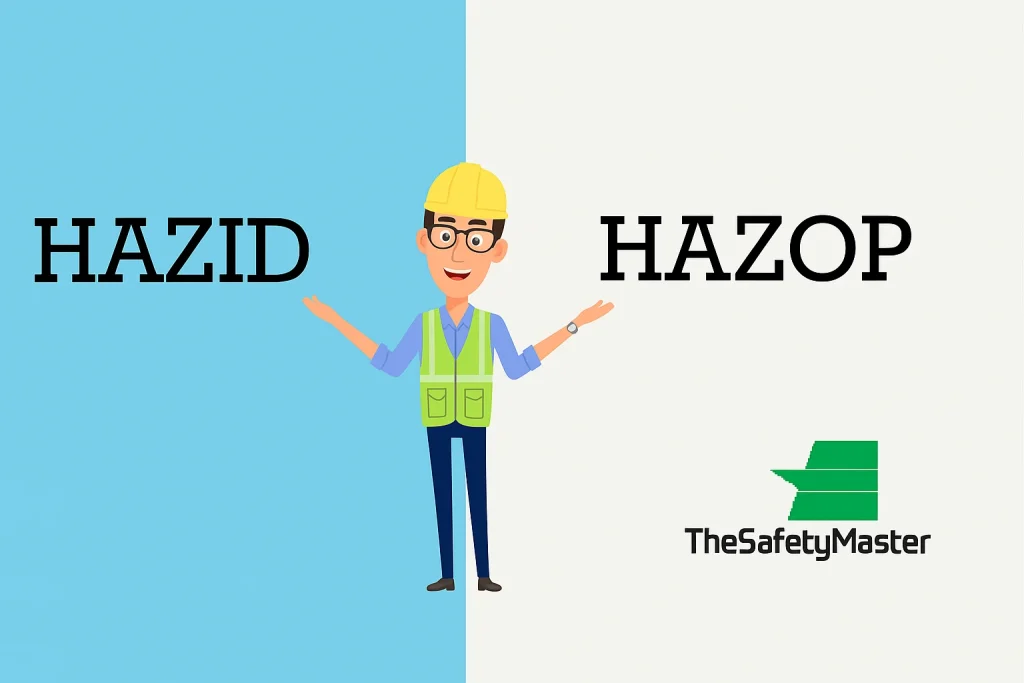
In high-risk industrial sectors such as oil and gas, chemical processing, pharmaceuticals, and manufacturing, workplace safety and process integrity are paramount. Identifying hazards early and implementing preventive measures protects lives, assets, and the environment.
Two of the most widely used risk assessment methodologies in industrial safety management are HAZOP (Hazard and Operability Study) and HAZID (Hazard Identification Study). While both methodologies share the ultimate goal of risk reduction, they serve distinct purposes at different stages of a project lifecycle.
At The Safety Master, we help organizations navigate complex risk management frameworks to foster safer, fully compliant industrial environments. This comprehensive guide breaks down the core differences between HAZOP and HAZID studies, their methodologies, and how to choose the right approach for your operational needs.
Understanding Hazard Identification in Industrial Safety
Before comparing specific techniques, it is essential to understand why structured hazard identification is vital. Uncontrolled hazards can lead to catastrophic incidents, costly facility downtime, regulatory fines, and environmental damage. Structured studies ensure systematic evaluation rather than reliance on ad-hoc assumptions.
Why Risk Assessment Frameworks Matter
Industrial risk management involves recognizing potential failure modes before they manifest. Implementing standardized hazard analysis techniques allows organizations to:
- Comply with international safety and environmental regulations.
- Safeguard operational personnel and surrounding communities.
- Reduce unexpected process interruptions and downtime.
- Optimize insurance outcomes and maintain regulatory standing.
What is a HAZID Study?
A HAZID (Hazard Identification) study is a high-level, early-stage risk assessment tool used to identify major hazards and potential threat scenarios associated with a project, facility, or operation.
Purpose and Scope of HAZID
HAZID is typically conducted during the early conceptual or preliminary engineering design stages (such as pre-FEED or FEED phases). It focuses on macro-level hazards rather than granular process details.
Key Focus Areas of a HAZID Study:
- External Hazards: Natural disasters, external impact, climate conditions, and adjacent facilities.
- Health and Environmental Hazards: Exposure to toxic chemicals, emissions, waste generation, and ergonomic factors.
- Facility Layout and Logistics: Plant location, access routes, SIMOPS (Simultaneous Operations), and escape routes.
- Major Process Hazards: High-pressure hazards, loss of containment, fire, and explosion risks.
How a HAZID Study Works
A HAZID workshop is facilitated by a trained risk expert from The Safety Master alongside a multidisciplinary team. The process relies on standard checklist categories to systematically evaluate potential hazards, existing safeguards, and necessary recommendations.
What is a HAZOP Study?
A HAZOP (Hazard and Operability) study is a detailed, structured, and systematic examination of a planned or existing process or operation. It focuses on identifying deviations from intended design conditions that could lead to safety, environmental, or operability issues.
Purpose and Scope of HAZOP
HAZOP studies are performed when detailed design information, such as Piping and Instrumentation Diagrams (P&IDs) and Process Flow Diagrams (PFDs), is fully available. It examines system parameters line-by-line or node-by-node.
Core Elements of a HAZOP Assessment:
- Nodes: Specific sections of the process line or equipment being evaluated.
- Parameters: Process variables such as Flow, Pressure, Temperature, Level, and Viscosity.
- Guide Words: Standardized terms used to deviate parameters (e.g., No, More, Less, As Well As, Reverse, Other Than).
- Deviations: Combinations of guide words and parameters (e.g., More Pressure, No Flow).
The HAZOP Methodology Cycle
- Divide the process system into manageable nodes.
- Apply guide words to process parameters to generate deviations.
- Identify causes and potential consequences of each deviation.
- Evaluate existing safeguards and controls.
- Recommend actions to mitigate unaddressed risks.
HAZOP vs HAZID Study: Detailed Comparison
While both tools are critical to industrial safety management, understanding the distinction between a HAZOP vs HAZID study ensures appropriate resource allocation and project execution.
Comparison Overview Table
| Feature | HAZID Study | HAZOP Study |
| Primary Focus | Macro-level global hazards and external risks | Micro-level process deviations and operability issues |
| Timing / Stage | Early design (Conceptual, Pre-FEED, FEED) | Detailed engineering design / Operational phase |
| Input Required | Plot plans, site layouts, simplified flowcharts | Detailed P&IDs, PFDs, Cause & Effect diagrams |
| Methodology | Checklist-driven brainstorming | Guide-word and parameter matrix evaluation |
| Outcome | High-level risk mitigation & site layout changes | Detailed engineering recommendations & procedural safeguards |
Key Differences Explained
1. Stage of Project Lifecycle
- HAZID occurs early in the project timeline. Identifying major risks early prevents costly design revisions late in construction.
- HAZOP takes place later, when exact pipe sizes, instrumentation, and control loops are fully defined.
2. Depth of Analysis
- HAZID provides a broad overview of health, safety, environmental, and site-wide operational risks.
- HAZOP provides a granular analysis of specific chemical, thermodynamic, and physical process deviations within individual piping nodes.
3. Documentation Required
- HAZID requires basic site layouts, block flow diagrams, and environmental data.
- HAZOP requires complete P&IDs, operating philosophies, safety interlock descriptions, and material balance sheets.
Integrating HAZID and HAZOP for Complete Risk Management
Choosing between HAZOP and HAZID is rarely an “either/or” decision; rather, they are complementary steps in a comprehensive safety lifecycle. A robust risk management plan transitions logically from a HAZID study during early development to a detailed HAZOP study prior to commissioning.
At The Safety Master, we assist organizations through every stage of this lifecycle:
- Facilitation: Experienced certified chairpersons lead structured workshops.
- Action Tracking: Ensuring all HAZID and HAZOP recommendations are tracked to resolution.
- Regulatory Alignment: Ensuring compliance with global standards such as IEC 61882, OSHA PSM, and local regulatory bodies.
Frequently Asked Questions (FAQs)
1. Can a HAZOP replace a HAZID study?
No. A HAZOP cannot replace a HAZID study because HAZOP focuses specifically on process line deviations using detailed P&IDs. It does not cover site-wide hazards, natural threats, or facility siting issues, which are evaluated during a HAZID study.
2. When is the ideal time to perform a HAZID study?
A HAZID study should ideally be conducted during the initial project phases, such as the conceptual design, pre-FEED (Front-End Engineering Design), or early FEED stages, before key structural and layout decisions are finalized.
3. Who should participate in a HAZOP vs HAZID workshop?
Both studies require a multidisciplinary team. A HAZID team typically includes project managers, civil/site engineers, environmental specialists, and safety leaders. A HAZOP team requires process engineers, instrument/control engineers, operations personnel, and maintenance managers led by an independent chairperson from The Safety Master.
4. How often should HAZOP and HAZID studies be updated?
While HAZID is primarily performed during early project development, re-validation may occur during major plant expansions. HAZOP studies, however, should be re-validated periodically (typically every 3 to 5 years) or whenever significant process modifications are made.
5. How does The Safety Master assist with HAZOP and HAZID studies?
The Safety Master provides expert risk assessment services, including workshop facilitation by certified chairs, software-driven documentation, customized reporting, and complete safety lifecycle management tailored to your facility’s operational requirements.
Conclusion
Both HAZID and HAZOP studies play essential, non-overlapping roles in identifying hazards and preserving operational continuity. While HAZID safeguards your project from foundational and macro-level threats, HAZOP ensures your process systems operate safely under all potential deviations.
Partner with The Safety Master to conduct rigorous, compliant, and efficient HAZOP and HAZID studies for your facility. Contact our team today to strengthen your industrial risk management strategy.