
A Detailed Guide to Safety Signs and Symbols

How AI & Predictive Analytics Are Transforming Safety Audits in 2025
September 24, 2025
Understanding PPE Safety: Types, Uses, and Essential Equipment
September 25, 2025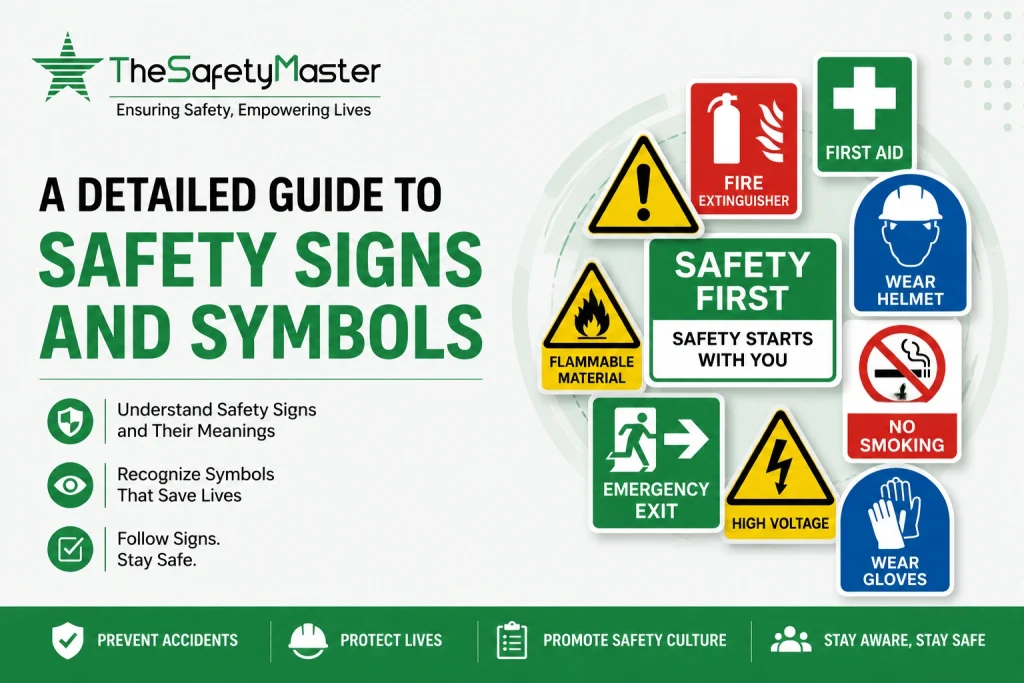
Safety signs and symbols are an essential part of every safe workplace. They communicate hazards, restrictions, required actions, emergency information, and safety instructions quickly—often without requiring lengthy text. From factories and construction sites to offices, warehouses, laboratories, and commercial buildings, properly placed signs help workers and visitors recognize hazards and respond correctly.
In this detailed guide, The Safety Master explains the major types of safety signs and symbols, their meanings, common workplace applications, and important examples. This article also covers 20 safety signs and symbols with names PDF, 10 safety signs and their meanings, electrical safety signs and symbols PDF, and other commonly searched safety-sign topics.
What Are Safety Signs and Symbols?
Safety signs and symbols are visual communication tools used to identify hazards, provide warnings, communicate mandatory actions, indicate prohibited activities, and guide people toward emergency facilities.
A safety sign may contain:
- A symbol or pictogram
- A signal word
- A specific safety message
- A standardized colour
- An arrow or directional indicator
- An emergency instruction
The purpose is simple: communicate important safety information quickly and clearly.
OSHA’s accident-prevention requirements classify signs according to their use, including danger signs, caution signs, and safety-instruction signs. OSHA also specifies colour conventions for certain sign categories.
Why Are Safety Signs Important in the Workplace?
A workplace can contain many hazards that are not immediately obvious to employees, contractors, or visitors. Safety signs provide a visible reminder of the precautions required in a particular area.
1. Identify Workplace Hazards
Signs can identify hazards such as:
- High voltage
- Flammable materials
- Toxic chemicals
- Moving machinery
- Slippery floors
- Radiation
- Compressed gases
- Hot surfaces
2. Communicate Required Actions
Mandatory signs tell people what they must do, such as:
- Wear safety helmet
- Wear safety goggles
- Use hearing protection
- Wear safety shoes
- Use fall protection
- Wear protective gloves
3. Prevent Unsafe Activities
Prohibition signs communicate actions that are not permitted, such as smoking, entering restricted areas, or using open flames.
4. Support Emergency Response
Emergency signs help people locate:
- Emergency exits
- First-aid stations
- Fire extinguishers
- Emergency showers
- Fire alarms
- Assembly points
Types of Safety Signs and Symbols
There are several types of safety signs and symbols commonly used across workplaces. The exact design and colour requirements can vary according to the applicable standard and country.
1. Warning Signs
Warning signs alert people to a potential hazard and indicate that appropriate precautions are required.
Examples include:
- Warning: Slippery Floor
- Warning: Forklift Traffic
- Warning: Hot Surface
- Warning: Moving Machinery
- Warning: Electrical Hazard
Yellow is commonly associated with caution or warning-related physical hazards in workplace safety systems. OSHA identifies yellow as the basic colour for caution and certain physical hazards.
2. Danger Signs
Danger signs are used where an immediate hazard exists and special precautions are necessary.
Examples include:
- Danger: High Voltage
- Danger: Toxic Chemicals
- Danger: Confined Space
- Danger: Explosion Hazard
- Danger: Do Not Enter
OSHA states that danger signs are intended for situations involving immediate danger.
3. Mandatory Signs
Mandatory signs tell workers that a particular action or precaution is required.
Common examples are:
- Wear Helmet
- Wear Safety Gloves
- Wear Eye Protection
- Wear Safety Shoes
- Wear Respiratory Protection
- Use Hearing Protection
These signs are particularly important in areas where PPE is required before entering or starting work.
4. Prohibition Signs
Prohibition signs indicate that a particular activity is not allowed.
Examples include:
- No Smoking
- No Open Flame
- No Entry
- Do Not Touch
- No Mobile Phones
- Do Not Operate
5. Emergency and Safe-Condition Signs
These signs identify safe locations and emergency facilities.
Examples include:
- Emergency Exit
- First Aid
- Emergency Assembly Point
- Eyewash Station
- Emergency Shower
- Safe Escape Route
6. Fire Safety Signs
Fire safety signs identify fire protection equipment and emergency fire facilities.
Examples include:
- Fire Extinguisher
- Fire Alarm
- Fire Hose Reel
- Fire Hydrant
- Fire Exit
- Fire Assembly Point
These signs should remain clearly visible and unobstructed.
20 Safety Signs and Symbols With Names
For readers looking for 20 safety signs and symbols with names PDF, the following list provides a useful reference for creating a workplace safety-signs handout or training document.
| No. | Safety Sign/Symbol | Meaning |
|---|---|---|
| 1 | High Voltage | Electrical shock hazard |
| 2 | No Smoking | Smoking is prohibited |
| 3 | Flammable Material | Fire or ignition hazard |
| 4 | Wear Safety Helmet | Head protection is required |
| 5 | Wear Safety Gloves | Hand protection is required |
| 6 | Wear Eye Protection | Eye protection is required |
| 7 | Wear Safety Shoes | Protective footwear is required |
| 8 | Emergency Exit | Indicates an emergency escape route |
| 9 | First Aid | Indicates first-aid facilities |
| 10 | Fire Extinguisher | Shows the location of an extinguisher |
| 11 | Fire Alarm | Indicates a fire alarm point |
| 12 | Toxic Material | Indicates a toxic hazard |
| 13 | Biohazard | Indicates a biological hazard |
| 14 | Radiation Hazard | Indicates ionizing-radiation hazards |
| 15 | Corrosive Material | Indicates corrosive substances |
| 16 | Explosive Material | Indicates an explosion hazard |
| 17 | Slippery Floor | Warns of a slip hazard |
| 18 | Forklift Traffic | Warns of moving industrial vehicles |
| 19 | Confined Space | Indicates a confined-space hazard |
| 20 | Emergency Assembly Point | Indicates where people should assemble during an emergency |
This list can be converted into a 20 safety signs and symbols with names PDF for employee induction, toolbox talks, safety training, or workplace notice boards.
10 Safety Signs and Their Meanings
Understanding common signs is important for every employee. Here are 10 safety signs and their meanings:
1. High Voltage Sign
Indicates the presence of electrical equipment or conductors that may cause serious electric shock or other injury.
2. No Smoking Sign
Indicates that smoking is prohibited because it could create a fire, explosion, or health hazard.
3. Wear Safety Helmet Sign
Tells workers that head protection is required in the designated area.
4. Wear Eye Protection Sign
Indicates that safety glasses, goggles, or another appropriate form of eye protection must be worn.
5. Flammable Material Sign
Warns that a material or area presents a fire or ignition hazard.
6. Biohazard Sign
Identifies materials, equipment, or areas associated with biological hazards.
7. Emergency Exit Sign
Shows the route or door to use during an emergency evacuation.
8. Fire Extinguisher Sign
Identifies the location of fire-extinguishing equipment.
9. Slippery Floor Sign
Warns people about a potential slip-and-fall hazard.
10. No Entry Sign
Restricts access to a particular area because of hazards, security requirements, or operational controls.
10 Safety Signs and Symbols Every Workplace Should Know
The most useful 10 safety signs and symbols depend on the workplace hazards, but a basic industrial safety set generally includes:
- Danger – High Voltage
- Warning – Slippery Floor
- No Smoking
- Wear Safety Helmet
- Wear Eye Protection
- Wear Safety Gloves
- Flammable Material
- Emergency Exit
- Fire Extinguisher
- First Aid
A workplace should select signs based on its actual hazards rather than simply displaying a large collection of generic signs.
Workplace Safety Signs and Symbols and Their Meanings
Workplace safety signs and symbols and their meanings should be explained during employee induction and periodic safety training.
For example, a helmet symbol does not merely represent a helmet—it communicates that head protection is required. Similarly, a lightning-bolt symbol communicates an electrical hazard, while a flame symbol may indicate flammable material.
The effectiveness of a sign depends on:
- Correct symbol selection
- Appropriate colour
- Good visibility
- Correct placement
- Adequate lighting
- Clear wording where necessary
- Employee awareness
- Regular inspection
OSHA requires signs to be visible when applicable work is being performed in construction settings and requires them to be removed or covered when the hazard no longer exists.
Electrical Safety Signs and Symbols
Electrical safety signs and symbols PDF resources are particularly useful for electrical workshops, substations, manufacturing plants, construction sites, commercial buildings, and maintenance areas.
Common electrical safety signs include:
High Voltage
Warns people about potentially dangerous electrical voltage.
Electrical Hazard
Identifies equipment or areas where electrical hazards may be present.
Authorized Personnel Only
Restricts access to electrical rooms, substations, panels, or other controlled areas.
Lockout/Tagout
Communicates that equipment must not be energized or operated because maintenance or servicing is underway.
Do Not Touch
Warns against contact with potentially energized equipment or surfaces.
Electrical signs should be positioned where workers can see them before reaching the hazardous area.
Safety Signs and Symbols PDF: What Should It Include?
People searching for a safety signs and symbols PDF generally need a quick-reference resource for training or workplace use.
A useful PDF can include:
- Safety sign name
- Symbol or pictogram
- Meaning
- Colour
- Application
- Required action
- Example workplace location
For employee training, it is also useful to divide the PDF into categories such as warning, danger, mandatory, prohibition, emergency, fire safety, and electrical safety.
For chemical hazards, OSHA’s Hazard Communication Standard uses standardized pictograms and signal words to communicate chemical hazards. Its pictograms use a square set at a point with a red frame and black symbol on a white background.
How to Choose the Right Safety Sign
Choosing the correct sign starts with understanding the hazard.
Step 1: Identify the Hazard
Conduct a workplace hazard identification exercise and determine what could cause injury, illness, fire, environmental damage, or property damage.
Step 2: Determine the Required Message
Decide whether people need to be warned, instructed, restricted, or directed to an emergency facility.
Step 3: Select the Appropriate Symbol
Use a recognizable pictogram that communicates the intended message quickly.
Step 4: Use Appropriate Colours
Colours should follow the relevant safety-sign standard applicable to the workplace.
Step 5: Install the Sign Correctly
Place the sign where employees can see and understand it before encountering the hazard.
Step 6: Inspect Regularly
Damaged, faded, hidden, or outdated signs should be repaired or replaced.
Common Mistakes When Using Safety Signs
Even correctly designed signs can become ineffective when they are poorly managed.
Common mistakes include:
- Installing too many signs in one area
- Using signs that do not match the actual hazard
- Placing signs behind equipment
- Using very small signs
- Allowing signs to become dirty or faded
- Failing to train employees
- Leaving obsolete signs in place
- Using unclear or inconsistent symbols
- Ignoring electrical and chemical hazards
- Failing to review signage after workplace changes
A good signage system should complement, not replace, hazard controls such as engineering controls, administrative controls, safe operating procedures, and appropriate PPE.
Safety Signs and Symbols for Industrial Workplaces
Industrial facilities often require a broader signage system because workers may encounter multiple hazards.
Important areas may include:
- Production lines
- Chemical storage areas
- Electrical rooms
- Boiler rooms
- Warehouses
- Workshops
- Confined spaces
- Loading and unloading areas
- Fire equipment locations
- Emergency exits
- Construction zones
The Safety Master can help organizations strengthen workplace safety through professional safety consulting, audits, training, risk assessment, and safety-management solutions.
How Safety Signs Support Safety Training
Safety signs should be included in employee induction and refresher training.
A practical training session can explain:
- What each colour means
- How to identify common symbols
- Difference between warning and danger
- Mandatory PPE requirements
- Emergency signs
- Fire safety signs
- Electrical warning signs
- Chemical hazard pictograms
- What action employees must take
- How to report damaged or missing signs
Employees should understand not only what a symbol looks like but also what action they must take after seeing it.
Safety Signs vs Safety Symbols
Although the terms are often used together, there is a simple distinction.
A safety symbol is generally a visual representation or pictogram used to communicate a hazard, instruction, prohibition, or safe condition.
A safety sign may combine the symbol with words, colours, borders, signal words, or additional instructions.
For example, a lightning-bolt pictogram can represent an electrical hazard, while a complete sign may say “DANGER – HIGH VOLTAGE” and include the symbol.
Major Point: Safety Signs Must Lead to Safe Action
The most important purpose of safety signs is not decoration or compliance alone. A sign is effective when it helps a person recognize a hazard and take the correct action.
For example:
Hazard → Warning Sign → Worker Recognizes Risk → Correct Precaution → Safer Action
This is why signs should be clear, visible, understandable, and relevant to the specific workplace.
Conclusion
Safety signs and symbols provide a simple and powerful way to communicate hazards and required safety actions. From 10 safety signs and their meanings to comprehensive 20 safety signs and symbols with names PDF resources, employees can use these visual tools to recognize common workplace hazards more quickly.
Organizations should identify their specific risks, select appropriate signs, install them in visible locations, maintain them regularly, and train employees to understand their meanings. Electrical areas, chemical storage, fire protection systems, machinery, emergency routes, and restricted areas should receive particular attention.
For businesses looking to improve workplace safety through professional risk assessment, audits, training, and safety management, The Safety Master provides safety-focused solutions designed around organizational requirements.
FAQs
What are 10 Safety Signs?
Safety signs and symbols are essential for communicating hazards and guiding safe behavior in various environments. Here are 10 common safety signs:
- No Smoking (Prohibition)
- Fire Exit (Emergency)
- Wear Hard Hat (Mandatory)
- Danger High Voltage (Warning)
- Flammable Materials (Warning)
- First Aid (Emergency)
- Slippery When Wet (Warning)
- No Entry (Prohibition)
- Corrosive Materials (Warning)
- Emergency Assembly Point (Emergency)
These types of safety signs are used universally to ensure a safer workplace by providing clear instructions and warnings.
What is the Meaning of Safety Signs and Symbols?
Safety signs and symbols are visual cues that communicate essential safety information at a glance. The safety signs and meanings are designed to prevent accidents by clearly indicating hazards, required actions, or emergency information. For example, warning signs and symbols like a yellow triangle with an exclamation mark alert workers to potential dangers, while industrial safety symbols such as the flame icon indicate flammable materials. Understanding safety signs and symbols with names is critical for anyone working in environments where hazards are present, as it ensures that safety measures are followed effectively.
What are the 7 Safety Signs?
The seven main types of safety signs include:
- Prohibition Signs (e.g., No Smoking)
- Warning Signs (e.g., Danger High Voltage)
- Mandatory Signs (e.g., Wear Protective Equipment)
- Emergency Information Signs (e.g., First Aid)
- Fire Safety Signs (e.g., Fire Exit)
- Hazard Signs (e.g., Toxic Material)
- Safe Condition Signs (e.g., Emergency Exit)
These workplace safety symbols help create a safer environment by providing clear and direct instructions for avoiding hazards and responding to emergencies. Understanding these safety signs and symbols is crucial for maintaining a safe workplace.