
BBS Implementation in the Workplace: A Complete Guide for Safer Work Practices

Process Safety Consultants in India: Why The Safety Master Is the Best Process Safety Consultant
August 7, 2026
Fire Safety Audit Checklist: Essential Points for Effective Fire Safety Inspection
August 13, 2026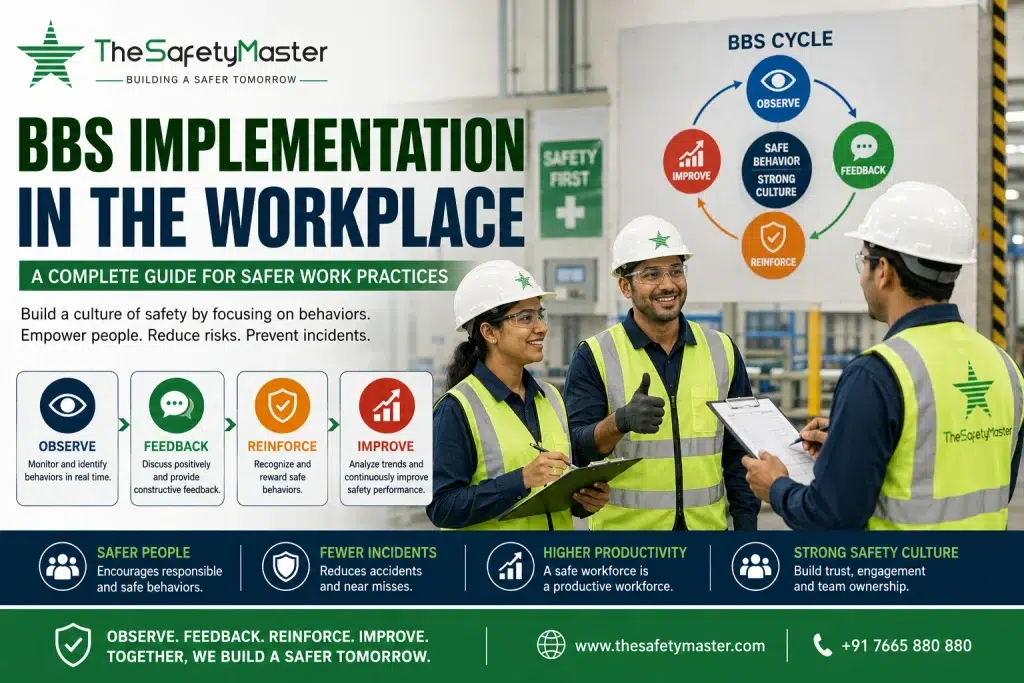
BBS Implementation in the Workplace is an effective approach to improving safety by focusing on employee behavior, workplace conditions, and safe work practices. Behavior-Based Safety (BBS) helps organizations identify unsafe behaviors before they result in incidents and encourages employees to actively participate in safety improvement. The Safety Master supports organizations in developing practical safety systems that help create safer and more responsible workplaces.
What Is Behavior-Based Safety (BBS)?
Behavior-Based Safety is a proactive safety management approach that focuses on observing and improving workplace behaviors. Instead of only investigating accidents after they happen, BBS aims to identify unsafe actions and conditions before they cause harm.
Key Principle of BBS
The main principle of BBS is that workplace safety can be improved by understanding why people behave in certain ways and encouraging safe behaviors through observation, communication, feedback, and continuous improvement.
Why Employee Behavior Matters
Employees interact with equipment, machinery, chemicals, tools, and work processes every day. Even when safety procedures are available, unsafe behaviors such as:
- Not wearing required PPE
- Bypassing machine guards
- Improper lifting
- Ignoring warning signs
- Taking shortcuts
- Failing to follow permit procedures
- Using damaged tools
can increase the possibility of workplace incidents.
Why Is BBS Implementation Important in the Workplace?
A strong BBS program can help organizations move from reactive safety management toward proactive risk prevention.
Reduces Unsafe Behaviors
Regular behavioral observations help identify unsafe actions and provide opportunities for correction before an incident occurs.
Builds Employee Safety Awareness
BBS encourages employees to think about how their actions can affect their own safety and the safety of their colleagues.
Encourages Safety Communication
Employees and supervisors can openly discuss safety concerns, unsafe conditions, and possible improvements.
Supports a Positive Safety Culture
When employees are involved in identifying and correcting safety issues, they are more likely to take ownership of workplace safety.
Helps Prevent Workplace Incidents
Identifying recurring unsafe behaviors and addressing their root causes can contribute to reducing incidents, injuries, and near misses.
Steps for BBS Implementation in the Workplace
Successful BBS implementation requires proper planning, employee involvement, and continuous monitoring.
Step 1: Obtain Management Commitment
Senior management should demonstrate visible commitment to the BBS program. Management must provide adequate resources, training, time, and support.
Define Clear Safety Objectives
Organizations should establish measurable objectives, such as:
- Increasing safe behavior observations
- Reducing repeated unsafe behaviors
- Improving PPE compliance
- Increasing near-miss reporting
- Improving employee participation
Clear objectives make it easier to evaluate the effectiveness of the program.
Step 2: Identify Critical Safety Behaviors
The organization should identify behaviors that have a significant impact on workplace safety.
Examples include:
- Proper PPE usage
- Safe material handling
- Correct equipment operation
- Safe work-at-height practices
- Lockout/Tagout compliance
- Safe chemical handling
- Proper housekeeping
Focus on High-Risk Activities
BBS should give priority to activities where unsafe behavior could result in serious injury, fire, explosion, environmental damage, or equipment failure.
Step 3: Develop a Behavioral Observation Checklist
A simple and practical checklist can help employees and supervisors conduct consistent observations.
What Should a Checklist Include?
A checklist may cover:
- PPE usage
- Body positioning
- Tool and equipment use
- Work procedures
- Housekeeping
- Manual handling
- Access and egress
- Emergency preparedness
- Communication
- Permit compliance
The checklist should be easy to understand and relevant to the actual workplace.
Step 4: Train Employees and Observers
Employees participating in the BBS program should understand the purpose and process.
Important Training Areas
Training can include:
- BBS principles
- Hazard identification
- Safe and unsafe behavior recognition
- Observation techniques
- Giving constructive feedback
- Reporting procedures
- Root-cause thinking
- Corrective action
Training should emphasize that BBS is designed to improve safety rather than punish employees.
Step 5: Conduct Regular Behavioral Observations
Regular observations are an important part of BBS implementation.
Employees, supervisors, or trained observers can observe work activities and record safe and at-risk behaviors.
Make Observations Constructive
Observers should communicate respectfully with workers. When an unsafe behavior is identified, the observer should explain the potential risk and discuss a safer alternative.
For example, instead of simply saying, “You are not following the procedure,” the observer can explain the potential consequence and discuss how the correct procedure can be followed more effectively.
Step 6: Provide Immediate Feedback
Feedback should be provided as close to the observation as practical.
Positive Feedback
Safe behaviors should be recognized and encouraged. Positive reinforcement can help employees understand which behaviors should continue.
Corrective Feedback
When an unsafe behavior is observed, the discussion should focus on the behavior and its risk rather than personally blaming the employee.
Step 7: Analyze Observation Data
Collected observations should be reviewed regularly to identify patterns.
Look for Repeated Unsafe Behaviors
For example, if observations repeatedly show employees removing PPE in a particular work area, management should investigate why.
Possible causes could include:
- PPE discomfort
- Incorrect PPE selection
- Poor availability
- Lack of awareness
- Workplace conditions
- Inadequate supervision
This approach helps organizations address the underlying causes instead of simply telling employees to “be careful.”
Step 8: Implement Corrective and Preventive Actions
Observation findings should lead to practical improvements.
Actions may include:
- Additional training
- Engineering controls
- Procedure changes
- Improved PPE
- Equipment modification
- Better supervision
- Workplace redesign
- Improved signage
BBS becomes more effective when observation findings result in measurable improvements.
Step 9: Monitor and Continuously Improve
BBS should not be treated as a one-time campaign. Organizations should continuously review results and improve the program.
Useful performance indicators may include:
- Number of observations completed
- Safe behavior percentage
- Repeated unsafe behaviors
- Corrective actions completed
- Employee participation
- Near-miss reporting
- Incident trends
Common Challenges in BBS Implementation
Although BBS can provide significant benefits, organizations may face challenges during implementation.
Employee Resistance
Some employees may initially believe that behavioral observations are intended for punishment.
Solution: Clearly communicate that BBS focuses on learning, prevention, and improvement.
Poor Management Participation
If managers do not participate, employees may not consider the program important.
Solution: Management should participate in observations, review results, and demonstrate visible safety leadership.
Inconsistent Observations
If different observers use different standards, the collected data may not be reliable.
Solution: Provide standardized training and use clear observation criteria.
Focusing Only on Individual Behavior
Not every unsafe act is caused by an individual’s choice. Workplace design, equipment, workload, procedures, and management systems can influence behavior.
Solution: Investigate both behavioral and organizational factors.
Role of Leadership in BBS
Leadership plays an important role in establishing a successful BBS culture.
Management Responsibilities
Management should:
- Provide resources
- Set safety expectations
- Participate in observations
- Review BBS performance
- Support corrective actions
- Recognize positive safety performance
Supervisor Responsibilities
Supervisors should communicate safety expectations, observe work activities, provide feedback, and ensure that corrective actions are completed.
How BBS Supports a Strong Safety Culture
A successful BBS program can help create an environment where safety becomes part of everyday work rather than a separate activity.
Employee Participation
Employees become active contributors to safety improvement.
Open Communication
Workers can report concerns and discuss safer ways of performing tasks.
Positive Reinforcement
Recognizing safe behaviors can encourage employees to maintain good practices.
Continuous Learning
Observation data can identify areas where procedures, training, equipment, or workplace conditions need improvement.
Best Practices for Effective BBS Implementation
Organizations can improve their BBS programs by following several practical principles.
Keep the Program Simple
Observation forms and procedures should be easy for employees to use.
Avoid a Blame-Based Approach
The objective should be learning and prevention rather than assigning blame.
Combine Behavior and Hazard Management
BBS should complement existing risk assessments, safety audits, incident investigations, and management systems.
Use Data for Decision-Making
Organizations should analyze observation trends and use the findings to prioritize corrective actions.
Recognize Employee Contributions
Employees who actively participate in safety improvement should receive appropriate recognition.
How The Safety Master Can Support Workplace Safety
Organizations need structured and practical approaches to manage workplace risks effectively. The Safety Master can help businesses strengthen their safety management practices through professional safety consulting, training, audits, risk assessment, and process safety solutions.
A well-designed BBS program should be aligned with the organization’s existing safety management system. By combining employee participation, behavioral observations, risk identification, corrective actions, and continuous improvement, organizations can develop a stronger safety culture.
FAQs About BBS Implementation in the Workplace
1. What is BBS implementation in the workplace?
BBS implementation is the process of introducing Behavior-Based Safety practices to identify, observe, and improve workplace behaviors that can influence safety performance.
2. What is the main objective of BBS?
The main objective is to encourage safe behaviors, identify at-risk behaviors, understand their causes, and prevent workplace incidents through proactive safety management.
3. Who should participate in a BBS program?
Employees, supervisors, safety professionals, managers, and other relevant personnel can participate. Employee involvement is particularly important for making the program practical and effective.
4. Is BBS only focused on employee behavior?
No. A good BBS program should consider workplace conditions, equipment, procedures, training, workload, supervision, and organizational factors that influence behavior.
5. How often should behavioral observations be conducted?
Observations should be conducted regularly according to workplace risks, operational requirements, and the organization’s BBS objectives. High-risk activities may require more frequent observations.
6. Can BBS reduce workplace accidents?
BBS can contribute to accident prevention by identifying unsafe behaviors and addressing their underlying causes before they contribute to incidents. However, it should work alongside engineering controls, risk assessments, procedures, training, and other safety measures.
7. How can employees be encouraged to participate in BBS?
Organizations can encourage participation through clear communication, training, positive recognition, simple observation processes, management involvement, and a non-punitive approach.
8. What makes a BBS program successful?
Management commitment, employee participation, clear behavioral standards, regular observations, constructive feedback, data analysis, corrective actions, and continuous improvement are key factors in successful BBS implementation.
Conclusion
Effective BBS Implementation in the Workplace can help organizations identify unsafe behaviors, improve employee participation, strengthen safety communication, and develop a proactive safety culture. The most successful programs do not focus on blaming individuals; they examine why behaviors occur and improve the systems, conditions, training, and controls that influence them. With proper planning, leadership commitment, employee involvement, regular observations, and continuous improvement, BBS can become an important part of a comprehensive workplace safety strategy. Organizations looking to strengthen these practices can work with The Safety Master for professional safety training, consulting, audits, and risk-management solutions.