How to Find the Best Safety Consultants Singapore Has to Offer

Annual Fire Safety Audit Services UAE: Complete Compliance and Safety Reviews
October 30, 2026
Navigating the stringent landscape of Workplace Safety and Health (WSH) regulations in Singapore requires more than basic compliance. Whether operating in high-risk construction, petrochemicals, logistics, or advanced manufacturing, partnering with top-tier health and safety advisors is essential. Finding the right advisory partner guarantees seamless operational continuity, minimizes risk exposure, and builds a resilient safety culture.
This comprehensive guide breaks down step-by-step how to identify, evaluate, and select the best safety consultants Singapore has available for your industrial and commercial needs.
Understanding the Importance of Workplace Safety Consultancy in Singapore
Singapore maintains some of the strictest occupational health and safety laws globally, enforced primarily by the Ministry of Manpower (MOM) under the Workplace Safety and Health Act (WSHA). Establishing robust risk management systems is not only a regulatory imperative but also a strategic business driver.
Key Legal Drivers and Regulatory Frameworks
- Workplace Safety and Health (WSH) Act:Mandates that every workplace take reasonably practicable steps to protect all employees and contractors.
- WSH (Risk Management) Regulations: Legally requires documented hazard identification, risk evaluation, and risk control measures (HIRA) for all work activities.
- Approved Codes of Practice (ACOP): Directs company leadership and directors on their legal duties regarding safety governance and resource allocation.
Business Benefits Beyond Regulatory Compliance
- Reduced Downtime:Eliminates costly stop-work orders and operational disruptions resulting from incidents.
- Enhanced Operational Efficiency: Streamlined procedures boost productivity and optimize human resource output.
- Improved Insurance & Reputational Standing: Maintains client trust and lowers insurance risk premiums by maintaining a verified safety record.
Core Qualities of the Best Safety Consultants in Singapore
When shortlisting advisory partners, evaluating technical competence and industry-specific capabilities is critical. Top consulting firms offer comprehensive, customized safety solutions rather than standard off-the-shelf templates.
1. Multi-Disciplinary Industry Expertise
The leading safety consultants demonstrate proven success across complex, high-consequence industries such as Oil & Gas, Energy, Pharmaceuticals, and Chemical Processing. They possess extensive hands-on experience handling specialized technical requirements alongside regional standards.
2. Comprehensive Service Offering
Look for partners who handle end-to-end Environmental Health and Safety (EHS) lifecycle requirements, including:
- Process Safety Management (PSM): Implementing detailed PSM frameworks, technical gap assessments, and mechanical integrity strategies.
- Risk Assessments:Conducting qualitative and quantitative risk analyses, including Hazard Identification and Risk Assessment (HIRA), HAZOP, SIL, and LOPA.
- System Implementation:Developing tailor-made EHS management systems compliant with ISO 45001 and ISO 14001 frameworks.
3. Focus on Safety Culture and Human Factors
Technical controls must be supported by human behavioral change. Exceptional safety consultants design Behavior-Based Safety (BBS) programs that transform worker mindsets, driving active safety habits across all organizational tiers.
Step-by-Step Guide: How to Evaluate Safety Advisory Partners
To select the right consulting partner for your business, follow this practical evaluation roadmap:
| Evaluation Step | Strategic Objective | Key Verification Action |
|---|---|---|
| 1. Define Scope | Determine specific technical needs | Identify whether you require process safety, audits, or ISO implementation. |
| 2. Review Credentials | Validate track record | Confirm global and regional client assignments and industry case studies. |
| 3. Inspect Methodology | Assess engineering capability | Verify rigorous methodologies like Quantitative Risk Assessment (QRA). |
| 4. Check Training Programs | Verify human capability development | Check for accredited worker and managerial safety training programs. |
| 5. Evaluate Post-Audit Support | Ensure continuous compliance | Choose consultants who assist with corrective action tracking and reviews. |
Practical Audit and Technical Assessment Capabilities
A qualified safety partner should perform specialized technical audits that uncover latent facility vulnerabilities:
- Electrical Safety Audits: Assessing arc flash risks, grounding, and power system stability.
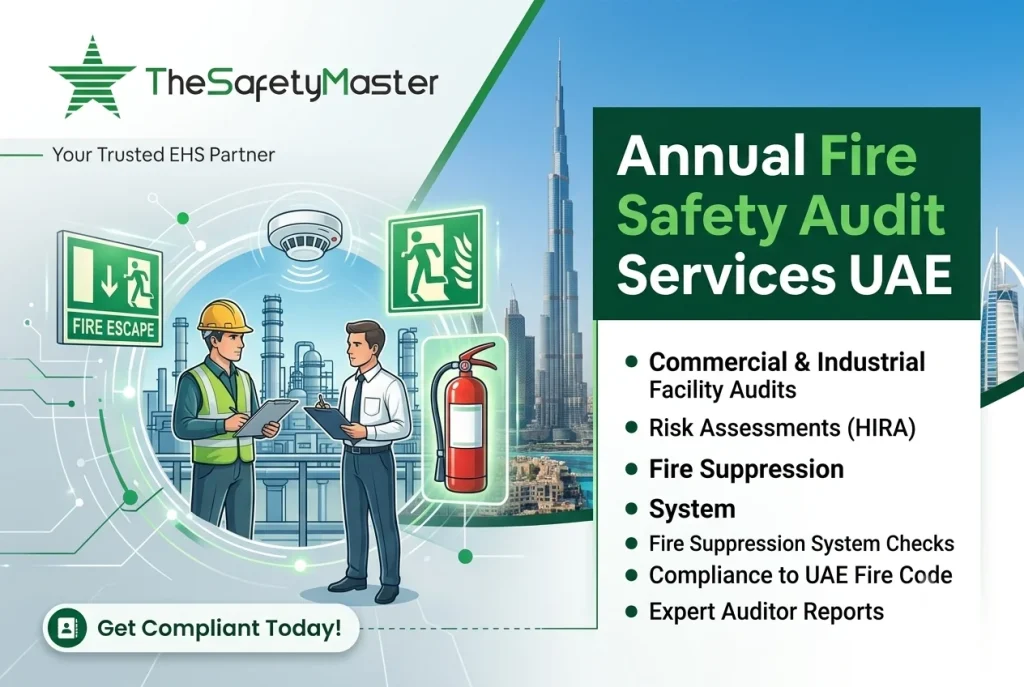
- Fire Safety Audits: Evaluating fire suppression systems, evacuation routes, and Civil Defense standards.
- Contractor Safety Management: Verifying sub-contractor adherence to plant safety requirements.
Why Choose The Safety Master as Your Preferred Consultancy Partner
When aiming to maintain competitive operational efficiency and high workplace safety standards, The Safety Master stands out as a world-class global safety advisory firm. Delivering technical expertise across Singapore and international markets, The Safety Master empowers businesses to exceed standard regulatory metrics.
Specialized Technical Engineering
The Safety Master offers advanced technical studies designed to eliminate high-severity risks:
- HAZOP & SIL/LOPA Studies: Identifying operational hazards and evaluating instrumented safety functions.
- Quantitative Risk Assessment (QRA): Calculating numerical risk profiles for complex facility layouts.
- Pre-Commissioning Safety Reviews (PSSR): Guaranteeing facility equipment readiness prior to plant startup.
Sustainable Safety Culture Transformation
Beyond engineering controls, The Safety Master delivers practical safety leadership training and customized Behavior-Based Safety (BBS) frameworks. This approach equips management teams and front-line workers with the tools needed to sustain zero-harm workplaces over the long term.
Transform Your Organization’s Safety Landscape Today
Finding the right safety consultant ensures your business remains fully compliant, highly productive, and protected against catastrophic risks. Partner with The Safety Master to access expert risk management, specialized technical audits, and world-class WSH advisory solutions.
Contact The Safety Master today to request a customized consultation and take your workplace safety standards to a global level.
Frequently Asked Questions (FAQs)
Look for consulting firms with verified global experience, robust engineering credentials (such as HAZOP, SIL, and QRA expertise), and a proven track record delivering WSH Act and ISO 45001 management systems.
While standard internal reviews should occur regularly, full-scale third-party safety audits (such as Fire Safety, Electrical Safety, or Contractor Safety audits) should be conducted annually or whenever major process modifications take place.
Basic workplace safety focuses on personal safety hazards such as slips, trips, falls, and PPE usage. Process Safety Management (PSM) focuses on preventing major catastrophic incidents involving toxic releases, chemical fires, and explosions in processing facilities.
Yes. Professional consultancies like The Safety Master build, implement, and audit Environmental Health and Safety (EHS) systems tailored for ISO 45001 (Occupational Health & Safety) and ISO 14001 (Environmental Management) certifications.
The Safety Master combines international industrial experience with deep technical engineering expertise. Having completed over 3,200 assignments globally, they deliver customized, end-to-end solutions spanning Process Safety, technical audits, regulatory compliance, and safety culture transformation.