Understanding Hazardous Area Classification in India for Oil, Gas, and Chemical Plants

Fire Safety Audit Report Format: Step-by-Step Checklist for Industrial Facilities
November 11, 2026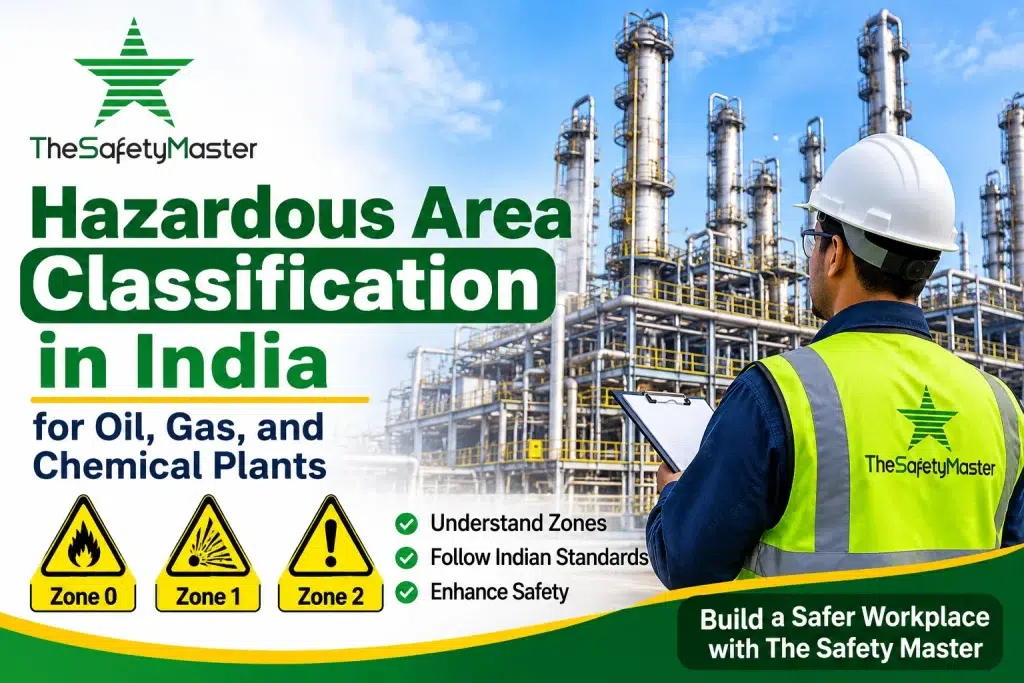
Industrial plants such as oil refineries, gas processing facilities, petrochemical industries, and chemical manufacturing units handle many flammable gases, vapours, and liquids. These materials can create dangerous conditions when they mix with air and come into contact with an ignition source.
A small spark from electrical equipment, hot surface, or static electricity can cause a fire or explosion if the surrounding atmosphere contains flammable substances.
This is why Hazardous Area Classification in India is an important part of industrial safety management. It helps identify locations where explosive atmospheres may occur and determines the type of electrical equipment that can be safely installed.
In India, hazardous area classification is important for industries that handle petroleum products, natural gas, LPG, chemicals, solvents, and other flammable materials.
The Safety Master supports industrial safety through risk assessment, process safety studies, hazardous area safety guidance, and professional safety consultancy services.
What Is Hazardous Area Classification?
Hazardous Area Classification (HAC) is the process of identifying and dividing industrial locations where flammable gases, vapours, or combustible dust may create an explosive atmosphere.
The main purpose is to understand the possibility of a dangerous atmosphere and define the boundaries of hazardous locations.
The classification helps industries select suitable electrical and electronic equipment, lighting systems, motors, instruments, and other installations.
For example, a chemical storage tank containing flammable liquid may release vapours through its vent. If these vapours mix with air in the right concentration, they can create an explosive atmosphere. The surrounding area must be assessed and classified according to the applicable standards.
Main Objectives of Hazardous Area Classification
- Identify locations where flammable gases and vapours may be present.
- Reduce the possibility of fire and explosion.
- Select suitable explosion-protected electrical equipment.
- Improve workplace and employee safety.
- Support compliance with applicable Indian regulations and standards.
- Provide clear hazardous area drawings for engineering and maintenance teams.
Importance of Hazardous Area Classification in India
India has many industries where flammable materials are manufactured, processed, transported, and stored. Oil refineries, petroleum terminals, chemical plants, pharmaceutical facilities, and gas installations require proper safety planning.
Hazardous Area Classification in India helps organisations understand explosion risks before installing electrical equipment or starting industrial operations.
1. Preventing Fire and Explosion Accidents
Flammable gases and vapours can create explosive atmospheres around equipment such as pumps, compressors, storage tanks, pipelines, and filling stations.
Correct classification helps identify these locations and reduce ignition risks.
2. Safe Selection of Electrical Equipment
Normal electrical equipment may produce sparks or high temperatures during operation. Such equipment can become an ignition source in hazardous locations.
Area classification helps engineers select appropriate equipment with suitable protection methods and certifications.
3. Supporting Regulatory Compliance
Industrial facilities must follow applicable safety regulations, technical standards, and industry-specific requirements.
Proper hazardous area classification supports safe electrical design, installation, inspection, and maintenance.
4. Improving Industrial Safety Management
Hazardous area drawings help safety professionals, electrical engineers, process engineers, and maintenance teams understand the risk levels in different plant locations.
Different Types of Hazardous Area Zones
Hazardous areas containing flammable gases and vapours are generally classified into three zones based on the frequency and duration of the explosive atmosphere.
Zone 0 – Continuous Hazardous Atmosphere
Zone 0 is an area where an explosive gas or vapour atmosphere is present continuously, for long periods, or frequently.
Examples include:
- Internal spaces of certain storage tanks.
- Internal sections of equipment containing flammable vapours.
- Areas where flammable gases are continuously present during normal operations.
Equipment used in Zone 0 requires a protection level suitable for this high-risk environment, such as equipment certified for EPL Ga.
Zone 1 – Hazardous Atmosphere During Normal Operations
Zone 1 is an area where an explosive gas or vapour atmosphere is likely to occur during normal operating conditions.
Examples include:
- Areas near certain pump seals.
- Gas compressor installations.
- Flammable liquid filling and loading points.
- Locations around process equipment where regular releases may occur.
Electrical equipment installed in Zone 1 must have suitable protection against ignition.
Zone 2 – Hazardous Atmosphere Under Abnormal Conditions
Zone 2 is an area where an explosive gas or vapour atmosphere is not likely to occur during normal operation. If it occurs, it is expected to remain for a short period.
Examples include:
- Areas surrounding certain Zone 1 locations.
- Locations near flanged connections where leakage is not expected during normal operation.
- Areas around equipment where flammable gas release may occur only under abnormal conditions.
Equipment must still meet the protection requirements for Zone 2 locations.
Indian Standards and Regulations for Hazardous Area Classification
Industries must consider applicable Indian regulations and recognised international standards when performing hazardous area classification.
Some important references include:
1. Petroleum Rules, 2002
The Petroleum Rules, 2002 provide important requirements for petroleum installations in India.
Rules 103 and 104 address hazardous areas and their classification.
Rule 104 identifies three hazardous zones:
- Zone 0: Flammable gases or vapours are expected to be continuously present.
- Zone 1: Flammable gases or vapours are likely to be present under normal operating conditions.
- Zone 2: Flammable gases or vapours are likely to be present only under abnormal conditions or equipment failure.
These requirements are important for petroleum storage, handling, refining, and related installations.
2. OISD-STD-113
OISD-STD-113 is an important Indian industry reference titled Classification of Area for Electrical Installations at Hydrocarbon Processing and Handling Facilities.
It provides guidance for hazardous area classification in hydrocarbon processing and handling facilities.
Oil refineries, petroleum terminals, and gas processing industries should consider its applicable requirements during electrical safety planning.
3. IS/IEC 60079 Series
The IS/IEC 60079 series covers important requirements related to explosive atmospheres and equipment used in hazardous locations.
Some important parts include:
- IEC 60079-0: General requirements for explosive atmosphere equipment.
- IEC 60079-10-1: Classification of areas containing explosive gas atmospheres.
- IEC 60079-10-2: Classification of areas containing combustible dust atmospheres.
- IEC 60079-14: Electrical installations design, selection, and erection requirements.
- IEC 60079-17: Inspection and maintenance of electrical installations.
The applicable Indian editions and amendments should be checked before project implementation.
How to Perform Hazardous Area Classification in India
A systematic approach is required to identify hazardous locations and prepare accurate classification drawings.
Step 1: Collect Plant Information
The first step is to collect the necessary technical information about the facility.
Important documents include:
- Process Flow Diagrams (PFDs).
- Piping and Instrumentation Diagrams (P&IDs).
- Plant layout drawings.
- Equipment specifications.
- Material Safety Data Sheets (MSDS/SDS).
- Operating and process conditions.
- Ventilation information.
These documents help engineers understand the plant layout and identify possible sources of flammable gas or vapour release.
Step 2: Identify Sources of Release
A source of release is a location from which flammable gas, vapour, or liquid may escape and create an explosive atmosphere.
Common sources include:
- Pumps and compressor seals.
- Storage tank vents.
- Flanges and pipe connections.
- Sampling points.
- Loading and unloading connections.
- Pressure relief and discharge systems.
- Process vessels and equipment openings.
Each source should be assessed according to its release characteristics and operating conditions.
Step 3: Identify the Type of Hazardous Material
The properties of flammable substances play an important role in hazardous area classification.
Important information includes:
- Flash point.
- Auto-ignition temperature.
- Lower Explosive Limit (LEL).
- Upper Explosive Limit (UEL).
- Vapour density.
- Gas or vapour group.
- Operating temperature and pressure.
This information helps engineers understand how a substance behaves when released into the surrounding environment.
Step 4: Evaluate Ventilation Conditions
Ventilation affects the concentration and duration of flammable gases and vapours.
Engineers must evaluate whether the area is:
- Naturally ventilated.
- Mechanically ventilated.
- Enclosed or partially enclosed.
- Poorly ventilated.
- Open to the atmosphere.
Good ventilation can help disperse released gases and reduce the possibility of explosive atmosphere formation. However, ventilation alone does not automatically make an area safe.
Step 5: Assign the Hazardous Area Zone
After evaluating the sources of release, material properties, operating conditions, and ventilation, engineers determine the appropriate hazardous zone.
The area may be classified as Zone 0, Zone 1, or Zone 2.
The classification must follow the applicable standards and should not be based only on the distance from equipment.
Step 6: Determine the Extent of Hazardous Areas
The next step is to define the boundaries of each hazardous location.
The extent depends on several factors, including:
- Type of flammable material.
- Release rate and release characteristics.
- Operating pressure and temperature.
- Ventilation effectiveness.
- Equipment design.
- Plant layout and surrounding structures.
The classified area is then represented through hazardous area classification drawings.
Step 7: Prepare and Review HAC Drawings
The final stage is to prepare detailed hazardous area classification drawings.
These drawings normally include:
- Equipment and process locations.
- Identified sources of release.
- Zone 0, Zone 1, and Zone 2 boundaries.
- Hazardous area dimensions.
- Gas group information.
- Temperature classification.
- Applicable standards and design notes.
The drawings should be reviewed by competent engineering and safety professionals and updated whenever significant process or plant changes occur.
Gas Groups Used in Hazardous Area Classification
Gas grouping helps determine the suitability of electrical equipment for the specific explosive atmosphere.
Under the IEC gas classification system, common gas groups include IIA, IIB, and IIC.
Gas Group IIA
Group IIA includes gases such as propane.
Equipment suitable for IIA applications has a lower gas protection requirement compared with IIB and IIC equipment.
Gas Group IIB
Group IIB includes gases such as ethylene.
Equipment suitable for IIB applications is designed for more demanding gas ignition characteristics than IIA.
Gas Group IIC
Group IIC includes gases such as hydrogen and acetylene.
IIC represents the most demanding group among IIA, IIB, and IIC.
Important: Equipment certified for IIC applications is generally suitable for IIB and IIA gas group applications, provided all other equipment requirements are also satisfied.
Temperature Classes in Hazardous Areas
Temperature classification identifies the maximum surface temperature that electrical equipment can reach under specified conditions.
The surface temperature must remain below the ignition temperature of the surrounding flammable substance.
The common temperature classes are:
| Temperature Class | Maximum Surface Temperature |
|---|---|
| T1 | 450°C |
| T2 | 300°C |
| T3 | 200°C |
| T4 | 135°C |
| T5 | 100°C |
| T6 | 85°C |
For example, equipment with a T4 rating has a maximum surface temperature of 135°C.
The correct temperature class must be selected according to the ignition temperature of the gas or vapour present in the classified area.
Common Industries Requiring Hazardous Area Classification
Hazardous area classification is important in many industrial sectors across India.
1. Oil and Gas Industry
Oil and gas facilities handle crude oil, natural gas, LPG, and other flammable materials.
Common hazardous locations include:
- Oil refineries.
- Gas processing plants.
- Drilling installations.
- Petroleum storage terminals.
- Pipeline facilities.
- Compressor stations.
2. Chemical Manufacturing Plants
Chemical industries use flammable solvents, gases, and liquids during manufacturing and processing.
Hazardous area classification helps identify locations around reactors, storage tanks, mixing units, and chemical transfer systems.
3. Petrochemical Industry
Petrochemical facilities process hydrocarbons and manufacture products such as polymers, plastics, and industrial chemicals.
Proper area classification is necessary around process equipment, storage systems, and loading facilities.
4. Pharmaceutical Industry
Some pharmaceutical manufacturing processes use flammable solvents such as ethanol, acetone, and other organic chemicals.
Hazardous area assessments may be required in solvent storage, handling, and processing locations.
5. Paint and Solvent Manufacturing
Paint, coating, and solvent manufacturing facilities may release flammable vapours during mixing, filling, storage, and cleaning operations.
Proper classification helps reduce ignition risks in these workplaces.
Common Mistakes in Hazardous Area Classification
Incorrect classification can increase industrial fire and explosion risks.
Some common mistakes include:
- Using outdated plant drawings.
- Ignoring small leakage points.
- Incorrect identification of gas groups.
- Selecting unsuitable electrical equipment.
- Ignoring ventilation conditions.
- Using incorrect hazardous area boundaries.
- Failing to update drawings after plant modifications.
- Not conducting periodic inspections.
Industries should ensure that classification studies are performed by qualified professionals using the latest available process information and applicable standards.
Benefits of Professional Hazardous Area Classification Services
Professional Hazardous Area Classification services help industries understand explosion risks and improve electrical safety.
Important benefits include:
- Improved Safety: Helps identify locations where explosive atmospheres may occur.
- Correct Equipment Selection: Supports the selection of suitable explosion-protected electrical equipment.
- Regulatory Support: Helps organisations address applicable Indian regulations and technical standards.
- Better Plant Design: Supports safer plant layouts and electrical installation planning.
- Reduced Accident Risks: Helps minimise ignition sources in classified locations.
- Better Maintenance Planning: Provides useful information for inspection and maintenance teams.
Why Choose The Safety Master for Industrial Safety Support?
The Safety Master provides industrial safety and risk management support to organisations working in different industrial sectors.
Proper risk identification and engineering assessment are important for improving workplace safety and preventing industrial accidents.
The Safety Master can support organisations through relevant safety consultancy and technical assessment services, including:
- Hazard Identification and Risk Assessment (HIRA).
- Hazard and Operability Study (HAZOP).
- Layer of Protection Analysis (LOPA).
- Process Safety Management (PSM).
- Industrial Safety Audits.
- Fire Safety Audits.
- Risk Assessment and Safety Consultancy.
For industries dealing with flammable gases, vapours, and chemicals, a properly planned hazardous area assessment is an important part of overall process safety management.
Contact The Safety Master for professional guidance on industrial safety, risk assessment, and process safety requirements.
Conclusion
Hazardous Area Classification in India is an important safety requirement for oil refineries, gas processing facilities, petrochemical industries, and chemical manufacturing plants. It helps organisations identify locations where flammable gases and vapours may create explosive atmospheres.
Understanding Zone 0, Zone 1, and Zone 2, along with gas groups, temperature classes, and applicable Indian standards, helps engineers make better decisions about electrical equipment selection and installation.
A proper classification study, accurate drawings, suitable equipment, and regular reviews can significantly improve industrial safety.
The Safety Master supports organisations with industrial risk assessment, process safety studies, and safety consultancy services to help create safer industrial workplaces.
Frequently Asked Questions (FAQs)
1. What is Hazardous Area Classification in India?
Hazardous Area Classification in India is the process of identifying industrial locations where flammable gases, vapours, or combustible dust may create an explosive atmosphere. It helps determine suitable electrical equipment and safety precautions.
2. What are the three hazardous area zones?
The three main gas and vapour hazardous area zones are:
- Zone 0: Explosive gas atmosphere is present continuously or for long periods.
- Zone 1: Explosive gas atmosphere is likely during normal operations.
- Zone 2: Explosive gas atmosphere is not likely during normal operations and, if it occurs, exists only for a short period.
3. Which Indian standards are used for hazardous area classification?
Important references include Petroleum Rules, 2002, OISD-STD-113, and the applicable IS/IEC 60079 series. The correct requirements depend on the industry, installation, and type of hazard.
4. Why is hazardous area classification important in oil and gas plants?
It helps identify locations where flammable gases and vapours may be released. It also supports correct electrical equipment selection, reduces ignition risks, and improves fire and explosion prevention.
5. Who can perform hazardous area classification studies?
Hazardous area classification studies should be conducted by competent professionals with suitable knowledge of process engineering, flammable materials, ventilation, electrical safety, and applicable hazardous area standards.