Understanding the Benefits of Ergonomics Assessments for Better Employee Health and Performance in Indian Industries

Unleashing the Potential: How Behaviour Based Safety Implementation Transforms Employee Mind-sets
October 30, 2023
Uncovering the Hidden Risks: A Comprehensive Safety Management Gap Assessment
November 1, 2023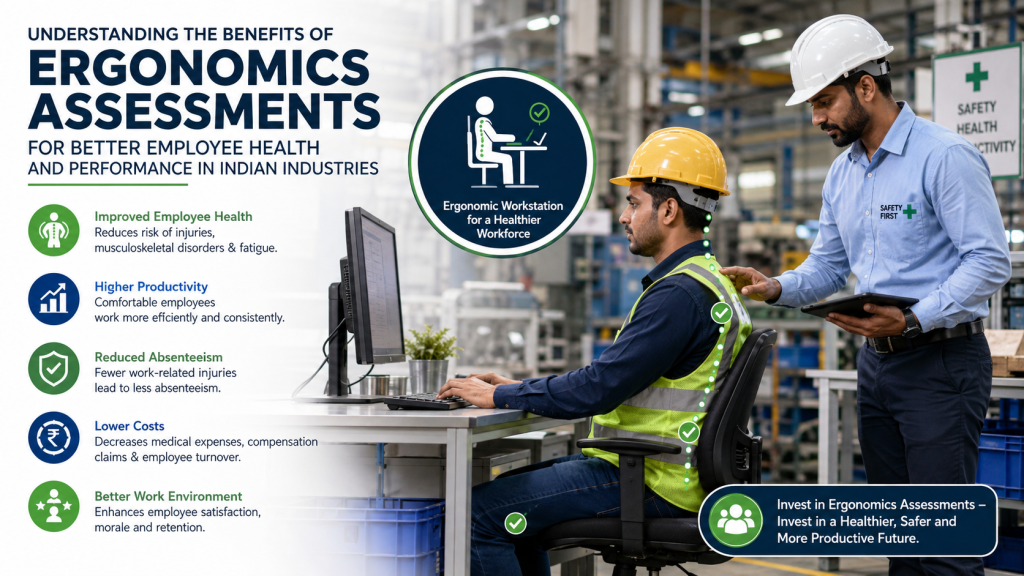
In this article, we shine a light on a pressing concern affecting countless employees in Indian industries—the lack of attention given to ergonomics. The Safety Master highlights the importance of workplace ergonomics assessments and how they can improve employee health, safety, and performance. These assessments help identify potential hazards, reduce physical strain, enhance productivity, and lower absenteeism. By understanding the importance of proper workplace design, employers and employees can work together to create a healthier, safer, and more efficient environment.
Introduction
Imagine a workplace where employees are not only productive but also healthy, motivated, and satisfied. A workplace where work-related injuries and illnesses are minimized while employee performance is optimized. This vision can be achieved through effective ergonomics assessments in Indian industries.
In today’s fast-paced business environment, employee well-being can sometimes take a backseat to productivity and operational targets. However, health and performance are closely connected. Addressing ergonomic issues can help organizations create workplaces that support both physical and psychological well-being while improving overall efficiency.
What Is Ergonomics Assessment?
Ergonomics is a multidisciplinary approach focused on designing and arranging workplaces according to the physical capabilities and limitations of employees. An ergonomics assessment examines how workers interact with their work environment to identify risks, hazards, discomfort, and other factors that may affect health and productivity.
These assessments consider factors such as posture, lighting, equipment design, workstation arrangement, repetitive movements, and workflow organization. The goal is to improve comfort and performance while reducing the possibility of occupational injuries and musculoskeletal disorders.
In Indian industries, ergonomics assessments can help customize workstations according to individual needs while encouraging proper body mechanics. Reducing unnecessary physical strain can improve concentration, comfort, and job satisfaction while creating a workplace culture that supports employee well-being.
Importance of Ergonomics Assessments in Indian Industries
Ergonomics assessments play an important role in Indian industries because employee health and productivity are essential to long-term business success. By evaluating workplace design, equipment usage, posture, and repetitive tasks, organizations can identify potential risks and introduce preventive measures.
Every employee has different physical requirements. Ergonomic assessments allow employers to adapt workstations and processes according to these needs while maintaining appropriate safety standards. This can reduce the likelihood of musculoskeletal disorders and demonstrate that employee welfare is an organizational priority.
Ergonomic improvements can also increase productivity. Employees working in comfortable conditions are less likely to experience unnecessary fatigue, discomfort, or physical strain. Better working conditions can help employees remain focused for longer periods and perform their responsibilities more efficiently.
Enhancing Employee Health Through Ergonomics Assessments
Ergonomics assessments can significantly improve employee health by identifying problems associated with workstations, equipment, tools, and workplace layouts. Experts can recommend practical changes, including appropriate chair height, monitor positioning, improved lighting, and supportive accessories.
These adjustments can encourage better posture and reduce physical strain. As a result, employees may experience fewer discomfort-related problems and a lower risk of workplace injuries. Addressing ergonomic concerns also shows employees that their health and well-being are valued.
A healthier workforce can contribute to better morale, improved attendance, and stronger productivity. By identifying risks before they develop into serious problems, organizations can take a proactive approach to workplace health.
Improving Employee Performance With Ergonomics Assessments
Ergonomics assessments can improve employee performance by identifying factors that interfere with comfort, concentration, and efficiency. Adjusting workstations, improving equipment placement, and providing suitable tools can reduce physical strain and allow employees to focus more effectively on their tasks.
Assessments can also help organizations review task design and workflow processes. Unnecessary movements, repetitive activities, and poorly organized work processes can contribute to fatigue and reduced efficiency. Ergonomic principles can help simplify these activities and create smoother workflows.
The benefits are not limited to physical comfort. A supportive workplace can improve employee motivation, engagement, and job satisfaction. When employees feel valued and comfortable, they are more likely to remain focused and contribute positively to organizational goals.
Reducing Workplace Injuries and Illnesses
Ergonomics assessments can help Indian industries reduce workplace injuries and occupational health problems. By evaluating the physical demands of different tasks, employers can identify risk factors that may contribute to musculoskeletal disorders, repetitive strain injuries, and other conditions.
Trained professionals can assess workstation design, equipment usage, work processes, and employee postures. Corrective measures may include adjusting chairs and desks, positioning monitors correctly, improving lifting practices, or redesigning repetitive tasks.
Taking preventive action can reduce workplace injuries and related absenteeism. It also helps create a safer environment where employees feel supported and protected while performing their duties.
Enhancing Employee Comfort and Satisfaction
Employee comfort is another important benefit of ergonomics assessments. Poor seating arrangements, insufficient lighting, incorrectly positioned monitors, and unsuitable equipment can cause discomfort throughout the working day.
Organizations can address these problems by introducing adjustable chairs, appropriate lighting, monitor stands, supportive equipment, and better workstation layouts. When employees feel physically comfortable, they can concentrate more effectively and experience greater job satisfaction.
Ergonomics also involves psychological well-being. Workplace stress, excessive workload, and inadequate opportunities for rest can affect employee performance. Providing suitable break areas, encouraging regular breaks, and promoting healthy work practices can contribute to a more positive work environment.
Cost Savings Through Ergonomics Assessments
Ergonomics assessments can provide significant financial benefits for Indian industries. Identifying and addressing ergonomic risks can reduce the frequency and severity of workplace injuries and illnesses. This can help organizations lower medical expenses and reduce productivity losses associated with employee absenteeism.
Investing in ergonomic equipment and better workstation design can also prevent long-term problems. Employees who experience continuous discomfort may become dissatisfied or seek other employment opportunities. Creating a comfortable and supportive workplace can improve employee retention and reduce recruitment, training, and onboarding costs.
Therefore, ergonomics assessments can create a balance between employee well-being and financial efficiency. Preventive workplace improvements can provide long-term value while supporting organizational performance.
Implementing Effective Ergonomics Assessments
To achieve the full benefits of ergonomics assessments, Indian industries should establish an effective implementation strategy. Organizations can create a dedicated team involving professionals with knowledge of workplace ergonomics, safety, and employee health.
The assessment team should work closely with management and employees to understand specific tasks, challenges, and workplace conditions. Employee participation is particularly valuable because workers can provide practical insights into discomfort and operational difficulties.
Organizations should also invest in appropriate ergonomic equipment, such as adjustable chairs, desks, monitor stands, and suitable tools. Regular communication and training should accompany these changes so employees understand proper posture, body mechanics, safe lifting techniques, and the importance of taking appropriate breaks.
Training and Education for Ergonomics
Training and education are essential for maintaining an effective ergonomics program. Employees should understand why ergonomics matters and how workplace conditions can influence their health and performance.
Training programs can teach employees how to identify ergonomic hazards, evaluate workstations, maintain proper posture, and use equipment correctly. Practical demonstrations and workplace examples can make training more effective.
Continuous education also encourages employees to take responsibility for their own well-being. When workers understand how to recognize and report ergonomic concerns, organizations can address problems before they become serious.
Successful Examples of Ergonomics Assessments
Several industries can benefit from ergonomic interventions. In office environments, adjustable workstations, ergonomic chairs, appropriate lighting, and monitor positioning can reduce discomfort and improve concentration.
Manufacturing facilities can evaluate repetitive tasks, workstation height, lifting procedures, and equipment placement. Redesigning workstations and providing proper training can reduce fatigue and repetitive strain while improving efficiency.
Call centres and other workplaces involving prolonged sitting can introduce standing desks, footrests, stretching breaks, and better seating arrangements. Such measures can help reduce discomfort and support employee focus during long working hours.
These examples demonstrate that ergonomics assessments can produce practical improvements across different types of Indian workplaces.
Conclusion
The implementation of ergonomics assessments in Indian industries is an important step toward improving employee health, safety, comfort, and performance. By evaluating workstations, equipment, tasks, and workplace processes, organizations can identify risks and introduce practical preventive measures.
Effective ergonomics programs can reduce workplace injuries, improve employee satisfaction, increase productivity, lower absenteeism, and generate long-term cost savings. More importantly, they demonstrate a genuine commitment to employee welfare.
By adopting a proactive approach to workplace ergonomics, Indian industries can create safer, healthier, and more productive environments where employees can perform at their best while organizations achieve sustainable growth.