Unleashing the Potential: How Behaviour Based Safety Implementation Transforms Employee Mind-sets

The Importance of HAZOP Study in Preventing Accidents and Promoting Safe Operations in Indian Chemical Plants
October 30, 2023
Understanding the Benefits of Ergonomics Assessments for Better Employee Health and Performance in Indian Industries
November 1, 2023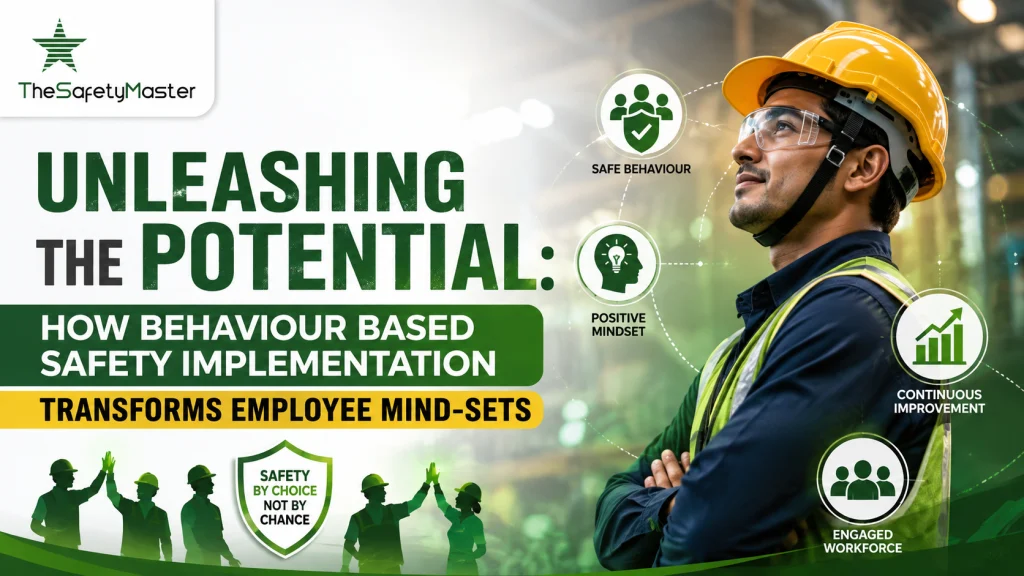
In today’s fast-paced and demanding work environments, ensuring employee safety and well-being is paramount. The Safety Master recognizes that traditional safety practices may not always be enough to transform employee mind-sets toward a proactive approach to safety. Behaviour Based Safety (BBS) implementation provides a powerful way to address complacency and disengagement by encouraging positive behavioural shifts. By focusing on employee actions, awareness, training, feedback, and continuous improvement, organizations can cultivate a proactive safety culture that enhances productivity, morale, and long-term employee growth.
Understanding Behaviour Based Safety Implementation
Behaviour Based Safety (BBS) is a proactive approach to reducing workplace accidents and injuries by focusing on human behaviour. It recognizes that employee actions and attitudes have a significant influence on safety outcomes. BBS seeks to transform employee mind-sets by creating a safety-conscious culture in which individuals take responsibility for their actions and actively contribute to maintaining a hazard-free workplace.
At its core, BBS moves beyond traditional safety protocols by recognizing that accidents can often result from predictable behavioural patterns. Understanding the psychological factors behind employee behaviour allows organizations to introduce targeted interventions that address the root causes of unsafe practices. These causes may include inadequate training, insufficient supervision, lack of awareness, or personal stress.
Successful BBS implementation requires organizational commitment. Instead of focusing only on identifying unsafe behaviour and assigning blame, organizations should understand why that behaviour occurs. Open communication, constructive feedback, and employee involvement can create an environment where workers feel valued, supported, and encouraged to prioritize safety.
By embracing BBS, organizations can establish collective responsibility for workplace safety. From senior management to frontline employees, everyone becomes involved in identifying hazards, correcting unsafe behaviours, and promoting safer practices.
The Importance of Employee Mind-sets in the Workplace
Employee mind-sets play a critical role in workplace behaviour and performance. A positive mind-set can encourage productivity, innovation, teamwork, and continuous improvement, while negative mind-sets may contribute to disengagement, inefficiency, and an unhealthy workplace environment.
Employees with a growth-oriented mind-set tend to view challenges as opportunities to learn and develop. They demonstrate resilience, seek better solutions, and remain committed to improving their skills and knowledge. This attitude supports a culture of continuous improvement and encourages employees to approach workplace challenges with confidence.
An optimistic mind-set can also promote creativity and collaboration. When employees feel comfortable sharing ideas without fear of judgment, communication becomes stronger and teams can address complex problems more effectively. Employees who believe in their abilities are also more willing to take calculated risks that may contribute to organizational growth.
Ultimately, when employees understand the value of their contributions, morale and job satisfaction can improve. Recognizing the importance of employee mind-sets therefore becomes essential for unlocking workforce potential and strengthening collective performance.
Unleashing the Potential Through Behaviour Based Safety
Behaviour Based Safety provides a practical approach to transforming employee mind-sets and building a culture of workplace safety. It focuses on identifying unsafe actions while reinforcing positive behaviours that contribute to safer working conditions.
Every action performed in the workplace can influence safety outcomes. By observing behaviour patterns and understanding the motivations behind them, organizations can develop interventions that encourage safe practices and reduce risks. Unsafe behaviour may be connected to inadequate training, lack of awareness, time pressure, or other workplace factors.
Effective BBS implementation encourages employees to become active participants rather than relying exclusively on rules and regulations. When employees recognize that their own behaviour contributes to safer outcomes, they develop a stronger sense of ownership and responsibility. Continuous communication and feedback between employees and management further strengthen this culture.
The result is more than risk reduction. BBS can contribute to improved morale, stronger employee engagement, better communication, and increased well-being throughout the organization.
Key Elements of Behaviour Based Safety Implementation
Strong leadership commitment is one of the most important elements of successful BBS implementation. Management should actively support the program, participate in safety initiatives, communicate clear expectations, and demonstrate safe behaviour through their own actions.
Organizations should also establish clear safety goals and expectations. Employees need to understand what is expected of them and how their behaviour contributes to workplace safety. Comprehensive training can help employees understand BBS principles, identify workplace hazards, and effectively observe and report behaviours.
Regular feedback and reinforcement are equally important. Positive reinforcement encourages employees to continue safe practices, while constructive corrective feedback helps them understand where improvements are necessary. Recognizing individuals and teams that consistently demonstrate safe behaviour can further strengthen the safety culture.
Together, leadership, clear expectations, training, and feedback can transform safety from a set of rules into an integral part of daily operations.
Behavioural Observations: Enhancing Safety Awareness
Behavioural observations are powerful tools for increasing workplace safety awareness. They involve systematically monitoring safe and at-risk behaviours and providing constructive feedback. Through this process, employees become more aware of their own actions as well as the actions of their colleagues.
Greater awareness helps workers recognize potential hazards and make conscious decisions to reduce risks. It also encourages employees to report near misses and unsafe conditions promptly. This proactive approach can help prevent accidents while encouraging greater accountability throughout the organization.
When employees become active participants in observing and improving workplace behaviour, safety becomes a shared responsibility rather than the responsibility of a single department.
Training Programs: Shaping Employee Behaviour
Training programs play a vital role in shaping employee behaviour. Effective training should provide workers with the knowledge and skills required to make safe decisions during daily activities. Important areas include hazard identification, risk assessment, appropriate use of personal protective equipment, emergency response, and effective communication.
Interactive workshops and simulations can make safety training more engaging. Employees can participate in realistic scenarios and learn how to respond to potential workplace incidents in a controlled environment. This allows them to learn from mistakes without facing real-world consequences.
Gamification can also improve engagement by incorporating rewards, achievements, or healthy competition into learning activities. However, training should go beyond simply providing information. Its ultimate purpose is to encourage employees to view safety as a core value and develop responsibility for their own well-being and the well-being of others.
Feedback and Reinforcement: Building a Positive Safety Culture
Feedback and reinforcement are essential for creating and maintaining a positive safety culture. Regular feedback demonstrates that management takes workplace safety seriously while helping employees understand the impact of their actions.
Constructive feedback provides employees with opportunities to recognize their strengths and identify areas for improvement. Recognition and reward systems can reinforce positive behaviours and motivate workers to maintain safe practices.
Positive reinforcement also encourages others to follow good examples. When employees see colleagues being recognized for responsible behaviour, they are more likely to participate actively in safety initiatives. Since safety culture develops over time, organizations must consistently provide feedback and reinforcement at every level.
Overcoming Challenges in Implementing Behaviour Based Safety
BBS implementation can face challenges, particularly resistance to change. Employees may believe that the program will increase their workload or interfere with established routines. Organizations can address this concern by clearly explaining the benefits of BBS and involving employees from the beginning.
Changing an established organizational culture can also be difficult. Deep-rooted beliefs and practices may prevent employees from adopting new safety measures. Education, open communication, leadership involvement, and positive examples can help overcome these barriers.
Adequate resources are another important consideration. Organizations need sufficient support and resources to implement BBS effectively. Demonstrating the potential benefits of fewer incidents, improved productivity, and stronger employee engagement can help secure stakeholder support.
A collaborative approach that involves employees at every level can make behaviour-based safety initiatives more sustainable and effective.
Case Studies: Real-Life Examples of Successful Implementations
Real-life examples demonstrate the potential impact of BBS implementation. In one manufacturing environment experiencing frequent accidents and employee disengagement, workers were trained to identify and report unsafe behaviours. Increased awareness, open communication, and timely feedback contributed to fewer incidents and improved attitudes toward safety.
Similarly, a construction firm facing risks associated with working at heights applied BBS principles to encourage workers to identify unsafe actions and conditions. Recognition of positive behaviours helped establish a culture in which safety became part of everyday work practices. The result was improved safety performance, productivity, and job satisfaction.
These examples demonstrate that empowering employees to take ownership of safety can create meaningful improvements across different industries.
Measuring the Impact of Behaviour Based Safety
Evaluating BBS effectiveness is essential for determining whether safety initiatives are producing positive results. Organizations can monitor workplace incidents and accidents, compare trends before and after implementation, and identify areas that require additional improvement.
Employee attitudes and behaviours should also be evaluated. Surveys and questionnaires can provide insight into employees’ perceptions of safety culture, confidence in identifying hazards, and adherence to safe practices.
Direct observation and simulation exercises can further demonstrate whether employees have internalized safe behaviours. A comprehensive evaluation combines numerical data with observations of employee attitudes and actions. This allows organizations to understand whether behavioural changes have become part of everyday routines.
Creating Long-Lasting Change
Sustaining Behaviour Based Safety requires organizations to embed safety practices into their workplace culture. Employee ownership is particularly important. When workers participate in decision-making and take responsibility for safety, safe behaviour becomes a natural part of daily activities.
Consistent communication is equally essential. Sharing progress, successes, and challenges helps employees understand the continued importance of safety. It also reinforces a collective mind-set focused on continuous improvement.
By encouraging ownership and maintaining open communication, organizations can develop a sustainable framework for BBS that continues to influence employee behaviour over time.
Conclusion
Behaviour Based Safety implementation has the potential to transform employee mind-sets and revolutionize workplace safety. By focusing on behavioural observations, effective training, continuous feedback, positive reinforcement, and employee involvement, organizations can develop a stronger and more proactive safety culture.
BBS does more than reduce risks. It encourages employees to become active participants in workplace safety, strengthens accountability, improves communication, and supports employee well-being. With committed leadership and engaged employees, organizations can create workplaces where safety becomes a shared responsibility and an essential part of everyday operations.