HIRA Risk Assessment: A Complete Guide to Identifying and Controlling Workplace Risks
How HIRA Safety Helps Organizations Identify Hazards and Prevent Workplace Accidents
October 5, 2026
Industrial Fire Risk Assessment: Using a Fire Safety Audit Checklist for Industry
October 5, 2026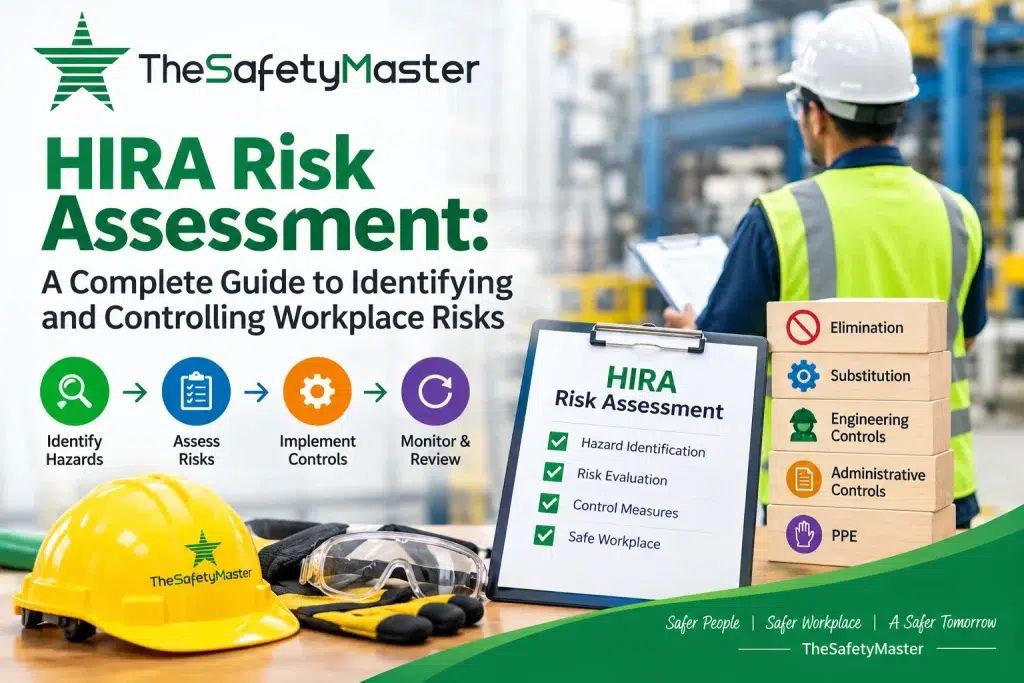
HIRA Risk Assessment: A Complete Guide to Identifying and Controlling Workplace RisksWorkplace safety is important for every industry. Employees may face many hazards during daily work, such as machines, chemicals, electricity, fire, working at height, moving equipment, and unsafe work practices. Identifying these hazards before they cause an incident is an important part of safety management.
HIRA Risk Assessment helps organizations identify workplace hazards, understand the risks associated with them, and select suitable control measures. It provides a systematic way to improve workplace safety and protect employees, equipment, property, and the environment.
The Safety Master provides safety-related training, consulting, audits, and risk management solutions to help organizations build safer workplaces.
What is HIRA?
HIRA stands for Hazard Identification and Risk Assessment. It is a systematic process used to identify hazards in a workplace and assess the level of risk associated with those hazards.
A HIRA study generally considers:
- What can cause harm?
- Who can be affected?
- How can the incident happen?
- How likely is the incident?
- How serious could the consequence be?
- What controls are already available?
- What additional controls are required?
The purpose of HIRA is not only to identify problems but also to reduce risks to an acceptable level through effective control measures.
What is the Primary Difference Between a Hazard and a Risk?
A hazard is something that has the potential to cause harm.
A risk is the possibility that the hazard will actually cause harm, together with the potential severity of that harm.
For example, an exposed electrical wire is a hazard. The possibility of a worker receiving an electric shock from that wire represents the risk.
Understanding this difference is important when performing a HIRA Risk Assessment.
Why is HIRA Risk Assessment Important?
A proper HIRA process can help organizations identify hazards before an accident occurs. It can also support better safety planning and decision-making.
Important benefits include:
- Identifying workplace hazards
- Reducing accidents and injuries
- Improving safety controls
- Protecting employees and contractors
- Supporting legal and safety compliance
- Improving emergency preparedness
- Reducing property and equipment damage
- Helping management prioritize safety actions
- Supporting safer work procedures
HIRA can be applied to manufacturing plants, construction sites, warehouses, chemical industries, oil and gas facilities, offices, and many other workplaces.
What are the 4 Steps of HIRA?
The exact HIRA methodology can differ between organizations, but a simple four-step approach includes hazard identification, risk assessment, risk control, and monitoring/review.
1. Hazard Identification
The first step is to identify all possible hazards associated with a job, process, activity, equipment, or workplace.
Examples include:
- Chemical exposure
- Electrical hazards
- Fire hazards
- Moving machinery
- Working at height
- Confined spaces
- Slips, trips, and falls
- Manual handling
- Noise and vibration
- Hot work
- Vehicle movement
2. Risk Assessment
After identifying hazards, the next step is to determine the level of risk.
Risk assessment commonly considers likelihood and severity. A risk matrix may then be used to classify the risk as low, medium, high, or another category defined by the organization.
3. Risk Control
Once risks are identified and assessed, suitable control measures should be selected.
The Hierarchy of Controls is commonly used to select effective controls. It generally follows this order:
- Elimination
- Substitution
- Engineering controls
- Administrative controls
- Personal Protective Equipment (PPE)
4. Monitoring and Review
HIRA should not be treated as a one-time activity. Risks may change when equipment, materials, processes, people, or working conditions change.
The assessment should therefore be reviewed and updated when necessary.
Hazard Identification and Risk Assessment PDF
A Hazard Identification and Risk Assessment PDF can be useful as a reference document for safety professionals, supervisors, engineers, and workers.
A typical HIRA document may contain:
- Activity or process details
- Hazard identification
- Possible consequences
- Existing controls
- Likelihood rating
- Severity rating
- Risk rating
- Additional control measures
- Responsible person
- Target completion date
- Residual risk
- Review date
Organizations should develop their HIRA documents according to their processes, workplace conditions, applicable requirements, and internal safety procedures.
HIRA Safety PDF
A HIRA Safety PDF can also be used for training and workplace awareness. It can explain important concepts such as hazards, risks, risk matrices, control measures, and safe work practices.
For safety teams, a well-prepared HIRA document can provide a clear record of identified risks and the actions required to control them.
Which Factors Influence Likelihood in a Risk Assessment?
Likelihood means how probable it is that a hazardous event may occur.
Several factors can influence likelihood, including:
- Frequency of exposure
- Duration of exposure
- Number of people exposed
- Existing control measures
- Condition of equipment
- Human factors
- Worker competency
- Work environment
- Frequency of the activity
- Previous incidents or near misses
- Reliability of safety systems
For example, a worker who performs a hazardous task every day may have a greater exposure frequency than someone who performs the same task once a year.
How is Risk Controlled in HIRA?
After assessing the risk, appropriate control measures should be implemented.
The strongest controls should be considered first.
Elimination
Eliminate the hazard completely whenever reasonably possible.
Substitution
Replace a hazardous material, process, or equipment with a safer alternative.
Engineering Controls
Use physical or technical solutions to separate people from hazards.
Examples include machine guards, ventilation systems, barriers, and interlocks.
Administrative Controls
These include procedures, training, signs, job rotation, permits, and safe work instructions.
PPE
PPE includes safety helmets, gloves, safety shoes, goggles, respirators, hearing protection, and other protective equipment.
When is PPE Considered the First Choice for Risk Control?
PPE is generally not the first choice when higher-level controls can effectively eliminate or reduce the hazard.
PPE is normally considered after elimination, substitution, engineering controls, and administrative controls have been considered. It may also be used as an additional layer of protection.
For example, if a chemical exposure cannot be completely eliminated, engineering and administrative controls may be combined with suitable chemical-resistant gloves and eye protection.
Why Must a Risk Assessment Be Reviewed?
A risk assessment must be reviewed because workplace conditions can change.
A review may be necessary when:
- A new machine is installed
- A process is changed
- New chemicals are introduced
- An accident or near miss occurs
- Work methods change
- New hazards are identified
- Safety controls are found to be ineffective
- Legal or regulatory requirements change
- There is a significant organizational change
- A scheduled review date is reached
Regular review helps ensure that the HIRA remains relevant to actual workplace conditions.
HIRA Risk Assessment Example
Consider a worker operating a cutting machine.
Hazard: Contact with moving cutting equipment.
Potential consequence: Serious hand injury.
Existing controls: Machine guarding and operating procedure.
Likelihood: Based on exposure and existing controls.
Severity: Potentially serious.
Risk: Determined using the organization’s risk matrix.
Additional controls: Improve guarding, verify interlocks, provide operator training, conduct inspections, and ensure appropriate PPE is used.
This example shows how HIRA connects hazard identification with practical risk control.
Role of The Safety Master in HIRA Risk Management
Effective risk management requires more than simply preparing a document. Organizations need to understand their actual workplace hazards and implement practical controls.
The Safety Master supports organizations with safety training, risk assessment, audits, consulting, and other safety management solutions.
A systematic HIRA Risk Assessment can help organizations move from simply reacting to incidents toward identifying and controlling hazards before incidents occur.
Conclusion
HIRA Risk Assessment is an important part of workplace safety and risk management. It helps organizations identify hazards, understand risks, and select appropriate control measures. From hazard identification and risk assessment to the Hierarchy of Controls and regular review, every stage contributes to a safer workplace.
Using proper HIRA practices can help reduce workplace incidents and improve safety performance. The Safety Master helps organizations strengthen their approach to workplace safety through professional safety training, audits, consulting, and risk management solutions.