How HIRA Safety Helps Organizations Identify Hazards and Prevent Workplace Accidents
Bridging Safety Gaps with Technology and AI
October 2, 2026
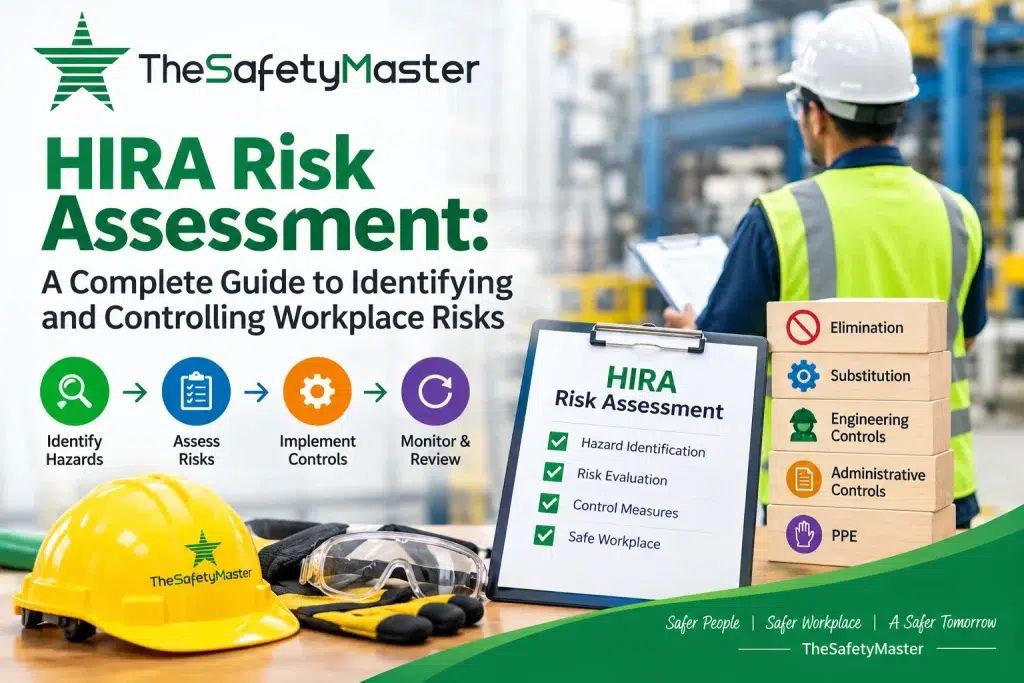
HIRA Risk Assessment: A Complete Guide to Identifying and Controlling Workplace Risks
October 5, 2026HIRA Safety is an important part of workplace safety because it helps organizations identify hazards before they cause injuries, equipment damage, fires, or other incidents. HIRA stands for Hazard Identification and Risk Assessment. It provides a systematic way to find hazards, understand the level of risk, and select suitable control measures.
For industries such as construction, manufacturing, oil and gas, chemicals, warehouses, and other workplaces, HIRA Safety can support better risk management and safer working conditions. The Safety Master provides safety-related knowledge, training, audits, and risk management solutions to help organizations improve their workplace safety practices.
What Is HIRA Safety?
HIRA Safety is a structured process used to identify workplace hazards and assess the risks associated with those hazards. The process normally considers the activity, possible hazards, consequences, existing controls, likelihood, severity, and additional control measures.
A good HIRA helps organizations answer three important questions:
- What can go wrong?
- How serious could the result be?
- What can we do to control the risk?
HIRA should be reviewed when there are changes in processes, equipment, materials, work methods, or workplace conditions.
HIRA Full Form in Safety
The HIRA full form in safety is Hazard Identification and Risk Assessment.
HIRA is widely used as a preventive safety management technique. It focuses on identifying hazards and evaluating risks before an unwanted event occurs.
Why Is HIRA Safety Important in the Workplace?
The main purpose of HIRA is to identify hazards and control risks before accidents happen. Instead of waiting for an incident, organizations can take preventive action.
HIRA Safety helps organizations:
- Identify hazards in work activities.
- Assess the level of risk.
- Prioritize high-risk activities.
- Select suitable control measures.
- Improve employee safety awareness.
- Reduce workplace accidents and incidents.
- Support safe work procedures.
- Improve emergency preparedness.
- Protect machinery, equipment, and property.
- Support legal and safety requirements.
Why Is It Important to Identify Hazards in a Workplace?
Identifying hazards is important because an uncontrolled hazard can lead to injury, illness, equipment damage, fire, environmental impact, or production loss.
Early identification gives management and workers an opportunity to control the hazard before an incident occurs.
HIRA Safety Steps
The HIRA process can be adapted according to the organization’s activities and risk management procedure. A practical HIRA process generally includes the following steps:
1. Identify the Activity
First, identify the job, process, operation, or activity that needs assessment.
2. Identify Hazards
Find anything that can potentially cause harm. This may include mechanical, electrical, chemical, physical, ergonomic, biological, or fire hazards.
3. Identify Possible Consequences
Determine what could happen if the hazard is not controlled. Consequences may include injury, occupational illness, fire, equipment damage, environmental harm, or production loss.
4. Assess the Risk
Evaluate the risk by considering factors such as likelihood and severity. A risk matrix can help classify the risk as low, medium, high, or critical.
5. Identify Existing Controls
Record the safety controls that are already in place, such as guarding, ventilation, PPE, procedures, training, alarms, or emergency systems.
6. Implement Additional Controls
Where the existing controls are not sufficient, introduce additional measures using the Hierarchy of Controls.
7. Review and Monitor
HIRA should be reviewed periodically and whenever there is a significant change in the activity, equipment, material, process, or workplace condition.
What Are the 7 Steps of HIRA?
The commonly used 7 steps of HIRA are:
- Define the activity or process.
- Identify hazards.
- Identify potential consequences.
- Assess the risk.
- Identify existing controls.
- Recommend additional control measures.
- Review, monitor, and update the assessment.
The exact number and names of steps can vary between organizations because HIRA procedures are often customized to the workplace.
What Is the 4 Step of HIRA?
A simplified 4-step HIRA process can be understood as:
- Hazard Identification – Find hazards associated with the activity.
- Risk Assessment – Evaluate the likelihood and severity of the risk.
- Risk Control – Apply appropriate measures to eliminate or reduce the risk.
- Monitoring and Review – Check whether the controls remain effective and update the HIRA when necessary.
This four-step approach provides a simple framework for workplaces that need a straightforward risk assessment process.
What Are 5 Ways to Identify Workplace Hazards?
Organizations can use different methods to identify hazards. Five practical methods include:
Workplace Inspections
Regular inspections can identify unsafe conditions, damaged equipment, blocked exits, poor housekeeping, and other hazards.
Job Safety Analysis
Breaking a job into individual steps can help identify hazards associated with each task.
Employee Feedback
Workers often have direct knowledge of hazards because they perform the activities regularly. Their observations can provide valuable information.
Incident and Near-Miss Analysis
Previous accidents and near misses can reveal hazards that may exist in similar activities.
Safety Audits and Risk Assessments
Audits and HIRA studies can systematically identify hazards and evaluate existing safety controls.
What Are the 7 Types of Hazards?
The classification of hazards can vary by organization. A commonly used workplace classification includes:
- Physical Hazards – Noise, heat, vibration, radiation, and poor lighting.
- Chemical Hazards – Toxic, corrosive, flammable, or reactive substances.
- Biological Hazards – Bacteria, viruses, fungi, and other biological agents.
- Mechanical Hazards – Moving machinery, rotating parts, crushing, cutting, or entanglement.
- Electrical Hazards – Electric shock, short circuits, arc flash, and electrical fires.
- Ergonomic Hazards – Poor posture, repetitive work, manual handling, and excessive physical effort.
- Psychosocial Hazards – Work-related stress, excessive workload, violence, harassment, or poor work organization.
Some organizations use different classifications or combine certain categories.
HIRA Safety Format
A HIRA safety format should clearly document the activity, hazard, consequences, risk level, existing controls, and recommended additional controls.
A basic format may include:
| Activity | Hazard | Consequence | Existing Controls | Likelihood | Severity | Risk Rating | Additional Controls |
|---|---|---|---|---|---|---|---|
| Material handling | Falling material | Injury | Safety helmet, safe lifting | Medium | High | High | Improve lifting method and supervision |
| Welding | Sparks and fumes | Fire/health effects | PPE, ventilation | Medium | High | High | Improve ventilation and fire controls |
The format can be expanded according to the complexity of the operation.
HIRA Safety PDF
A HIRA Safety PDF can be useful for documenting and sharing risk assessments within an organization. A typical HIRA PDF may contain:
- Activity and process details
- Hazard identification
- Risk assessment methodology
- Risk matrix
- Existing controls
- Additional control measures
- Responsible person
- Target completion date
- Residual risk
- Review date
- Approval details
Organizations should use a HIRA format that matches their activities, hazards, risk criteria, and internal safety management system.
Hazard Identification and Risk Assessment (HIRA PDF Free Download)
People often search for Hazard Identification and Risk Assessment (HIRA PDF free download) to understand HIRA formats, risk matrices, and assessment methods.
However, a downloaded template should not simply be copied and used without reviewing the actual workplace. Every workplace has different processes, equipment, materials, people, and hazards.
A HIRA document should be prepared based on actual site conditions and reviewed by competent personnel.
Difference Between HIRA and JSA
HIRA and JSA are both useful safety tools, but their application can be different.
HIRA generally provides a broader assessment of hazards and risks associated with processes, activities, operations, or areas.
JSA (Job Safety Analysis) generally focuses on a particular job and breaks it into steps to identify hazards and define controls for each step.
For example, HIRA may assess risks associated with a manufacturing process, while JSA may focus specifically on maintenance work on a particular machine.
Both methods can complement each other as part of an effective safety management system.
What Are the 5 Pillars of Risk Assessment?
There is no single universal five-pillar model used by every organization. A practical five-part approach to risk assessment can include:
- Hazard Identification
- Risk Analysis
- Risk Evaluation
- Risk Control
- Monitoring and Review
These elements help organizations move from identifying a hazard to controlling and continuously monitoring the associated risk.
Hazard Full Form in Safety
The word hazard does not have a standard “full form” in safety. It is not an acronym. A hazard means a source, situation, condition, or activity with the potential to cause harm.
For example, exposed electrical wiring is a hazard because it can potentially cause electric shock or fire.
HIRA Safety and Accident Prevention
HIRA Safety supports accident prevention by moving safety management from a reactive approach to a preventive approach.
When hazards are identified early, organizations can apply suitable controls before employees are exposed to unacceptable risks. HIRA can also improve communication between workers, supervisors, engineers, safety professionals, and management.
An effective HIRA should not remain only as a document. The controls identified in the assessment should be implemented, communicated, monitored, and reviewed.
How HIRA Safety Supports Better Workplace Risk Management
A strong HIRA program can help organizations create a more systematic approach to workplace safety. It can support:
- Better identification of high-risk activities.
- Improved safety planning before work starts.
- Stronger communication between workers and supervisors.
- Better selection of engineering and administrative controls.
- Improved emergency planning.
- Continuous improvement of safety procedures.
- Reduction of preventable incidents.
The Safety Master focuses on practical safety knowledge and risk management approaches that can help organizations build safer workplaces.
Conclusion
HIRA Safety is an important tool for identifying hazards, assessing risks, and selecting effective control measures. By following a systematic process, organizations can understand where risks exist and take preventive action before accidents occur.
From HIRA safety format and risk matrices to hazard identification, risk assessment, and control measures, every part of the process should be based on actual workplace conditions. HIRA should also be reviewed regularly so that changes in equipment, processes, materials, and work conditions are properly considered.
For organizations looking to improve hazard identification and workplace risk management, The Safety Master can provide useful safety resources, training, audits, and professional safety solutions.