Leading Consulting Services and Regulatory Requirements for HAZOP Study in India

Top-Rated HAZOP Study Consultants in India for Chemical, Oil, and Industrial Plants
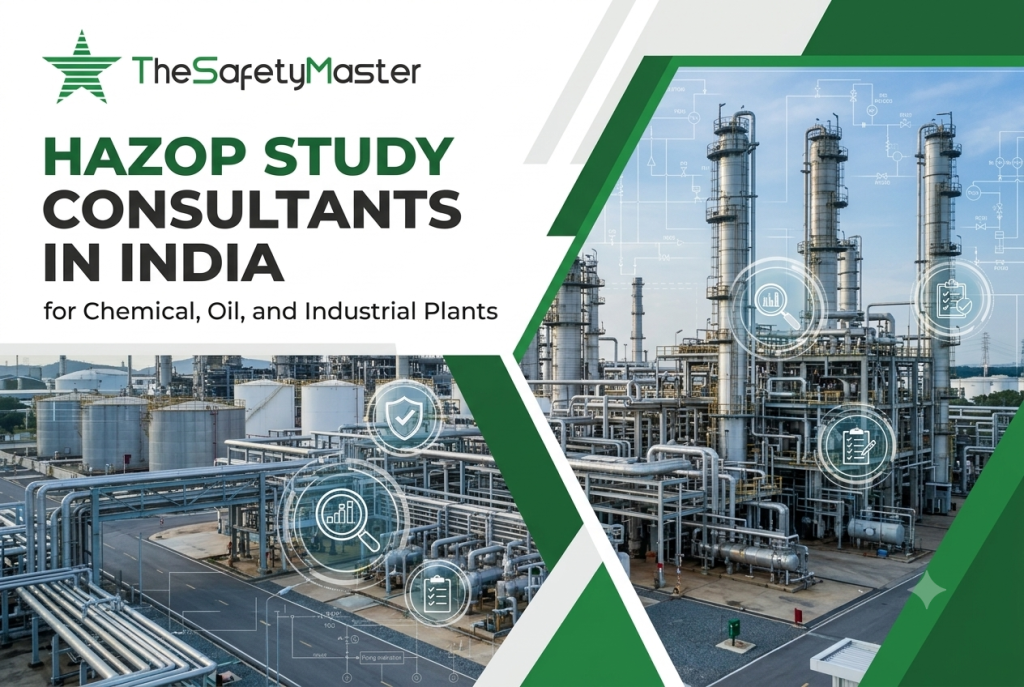
November 18, 2026Processing facilities handle complex interactions between high temperatures, volatile pressures, toxic chemicals, and automated control loops daily. In high-hazard industrial environments across India—including chemical plants, oil refineries, pharmaceutical units, and bulk storage installations—preventing operational deviations is vital for protecting lives, assets, and the environment.A HAZOP study in India (Hazard and Operability Study) serves as a core qualitative risk assessment technique, systematically evaluating process designs to identify hazards and operability flaws before major incidents occur.
As regulatory authorities tighten enforcement of process safety management standards, executing a rigorous hazop study in india has shifted from a best practice into an essential legal and operational requirement.The Safety Master delivers title-leading consulting services, certified facilitation, and comprehensive technical reviews to ensure your facility maintains compliance and operational safety.
What is a HAZOP Study?
A Hazard and Operability (HAZOP) Study is a structured, multidisciplinary team examination of a process, system, or piping and instrumentation diagram (P&ID).Guided by a qualified facilitator, the team uses standardized guide words combined with process parameters (e.g., More Flow, No Pressure, Reverse Temperature) to identify deviations from the intended design intent.
 [ Design Intent ] ---> [ Guideword + Parameter ] ---> [ Process Deviation ]
 |
 [ Recommended Safeguard ] <--- [ Consequence & Risk ] <--- [ Root Cause ]
Key Components of a HAZOP Analysis
- Node Definition:Breaking down complex Process Flow Diagrams (PFDs) and P&IDs into manageable sections or loops with clear boundaries.
- Guideword Application: Combining standard terms (No, More, Less, As Well As, Reverse, Other Than) with process variables to hypothesize potential failures.
- Cause & Consequence Mapping:Trace initial root causes (e.g., valve failure, operator error, instrument drift) through to their ultimate physical outcomes.
- Safeguard Verification:Evaluating existing engineering controls, safety instrumented systems (SIS), interlocks, and procedural barriers to ensure risk mitigation.
- Actionable Recommendations:Defining clear, prioritized safety actions to close identified safeguard gaps.
Regulatory Framework & Statutory Requirements in India
Conducting a hazop study in india is backed by statutory frameworks governed by federal and state environmental, labor, and energy safety authorities. Plants handling hazardous materials must comply with multiple key regulations:
1. Manufacture, Storage and Import of Hazardous Chemical (MSIHC) Rules, 1989
Under the Environment (Protection) Act, 1986, major accident hazard (MAH) units handling threshold quantities of toxic or flammable chemicals must prepare comprehensive Safety Reports, carry out Process Hazard Analyses (PHA), and submit update filings containing quantitative and qualitative risk assessments.
2. The Factories Act, 1948 & State Factory Rules
Section 41-B of The Factories Act mandates compulsory disclosure of information regarding process hazards in hazardous chemical industries. State Factories Rules mandate safety reviews, process hazard reviews, and safety audits for ongoing operations and major facility expansions.
3. MoEFCC Environmental Clearance (EC) Guidelines
The Ministry of Environment, Forest and Climate Change (MoEFCC) requires industrial projects seeking Consent to Establish (CTE) or Environmental Clearance to submit HAZOP and risk analysis reports during the initial environmental impact assessment (EIA) stage.
4. Petroleum and Natural Gas Regulatory Board (PNGRB) Codes
For oil refineries, natural gas pipelines, city gas distribution networks, and bulk storage terminals, PNGRB regulations stipulate mandatory HAZOP, LOPA, and QRA studies to maintain a valid license to operate.
When Should a HAZOP Study be Conducted?
[ Engineering & Design ] ==> [ Pre-Commissioning ] ==> [ Operational Review ] ==> [ Plant Modification ]
 Detail Design HAZOP Pre-Startup Review Periodic Audit (3–5 yrs) Management of Change
- Detailed Engineering & Design Phase: Prior to procurement and construction, while P&IDs are fully defined and design changes remain cost-effective.
- Pre-Commissioning & Startup: Verifying that as-built installations match process safety requirements before introducing hazardous fluids.
- Periodic Re-validation: Conducting systematic re-evaluations every 3 to 5 years as part of ongoing Process Safety Management (PSM) cycles.
- Management of Change (MOC): Reviewing proposed equipment modifications, operating condition shifts, or chemical substitutions to prevent secondary hazards.
Title-Leading HAZOP Consulting Services by The Safety Master
Executing an efficient risk assessment requires independent oversight, certified session leaders, and structured safety engineering expertise. The Safety Master provides specialized consultancy services tailored to the industrial needs of modern processing facilities across India.
Why Choose The Safety Master?
- Certified Independent Facilitators: Our experts guide multidisciplinary teams through unbiased, structured sessions to uncover hidden risk interactions.
- Multidisciplinary Team Integration: We bridge process engineering, instrumentation, operations, maintenance, and safety teams to deliver actionable recommendations.
- Integrated Safety Engineering:We seamlessly combine HAZOP with Layer of Protection Analysis (LOPA), Safety Integrity Level (SIL) studies, and Quantitative Risk Assessment (QRA).
- Comprehensive Documentation: Delivering audit-ready worksheets, risk matrices, and action tracker reports that simplify regulatory compliance and inspection sign-offs.
The 4-Phase HAZOP Workflow
+———————————————————————–+
| PHASE 1: PREPARATION |
| – Collect P&IDs, PFDs, MSDS, Safe Operating Procedures (SOPs) |
| – Establish Node Boundaries and Select Team Members |
+———————————————————————–+
|
v
+———————————————————————–+
| PHASE 2: SYSTEMATIC EXAMINATION |
| – Apply Guidewords to Node Parameters (Flow, Temp, Press, Level) |
| – Uncover Causes, Assess Consequences, Validate Safeguards |
+———————————————————————–+
|
v
+———————————————————————–+
| PHASE 3: RISK RANKING & RECOMMENDATIONS |
| – Evaluate Severity and Likelihood using Risk Matrix |
| – Formulate Engineering Controls & Instrument Interlocks |
+———————————————————————–+
|
v
+———————————————————————–+
| PHASE 4: DOCUMENTATION & CLOSURE |
| – Generate Audit-Ready HAZOP Report & Action Tracking Log |
| – Verify Implementation during Pre-Startup Safety Reviews (PSSR) |
+———————————————————————–+
Frequently Asked Questions (FAQs)
A standard session requires a qualified, independent Facilitator/Scribe alongside internal plant experts, including the Lead Process Engineer, Operations/Plant Specialist, Control & Instrumentation Engineer, Mechanical/Maintenance Specialist, and Safety Manager.
It is compulsory for Major Accident Hazard (MAH) installations, chemical manufacturing, petroleum refiners, pharmaceutical plants, and projects requiring MoEFCC Environmental Clearances or PNGRB operational approvals.
A HAZOP study must be re-validated every 3 to 5 years under standard PSM guidelines, as well as whenever major process modifications, equipment changes, or incident investigations trigger a Management of Change (MOC) process.