How to Use a HIRA Risk Matrix to Evaluate and Control Workplace Hazards

Industrial Fire Risk Assessment: Using a Fire Safety Audit Checklist for Industry
October 5, 2026
A Complete Guide to Learning HAZOP Training Online for Process Safety Professionals
October 6, 2026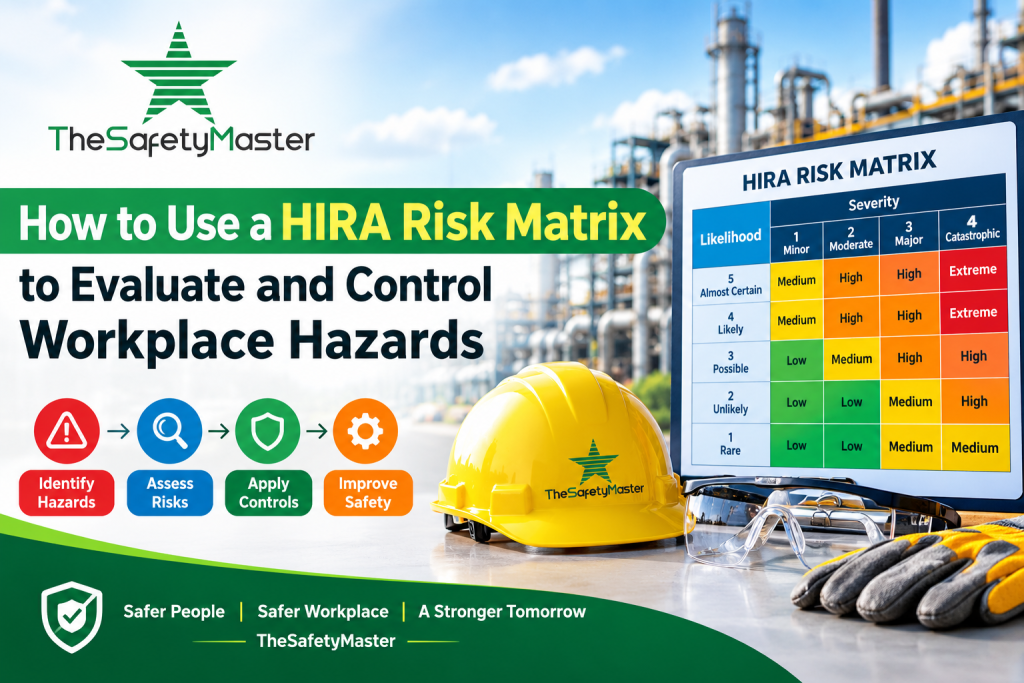
Workplace hazards can cause injuries, property damage, equipment failure, environmental harm, and business disruption if they are not properly identified and controlled. Hazard Identification and Risk Assessment (HIRA) is an important safety process used to identify hazards, evaluate risks, and select suitable control measures.
A HIRA Risk Matrix helps safety professionals determine the level of risk by considering the likelihood of an incident and the severity of its possible consequences. It provides a simple and practical way to prioritize workplace hazards and decide which risks need immediate attention.
The Safety Master supports organizations with practical safety solutions, risk assessment, HIRA studies, and workplace hazard management.
What Is HIRA in Safety?
HIRA stands for Hazard Identification and Risk Assessment. It is a systematic method used to identify workplace hazards and assess the risks associated with different activities.
HIRA can be applied to:
- Manufacturing plants
- Construction sites
- Chemical industries
- Oil and gas facilities
- Warehouses
- Power plants
- Maintenance activities
- Laboratories
- Offices
- Process industries
The main purpose of HIRA is to understand what can go wrong, how serious the consequences could be, and what controls can reduce the risk.
HIRA Full Form in Safety
The HIRA full form in safety is Hazard Identification and Risk Assessment.
It is commonly used as part of workplace safety management to identify hazards before an accident or unwanted event occurs.
What Is a HIRA Risk Matrix?
A HIRA Risk Matrix is a tool used to determine the level of risk associated with an identified hazard.
The matrix generally considers two important factors:
Risk = Likelihood × Severity
Likelihood refers to the possibility or frequency of an incident occurring, while severity refers to the potential consequence if the incident occurs.
For example:
| Likelihood | Severity | Risk |
|---|---|---|
| Low | Minor | Low |
| Medium | Moderate | Medium |
| High | Major | High |
| Very High | Critical | Extreme |
The exact scoring system can differ between organizations. A company should establish its own risk-rating criteria based on its activities, hazards, legal requirements, and safety management system.
How Does a HIRA Risk Assessment Matrix Work?
A HIRA Risk Assessment Matrix helps convert a qualitative or quantitative assessment into a clear risk rating.
Step 1: Identify the Activity
Start by identifying the activity or task being assessed.
Examples include:
- Working at height
- Welding
- Chemical handling
- Electrical maintenance
- Material handling
- Confined space entry
- Machine operation
Step 2: Identify the Hazards
Identify anything that could cause harm during the activity.
For example, during welding, hazards may include:
- Fire
- Explosion
- Electric shock
- Welding fumes
- Burns
- Eye injury
Step 3: Identify Possible Consequences
Determine what could happen if the hazard is not controlled.
Possible consequences may include:
- First-aid injury
- Serious injury
- Fatality
- Fire
- Explosion
- Equipment damage
- Environmental impact
Step 4: Determine Likelihood
Estimate how likely the unwanted event is to occur.
A simple rating system may be:
- Rare
- Unlikely
- Possible
- Likely
- Almost certain
Step 5: Determine Severity
Evaluate how serious the potential consequence could be.
For example:
- Insignificant
- Minor
- Moderate
- Major
- Catastrophic
Step 6: Calculate the Risk Rating
Multiply likelihood by severity according to the organization’s approved risk methodology.
For example:
Likelihood = 4
Severity = 5
Risk score:
4 × 5 = 20
The organization’s risk matrix then determines whether the score represents low, medium, high, or extreme risk.
HIRA Hazard Identification and Risk Assessment
HIRA hazard identification and risk assessment should consider both routine and non-routine activities.
A good assessment should examine:
- People
- Equipment
- Materials
- Processes
- Workplace conditions
- Environmental factors
- Maintenance activities
- Emergency situations
It is also important to consider workers who may be more exposed to particular hazards, such as new employees, contractors, maintenance personnel, and visitors.
What Are HIRA Control Measures?
After identifying and rating a hazard, suitable controls should be selected.
HIRA control measures should preferably follow the hierarchy of controls.
Elimination
Remove the hazard completely where possible.
Substitution
Replace a hazardous material, process, or activity with a safer alternative.
Engineering Controls
Use physical or technical controls to separate people from hazards.
Examples include:
- Machine guarding
- Interlocks
- Ventilation
- Barriers
- Automatic shutdown systems
Administrative Controls
Use procedures, training, warning signs, work instructions, and scheduling to reduce exposure.
Personal Protective Equipment
PPE may include:
- Safety helmets
- Safety shoes
- Gloves
- Safety goggles
- Face shields
- Respiratory protection
- Hearing protection
PPE is important, but it should not be treated as the only control when higher-level controls are reasonably practicable.
What Is the 4 Step of HIRA?
Different organizations may use different HIRA methodologies. A simple 4-step HIRA approach can include:
- Identify the activity and hazards
- Assess the risk
- Select and implement control measures
- Monitor and review the controls
More detailed HIRA procedures may divide these steps into additional stages.
What Are the 7 Steps of HIRA?
A detailed HIRA process can be organized into seven practical steps:
- Define the activity or process.
- Identify hazards.
- Identify people who may be exposed.
- Determine potential consequences.
- Assess likelihood and severity.
- Select suitable control measures.
- Review and monitor the risk assessment.
The exact process may vary according to the organization’s HIRA procedure.
HIRA Risk Assessment Template
A HIRA risk assessment template helps safety teams document hazards and controls in a consistent format.
A basic template can contain:
| Activity | Hazard | Consequence | Existing Controls | Likelihood | Severity | Risk | Additional Controls |
|---|---|---|---|---|---|---|---|
| Welding | Fire | Fire/Property Damage | Fire extinguisher | 3 | 5 | 15 | Improve hot-work controls |
| Chemical handling | Chemical exposure | Injury | PPE | 3 | 4 | 12 | Improve ventilation |
| Work at height | Fall | Serious injury | Guardrails | 2 | 5 | 10 | Additional fall protection |
The scoring criteria should be defined by the organization’s approved risk assessment procedure.
HIRA Safety PDF and HIRA PDF Free Download
People often search for HIRA Safety PDF, Hazard Identification and Risk Assessment PDF free download, or a HIRA format to understand how risk assessments are documented.
A useful HIRA PDF should explain:
- HIRA methodology
- Hazard identification
- Risk evaluation
- Risk matrix
- Risk ratings
- Existing controls
- Additional controls
- Responsibility
- Review requirements
A downloaded template should always be adapted to the actual workplace. A generic PDF should not be treated as a complete risk assessment for a specific facility.
How Will You Evaluate Hazards and Risks in the Workplace?
Workplace hazards can be evaluated by following a systematic process.
First, identify the activity and potential hazards. Next, determine who can be affected and what could happen. Then evaluate likelihood and severity using the organization’s approved criteria.
After calculating the risk rating, determine whether existing controls are adequate. If the risk is not acceptable, additional controls should be selected and implemented.
Finally, the assessment should be reviewed after significant changes, incidents, new equipment, new processes, or other relevant changes.
How to Use a Risk Matrix?
To use a risk matrix:
- Identify the hazard.
- Identify the possible consequence.
- Estimate the likelihood.
- Estimate the severity.
- Find the intersection of likelihood and severity on the matrix.
- Record the risk rating.
- Apply additional controls where required.
- Reassess the residual risk.
The matrix should support decision-making rather than replace professional judgment.
What Is a Risk Matrix Used for in Hazard Analysis?
A risk matrix is used to prioritize hazards according to their risk level.
For example, if one hazard has a high likelihood and severe consequence, it may receive a high or extreme risk rating. Management can then prioritize controls for that hazard.
A risk matrix can help organizations:
- Prioritize hazards
- Compare different risks
- Select control measures
- Communicate risk levels
- Track improvements
- Support management decisions
Examples of Hazard Risks
There are many types of workplace hazards.
Physical Hazards
Examples include:
- Slips and trips
- Noise
- Heat
- Working at height
- Moving machinery
Chemical Hazards
Examples include:
- Toxic chemicals
- Flammable liquids
- Corrosive substances
- Chemical vapors
Electrical Hazards
Examples include:
- Electric shock
- Short circuits
- Damaged cables
- Overloaded circuits
Fire and Explosion Hazards
Examples include:
- Flammable gases
- Combustible materials
- Ignition sources
- Hot work
Ergonomic Hazards
Examples include:
- Manual handling
- Repetitive work
- Poor posture
- Improper workstation design
Importance of HIRA Risk Matrix in Workplace Safety
A properly designed HIRA Risk Matrix makes risk assessment easier to understand and communicate.
It helps safety teams focus their attention on the hazards that require the greatest level of control. It can also support discussions between workers, supervisors, engineers, and management.
However, the quality of the final risk assessment depends on accurate hazard identification, appropriate scoring criteria, competent assessment, and effective control measures.
Final Thoughts
Hazard Identification and Risk Assessment (HIRA) is an important part of workplace risk management. By identifying hazards, evaluating likelihood and severity, and implementing effective controls, organizations can reduce workplace risks.
A HIRA Risk Assessment matrix provides a practical method for ranking hazards and prioritizing corrective actions. HIRA templates, PDFs, and checklists can support documentation, but they should always be customized according to the actual workplace, activities, and hazards.
The Safety Master helps organizations develop practical approaches to HIRA, risk assessment, hazard identification, and safety management so that workplace risks can be identified and controlled more effectively.