Essential Steps to Execute a Risk-Based HIRA Study in High-Hazard Facilities

How to Create a Practical Fire Safety Audit Checklist for Industry and Manufacturing Plants
October 17, 2026
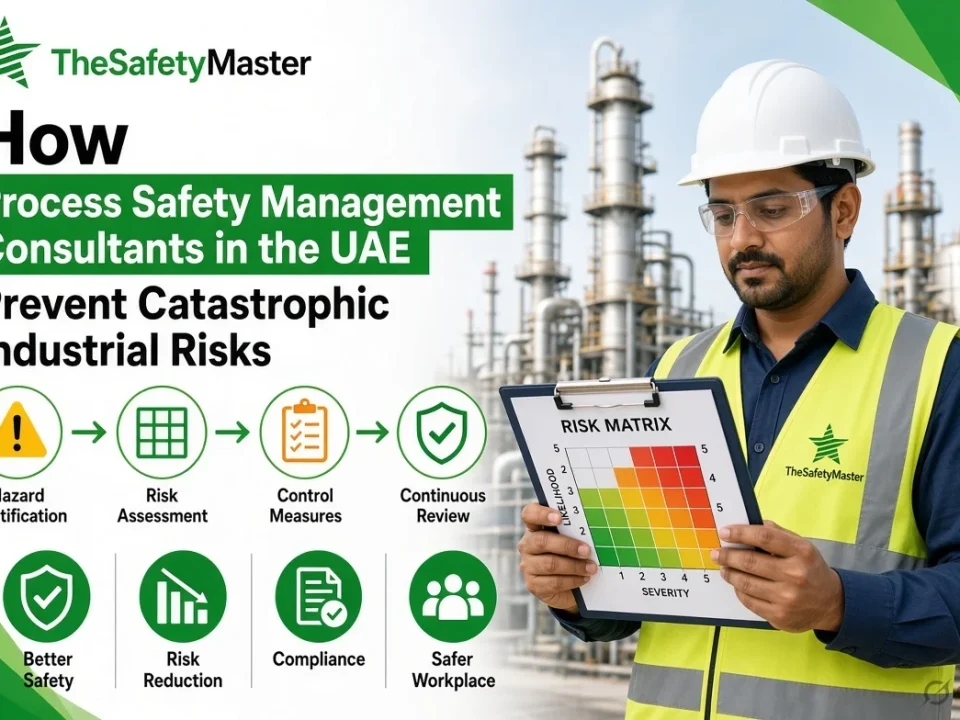
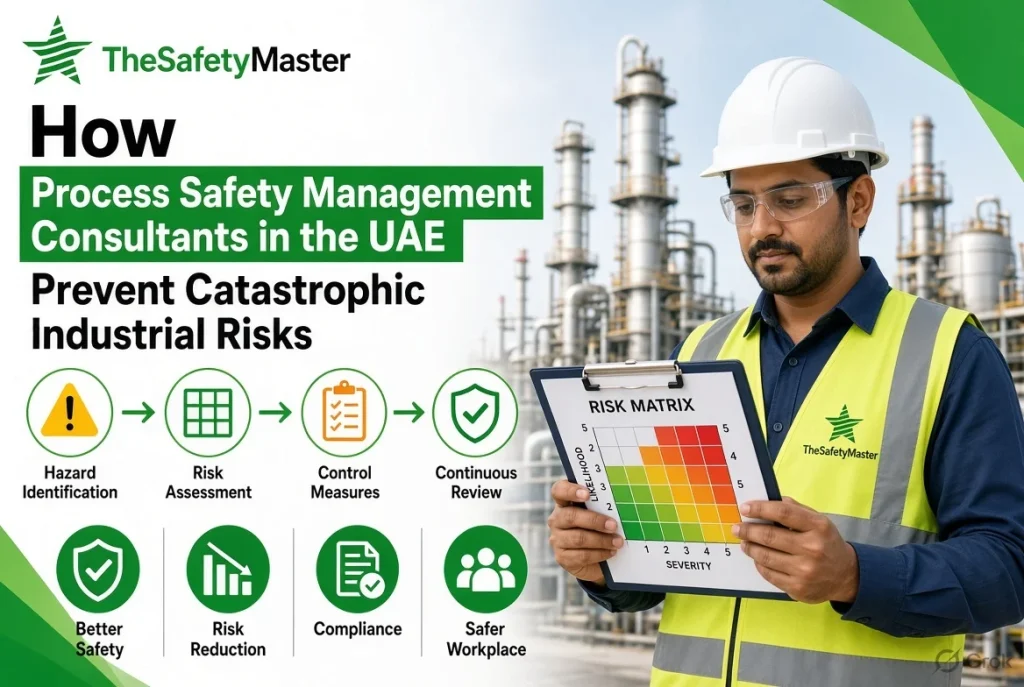
How Process Safety Management Consultants in the UAE Prevent Catastrophic Industrial Risks
October 21, 2026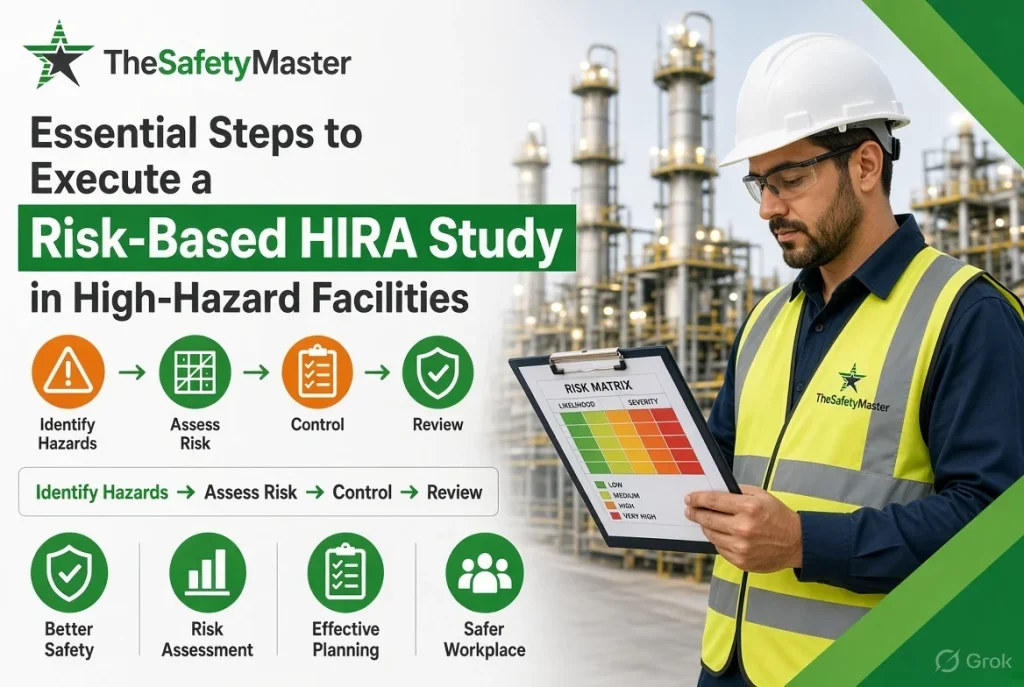
High-hazard facilities such as chemical plants, oil and gas processing units, pharmaceutical manufacturing sites, and large-scale energy installations operate under conditions where a single uncontrolled hazard can escalate into a catastrophic event. Fires, explosions, toxic releases, or structural failures can result in fatalities, environmental damage, regulatory penalties, and long-term reputational harm.
A risk-based HIRA study (Hazard Identification and Risk Assessment) provides a structured, prioritized approach to identifying hazards, evaluating their likelihood and consequences, and implementing controls that reduce residual risk to a tolerable level. Unlike generic checklists, a risk-based method focuses resources on the highest-consequence scenarios first, making it especially valuable in complex, high-hazard environments.
TheSafetyMaster has supported numerous facilities in implementing robust risk-based HIRA programs that align with ISO 45001, OSHA Process Safety Management (PSM), and industry best practices such as those from CCPS. This guide outlines the essential steps to execute an effective risk-based HIRA study.
Understanding Risk-Based HIRA in High-Hazard Settings
What Makes a HIRA “Risk-Based”?
Traditional hazard assessments often treat all identified hazards equally. A risk-based HIRA goes further by combining two key dimensions:
- Likelihood (probability of occurrence)
- Severity (potential consequence to people, environment, assets, or reputation)
The product of these factors produces a risk ranking that drives prioritization. High-risk scenarios receive immediate attention and higher-order controls, while lower-risk items are managed through monitoring or administrative measures.
In high-hazard facilities, this approach is critical because resources are finite and the cost of failure is extreme. Risk-based methods also support ALARP (As Low As Reasonably Practicable) decision-making and demonstrate due diligence to regulators and insurers.
Key Benefits for High-Hazard Facilities
- Early identification of major accident hazards (MAHs)
- Clear prioritization of control investments
- Stronger compliance evidence for audits and regulatory submissions
- Improved workforce engagement and safety culture
- Continuous improvement through structured review cycles
Essential Steps to Execute a Risk-Based HIRA Study
Step 1: Define Scope, Objectives, and Boundaries
Begin by clearly establishing what the study will cover. Ambiguous scope is one of the most common reasons HIRA studies become ineffective or overly broad.
Key actions include:
- Identify the specific process unit, equipment system, or activity under review (for example, a reactor train, storage tank farm, or maintenance turnaround).
- Define physical and operational boundaries.
- Clarify objectives — compliance, design verification, management of change (MoC), or periodic revalidation.
- Gather baseline documents: process flow diagrams (PFDs), piping and instrumentation diagrams (P&IDs), operating procedures, safety data sheets, previous incident reports, and existing risk assessments.
TheSafetyMaster recommends involving process engineers and operations supervisors at this stage to prevent scope creep and ensure practical relevance.
Step 2: Assemble a Multidisciplinary Team
Effective hazard identification requires diverse perspectives. A typical high-hazard HIRA team includes:
- Process safety or HSE specialist (facilitator)
- Process or chemical engineer
- Operations supervisor or experienced operators
- Maintenance representative
- Instrument/control systems engineer (when relevant)
- External specialist if novel technology or major hazard potential exists
The facilitator should be trained in structured techniques such as HAZID, What-If, or checklist methods. Team members who perform the work daily often identify latent hazards that desk-based reviews miss.
Step 3: Systematically Identify Hazards
Use structured methods rather than relying solely on experience. Common techniques for high-hazard facilities include:
- Guided brainstorming with prompt lists (physical, chemical, mechanical, electrical, ergonomic, and human-factor categories)
- Review of historical incidents and near-misses
- Walkdowns and field observations
- Examination of deviations from design intent (high/low pressure, temperature, flow, composition, etc.)
Document every credible hazard scenario. For each, note the initiating event, potential consequences, and existing safeguards. In high-hazard settings, pay particular attention to loss-of-containment events, runaway reactions, and cascade failures.
Step 4: Assess and Rank Risks Using a Risk Matrix
For every identified hazard, evaluate:
- Likelihood of the hazardous event occurring
- Severity of the worst credible consequence
Most organizations use a 5×5 risk matrix. Likelihood may range from “rare” to “almost certain,” while severity ranges from “minor injury” to “multiple fatalities or major environmental impact.” The resulting risk score (likelihood × severity) places the scenario into categories such as low, medium, high, or extreme.
Record both the inherent risk (before controls) and residual risk (after existing controls). This distinction is essential for demonstrating the effectiveness of current safeguards and identifying gaps.
Step 5: Develop and Prioritize Control Measures
Apply the hierarchy of controls rigorously:
- Elimination – Remove the hazard entirely where feasible.
- Substitution – Replace hazardous materials or processes with safer alternatives.
- Engineering controls – Install passive or active barriers (relief systems, interlocks, secondary containment, gas detection).
- Administrative controls – Procedures, permits, training, and supervision.
- Personal protective equipment (PPE) – The last line of defense.
For high-risk scenarios, prioritize higher-order controls. Assign clear ownership, deadlines, and verification methods for each recommended action. Risk reduction should be demonstrated, not assumed.
Step 6: Document, Communicate, and Implement Findings
A complete HIRA report should include:
- Scope and methodology
- Team composition
- Hazard register with risk rankings
- Recommended actions and residual risk levels
- Assumptions and limitations
Communicate findings to all affected personnel through toolbox talks, procedure updates, and management briefings. Implementation tracking is critical — unclosed actions undermine the entire study.
Step 7: Review, Update, and Maintain as a Living Process
A risk-based HIRA is not a one-time exercise. Schedule formal reviews:
- Periodically (typically every 3–5 years for major processes)
- After significant changes (MoC triggers)
- Following incidents, near-misses, or audit findings
- When new information or technology becomes available
Treat the HIRA as a living document that evolves with the facility. Digital tools and mobile inspection platforms can help keep assessments current and accessible.
Common Pitfalls to Avoid in High-Hazard Facilities
- Treating the study as a compliance checkbox rather than a decision-support tool
- Underestimating human factors and organizational issues
- Failing to involve frontline workers
- Over-reliance on PPE instead of engineering solutions
- Neglecting residual risk evaluation after controls are applied
- Incomplete documentation or weak action tracking
Avoiding these pitfalls significantly increases the value of the risk-based HIRA study.
How TheSafetyMaster Supports Effective HIRA Programs
The Safety Master provides facilitation, training, and independent review services tailored to high-hazard industries. Our consultants help organizations design risk matrices aligned with corporate risk tolerance, train internal teams, and integrate HIRA outputs into broader process safety management systems. Whether you are preparing for a regulatory audit, validating a new process design, or strengthening existing controls, a structured risk-based approach delivers measurable safety improvements.
Conclusion
Executing a risk-based HIRA study in high-hazard facilities is one of the most effective ways to prevent major accidents and protect people, assets, and the environment. By defining clear scope, assembling the right team, systematically identifying hazards, ranking risks, applying the hierarchy of controls, documenting findings, and maintaining the assessment as a living process, organizations can move from reactive safety management to proactive risk reduction.
Start with the highest-risk processes, involve experienced personnel, and treat every recommendation as an opportunity to strengthen resilience. When done well, a risk-based HIRA study becomes a cornerstone of operational excellence and regulatory confidence. Partner with TheSafetyMaster to ensure your next HIRA study delivers real safety results.