Hazardous Area Classification UAE Safety Standards for Oil and Gas Industries

How to Lead a Detailed HAZOP Study to Identify and Mitigate Process Risks
November 3, 2026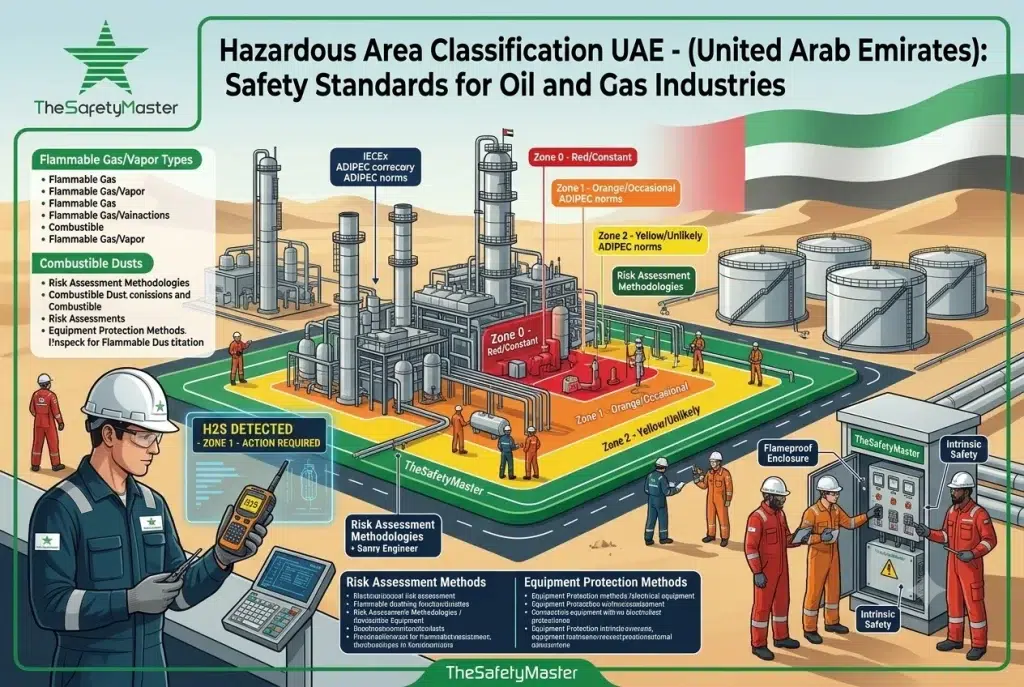
The oil and gas industry plays an important role in the economy of the United Arab Emirates (UAE). Oil refineries, gas processing plants, offshore platforms, storage terminals and petrochemical facilities handle flammable gases, liquids and vapours every day. These materials can create serious fire and explosion risks when they are released into the surrounding environment.
Hazardous Area Classification UAE is an important safety process that helps identify locations where explosive atmospheres may occur. It helps companies understand the level of risk and select suitable electrical and mechanical equipment for each classified area.
The Safety Master provides industrial safety and risk management solutions to help organisations improve workplace safety and manage hazardous conditions. Proper hazardous area classification supports safe plant design, equipment selection, maintenance and daily operations.
What Is Hazardous Area Classification?
Hazardous Area Classification is a systematic process used to identify and classify areas where flammable gases, vapours or combustible dust may create an explosive atmosphere.
In oil and gas facilities, leaks from pipelines, valves, pumps, compressors, storage tanks and other equipment can release flammable substances. When these substances mix with air and meet an ignition source, they can cause a fire or explosion.
The main purpose of hazardous area classification is to:
- Identify possible sources of flammable gas and vapour releases.
- Determine the size and extent of hazardous areas.
- Classify locations according to the level of explosion risk.
- Select suitable explosion-protected electrical equipment.
- Reduce fire and explosion incidents.
- Improve employee and plant safety.
- Support compliance with applicable safety standards.
The Safety Master recommends a systematic assessment of hazardous locations to support safe industrial operations.
Importance of Hazardous Area Classification in UAE
The UAE has major oil and gas operations, particularly in Abu Dhabi, Dubai and other industrial regions. These facilities use complex equipment and processes that require proper risk management.
Hazardous Area Classification UAE helps companies identify dangerous locations before selecting electrical equipment or starting industrial operations.
1. Preventing Fire and Explosion Risks
Oil and gas facilities handle materials such as natural gas, LPG, hydrogen, methane and other flammable hydrocarbons. A small leak can create an explosive atmosphere under suitable conditions.
Area classification helps identify locations where special precautions are required to prevent ignition.
2. Safe Electrical Equipment Selection
Normal electrical equipment may produce sparks, heat or other ignition sources. Such equipment may not be suitable for locations containing flammable gases.
Hazardous area classification helps engineers select equipment with suitable explosion protection.
3. Improving Workplace Safety
Employees working around gas processing units, refineries and storage facilities may face serious risks from flammable releases.
Proper classification helps organisations establish suitable safety controls and reduce the possibility of accidents.
4. Supporting Regulatory and Industry Compliance
Oil and gas companies must follow applicable UAE regulations, client requirements and recognised international standards.
A proper hazardous area study provides technical information to support safe engineering and compliance activities.
Hazardous Area Classification Zones
Hazardous areas are generally classified into three zones for explosive gas atmospheres under the IEC 60079 classification system.
Zone 0 – Continuous Hazardous Atmosphere
Zone 0 is an area where an explosive gas atmosphere is present continuously, frequently or for long periods.
Examples include:
- Certain internal spaces of process equipment.
- Specific locations inside storage tanks.
- Areas inside equipment containing flammable vapours.
Equipment used in Zone 0 requires a very high level of explosion protection.
Zone 1 – Likely Hazardous Atmosphere
Zone 1 is an area where an explosive gas atmosphere is likely to occur occasionally during normal operations.
Examples include:
- Areas around certain pump seals.
- Locations near gas sampling points.
- Specific filling and transfer locations.
- Areas around equipment handling flammable liquids.
Electrical and instrumentation equipment installed in Zone 1 must have suitable protection for the identified gas group and temperature class.
Zone 2 – Unlikely Hazardous Atmosphere
Zone 2 is an area where an explosive gas atmosphere is not likely to occur during normal operations. If it occurs, it is expected to remain for a short period.
Examples include:
- Areas surrounding some Zone 1 locations.
- Locations near flanged connections.
- Areas around certain pipeline connections.
Suitable explosion-protected equipment must still be selected for Zone 2.
Important Standards for Hazardous Area Classification UAE
International standards provide technical guidance for identifying hazardous locations and selecting suitable equipment. UAE projects may also have additional requirements from authorities, operators and engineering specifications.
IEC 60079 Series
The IEC 60079 series is one of the most important international standards for explosive atmospheres.
Important parts include:
- IEC 60079-10-1: Classification of areas with explosive gas atmospheres.
- IEC 60079-10-2: Classification of areas with combustible dust atmospheres.
- IEC 60079-14: Electrical installation design, equipment selection, installation and initial inspection.
- IEC 60079-17: Inspection and maintenance of electrical installations in hazardous areas.
- IEC 60079-0: General requirements for explosion-protected electrical equipment.
These standards help engineers establish suitable protection measures for hazardous locations.
API Recommended Practices
API standards and recommended practices are also important in petroleum and natural gas facilities.
API RP 500 and API RP 505 provide guidance on classifying locations for electrical installations in petroleum facilities.
The applicable classification approach should be selected according to project specifications and client requirements.
Energy Institute Model Code of Practice Part 15
The Energy Institute Model Code of Safe Practice Part 15 provides guidance on area classification for installations handling flammable fluids.
It considers release sources, ventilation and the characteristics of flammable materials.
UAE and ADNOC Engineering Requirements
UAE oil and gas projects may follow specific engineering requirements established by operators and project owners.
For example, ADNOC’s published Electrical Engineering Design Guide refers to IEC 60079 zone classification and the Energy Institute Part 15 approach for hazardous area classification.
Companies should review the latest applicable project specifications and obtain approval from the responsible authority or client before finalising the classification.
Key Factors Considered During Hazardous Area Assessment
A proper hazardous area assessment requires technical information about the process, equipment and operating conditions.
1. Type of Flammable Material
Engineers identify the chemicals, gases and liquids handled in the facility.
Important information includes:
- Chemical name and composition.
- Flash point.
- Flammable limits.
- Gas or vapour density.
- Auto-ignition temperature.
- Gas group.
2. Sources of Release
A source of release is a point or location from which flammable substances may escape into the surrounding atmosphere.
Common examples include:
- Pumps and compressors.
- Valves and flanges.
- Pipeline connections.
- Storage tanks.
- Pressure relief devices.
- Sampling and drainage points.
3. Operating Pressure and Temperature
Pressure and temperature affect the behaviour and release characteristics of flammable materials.
Engineers review normal operating conditions, maximum design pressure and temperature, and possible abnormal conditions.
4. Ventilation Conditions
Ventilation plays an important role in reducing the concentration of flammable gases and vapours.
The assessment considers:
- Natural ventilation.
- Mechanical ventilation.
- Air movement.
- Ventilation availability.
- Possible ventilation failure.
5. Release Grade
The frequency and duration of a potential release are considered when classifying hazardous areas.
Sources are generally assessed as continuous, primary or secondary grades of release, according to the applicable standard.
Hazardous Area Classification Process for Oil and Gas Industries
A structured approach helps organisations prepare accurate hazardous area classification studies.
Step 1: Collect Plant and Process Information
The first step is to collect the required engineering documents.
These may include:
- Process Flow Diagrams (PFDs).
- Piping and Instrumentation Diagrams (P&IDs).
- Equipment layout drawings.
- Plot plans.
- Safety Data Sheets (SDS).
- Equipment specifications.
- Process operating conditions.
Step 2: Identify Potential Release Sources
Engineers review the process equipment and identify possible gas and vapour release points.
Each source is evaluated according to its release characteristics and operating conditions.
Step 3: Analyse Gas and Vapour Properties
The properties of each flammable material are reviewed to determine its gas group, temperature class and other relevant characteristics.
Step 4: Evaluate Ventilation
Ventilation conditions are assessed to understand how quickly released gases or vapours may disperse.
Step 5: Determine Hazardous Zones
The identified release sources and ventilation conditions are evaluated to determine the applicable hazardous zone and its extent.
Step 6: Prepare Hazardous Area Classification Drawings
The classification results are presented in technical drawings.
These drawings identify:
- Zone 0 areas.
- Zone 1 areas.
- Zone 2 areas.
- Hazardous area boundaries.
- Relevant equipment and locations.
- Applicable gas groups and temperature classes.
Step 7: Prepare the Final Report
A final report documents the study methodology, assumptions, release sources, calculations, zone classifications and recommendations.
The report supports engineering decisions, equipment selection and future inspections.
Equipment Selection for Hazardous Areas
Selecting suitable equipment is an important part of explosion prevention.
Equipment must be suitable for the classified zone, gas group, temperature class, equipment protection level and environmental conditions.
Explosion-Proof Electrical Equipment
Common equipment includes:
- Explosion-protected motors.
- Certified lighting systems.
- Junction boxes.
- Electrical switches.
- Control panels.
- Gas detectors.
- Instrumentation and sensors.
Gas Groups
For explosive gas atmospheres, equipment selection considers the relevant gas group.
- IIA: Includes gases such as propane.
- IIB: Includes gases such as ethylene.
- IIC: Includes gases such as hydrogen and acetylene.
Equipment certified for a more demanding gas group may be suitable for less demanding groups, subject to its certification and installation requirements.
Temperature Classes
Temperature classes indicate the maximum surface temperature of equipment.
- T1: Maximum 450°C.
- T2: Maximum 300°C.
- T3: Maximum 200°C.
- T4: Maximum 135°C.
- T5: Maximum 100°C.
- T6: Maximum 85°C.
The equipment temperature class must be appropriate for the auto-ignition temperature of the hazardous material.
Industries That Require Hazardous Area Classification in UAE
Hazardous area classification is important for industries that handle flammable gases, vapours and combustible materials.
Oil Refineries
Refineries process crude oil and petroleum products. Pumps, pipelines, storage tanks and processing units may create hazardous locations.
Gas Processing Plants
Gas processing facilities handle natural gas and other flammable substances. Proper classification helps control explosion risks around compressors, separators and gas treatment systems.
Petrochemical Industries
Petrochemical plants use chemicals and hydrocarbons in different production processes. Hazardous area classification helps identify locations requiring explosion-protected equipment.
Offshore Oil and Gas Platforms
Offshore platforms have limited space and complex process equipment. Proper classification supports safe equipment installation and operations.
Oil and Gas Storage Terminals
Storage terminals handle large quantities of petroleum products, LPG and other flammable liquids. Tank farms, loading areas and transfer systems require careful assessment.
Chemical Manufacturing Plants
Chemical facilities may handle flammable solvents, gases and vapours. Hazardous area studies help improve workplace safety and equipment selection.
Common Challenges in Hazardous Area Classification
Industrial facilities may face several challenges while conducting hazardous area studies.
Incomplete Engineering Information: Missing or outdated P&IDs and equipment details can affect the accuracy of the assessment.
Incorrect Release Source Identification: Failure to identify all potential leak points may result in unsafe area boundaries.
Poor Ventilation Assessment: Incorrect ventilation assumptions can affect the classification results.
Wrong Equipment Selection: Equipment that does not match the zone, gas group or temperature class can create serious safety risks.
Outdated Classification Drawings: Plant modifications may change hazardous area boundaries. Drawings must be reviewed and updated when necessary.
Lack of Competent Personnel: Hazardous area studies require suitable technical knowledge and experience with applicable standards.
Benefits of Professional Hazardous Area Classification Services UAE
Professional hazardous area classification services help companies understand and control explosion risks.
Key benefits include:
- Better identification of hazardous locations.
- Improved electrical and instrumentation safety.
- Correct selection of explosion-protected equipment.
- Reduced fire and explosion risks.
- Better engineering and maintenance planning.
- Improved safety documentation.
- Support for applicable industry standards and client requirements.
- Increased confidence in plant safety management.
The Safety Master supports organisations with industrial risk management and process safety solutions to help improve safety performance across industrial operations.
Why Choose The Safety Master for Industrial Safety Solutions?
The Safety Master understands the importance of identifying workplace hazards and implementing effective safety controls in industrial facilities.
Our safety-focused approach supports organisations in improving risk management, process safety and operational performance.
We focus on:
- Industrial safety and risk management.
- Hazard identification and risk assessment.
- Process safety support.
- Safety audits and assessments.
- Technical safety documentation.
- Practical recommendations for improving workplace safety.
For organisations planning Hazardous Area Classification UAE projects, a competent engineering assessment and coordination with the project owner are essential for achieving reliable results.
Conclusion
Hazardous Area Classification UAE is an important part of fire and explosion risk management in oil refineries, gas processing plants, petrochemical facilities and offshore operations. It helps organisations identify locations where explosive atmospheres may occur and select suitable explosion-protected equipment.
Following applicable IEC 60079 standards, operator specifications and project requirements helps improve the safety of electrical installations and industrial operations.
Regular reviews, accurate drawings, suitable equipment and competent technical personnel are important for maintaining safe working conditions. The Safety Master supports industrial organisations with safety and risk management solutions to help create safer and more reliable workplaces.
Frequently Asked Questions (FAQs)
Hazardous Area Classification is a process used to identify locations where flammable gases, vapours or combustible dust may create an explosive atmosphere. It helps UAE oil and gas companies select suitable explosion-protected equipment and improve industrial safety.
The IEC 60079 series is widely used for hazardous area classification and explosion protection. Other references include API RP 500, API RP 505 and the Energy Institute Model Code of Practice Part 15, depending on project requirements.
Zone 0 refers to locations where an explosive gas atmosphere is present continuously or for long periods. Zone 1 refers to locations where it is likely to occur occasionally during normal operations. Zone 2 refers to locations where it is unlikely to occur during normal operations and, if it occurs, will exist only for a short time.
It helps identify explosion risks, determine hazardous zone boundaries and select suitable electrical equipment. It also supports safer plant design, maintenance activities and industrial operations.
Oil refineries, gas processing plants, petrochemical facilities, offshore platforms, chemical industries, petroleum storage terminals and other facilities handling flammable materials may require hazardous area classification.