Complete Guide to Hazardous Area Classification: Standards, Zones, and Best Practices for Industrial Safety

How to Perform Hazardous Area Classification for Oil and Gas Facilities: A Step-by-Step Process
November 5, 2026
Top-Rated Industrial PPE Supplier in Delhi NCR for Certified Safety Gear & Equipment
November 7, 2026Industrial facilities handling flammable gases, vapors, mists, or combustible dusts operate under constant operational risk. A single uncontrolled spark in a volatile environment can trigger catastrophic fires or explosions. Hazardous Area Classification (HAC) is a foundational safety procedure designed to analyze and classify environments where explosive atmospheres may form.
By defining the risk profile of operational zones, organizations can safely select explosion-protected electrical and non-electrical equipment, design adequate ventilation, and establish robust safety protocols. At The Safety Master, we help industrial enterprises systematically identify ignition risks, maintain compliance with global standards, and implement end-to-end process safety solutions.
What is Hazardous Area Classification?
Hazardous Area Classification (HAC) is a structured analytical method used to determine the probability, frequency, and duration of explosive atmospheres in processing plants.
The Core Objective of HAC
The ultimate goal of HAC is to prevent ignition by ensuring that potential ignition sources (such as electrical arcs, hot surfaces, or static electricity) are excluded from environments where flammable atmospheres exist.
Key Flammable Properties Evaluated
To classify an area effectively, process safety engineers evaluate the specific properties of materials present in the process:
- Flash Point: The lowest temperature at which a liquid produces enough vapor to ignite in air.
- Auto-Ignition Temperature (AIT): The minimum temperature required to initiate self-sustained combustion without an external spark.
- Lower & Upper Explosive Limits (LEL / UEL): The concentration range of flammable vapor in air within which an explosion can occur.
- Vapor Density: Determines whether released vapors will pool near the ground or dissipate into upper structures.
Global Standards for Hazardous Area Classification
Different regions and industries rely on specific codes and standards to conduct Hazardous Area Classification.Understanding these international frameworks ensures global compliance and equipment interoperability.
 ┌───────────────────────────────────────────────┐
 │ Hazardous Area Classification Frameworks │
 └───────────────────────┬───────────────────────┘
 │
 ┌────────────────────────────────────────────┼────────────────────────────────────────────┐
 ▼ ▼ ▼
┌──────────────┐ ┌──────────────┐ ┌──────────────┐
│ IEC / IECEx │ │ ATEX │ │ NEC 500 / │
│ (Global) │ │ (Europe) │ │ NEC 505 │
└───────┬──────┘ └───────┬──────┘ └───────┬──────┘
 │ │ │
 ├─ IEC 60079-10-1 (Gas/Vapor) ├─ ATEX 1999/92/EC (Workplace Safety) ├─ Class/Division (NEC 500)
 ├─ IEC 60079-10-2 (Dust) └─ ATEX 2014/34/EU (Equipment Specs) └─ Class/Zone (NEC 505)
 └─ IS/IEC Standards (India)
1. IEC / IECEx System (International)
- IEC 60079-10-1:Classification of areas where flammable gas or vapor hazards may arise.
- IEC 60079-10-2: Classification of areas where combustible dust hazards are present.
- Widely adopted across Asia, Europe, Australia, and the Middle East, serving as the benchmark for international compliance.
2. ATEX Directives (European Union)
- ATEX 1999/92/EC (ATEX 137):Directs employer responsibilities for protecting workers in explosive environments.
- ATEX 2014/34/EU (ATEX 114):Dictates safety requirements for equipment manufactured for hazardous locations.
3. North American NEC System (US / Canada)
- NEC 500 (Class/Division System): Divides hazards into Class I (Gases/Vapors), Class II (Dusts), and Class III (Fibers), categorized into Division 1 and Division 2.
- NEC 505 / 506 (Zone System): Harmonized alternative aligning North American standards closer to international IEC Zone definitions.
Understanding Hazardous Zones: Gas vs. Dust
The Zone System classifies hazardous locations based on how often and for how long an explosive atmosphere is expected to be present.
Environment Type Hazard Duration / Frequency Zone Designation Risk Profile Gases, Vapors, & Mists Continuous or long periods (>1000 hrs/yr) Zone 0 High Risk (Inside tanks, reaction vessels) Likely during normal operations (10-1000 hrs/yr) Zone 1 Medium Risk (Near sampling points, relief valves) Unlikely; short duration if present (<10 hrs/yr) Zone 2 Low Risk (Flange connections, pump seals) Combustible Dusts Continuous cloud presence (>1000 hrs/yr) Zone 20 High Risk (Inside hoppers, silos, dust collectors) Likely during normal operation (10-1000 hrs/yr) Zone 21 Medium Risk (Bag filling stations, discharge chutes) Unlikely; short duration if present (<10 hrs/yr) Zone 22 Low Risk (Storage rooms around closed containment)
Gas Groups and Temperature Classes
Equipment selection requires matching both the Gas Group (Ignition Energy) and Temperature Class (Maximum Surface Temp):
- Gas Groups:
- Group I: Underground Mining (Methane).
- Group IIA: Propane, Gasoline (Least sensitive).
- Group IIB: Ethylene, Town Gas.
- Group IIC: Hydrogen, Acetylene (Most easily ignited).
- Temperature Classes (T1 to T6): Ensure equipment surface temperatures stay well below the auto-ignition temperature of local gases. (For example, T6 limits surface temp to 85°C).
Step-by-Step Hazardous Area Classification Process
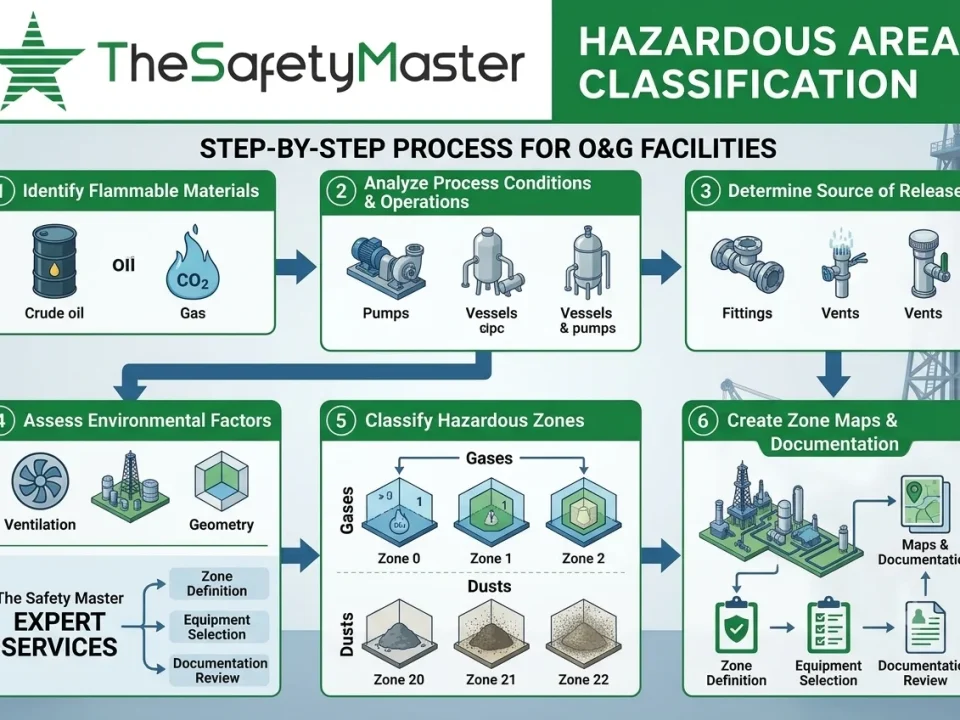
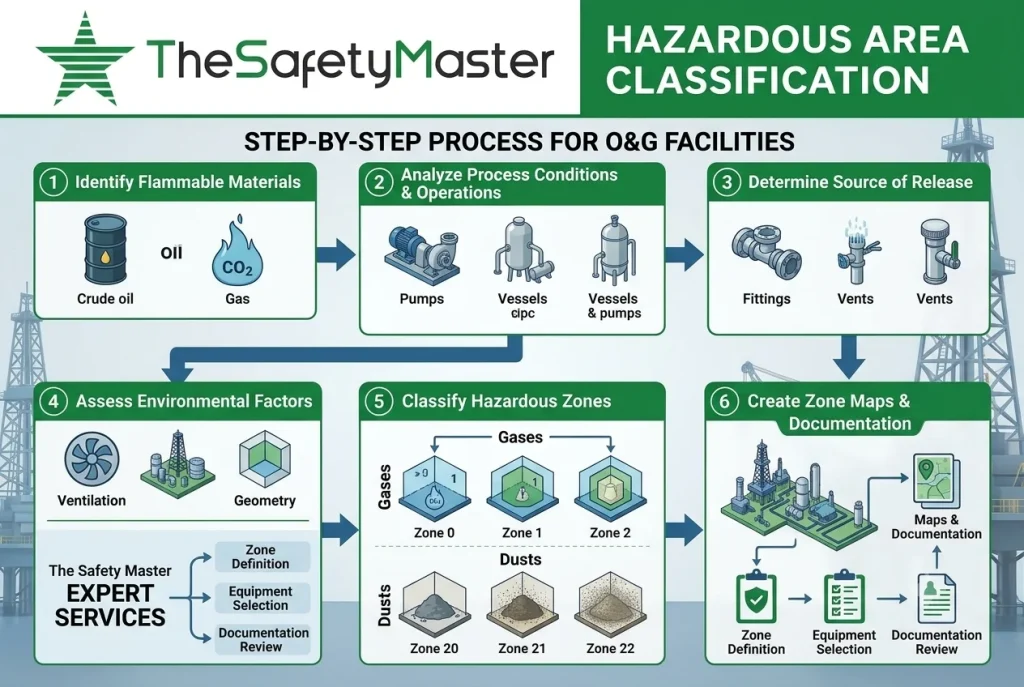
Executing a reliable HAC assessment requires systematic engineering evaluation. The Safety Master follows a structured 6-step methodology to ensure complete process safety compliance:
1.Collect Facility & Process Data:Prerequisite Phase.
Gather detailed engineering documentation, including Process Flow Diagrams (PFDs), Piping & Instrumentation Diagrams (P&IDs), plot plans, and Safety Data Sheets (SDSs) for all materials.
2.Identify Materials & Sources of Release:
Catalog all flammable liquids, gases, and dusts. Pinpoint every potential source of release (Grade of Release: Continuous, Primary, or Secondary) such as pumps, seals, flanges, sampling points, and relief valves.
3.Evaluate Ventilation & Dispersion Conditions:
Assess ventilation effectiveness (High, Medium, or Low availability). Proper natural or mechanical ventilation dilutes flammable release concentrations, shrinking zone sizes or downgrading risk levels (e.g., Zone 1 to Zone 2).
4.Determine Zones & Extent of Hazard:
Calculate release rates, dispersion distances, and hazardous boundaries using standardized formulas or CFD modeling to assign appropriate Zone numbers.
5.Assign Gas Groups & Temperature Classes:
Match local chemical characteristics with equipment specification requirements (Group IIA/IIB/IIC and T-Class rating).
6.Document HAC Deliverables & Review:
Generate detailed Hazardous Area Classification schedules, hazardous area drawings (HAC Layouts), and comprehensive technical reports for ongoing plant compliance and audit readiness.
Best Practices for Industrial Safety Compliance
Maintaining an accurate classification schedule requires active management throughout the facility’s operational lifecycle.
Key Operations Practices
- Avoid Over-Classification: Classifying an area as Zone 1 when it qualifies as Zone 2 inflates capital expenditure unnecessarily due to over-specified equipment costs.
- Maintain Updated Drawings: Always update HAC drawings when modifying process lines, changing raw materials, or upgrading machinery.
- Integrate Mechanical Ignition Controls: Remember that non-electrical equipment (e.g., gearboxes, pumps, conveyer belts) can also produce mechanical sparks or high surface temperatures.
- Audit Equipment Ex Marking: Ensure installed electrical gear matches the required zone, gas group, and T-class rating before commissioning.
Why Choose The Safety Master?
Conducting a thorough Hazardous Area Classification requires expert process safety insights, fluid dynamics modeling, and deep knowledge of regulatory standards. The Safety Master provides comprehensive consulting services to keep industrial plants safe and compliant:
- End-to-End HAC Studies: Full technical assessments for chemical, petrochemical, oil & gas, pharmaceutical, and manufacturing industries.
- Process Safety Management (PSM): Integrated risk assessments, including HAZOP, Quantitative Risk Analysis (QRA), and Dust Explosion Hazard Assessments.
- Customized Safety Audits: Thorough site inspections to verify Ex equipment installation and compliance against global standards.
Protect your workforce, maintain operational continuity, and prevent industrial explosion risks. Partner with The Safety Master for professional Hazardous Area Classification and process safety management solutions.
Frequently Asked Questions (FAQs)
The primary purpose of Hazardous Area Classification (HAC) is to identify areas where explosive gas, vapor, or dust atmospheres may exist, enabling engineers to select appropriate explosion-protected equipment and prevent ignition risks.
The zones are categorized by how frequently explosive gas atmospheres occur:
Zone 0:Explosive atmosphere present continuously or for long periods.
Zone 1:Explosive atmosphere likely to occur during normal operations.
Zone 2:Explosive atmosphere unlikely to occur and exists only for a short time if it does.
ATEX is a legal requirement mandatory within the European Economic Area (EEA), whereas IECEx is a global voluntary certification scheme. While both share identical technical zone definitions (Zones 0, 1, 2), IECEx requires third-party certification with strict rule-based criteria, while ATEX offers flexibilities like self-certification for Zone 2 equipment.
HAC drawings and schedules should be reviewed whenever process changes, piping modifications, or material substitutions occur. Additionally, a formal re-validation should be conducted every 3 to 5 years as part of routine Process Safety Management (PSM) re-validation.
Yes. Effective ventilation dilutes released flammable gases or vapors below their Lower Explosive Limit (LEL). Strong, reliable mechanical or natural ventilation can shrink the physical boundary of a zone or downgrade its classification (e.g., converting a Zone 1 area to a Zone 2 area).