HIRA Study Methodology: Hazard Identification and Risk Assessment Explained

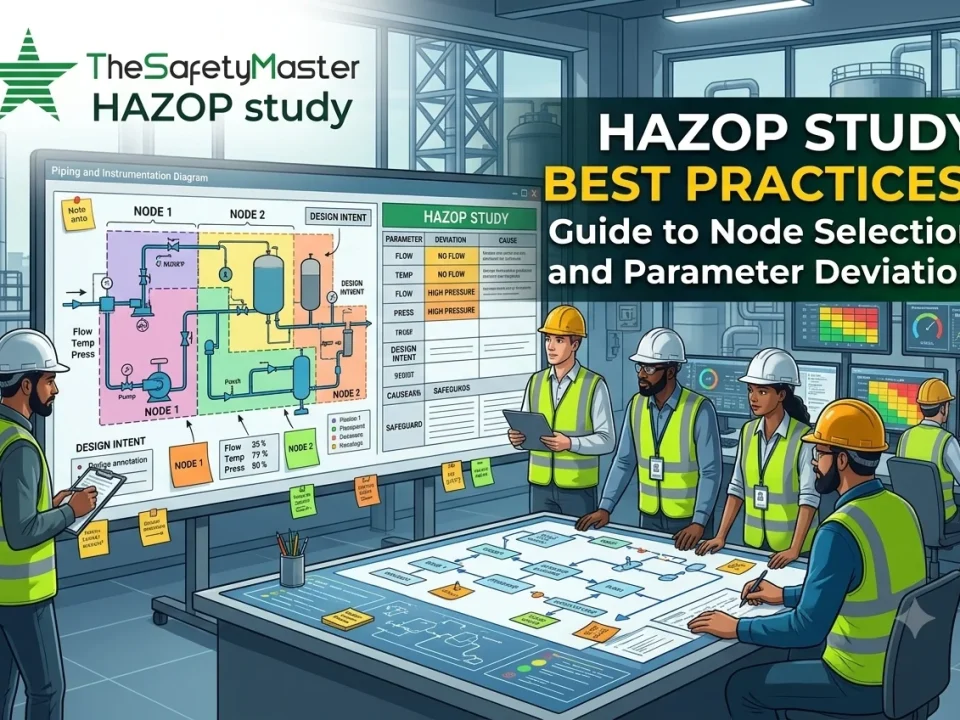
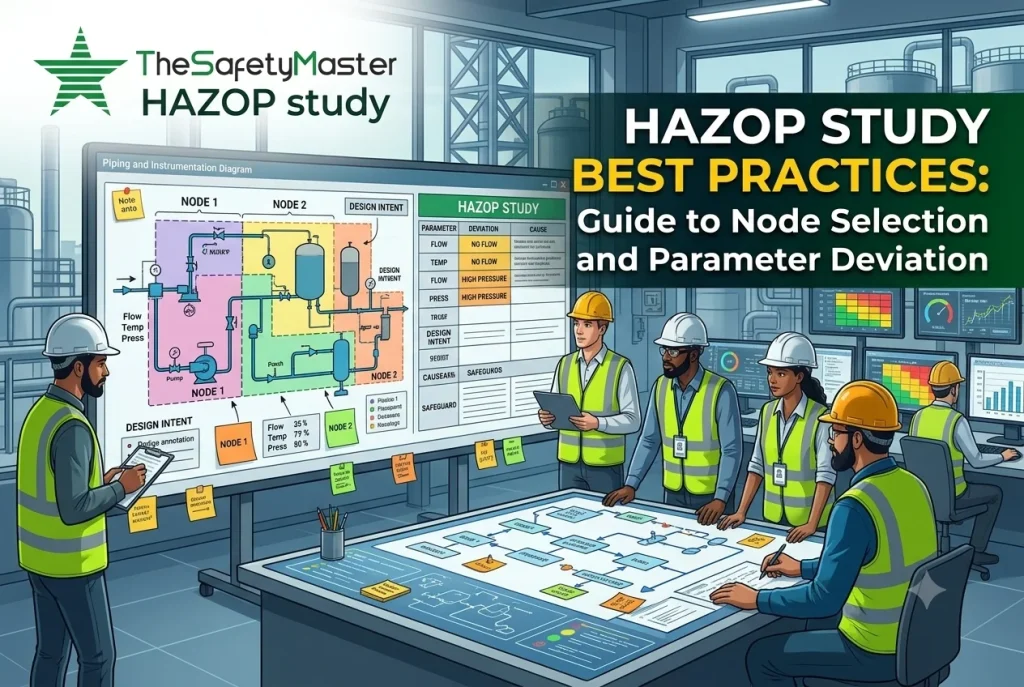
HAZOP Study Best Practices: Guide to Node Selection and Parameter Deviation
November 25, 2026Workplace safety is non-negotiable across manufacturing facilities, construction sites, power plants, and chemical processing complexes. Operating without a clear understanding of potential workplace hazards exposes personnel to injury, creates regulatory compliance violations, and threatens business continuity. Preventing major incidents requires a systematic process to pinpoint vulnerabilities before accidents occur.
This is where a HIRA Study (Hazard Identification and Risk Assessment) becomes indispensable. Conducted by safety specialists like The Safety Master, a structured HIRA Study methodology transforms reactive safety fixes into a proactive safety culture.
What is a HIRA Study?
A HIRA Study is a structured, quantitative, and qualitative safety framework designed to identify hazards in a work environment, evaluate the risks associated with those hazards, and establish appropriate control measures to minimize or eliminate harm.
Defining Hazard vs. Risk
To understand the methodology, safety professionals clear up a common misunderstanding:
- Hazard: Any source, situation, or act with the potential to cause harm, injury, ill health, property damage, or environmental damage. Examples include unshielded high-voltage wiring, toxic chemical storage, or slippery floors.
- Risk: The combination of the probability (likelihood) that a hazardous event will occur and the severity (consequence) of the injury or harm caused by that event.
A HIRA Study systematically connects hazards to their operational risks, delivering a quantifiable score that ranks which dangers demand immediate budget and engineering interventions.
The Strategic Importance of HIRA in Industrial Operations
Implementing a comprehensive HIRA Study is more than just ticking a compliance box for regulatory bodies. It serves as the operational backbone for organizational safety leadership.
Key Benefits of a HIRA Study
- Prevents Workplace Fatalities and Injuries: Early identification lets engineering teams fix vulnerabilities before workers encounter them.
- Regulatory Compliance: Meets requirements set by global and national regulatory standards, including ISO 45001, OSHA, and local statutory factory rules.
- Reduces Financial Liabilities: Minimizes costs associated with equipment damage, plant shutdowns, medical claims, insurance premium hikes, and legal penalties.
- Enhances Operational Productivity: Safe, well-maintained environments experience fewer unexpected operational downtime events.
Core Components of the HIRA Study Methodology
Executing an effective HIRA Study requires a rigorous, step-by-step approach. The Safety Master utilizes a proven five-stage process to ensure total coverage across plant operations, routine tasks, and non-routine maintenance activities.
+-------------------------------------------------------------+
| 1. System & Scope Setup |
+-------------------------------------------------------------+
 |
 v
+-------------------------------------------------------------+
| 2. Hazard Identification |
+-------------------------------------------------------------+
 |
 v
+-------------------------------------------------------------+
| 3. Risk Assessment |
| [ Likelihood (L) x Consequence (C) = Risk ] |
+-------------------------------------------------------------+
 |
 v
+-------------------------------------------------------------+
| 4. Risk Mitigation & Controls |
| [ Hierarchy of Controls ] |
+-------------------------------------------------------------+
 |
 v
+-------------------------------------------------------------+
| 5. Monitoring, Review & Audit |
+-------------------------------------------------------------+
Stage 1: Scope Definition and Work Process Mapping
Before looking for hazards, the assessment boundary must be clearly established. The Safety Master begins by mapping every operational area, breaking down complex plant workflows into distinct, manageable tasks.
- Routine Tasks: Daily operations, automated line handling, material transfer, packaging.
- Non-Routine Tasks: Annual overhauls, equipment commissioning, emergency shutdowns, pipe welding.
- Third-Party Activities: Contractor maintenance, vendor deliveries, visitor site tours.
Stage 2: Systematic Hazard Identification
Once the workflow is mapped, safety engineers examine each task to surface potential dangers. This phase categorizes hazards into distinct technical groups:
Hazard ClassDescriptionIndustrial ExamplesPhysical Energy sources that harm the body High noise levels, unshielded rotating shafts, extreme heat, vibrating tools Chemical Exposure to hazardous gases, liquids, or dusts Corrosive acid splashes, toxic vapor inhalation, combustible dust accumulation Electrical Contact with live current or static buildup Exposed cabling, ungrounded machinery, overloaded circuits Ergonomic Physical stress due to poor equipment design Repetitive lifting, poor body mechanics, inadequate workstation height Biological Organisms or biological substances Mold growth in HVAC systems, bacterial growth in cooling towers Psychosocial Factors affecting mental well-being Extreme shift rotation, high task urgency, inadequate rest breaks
Stage 3: Quantitative Risk Assessment
With hazards inventoried, safety auditors quantify the risk level of each item. Risk scoring uses standard mathematical parameters:
$$\text{Risk Rating} = \text{Likelihood (L)} \times \text{Consequence (C)}$$
- Likelihood Score (1 to 5): Evaluates how frequently a worker is exposed to the hazard and the probability of an incident occurring.
- Consequence/Severity Score (1 to 5): Evaluates the worst possible outcome, ranging from minor first-aid injuries (1) to multiple fatalities or total facility loss (5).
Interpreting Risk Matrix Categories
Calculated risk scores fall into standard risk management action tiers:
- High Risk (Red | Score 15–25): Intolerable risk. Operations must pause immediately until engineering controls lower the score.
- Medium Risk (Yellow | Score 8–12): Undesirable risk. Requires specific management action plans, standard operating procedures (SOPs), and strict timelines for risk reduction.
- Low Risk (Green | Score 1–6): Acceptable risk. Maintain existing controls and monitor during standard safety reviews.
Stage 4: Risk Control & The Hierarchy of Controls
Once risks are categorized, safety engineering teams implement control measures. The Safety Master applies the internationally recognized Hierarchy of Controls, prioritizing controls from most effective to least effective:
 \ 1. ELIMINATION / Most Effective
 \----------------/
 \ 2. SUBSTITUTION \
 \----------------/
 \ 3. ENGINEERING /
 \--------------/
 \ 4. ADMIN /
 \----------/
 \ 5. PPE / Least Effective
- Elimination: Completely remove the hazard from the process (e.g., redesigning a process to remove high-altitude manual work).
- Substitution: Replace hazardous equipment or chemicals with safer alternatives (e.g., replacing solvent-based paints with water-based paints).
- Engineering Controls: Isolate personnel from the hazard physically (e.g., placing acoustic enclosures around high-decibel generators or installing automated light curtains on press machines).
- Administrative Controls: Change the way people work through procedural rules (e.g., Lockout/Tagout procedures, job rotation schedules, permit-to-work systems).
- Personal Protective Equipment (PPE): Protect the worker with physical gear as a last line of defense (e.g., safety helmets, arc-flash suits, respirator masks).
Stage 5: Residual Risk Evaluation and Continuous Review
Applying controls lowers the risk score down to a safe, acceptable level. However, controls can create secondary risks if implemented poorly. The final stage evaluates Residual Risk (the risk remaining after controls are in place) and sets up ongoing monitoring schedules.
Best Practices for Conducting a Successful HIRA Study
A HIRA Study should never sit on a shelf as static documentation. To maximize its impact on workplace safety, follow these industry best practices:
Involve Floor Operators and Supervisors
Floor operators interact directly with plant equipment every shift. They understand real-world operational challenges, improvised workarounds, and subtle machinery defects better than anyone else. Including workers in brainstorming sessions ensures realistic hazard identification.
Revisit the HIRA Study Periodically
A HIRA assessment is a living document. It requires mandatory updates whenever:
- New machinery or technological lines are installed.
- Chemical formulas or raw materials change.
- Facility layout modifications occur.
- Near-miss incidents or lost-time injuries trigger an internal investigation.
Integrate HIRA with ISO Standards
Aligning your HIRA Study with ISO 45001 (Occupational Health and Safety Management Systems) creates a seamless safety integration across all operational departments.
Why Partner with The Safety Master for Your HIRA Study?
Conducting an internal hazard assessment can introduce operational blind spots, bias, or oversight. Working with specialized safety consultants ensures objective evaluation and expert insights.
The Safety Master provides comprehensive safety auditing and consultancy services tailored to industrial plants, infrastructure projects, and manufacturing hubs:
- Certified Safety Experts: Highly experienced safety auditors with deep expertise in chemical, mechanical, electrical, and process safety.
- Customized HIRA Frameworks: Tailored risk scoring models designed to fit your specific industry guidelines and regulatory demands.
- End-to-End Safety Delivery: Full support covering everything from initial site inspections to training, engineering control design, and ISO compliance reporting.
Protect your workforce, secure your operational assets, and build a culture of safety excellence. Partner with The Safety Master to execute a rigorous, compliant HIRA Study for your facility today.