Leading Safety Indicators vs. Lagging Safety Indicators: Key Differences and Importance

Enhancing Electrical Safety for Non-Electrical Workers: The Safety Master’s Expertise
June 24, 2023
The Safety Master’s Fire Risk Assessment Revolution: Redefining Safety Standards
June 27, 2023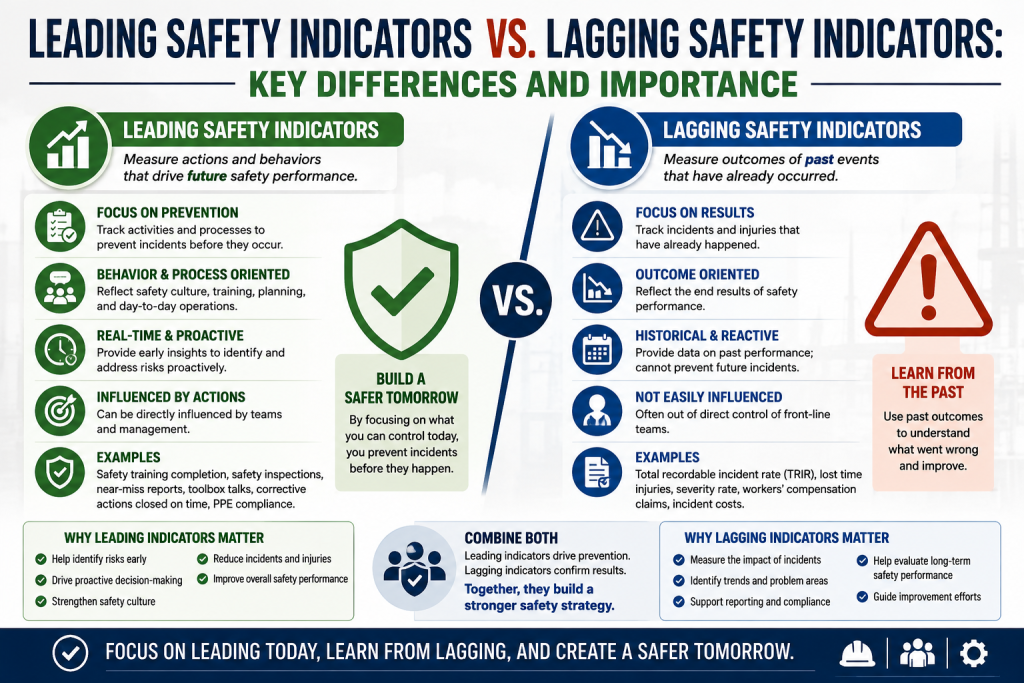
Workplace safety is an essential part of successful business operations. Organizations across industries continuously work to identify hazards, prevent accidents, protect employees, and maintain compliance with applicable safety requirements. To determine whether safety programs are working effectively, organizations need reliable methods for measuring safety performance.
This is where Leading Safety Indicators and Lagging Safety Indicators become important. Both metrics provide valuable information, but they measure different aspects of safety performance. The Safety Master can help organizations understand and apply these indicators to strengthen their safety management approach. Leading indicators focus on proactive activities that can help prevent incidents, while lagging indicators measure outcomes after incidents or injuries have already occurred.
Understanding the difference between these two types of indicators allows organizations to build more effective safety management systems. A balanced approach that uses both leading and lagging indicators can provide a comprehensive view of workplace safety.
What Are Leading Safety Indicators?
Leading Safety Indicators are proactive measurements that focus on activities, conditions, and actions that can help prevent accidents and incidents before they happen.
These indicators are generally forward-looking. They help organizations determine whether preventive safety measures are being implemented effectively and whether employees and management are actively participating in safety initiatives.
Examples of leading safety indicators include:
- Number of safety training sessions completed
- Employee participation in safety programs
- Number of workplace safety inspections
- Safety observations completed
- Near-miss reports submitted
- Corrective actions completed on time
- Preventive maintenance activities
- Emergency drills conducted
- Risk assessments completed
- Safety meetings conducted
For example, if an organization tracks the number of employees completing safety training, it can determine whether its workforce is receiving the knowledge required to work safely.
Similarly, tracking corrective actions can help management understand whether identified hazards are being addressed promptly.
Why Are Leading Indicators Important?
The biggest advantage of leading indicators is their proactive nature. Organizations do not need to wait for an accident to happen before taking action.
Suppose a company notices that employees are frequently reporting unsafe conditions or near misses in a particular production area. This information can be investigated immediately. Management can identify the underlying hazard and introduce corrective measures before the situation results in an injury or major incident.
Leading indicators therefore help organizations move from a reactive safety culture toward a preventive safety culture.
They can also encourage employees to participate actively in workplace safety. When employees are involved in safety observations, inspections, training, and near-miss reporting, management receives more information about potential risks.
What Are Lagging Safety Indicators?
Lagging Safety Indicators are reactive metrics that measure safety outcomes after an incident, accident, injury, or other safety event has occurred.
They provide a historical view of an organization’s safety performance. Instead of measuring what an organization is doing to prevent incidents, lagging indicators measure the results of those efforts.
Common examples include:
- Number of workplace injuries
- Lost-time injury frequency
- Total Recordable Injury Rate (TRIR)
- Lost workdays
- Number of fatalities
- Occupational illness cases
- Number of reportable incidents
- Workers’ compensation claims
- Accident-related costs
- Property damage incidents
For example, if an organization records ten workplace injuries during a particular year, this information can be used to evaluate its historical safety performance.
Lagging indicators are useful for identifying trends and determining whether safety performance has improved or deteriorated over time.
Why Are Lagging Indicators Important?
Although lagging indicators are reactive, they remain an important part of safety management.
They provide measurable evidence of actual safety outcomes. Organizations can compare injury rates, incident frequencies, and other historical data across different periods to determine whether safety performance is changing.
For example, if the number of recordable injuries decreases consistently over several years, it may indicate that the organization’s safety program is becoming more effective.
However, lagging indicators have an important limitation: by the time an adverse outcome appears in the data, the incident has already happened.
This is why organizations should not depend solely on lagging indicators.
Leading vs. Lagging Safety Indicators
The differences between leading and lagging safety indicators can be understood through several important factors.
1. Focus
Leading indicators focus on preventive actions and safety activities.
They answer questions such as:
- Are employees receiving safety training?
- Are safety inspections being completed?
- Are hazards being reported?
- Are corrective actions being closed?
- Are emergency drills being conducted?
Lagging indicators focus on safety outcomes.
They answer questions such as:
- How many injuries occurred?
- How many employees lost workdays?
- How many incidents were reported?
- How much did workplace accidents cost?
2. Timing
Leading indicators are generally measured before an incident occurs. They provide information about ongoing safety activities and conditions.
Lagging indicators are measured after an incident or safety outcome has occurred. They therefore provide historical information.
3. Predictive Value
Leading indicators can provide early warning signals about potential safety problems. For example, a decline in safety inspections or employee training participation may indicate that preventive controls are weakening.
Lagging indicators generally have limited predictive capability because they measure events that have already occurred.
4. Actionability
Leading indicators are often highly actionable. If an organization discovers that corrective actions are taking too long, management can immediately investigate the reason and improve the process.
Lagging indicators can also lead to corrective action, but they primarily explain what happened rather than what may happen next.
5. Measurement
Leading indicators typically measure safety activities, behaviors, controls, and preventive processes.
Lagging indicators measure injuries, incidents, losses, and other outcomes.
Examples of Leading and Lagging Indicators
Consider a manufacturing facility that wants to improve its workplace safety performance.
Its leading indicators might include:
- 95% employee participation in safety training
- Weekly workplace inspections
- Monthly emergency drills
- Near-miss reporting rates
- 90% corrective action closure within the required timeframe
Its lagging indicators might include:
- Number of recordable injuries
- Lost-time injury cases
- Number of workplace incidents
- Days away from work
- Accident-related financial losses
By monitoring both sets of indicators, management can understand not only what has happened but also whether preventive activities are being implemented effectively.
Why Organizations Should Use Both Indicators
Using only one type of safety indicator can provide an incomplete picture.
An organization may have a low injury rate, but this does not automatically mean its safety management system is strong. A low number of incidents could result from underreporting, limited employee participation, or insufficient monitoring.
Similarly, an organization may have a high number of near-miss reports. This does not necessarily mean safety performance is poor. In some cases, a high reporting rate may indicate that employees are actively identifying and communicating hazards.
Therefore, organizations should interpret safety indicators within their operational context.
A balanced safety performance measurement system combines leading and lagging indicators. Leading indicators help management monitor preventive activities, while lagging indicators help evaluate actual outcomes.
Role of Safety Consultants in Safety Performance Management
Safety consultants can help organizations develop meaningful safety performance measurement systems.
Instead of simply collecting large amounts of data, consultants can help businesses identify indicators that are relevant to their specific risks and operational objectives.
For example, a construction company may focus on work-at-height inspections, toolbox talks, equipment inspections, and near-miss reporting. A manufacturing facility may place greater emphasis on machine safety inspections, process safety controls, preventive maintenance, and employee training.
The right indicators should therefore reflect the organization’s hazards and safety objectives.
Safety Master’s Approach to Safety Management
Safety Master is a professional safety consultancy that supports organizations in identifying hazards, assessing risks, improving safety systems, and developing practical safety strategies.
Its approach recognizes the importance of combining proactive safety activities with measurable safety outcomes.
Safety Master can assist organizations with services such as Fire Risk Assessments, Fire Audits, and Fire Safety Audits. These assessments can help organizations identify potential hazards, evaluate existing controls, and determine areas where safety improvements may be required.
By combining risk assessment with performance monitoring, organizations can develop a more structured approach to safety management.
Fire Risk Assessments and Safety Indicators
Fire safety is another area where leading and lagging indicators can be valuable.
Leading fire safety indicators may include:
- Number of fire inspections completed
- Fire extinguisher inspections
- Emergency evacuation drills
- Fire safety training sessions
- Fire alarm testing
- Corrective actions completed
- Fire risk assessments conducted
Lagging indicators may include:
- Number of fire incidents
- Fire-related injuries
- Property damage
- Fire-related downtime
- Emergency response incidents
Tracking these indicators can help organizations understand whether their fire prevention measures are functioning effectively.
Fire Audits and Fire Safety Audits
Regular Fire Audits and Fire Safety Audits can provide organizations with valuable information about the condition of their fire prevention and protection systems.
A professional audit may examine fire detection systems, fire extinguishers, emergency exits, fire alarms, evacuation procedures, emergency response arrangements, documentation, and employee awareness.
The findings can then be converted into corrective actions and tracked as leading indicators.
This creates a continuous improvement cycle:
Identify hazards → Assess risks → Implement controls → Monitor leading indicators → Measure outcomes → Improve safety systems
Benefits of Using Leading and Lagging Indicators Together
A combined approach provides several benefits.
Better Risk Management
Leading indicators help identify weaknesses before they result in incidents, while lagging indicators show where incidents have already occurred.
Improved Decision-Making
Management can use safety data to make informed decisions about training, inspections, equipment, resources, and corrective actions.
Stronger Safety Culture
Tracking employee participation, safety observations, and hazard reporting encourages workers to become actively involved in safety.
Continuous Improvement
Organizations can compare performance over time and identify areas requiring additional attention.
Improved Accountability
Clearly defined safety indicators help departments and management teams understand their responsibilities and track progress.
Best Practices for Selecting Safety Indicators
Organizations should avoid selecting too many indicators simply for the sake of collecting data. The most effective indicators are relevant, measurable, understandable, and connected to actual safety risks.
A good safety indicator should:
- Address a significant workplace risk
- Be easy to measure consistently
- Provide useful information
- Support corrective action
- Have a clear owner
- Be reviewed regularly
- Contribute to safety objectives
It is also important to ensure that employees understand what is being measured and why.
Conclusion
Leading Safety Indicators and Lagging Safety Indicators serve different but complementary purposes in workplace safety management. Leading indicators focus on proactive activities such as training, inspections, near-miss reporting, safety observations, and corrective actions. An Electrical Safety Audit can also support these proactive efforts by identifying hazards and evaluating existing safety controls. Lagging indicators measure outcomes such as injuries, lost workdays, incidents, fatalities, and accident-related costs.
Neither type should be used in isolation. A strong safety management system combines both to provide a comprehensive understanding of safety performance.
Safety Master supports organizations through professional safety consultancy services, including Fire Risk Assessments, Fire Audits, and Fire Safety Audits. By identifying hazards, evaluating risks, strengthening preventive measures, and encouraging continuous improvement, organizations can build stronger safety management systems.
Ultimately, the goal of safety performance measurement is not simply to produce numbers. It is to use meaningful information to prevent incidents, protect employees, improve operational performance, and create a workplace where safety is treated as a continuous responsibility.