Achieving CPD Certification through BBSM Training: What It Means for Safety Professionals

BBSM Case Studies: Real-Life Examples of Successful Safety Improvements
July 26, 2023
A Comprehensive Guide to Developing an Effective Contractor Safety Manual: Ensuring Safety Excellence on Every Worksite
July 26, 2023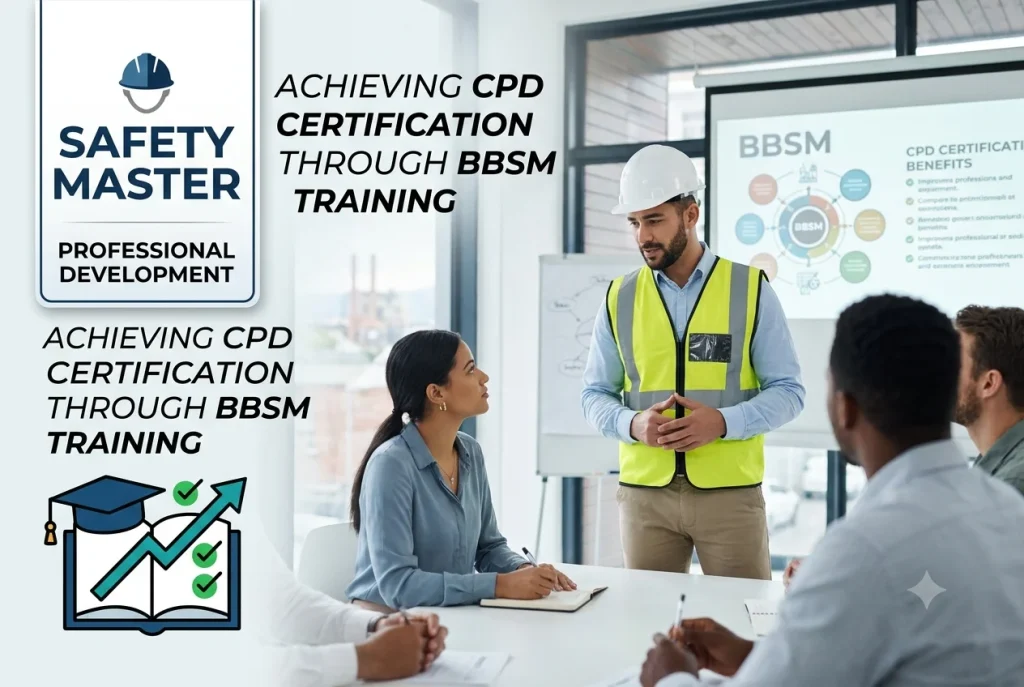
In the modern industrial landscape, workplace safety has evolved far beyond traditional compliance checklists and mandatory regulatory rulebooks. While engineering controls and standard operating procedures remain foundational, safety leaders increasingly recognize that human behavior drives the majority of workplace incidents. Behavior-Based Safety Management (BBSM) has emerged as a transformative framework for identifying, measuring, and modifying at-risk actions. For safety practitioners aiming to validate their expertise, Achieving CPD Certification through BBSM Training represents a powerful milestone.
Delivered by industry leaders like The Safety Master, structured professional development programs that combine behavior-based principles with Continuing Professional Development (CPD) accreditation offer immense value. This comprehensive guide explores what CPD-accredited BBSM training entails, why it matters, and how it elevates safety careers and organizational safety culture.
Understanding the Foundation of Behavior-Based Safety Management (BBSM)
To appreciate the value of CPD certification, safety professionals must first examine the core mechanics of BBSM. Traditional safety management focuses heavily on physical conditions and top-down rules. Conversely, Behavior-Based Safety Management zeroes in on human actions—the observable behaviors that either precipitate accidents or safeguard operations.
The Psychology Behind Workplace Actions
BBSM is rooted in behavioral science and operational psychology. It posits that behavior is a function of its consequences. When workers are rewarded or recognized for safe practices, those behaviors multiply. When unsafe shortcuts go uncorrected or yield convenience without immediate penalty, risky habits become deeply ingrained.
Core Components of BBSM Implementation
- Identifying Critical Behaviors: Pinpointing specific, observable actions that directly influence high-risk tasks, such as correct Personal Protective Equipment (PPE) utilization, safe material handling, or adherence to lockout/tagout (LOTO) protocols.
- Structured Workplace Observations: Empowering trained peer observers and supervisors to conduct routine observations, logging safe versus at-risk behaviors.
- Supportive Interventions and Feedback: Replacing punitive measures with constructive, real-time conversations to correct unsafe acts and reinforce positive habits.
- Data-Driven Continuous Improvement: Analyzing observation trends to eliminate systemic barriers and continuously refine safety protocols.
What is CPD Certification and Why Does It Matter?
Continuing Professional Development (CPD) refers to the ongoing enhancement of a professional’s skills, knowledge, and competence throughout their career. CPD accreditation provides formal, independent validation that a training program meets the highest international educational and professional standards.
The Value of CPD Accreditation for Safety Experts
For safety officers, HSE managers, and industrial consultants, maintaining stagnant credentials is no longer an option. Industries change, regulations tighten, and workforce dynamics shift. Earning CPD points or certification through specialized programs signals to employers and regulatory bodies that a professional is committed to lifelong learning and up-to-date competency.
When integrated with specialized operational frameworks like BBSM, CPD certification bridges the gap between theoretical safety concepts and practical, career-boosting credentials.
What Achieving CPD Certification Through BBSM Training Means for Your Career
Pursuing and Achieving CPD Certification through BBSM Training is much more than adding a line to your resume. It transforms your professional trajectory across several dimensions:
1. Validation of Advanced Competency
Earning a CPD-certified credential from an established authority like The Safety Master provides objective proof of your capability to design, implement, and audit behavior-based safety initiatives. It demonstrates that you understand not just the mechanics of compliance, but the nuanced psychology of human behavior.
2. Accelerated Career Advancement and Leadership Opportunities
Employers across manufacturing, oil and gas, construction, chemical processing, and logistics actively seek out safety leaders who can move beyond bureaucratic enforcement and build true safety cultures. Professionals holding advanced BBSM credentials are prime candidates for promotions to HSE Director, Senior Safety Consultant, or Operational Risk Manager roles.
3. Practical Skill Acquisition for Real-World Impact
Theoretical knowledge alone cannot prevent workplace injuries. CPD-accredited BBSM courses focus heavily on practical application—teaching you how to train peer observers, conduct effective safety conversations, analyze observation metrics, and overcome employee resistance to safety change.
How The Safety Master Drives Excellence in BBS Training
The Safety Master has established itself as a premier safety consultancy and training provider, empowering organizations and individuals globally to elevate their safety standards.
Bridging Theory and Industrial Practice
Many safety training programs remain purely academic. The Safety Master ensures that its BBSM modules are deeply rooted in real-world industrial environments. Whether applied in hazardous manufacturing plants, complex construction sites, or chemical facilities, the training equips safety professionals with actionable strategies that can be deployed immediately on the shop floor.
Comprehensive Curriculum Tailored for Modern HSE Needs
A robust BBSM training program covers a progressive learning curve:
- Fundamentals of Behavioral Science: Understanding triggers, behaviors, and consequences.
- Designing Observation Checklists: Crafting clear, measurable criteria for peer-to-level observations.
- Soft Skills for Safety Observers: Training managers and supervisors to deliver non-punitive, constructive feedback.
- Sustaining Long-Term Engagement: Preventing safety initiatives from becoming a temporary “flavor-of-the-month” campaign and embedding safety into daily organizational DNA.
Frequently Asked Questions (FAQs)
1. What is BBSM training, and how does it differ from traditional safety training?
BBSM (Behavior-Based Safety Management) training focuses specifically on observing, analyzing, and modifying human behavior in the workplace. While traditional safety training emphasizes compliance, rules, and physical hazard elimination, BBSM addresses the psychological and behavioral drivers of everyday actions, fostering a proactive culture where workers actively prevent incidents.
2. Why is CPD certification important for safety professionals?
CPD (Continuing Professional Development) certification validates that a training program adheres to rigorous professional standards. It proves to employers, clients, and regulatory authorities that a safety professional is dedicated to maintaining high competence, expanding their skill set, and staying abreast of modern industry practices.
3. Who should enroll in CPD-certified BBSM training?
This training is ideal for HSE officers, safety managers, plant supervisors, industrial engineers, operations directors, and safety consultants who want to deepen their expertise in behavioral science and enhance their professional credentials.
4. How does The Safety Master incorporate practical learning into its BBSM courses?
The Safety Master designs its training modules around real-world industrial scenarios, case studies, and practical exercises. Participants learn how to construct observation matrices, conduct constructive safety dialogues, analyze behavioral data, and address employee resistance effectively.
5. How can achieving this certification improve organizational safety performance?
By deploying certified BBSM practitioners, organizations can systematically identify recurring at-risk behaviors before they result in accidents. This leads to higher employee engagement, reduced incident rates, lower insurance and legal costs, and the cultivation of a sustainable, human-centric safety culture.