Emerging Trends in Safety Software in India: A Technology-Driven Safety Revolution
Pre startup Safety Review by TheSafetyMaster
August 17, 2023
HAZOP and QRA Study by TheSafetyMaster
August 19, 2023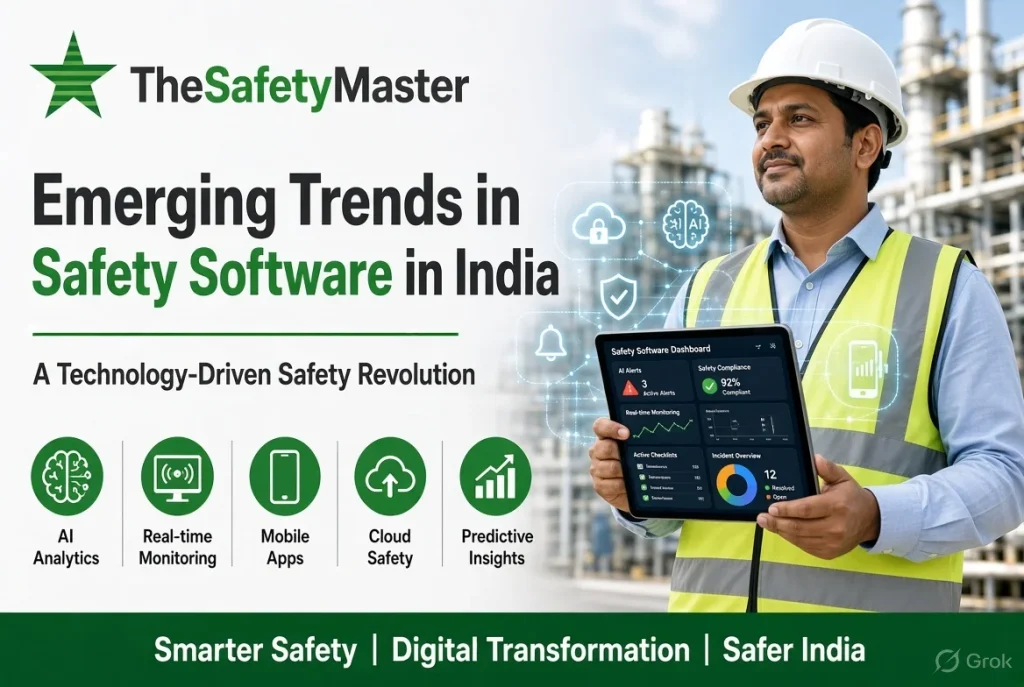
Workplace safety is becoming more important for Indian industries. Manufacturing plants, construction sites, chemical industries, warehouses, and power plants need effective systems to identify hazards and prevent accidents. Traditional safety methods often depend on paper records, manual inspections, and spreadsheets. These methods can take time and make it difficult to manage safety information across different locations.
Safety software in India is helping organisations improve their safety management systems through digital technology. It allows safety teams to record incidents, conduct inspections, track corrective actions, manage risk assessments, and maintain compliance records in one place.
New technologies such as Artificial Intelligence (AI), the Internet of Things (IoT), cloud computing, mobile applications, and data analytics are creating new opportunities for workplace safety. These tools can help companies identify potential risks earlier and make better decisions.
The Safety Master recognises the importance of combining practical safety knowledge with modern technology. When digital systems are supported by trained professionals and effective safety procedures, organisations can build a stronger safety culture and improve workplace risk management.
What Is Safety Software?
Safety software is a digital tool used to manage workplace health, safety, environmental protection, and regulatory compliance activities. It helps companies organise safety information and complete important safety tasks more efficiently.
Instead of maintaining separate paper files for every activity, organisations can use software to manage records and monitor progress from a central system.
Common functions of safety software include:
- Workplace safety inspections and audits.
- Hazard identification and risk assessment.
- Incident and near-miss reporting.
- Corrective and preventive action tracking.
- Permit-to-work management.
- Employee safety training records.
- Personal protective equipment (PPE) monitoring.
- Emergency response planning.
- Environmental and safety compliance records.
- Safety performance reports and dashboards.
For example, a manufacturing company can use safety software to record a machine-related hazard, assign corrective action to a responsible person, set a completion date, and verify whether the issue has been resolved.
This process improves accountability and reduces the risk of important safety actions being forgotten.
Emerging Trends in Safety Software in India
1. Artificial Intelligence in Safety Management
Artificial Intelligence is becoming an important technology in digital safety management. AI-powered systems can analyse large amounts of safety information and help identify patterns that may not be easy to notice through manual reviews.
For example, a company may have repeated reports of slips, machinery-related hazards, or unsafe working practices. An AI-enabled system can help identify common factors across these reports and highlight areas that require further investigation.
AI can support several workplace safety activities:
- Analysing incident and near-miss reports.
- Identifying repeated hazards.
- Supporting risk assessment reviews.
- Summarising inspection findings.
- Helping safety teams prioritise corrective actions.
- Preparing safety reports from available records.
AI can also help safety professionals spend less time on repetitive documentation and more time on workplace inspections, hazard control, and employee engagement.
However, AI recommendations should always be reviewed by qualified safety professionals. Incorrect or incomplete data can lead to misleading results. Human judgement remains essential when evaluating serious industrial risks.
2. Internet of Things (IoT) for Real-Time Safety Monitoring
The Internet of Things connects devices, sensors, and equipment so that information can be collected and shared automatically.
In industrial workplaces, IoT sensors can monitor environmental conditions and equipment performance. This can help safety teams identify dangerous conditions before they develop into serious incidents.
Examples include:
- Gas detectors that identify hazardous gas concentrations.
- Temperature sensors that monitor overheating equipment.
- Wearable devices that provide worker location information.
- Sensors that detect environmental changes.
- Equipment monitoring systems that identify unusual operating conditions.
For example, a chemical plant can use connected gas detectors to send alerts when gas concentrations exceed predefined limits. Workers and emergency response teams can then follow the appropriate response procedures.
IoT technology is particularly useful in chemical plants, oil and gas facilities, confined spaces, manufacturing units, and other high-risk workplaces.
The effectiveness of these systems depends on proper installation, calibration, maintenance, alarm management, and suitable emergency procedures.
3. Cloud-Based Safety Software
Cloud-based safety software allows authorised users to access safety information through internet-connected devices. Companies can store records centrally and share information between departments and locations.
This is useful for businesses that operate multiple factories, construction projects, warehouses, or offices.
Important benefits include:
- Centralised safety records.
- Easier document access.
- Faster communication between locations.
- Improved tracking of inspections and corrective actions.
- Better visibility of safety performance.
- Reduced dependence on physical files.
For example, a safety manager overseeing several manufacturing facilities can review inspection findings and outstanding corrective actions from a central dashboard.
Cloud systems should include suitable access controls, secure backups, data protection measures, and clear rules for handling confidential information.
4. Mobile Applications for Workplace Safety
Mobile safety applications allow employees and supervisors to report hazards and complete safety tasks directly from their phones or tablets.
This makes safety reporting easier for workers who spend most of their time on the shop floor, at construction sites, or in remote industrial locations.
Mobile safety applications can support:
- Daily safety inspections.
- Near-miss reporting.
- Workplace hazard photographs.
- Digital checklists.
- Toolbox talk attendance.
- Safety observation reports.
- Permit approvals.
- Corrective action updates.
For example, a construction supervisor can identify an unsafe scaffold, take a photograph, submit a report, and assign the issue to the responsible contractor.
Some applications also support offline data entry, allowing employees to record information in locations with limited internet connectivity and synchronise it later.
Easy-to-use mobile applications can encourage employees to report hazards more consistently and help safety teams respond more quickly.
5. Predictive Analytics for Accident Prevention
Traditional safety reporting often focuses on incidents that have already occurred. Predictive analytics helps organisations study existing information to identify possible risk patterns.
Safety software can analyse information such as previous incidents, near misses, inspection findings, equipment failures, and overdue corrective actions.
These findings can help companies identify areas that need closer attention.
For example, repeated equipment defects combined with overdue maintenance actions may indicate a need for additional inspections or maintenance planning.
Predictive analytics can help organisations:
- Identify recurring safety problems.
- Monitor changes in risk levels.
- Prioritise high-risk work areas.
- Review safety performance indicators.
- Plan preventive maintenance.
- Improve resource allocation.
Predictive systems do not guarantee that an accident will be prevented. Their value depends on reliable data, suitable analysis, and timely action by management and workers.
6. Digital Risk Assessment and Hazard Management
Hazard Identification and Risk Assessment (HIRA) is an important part of workplace safety. It helps organisations identify hazards, evaluate risks, and select appropriate control measures.
Digital safety software can make the risk assessment process easier to document and monitor.
A digital risk assessment system may include:
- Hazard identification forms.
- Severity and likelihood ratings.
- Risk matrix calculations.
- Existing control measures.
- Additional recommended controls.
- Responsible persons and target dates.
- Review and approval records.
For example, during a construction project, a safety team may identify fall hazards during work at height. The software can record the risk level, existing safeguards, required improvements, and the person responsible for completing the actions.
Digital HIRA records can also be reviewed when equipment, processes, materials, or working conditions change.
The software should support a structured assessment process rather than replace a competent person’s evaluation of the actual workplace.
7. Digital Permit-to-Work Systems
A Permit-to-Work (PTW) system controls activities that require additional safety precautions. These activities may include hot work, confined space entry, electrical maintenance, and work on hazardous equipment.
Paper-based permit systems can create delays when approvals, isolation certificates, and supporting documents are maintained separately.
Digital permit-to-work software can help organisations manage the complete permit process.
Key functions may include:
- Online permit requests.
- Hazard and risk assessment reviews.
- Isolation and lockout/tagout checks.
- Authorisation by responsible personnel.
- Permit validity monitoring.
- Shift handover records.
- Permit closure and verification.
For example, before hot work begins in an industrial plant, the digital system can help authorised personnel verify that the required precautions and approvals have been completed.
A digital permit must not automatically authorise hazardous work without the necessary physical checks, competent approvals, and site-specific precautions.
8. Wearable Technology and Smart PPE
Wearable technology is creating new ways to monitor certain workplace hazards. Smart helmets, connected gas detectors, location devices, and other sensor-based equipment can provide useful information about working conditions.
Depending on the device, wearable technology may help detect hazardous gas exposure, monitor worker location, or provide alerts about restricted areas.
Smart PPE can be useful in industries where workers face high temperatures, hazardous atmospheres, heavy machinery, or remote working conditions.
However, companies should carefully assess the suitability of each device before introducing it.
Important considerations include comfort, battery life, sensor accuracy, maintenance, worker privacy, and compatibility with existing safety equipment.
Wearable technology should support, rather than replace, appropriate PPE, engineering controls, safe work procedures, and worker training.
9. Digital Training and Virtual Reality
Safety training is essential for preparing employees to recognise hazards and follow safe working procedures. Digital learning platforms allow companies to deliver training materials, track attendance, and assess employee understanding.
Virtual Reality (VR) and Augmented Reality (AR) can provide interactive learning experiences for selected safety tasks.
Examples include:
- Fire emergency simulations.
- Work-at-height training scenarios.
- Confined space hazard awareness.
- Machinery safety demonstrations.
- Emergency evacuation practice.
- Hazard recognition exercises.
Employees can practise responding to simulated situations without being exposed to the actual workplace hazard during the exercise.
Digital training records can also help safety managers monitor course completion, refresher training requirements, and competency assessments.
Practical demonstrations and supervised workplace training remain important, particularly for activities involving equipment operation, emergency response, and high-risk work.
10. Integration of Safety Software with Other Business Systems
Modern organisations often use separate systems for maintenance, human resources, production, environmental management, and quality control.
Integrating these systems can help safety teams access relevant information without repeatedly entering the same data.
For example, maintenance records can help identify equipment with recurring defects. Human resource records can support the tracking of safety training, while production schedules can help managers plan risk assessments for changing operations.
Integrated systems can improve coordination between departments and make safety information more useful for operational decision-making.
Before integration, companies should check data accuracy, system compatibility, access permissions, and cybersecurity requirements.
Benefits of Safety Software for Indian Industries
The adoption of safety software in India can support organisations in several practical ways.
Better hazard reporting: Employees can report unsafe conditions through digital forms and mobile applications.
Improved record management: Inspection reports, training records, risk assessments, and incident details can be stored in an organised system.
Faster corrective action: Responsible persons can receive assigned tasks and track completion dates.
Improved management visibility: Dashboards can help managers review safety performance and identify areas requiring attention.
More consistent inspections: Digital checklists can help teams follow standard inspection procedures across multiple locations.
Better coordination: Employees, supervisors, contractors, and safety managers can share relevant information more easily.
Stronger risk management: Historical data and risk assessment records can help organisations identify recurring problems and review control measures.
The actual benefits depend on the software selected, the quality of implementation, employee participation, and management commitment.
Challenges in Adopting Safety Software in India
Although digital tools offer several advantages, companies may face challenges when implementing them.
Initial Cost and Implementation
Some organisations may need to invest in software licences, devices, system integration, and employee training.
Businesses should evaluate the total cost of ownership and choose a solution that matches their operational requirements.
Employee Training and Acceptance
Employees may find new digital systems difficult to use, especially when they are accustomed to paper-based processes.
Simple interfaces, clear instructions, and practical training can improve adoption.
Data Security and Privacy
Safety systems may contain incident reports, employee information, photographs, and operational details.
Organisations should use appropriate cybersecurity controls, role-based access, secure backups, and clear data retention policies.
Integration with Existing Systems
Older equipment and business applications may not connect easily with new safety software.
Companies should review integration requirements before selecting a platform.
Dependence on Data Quality
Incorrect or incomplete information can reduce the value of safety dashboards, automated alerts, and predictive analytics.
Regular data reviews and clear reporting procedures are essential.
How to Choose the Right Safety Software
Selecting the right safety management platform requires a clear understanding of workplace risks and business needs.
Organisations should consider the following factors:
- Identify operational requirements: Determine whether the priority is HIRA, incident management, audits, PTW, training, or compliance records.
- Check industry suitability: Ensure the system supports the risks and activities associated with the company’s operations.
- Review ease of use: Choose software that employees and contractors can use without unnecessary complexity.
- Evaluate reporting features: Check whether it provides useful dashboards, trend analysis, and exportable reports.
- Check security measures: Review data protection, user permissions, backup arrangements, and access controls.
- Confirm scalability: Ensure the system can support future sites, users, and operational changes.
- Provide employee training: Train users before introducing the system across the organisation.
- Measure performance: Review reporting quality, corrective action closure, inspection completion, and other relevant indicators.
A pilot implementation at one facility or department can help organisations identify problems before expanding the system across the business.
The Future of Safety Software in India
The future of safety software in India is likely to involve greater use of connected devices, AI-assisted analysis, predictive risk management, mobile reporting, and integrated digital systems.
As industrial operations become more complex, companies will need better ways to manage safety information and coordinate preventive action.
Digital tools may help safety teams identify recurring hazards, monitor workplace conditions, and improve access to critical information. However, technology alone cannot create a safe workplace.
Successful safety management requires competent professionals, employee participation, effective engineering controls, regular inspections, suitable training, and strong leadership.
The Safety Master supports a practical approach to workplace safety in which technology complements professional expertise and established risk management practices. Organisations should select digital solutions based on their actual hazards, business needs, and ability to implement the system effectively.
Conclusion
Safety software in India is helping organisations move from manual recordkeeping towards more connected and data-driven safety management. AI, IoT, cloud computing, mobile applications, predictive analytics, digital risk assessments, and smart PPE offer opportunities to improve hazard reporting, risk monitoring, and corrective action management.
The best results come when companies combine appropriate technology with strong safety procedures and competent human supervision. Organisations should begin by identifying their main safety challenges, choosing suitable software, training employees, and regularly reviewing performance.
The Safety Master encourages businesses to focus on practical risk control, continuous improvement, and responsible use of technology. By combining digital tools with effective safety management, Indian industries can work towards safer workplaces and more reliable operations.
About The Safety Master
The Safety Master supports organisations in improving workplace safety through professional safety services, risk management, audits, and training. Combining appropriate digital tools with practical safety expertise can help businesses strengthen their safety management practices.