Ammonia Storage Safety Case Study: Preventing a Major Leak Through Early Detection and Emergency Response

Integrating BBS Implementation with Process Safety Programs for Better Risk Control and Operational Excellence
July 8, 2026
How Process Safety Consultants Help Industries Reduce Operational Risks Through Advanced Hazard Assessment Methods
July 11, 2026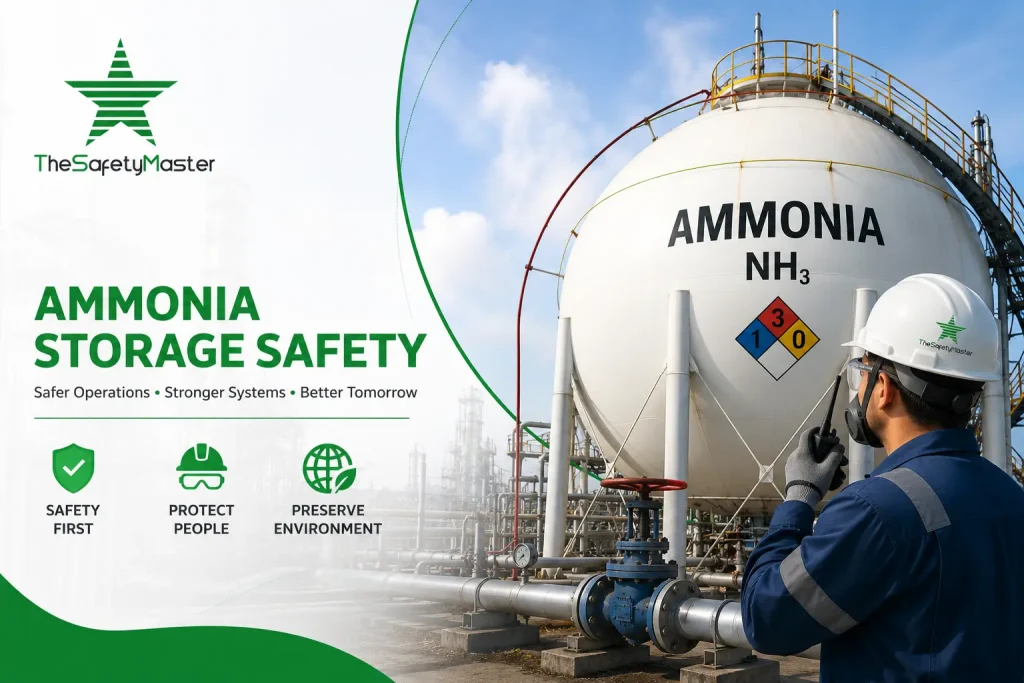
Ammonia (NH₃) is one of the most widely used industrial chemicals worldwide, particularly in fertilizer production, refrigeration systems, pharmaceuticals, petrochemicals, explosives, and chemical manufacturing. Due to its toxic, corrosive, and flammable characteristics under certain conditions, ammonia requires strict safety measures during storage, handling, transportation, and emergency response. Improper storage can result in toxic gas release, fire, explosion, environmental contamination, equipment failure, and loss of life.
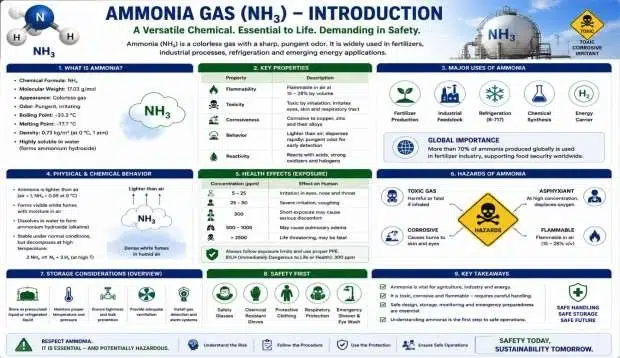
Ammonia (NH₃) is a colorless gas with a strong pungent odor. It is one of the highest-volume chemicals produced globally, mainly for fertilizer production through the Haber-Bosch process.
Industries using ammonia include:
- Fertilizer plants
- Refrigeration plants
- Petrochemical industries
- Food processing
- Pharmaceuticals
- Textile industries
- Power plants
- Explosive’s manufacturing
Because ammonia is toxic and stored under pressure or at low temperatures, safe storage is one of the most critical aspects of process safety management.
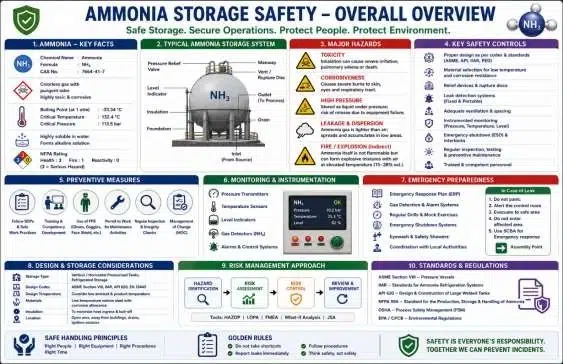
Ammonia is defined as :- Ammonia (NH₃) is a colorless, toxic gas with a strong, pungent smell. It is made of one nitrogen atom (N) and three hydrogen atoms (H).
CHEMICAL INFORMATION
| Property | Details |
| Chemical Name | Ammonia |
| Chemical Formula | NH₃ |
| Molecular Weight | 17.03 g/mol |
| CAS Number | 7664-41-7 |
| Appearance | Colorless gas |
| Odor | Strong pungent smell |
| Density | 0.73 kg/m³ (gas at STP) |
| Boiling Point | -33.34°C |
| Melting Point | -77.7°C |
| Auto-Ignition Temperature | 651°C |
| Flammable Range | 15–28% by volume in air |
| Solubility | Highly soluble in water |
| Vapor Density | 0.59 (Air = 1) |
| pH of Aqueous Solution | Approximately 11–12 |
APPLICATION OF AMMONIA:-
- Urea manufacturing
- Ammonium nitrate production
- Nitric acid manufacturing
- Refrigeration systems
- Explosive manufacturing
AMMONIA STORAGE SAFETY IS IMPORTANT BECAUSE:-
Improper storage may lead to:
- Toxic gas release
- Fire hazards
- Explosion risks
Types of Storage Tanks
- Horton Sphere
- Bullet Tank
- Cylindrical Tank
- Double Containment Tank
- Full Containment Tank
Components of Storage Tank
- Tank Shell
- Roof
- Bottom Plate
- Nozzles
- Pressure Relief Valve
- Level Gauge
- Pressure Indicator
- Temperature Indicator
- Safety Valve
Hazards of Ammonia Storage
- Toxic Hazard
- Fire Hazard
- Explosion Hazard
- Corrosion Hazard
- Cryogenic Hazard
- Environmental Hazard Causes of Ammonia Leakage Common causes include:
- Corrosion
- Overpressure
- Mechanical failure
- Improper maintenance
- Human error
- Valve leakage
Personal Protective Equipment (PPE) Used in Ammonia Plant:-
Personnel working near ammonia storage should wear:
- Chemical-resistant gloves
- Face shield
- Safety goggles
- Chemical suit
- Rubber boots
RISK ASSESSMENT IN AMMONIA STORAGE
Risk assessment is the systematic process of identifying hazards, evaluating the level of risk, and implementing control measures to prevent accidents during ammonia storage. Its main objective is to protect people, equipment, the environment, and plant operations from incidents such as ammonia leaks, fire, explosion, or overpressure.
Objectives of Risk Assessment
- Identify potential hazards in ammonia storage.
- Assess the likelihood and consequences of an accident.
- Implement suitable control measures to reduce risk.
- Ensure compliance with safety regulations.
- Improve emergency preparedness and response.
Major Hazards in Ammonia Storage
- Ammonia leakage from tanks, pipelines, or valves.
- Overpressure due to blocked outlets or equipment failure.
- Tank rupture caused by corrosion or mechanical damage.
- Fire and explosion under specific flammable conditions.
- Toxic exposure to workers and nearby communities.
- Environmental contamination due to accidental release.
Risk Assessment Process
- Hazard Identification – Identify possible hazards such as leaks, overfilling, corrosion, and equipment failure.
- Risk Analysis – Evaluate the likelihood and severity of each hazard.
- Risk Evaluation – Decide whether the risk is acceptable or requires additional controls.
- Risk Control – Implement engineering, administrative, and PPE controls.
- Review and Monitoring – Regularly inspect and update the risk assessment.
Risk Control Measures
- Install ammonia gas detectors with alarms.
- Use pressure relief valves (PRVs) to prevent overpressure.
- Conduct regular inspection and maintenance of tanks and pipelines.
- Provide emergency shutdown (ESD) systems.
- Train employees in ammonia handling and emergency response.
- Ensure availability of PPE such as goggles, gloves, chemical suits, and SCBA.
- Develop and practice an Emergency Response Plan (ERP).
RISK ASSESSMENT MATRIX (EXAMPLE)
| Hazard | Risk | Control Measure |
| Ammonia Leak | High | Gas detectors, leak testing, emergency isolation |
| Overpressure | High | Pressure relief valves, pressure monitoring |
| Tank Corrosion | Medium | Regular inspection and thickness measurement |
| Overfilling | High | Level indicators, high-level alarms, automatic shut-off |
| Worker Exposure | High | PPE, training, emergency showers and eyewash |
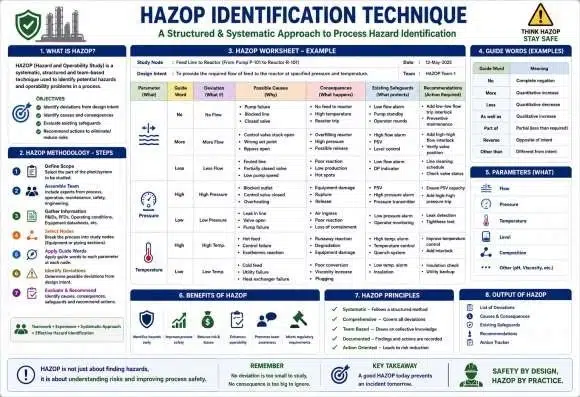
HAZOP IDENTIFICATION TECHNIQUE
HAZOP is a systematic and team-based technique used to identify process hazards and operational problems by examining deviations from the intended design.
- Conducted by a multidisciplinary team.
- Uses guide words such as No, More, Less, Reverse, As Well As.
- Identifies causes, consequences, and safeguards.
- Commonly used in chemical and petrochemical industries.
2. HAZID (Hazard Identification Study)
HAZID is a high-level hazard identification method used during the early stages of a project to identify major hazards.
- Performed during project planning and design.
- Identifies fire, explosion, toxic release, and environmental hazards.
- Helps prioritize risks for further analysis.
- Faster and simpler than HAZOP.
3. FMEA (Failure Mode and Effects Analysis)
FMEA is a structured method used to identify how equipment or components can fail and the effects of those failures
- Identifies failure modes and their causes.
- Evaluates Severity (S), Occurrence (O), and Detection (D).
- Calculates Risk Priority Number (RPN = S × O × D).
- Helps prioritize corrective actions.
4. What-if Analysis
A brainstorming technique that asks “What if this happens?” to identify possible hazards and operational problems.
- Simple and quick method.
- Based on experience and expert judgment.
- Suitable for small process modifications.
- Identifies preventive measures.
5. Bow-Tie Analysis
Bow-Tie Analysis is a visual risk assessment tool that shows the relationship between hazards, causes, preventive barriers, consequences, and recovery measures.
- Hazard is placed at the center (Top Event).
- Left side: Causes and preventive controls.
- Right side: Consequences and mitigation controls.
- Easy to understand and communicate risks.
6. Fault Tree Analysis (FTA)
FTA is a top-down analytical technique used to determine the root causes of an undesired event.
- Starts with the Top Event.
- Uses logical AND and OR gates.
- Identifies combinations of failures.
- Useful for reliability and safety analysis.
7. Event Tree Analysis (ETA)
ETA is a forward-looking method that evaluates the possible outcomes after an initiating event.
- Begins with an initiating event.
- Analyzes success or failure of safety systems.
- Predicts accident consequences.
- Supports emergency planning.
8. QRA (Quantitative Risk Assessment)
QRA is a numerical method used to calculate the likelihood and consequences of hazardous events.
- Estimates individual and societal risk.
- Uses accident frequencies and consequence modeling.
- Helps determine acceptable risk levels.
- Widely used for ammonia storage, LNG terminals, refineries, and chemical plants.
SAFETY SYSTEM IN AMMONIA STORAGE
1. Pressure Relief Valve (PRV)
A Pressure Relief Valve (PRV) is a safety device that automatically releases excess pressure from an ammonia storage tank to prevent overpressure and tank rupture.
- Prevents overpressure in storage tanks and pipelines.
- Opens automatically when pressure exceeds the set value.
- Protects equipment from explosion or damage.
- Must be tested and calibrated periodically.
- Discharge is directed to a safe location or flare/scrubber system.
2. Emergency Shutdown System (ESD)
An Emergency Shutdown System (ESD) is an automatic safety system that safely shuts down the plant during an emergency, such as an ammonia leak, fire, or high pressure.
- Stops pumps and compressors automatically.
- Closes emergency isolation valves.
- Activated manually or automatically.
- Minimizes ammonia release.
3. Gas Detection System
A Gas Detection System continuously monitors ammonia concentration in the air and activates alarms when gas is detected above safe limits.
- Detects ammonia leaks at an early stage.
- Provides audible and visual alarms.
- Automatically activates emergency systems if required.
- Requires regular calibration and maintenance.
4. Fire Water System
A Fire Water System supplies water to firefighting equipment for controlling fires and cooling ammonia storage tanks exposed to heat.
- Provides water through hydrants, monitors, and sprinklers.
- Cools storage tanks to prevent overheating.
- Protects nearby equipment during a fire.
- Includes fire pumps and dedicated water storage.
5. Water Curtain System
A Water Curtain System creates a continuous spray of water around an ammonia leak to absorb and disperse ammonia vapors, reducing their spread.
- Reduces ammonia vapor concentration.
- Helps protect workers and nearby communities.
- Limits toxic gas dispersion.
- Used during emergency leak response.
- Installed around storage tanks and unloading areas.
6. Emergency Vent
An Emergency Vent is a large-capacity vent designed to release excessive pressure from a storage tank during abnormal conditions such as fire or rapid pressure rise.
- Prevents catastrophic tank failure.
- Operates during emergency overpressure conditions.
- Provides rapid pressure relief.
- Used in addition to pressure relief valves.
- Designed according to international safety standards.
MAINTENANCE OF AMMONIA STORAGE
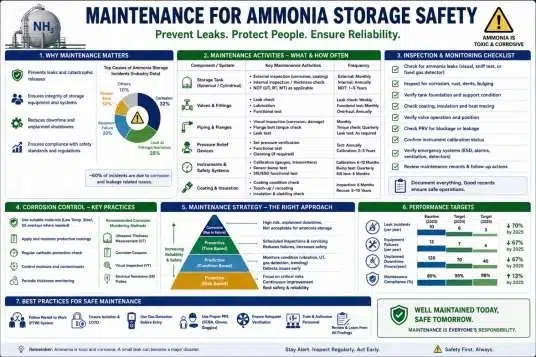
1. Preventive Maintenance
Definition:- Planned maintenance performed at regular intervals to prevent equipment failure.
- Scheduled inspection and servicing.
- Lubricate valves and moving parts.
- Replace worn or damaged components.
2. Predictive Maintenance
Definition: Maintenance based on the actual condition of equipment using monitoring techniques.
- Uses vibration, temperature, and thickness monitoring.
- Detects faults before failure occurs.
- Reduces unplanned shutdowns.
3. Shutdown Maintenance
Definition: Major maintenance carried out during a planned plant shutdown.
- Inspect and repair storage tanks.
- Replace damaged valves, pumps, and pipelines.
- Test safety systems before restart.
4. Calibration
Definition: Adjustment of instruments to ensure accurate measurement and reliable operation.
- Calibrate pressure gauges and transmitters.
- Calibrate temperature and level sensors.
- Test ammonia gas detectors.
- Follow the calibration schedule.
5. Leak Testing
Definition: Process of checking tanks, pipelines, valves, and joints for ammonia leakage.
- Perform before commissioning and after maintenance.
- Check flanges, valves, welds, and pipe joints.
- Repair leaks immediately
OPERATING PROCEDURES IN AMMONIA STORAGE
Operating procedures are standard step-by-step instructions followed to ensure the safe handling, storage, and transfer of ammonia. Proper operating procedures minimize the risk of leaks, overpressure, equipment damage, and accidents
1. Tank Filling
Tank filling is the process of transferring liquid ammonia into a storage tank under controlled conditions.
- Inspect the tank, valves, and pipelines before filling.
- Ensure the storage tank has sufficient capacity.
- Do not fill the tank beyond 85–90% of its volume to allow for thermal expansion.
- Stop filling immediately if any leak or abnormal condition is detected.
2. Tank Empty
Tank empty is the controlled removal of liquid ammonia from the storage tank for process use or transfer.
- Verify the receiving system is ready.
- Open discharge valves gradually.
- Monitor tank pressure and liquid level during transfer.
- Prevent vacuum formation inside the tank.
- Check pipelines and connections for leaks.
- Close all valves after the transfer is completed.
3. Isolation
Isolation is the process of safely separating equipment from the ammonia system before maintenance or emergency work.
- Close all inlet and outlet isolation valves.
- Apply Lockout/Tagout (LOTO) procedures.
- Depressurize the isolated equipment.
- Display warning signs and tags.
- Confirm zero energy before starting maintenance.
4. Purging
Purging is the removal of ammonia or air from tanks and pipelines using an inert gas such as nitrogen.
- Use dry nitrogen for purging.
- Remove residual ammonia before maintenance.
- Prevent formation of flammable or explosive mixtures.
- Confirm gas-free condition using a gas detector.
- Vent purged gas safely through an approved system.
5. Commissioning
Commissioning is the process of preparing and testing a new or repaired ammonia storage system before it is put into operation.
- Inspect all equipment and piping.
- Verify instrument calibration and alarm systems.
- Test pressure relief valves and emergency shutdown (ESD).
- Perform leak testing before introducing ammonia.
- Start the system gradually while monitoring all operating parameters.
6. Decommissioning
Decommissioning is the safe shutdown and removal of an ammonia storage system from service.
- Empty the tank completely.
- Purge the tank and pipelines with nitrogen.
- Isolate all utilities and energy sources.
- Remove any remaining ammonia safely.
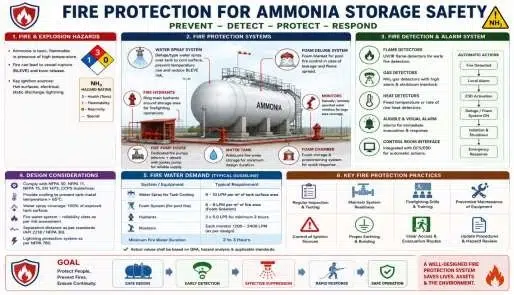
FIRE PROTECTION
Fire protection systems are designed to prevent, control, and minimize the impact of fire and heat exposure in ammonia storage facilities. Although ammonia is not highly flammable, tanks and equipment exposed to fire can experience dangerous pressure build-up. Therefore, effective fire protection systems are essential.
1. Hydrant
Definition: A fire hydrant is a fixed water outlet that provides a continuous water supply for firefighting.
- Supplies water to firefighters.
- Used to extinguish nearby fires.
- Located around ammonia storage areas.
- Regular inspection and testing are essential
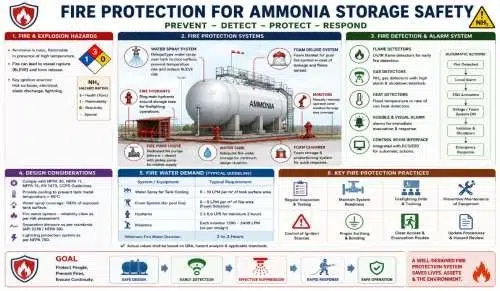
2. Water Spray System
Definition: A water spray system applies water over ammonia storage tanks and equipment to keep them cool during a fire.
- Cools tanks exposed to fire.
- Reduces tank pressure caused by heat.
- Helps prevent tank failure.
- Activated manually or automatically.
3. Foam System
Definition: A foam system produces a foam blanket to suppress fires involving flammable liquids near ammonia storage.
- Controls surrounding hydrocarbon or fuel fires.
- Prevents re-ignition of flammable liquid fires.
- Not normally used directly on ammonia gas.
- Used in loading and unloading areas where fuels may be present.
4. Fire Extinguishers
Definition: Portable firefighting equipment used to control small fires during the initial stage.
- Use Dry Chemical Powder (DCP) or CO₂ extinguishers for electrical and equipment fires.
- Place extinguishers at accessible locations.
- Inspect and recharge regularly.
- Operators should be trained in proper use.
5. Deluge System
Definition: A deluge system is a fixed firefighting system that releases a large quantity of water through open nozzles when activated.
- Provides rapid cooling of storage tanks.
- Protects equipment from fire exposure.
- Operates automatically or manually.
- Covers a large area during emergencies.
6. Emergency Shutdown (ESD)
Definition: An Emergency Shutdown System automatically or manually stops plant operations during a fire or major emergency.
- Stops pumps and compressors.
- Closes emergency isolation valves.
- Minimizes ammonia release.
- Protects personnel, equipment, and the environment.
- Should be tested periodically
SAFETY STANDARDS FOR AMMONIA STORAGE
Safety standards provide guidelines for the safe design, construction, operation, inspection, maintenance, and handling of ammonia storage systems. Compliance with these standards helps prevent accidents, protects workers, and ensures regulatory compliance.
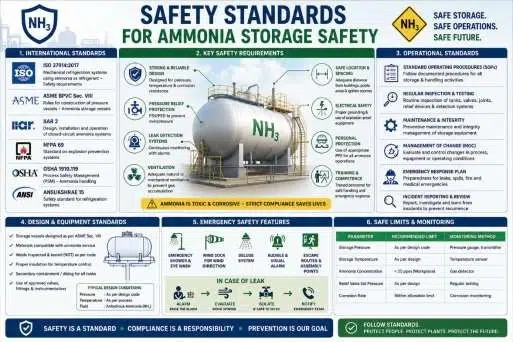
1. OSHA (Occupational Safety and Health Administration)
Purpose:– Protects workers from workplace hazards.
- Ensures safe handling of ammonia.
- Requires Hazard Communication (HazCom) and Safety Data Sheets (SDS).
- Mandates use of appropriate PPE.
- Requires emergency response planning and employee training.
- Promotes safe work practices and inspections.
2. ISO 45001 – Occupational Health and Safety Management System
Purpose:– International standard for managing occupational health and safety.
- Identifies and controls workplace risks.
- Improves worker health and safety.
- Encourages continuous improvement.
- Requires regular safety audits and training.
- Reduces workplace accidents and injuries.
3. API 620 – Design of Low-Pressure Storage Tanks
Purpose: Standard for designing and constructing large low-pressure storage tanks.
- Applies to refrigerated ammonia storage tanks.
- Specifies design, materials, fabrication, and testing.
- Ensures structural integrity and safe operation.
- Widely used for cryogenic ammonia storage
4. API 2000 – Venting of Storage Tanks
Purpose: Provides requirements for pressure and vacuum venting of storage tanks.
- Prevents tank overpressure and vacuum collapse.
- Specifies vent sizing requirements.
- Protects tanks during filling and emptying.
- Improves storage tank safety.
5. API 510 – Pressure Vessel Inspection Code
Purpose: Standard for inspection, repair, alteration, and rerating of pressure vessels.
- Uses NDT methods for defect detection.
- Extends equipment service life.
CASE STUDY OF AMMONIA STORAGE SAFETY
A large fertilizer manufacturing plant stored liquid ammonia in a refrigerated storage tank for urea production. During a routine inspection, an operator noticed a strong ammonia odor near a pipeline connected to the storage tank. At the same time, the fixed gas detection system detected a rise in ammonia concentration and automatically activated the emergency alarm. The control room immediately initiated the Emergency Shutdown System (ESD), stopped the transfer pumps, and isolated the affected pipeline to prevent further leakage.
Following the emergency procedures, all non-essential personnel were evacuated to the designated assembly point, while the emergency response team entered the area wearing Self-Contained Breathing Apparatus (SCBA) and chemical protective suits. A water curtain system was activated to reduce the spread of ammonia vapor, and continuous air monitoring confirmed that the gas concentration was decreasing. The damaged flange gasket was identified as the source of the leak and was safely replaced after the system was isolated and purged with nitrogen.
The incident was investigated using Root Cause Analysis (RCA), which revealed that the gasket had deteriorated due to aging and inadequate preventive maintenance. As a corrective action, the plant replaced all similar gaskets, increased the frequency of inspections, improved preventive maintenance schedules, and provided additional safety training for operators. The case demonstrated that early leak detection, emergency shutdown, proper PPE, and regular maintenance are essential to prevent major ammonia storage accidents and protect workers, equipment, and the environment.
FUTURE OF AMMONIA STORAGE SAFETY
As industries move toward digitalization, automation, and sustainable energy, ammonia storage systems are becoming safer, smarter, and more environmentally friendly. Future ammonia storage facilities will rely on green ammonia production, artificial intelligence (AI), robotics, IoT, and advanced monitoring technologies to improve safety, reduce operational costs, and support the global
transition to clean energy.
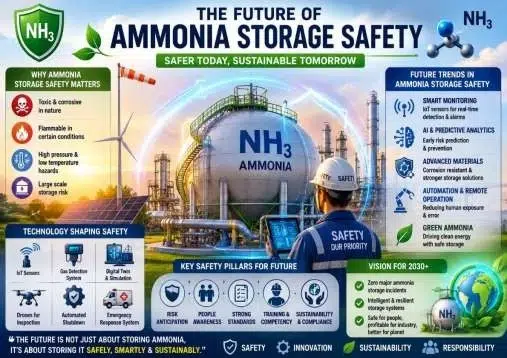
1. Green Ammonia
Green ammonia is ammonia produced using renewable energy sources such as solar, wind, or hydroelectric power instead of fossil fuels. Hydrogen is generated by water electrolysis, and nitrogen is separated from air. The hydrogen and nitrogen are then combined through the Haber-Bosch process to produce ammonia without significant carbon emissions.
Future Scope
- Reduces CO₂ emissions and supports net-zero carbon goals.
- Serves as an efficient hydrogen carrier for storage and transportation.
- Supports renewable energy storage by converting surplus electricity into chemical energy.
2. AI-Based Leak Detection
Artificial Intelligence (AI) analyzes data from gas detectors, pressure sensors, cameras, and thermal imaging systems to identify ammonia leaks before they become serious incidents.
Future Scope
- Detects leaks at a very early stage.
- Predicts equipment failure using machine learning.
- Sends real-time alerts to operators and emergency teams.
- Improves plant safety and reliability
3. Robotics for Inspection
Inspection robots and drones are used to inspect ammonia storage tanks, pipelines, valves, and hard-to-reach areas without exposing workers to hazardous environments.
Future Scope
- Reduces worker exposure to toxic gas.
- Performs inspections in confined and hazardous areas.
- Improves maintenance planning.
- Supports unmanned inspections in large storage terminals.
4. Advanced Monitoring Systems
Advanced monitoring systems combine IoT sensors, SCADA, cloud computing, digital twins, and real-time analytics to continuously monitor the condition of ammonia storage facilities.
Future Scope
- Real-time monitoring of pressure, temperature, level, and gas concentration.
- Remote access to plant data from anywhere.
- Predictive maintenance through continuous data analysis.
- Integration with emergency response systems.
- Better decision-making using digital dashboards.
CONCLUSION
Ammonia is one of the most important industrial chemicals, widely used in fertilizer production, refrigeration, and chemical manufacturing. However, because it is toxic, corrosive, and stored under pressure or at cryogenic temperatures, it presents significant safety risks if not handled properly. Therefore, the safe storage of ammonia requires properly designed storage tanks, reliable safety systems, regular inspection and maintenance, leak detection systems, trained personnel, and strict adherence to standard operating procedures.
Effective ammonia storage safety depends on a combination of engineering controls, administrative controls, emergency preparedness, and the use of appropriate personal protective equipment (PPE). Risk assessment techniques such as HAZOP, HAZID, FMEA, and QRA, together with compliance with international standards such as OSHA, ISO 45001, API, ASME, and NFPA, help minimize the risk of leaks, fires, explosions, and toxic exposure while ensuring safe and reliable plant operations.
Looking ahead, the future of ammonia storage will be shaped by green ammonia, artificial intelligence (AI), automation, robotics, IoT, and advanced monitoring systems. These technologies will improve leak detection, predictive maintenance, remote monitoring, and overall plant safety while supporting sustainable industrial development. By combining advanced technology with strong safety management practices and continuous training, industries can ensure that ammonia is stored and handled safely, protecting workers, equipment, the environment, and surrounding communities.
REFERENCES
Books
- Perry, R. H., & Green, D. W. (Eds.). Perry’s Chemical Engineers’ Handbook (9th Edition). McGraw-Hill Education, 2019.
- Towler, G., & Sinnott, R. K. Chemical Engineering Design: Principles, Practice and Economics of Plant and Process Design (3rd Edition). Elsevier, 2021.
- Crowl, D. A., & Louvar, J. F. Chemical Process Safety: Fundamentals with Applications (4th Edition). Pearson Education, 2019.
Codes and Standards
- API Standard 620 – Design and Construction of Large, Welded, Low-Pressure Storage Tanks. American Petroleum Institute (API).
- API Standard 2000 – Venting Atmospheric and Low-Pressure Storage Tanks. American Petroleum Institute (API).
- API Standard 510 – Pressure Vessel Inspection Code: Inspection, Repair, Alteration, and Rerating. American Petroleum Institute (API).
- ASME Boiler and Pressure Vessel Code (BPVC), Section VIII – Rules for Construction of Pressure Vessels. American Society of Mechanical Engineers (ASME).
Guidelines and Publications
- Center for Chemical Process Safety (CCPS). Guidelines for Risk Based Process Safety. AIChE, 2007.
- Center for Chemical Process Safety (CCPS). Guidelines for Hazard Evaluation Procedures (3rd Edition). AIChE, 2008.
- International Fertilizer Association (IFA). Guidance for the Safe Storage and Handling of Ammonia. IFA Publications.
- European Fertilizer Manufacturers Association (Fertilizers Europe). Best Available Techniques for Ammonia Storage and Handling.
Government and International Organizations
- Occupational Safety and Health Administration (OSHA) – Process Safety Management (PSM) Guidelines.
- National Institute for Occupational Safety and Health (NIOSH) – Pocket Guide to Chemical Hazards (Ammonia).
- U.S. Environmental Protection Agency (EPA) – Risk Management Program (RMP) Guidance for Ammonia Facilities.
- International Labour Organization (ILO) – Occupational Safety and Health Conventions and Recommendations.
CONTACT INFORMATION:
+91-7665231743
www.thesafetymaster.com info@thesafetymaster.com
336C, 3rd Floor, Tower B3, Spaze I-Tech Park, Sohna Road Sector 49, Gurugram, Haryana 122018