Complete Guide to HIRA Risk Assessment: Process, Examples & Safety Controls

PSM Implementation: A Complete Roadmap for High-Hazard Chemical & Process Industries
September 2, 2026
Industrial Fire Safety Audit: A Technical Framework for Identifying Critical Fire Risks
September 4, 2026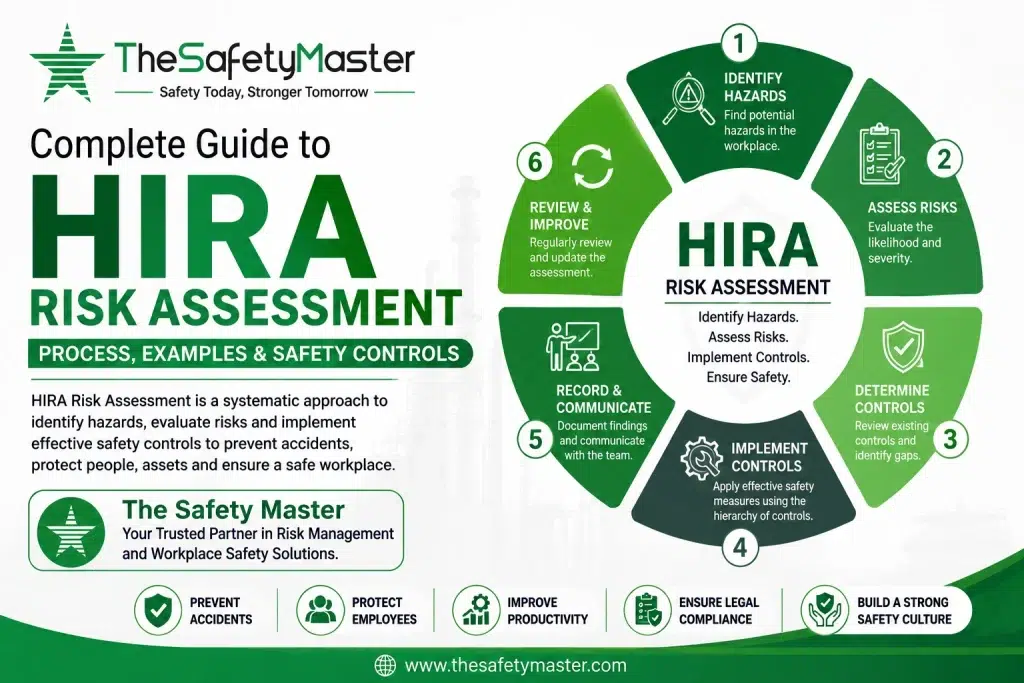
Workplace hazards can lead to injuries, equipment damage, environmental incidents, production losses, and even major accidents if they are not identified and controlled properly. A systematic approach is therefore essential for understanding workplace risks before they cause harm.
HIRA Risk Assessment is one of the important methods used by organizations to identify hazards, evaluate associated risks, and implement suitable safety controls. It helps safety professionals and management make informed decisions and improve overall workplace safety.
In this complete guide, we will explain the HIRA process, common examples, risk assessment methods, risk levels, and the hierarchy of safety controls.
What Is HIRA Risk Assessment?
HIRA stands for Hazard Identification and Risk Assessment. It is a structured process used to identify hazards associated with workplace activities and determine the level of risk they present.
A HIRA assessment generally answers three important questions:
- What can go wrong?
- How likely is it to happen?
- What could be the consequence?
Once the risks are evaluated, appropriate controls can be selected to reduce the likelihood or severity of an incident.
Why Is HIRA Important?
A properly conducted assessment can help organizations:
- Identify workplace hazards
- Evaluate potential risks
- Prevent accidents and injuries
- Improve safety procedures
- Select appropriate control measures
- Protect employees, equipment, and the environment
- Support regulatory and organizational safety requirements
- Improve overall safety culture
HIRA Process: Step-by-Step
A successful HIRA process should be systematic and practical.
Step 1: Identify the Activity or Task
Start by defining the activity, process, equipment, or job that needs to be assessed.
Examples include:
- Material handling
- Welding
- Chemical handling
- Working at height
- Confined space entry
- Electrical maintenance
- Machine operation
- Construction activities
Step 2: Identify the Hazards
Identify anything that has the potential to cause harm.
Common workplace hazards include:
Physical Hazards
Examples include:
- Noise
- Vibration
- Heat
- Radiation
- Moving machinery
- Slips, trips, and falls
Chemical Hazards
These may include:
- Toxic chemicals
- Flammable substances
- Corrosive materials
- Chemical vapors
- Dust and fumes
Electrical Hazards
Examples include:
- Electric shock
- Short circuits
- Damaged cables
- Arc flash
- Improper grounding
Biological Hazards
These may involve:
- Bacteria
- Viruses
- Biological waste
- Contaminated materials
Ergonomic Hazards
Examples include:
- Poor posture
- Manual handling
- Repetitive movements
- Improper workstation design
Step 3: Identify Potential Consequences
After identifying a hazard, determine what could happen if the hazard is not controlled.
For example:
Hazard: Working at height
Potential consequence: Fall from height resulting in serious injury or fatality.
Another example:
Hazard: Exposure to corrosive chemicals
Potential consequence: Skin burns, eye injury, or respiratory problems.
Step 4: Assess the Risk
Risk is generally evaluated by considering the likelihood of an incident and the severity of its consequences.
A commonly used approach is:
Risk = Likelihood × Severity
Organizations may use a risk matrix to categorize risks as low, medium, high, or critical.
Example Risk Matrix
| Likelihood | Severity | Risk Level |
|---|---|---|
| Rare | Minor | Low |
| Possible | Moderate | Medium |
| Likely | Serious | High |
| Almost Certain | Severe | Critical |
The exact scoring system can vary depending on the organization’s risk assessment methodology.
Step 5: Determine Existing Controls
Identify the controls that are already in place.
Examples include:
- Machine guarding
- Safety procedures
- Warning signs
- PPE
- Ventilation systems
- Emergency shutdown systems
- Training
- Permit-to-work systems
The assessment should determine whether these existing controls are sufficient.
Step 6: Implement Additional Controls
If the existing controls do not reduce the risk to an acceptable level, additional measures should be introduced.
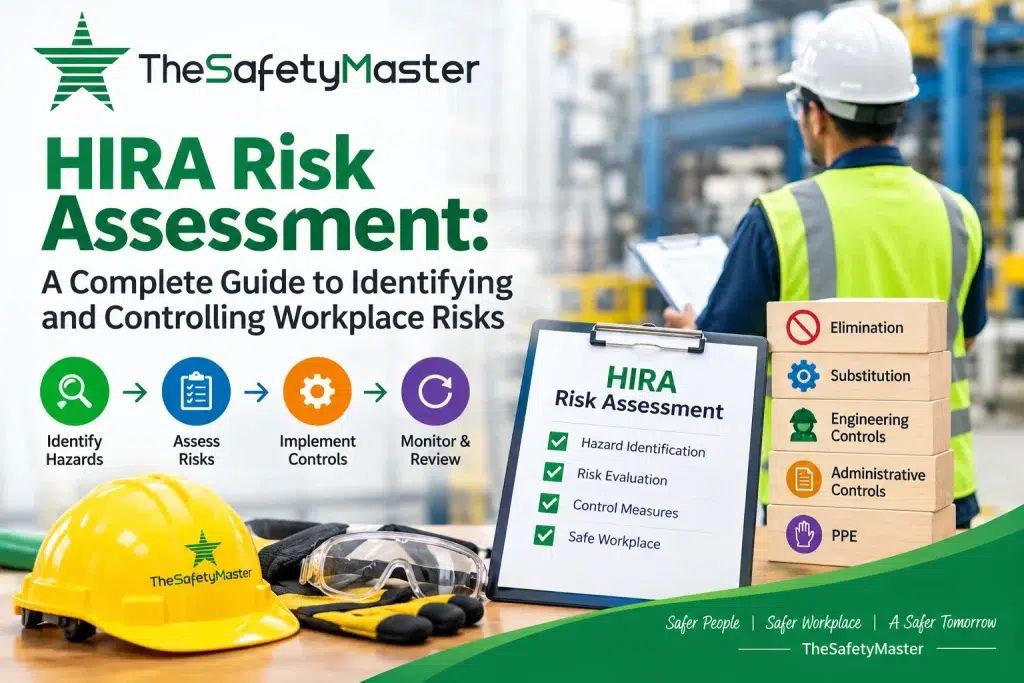
Controls should preferably follow the Hierarchy of Controls.
Elimination
Remove the hazard completely.
Example: Eliminate work at height by performing the task at ground level where practical.
Substitution
Replace the hazard with a safer alternative.
Example: Replace a highly hazardous chemical with a less hazardous substance.
Engineering Controls
Use physical or technical solutions to isolate people from hazards.
Examples include:
- Machine guards
- Interlocks
- Local exhaust ventilation
- Barriers
- Automatic shutdown systems
Administrative Controls
These include:
- Safe operating procedures
- Training
- Job rotation
- Warning signs
- Permit systems
- Inspection programs
Personal Protective Equipment
PPE is used to provide an additional layer of protection.
Examples include:
- Safety helmets
- Gloves
- Safety goggles
- Respirators
- Safety footwear
- Hearing protection
- Fall protection equipment
Step 7: Record and Communicate the Assessment
The findings should be documented clearly and communicated to the people involved in the activity.
A typical HIRA document may include:
- Activity/task
- Hazard
- Cause
- Potential consequence
- Existing controls
- Likelihood
- Severity
- Risk rating
- Additional controls
- Responsible person
- Target completion date
- Residual risk
Step 8: Review and Update HIRA
HIRA should not be considered a one-time activity.
The assessment should be reviewed when:
- A process changes
- New equipment is introduced
- A new chemical is used
- An incident occurs
- Regulations or requirements change
- Existing controls are found to be ineffective
- A new activity begins
Regular review helps ensure that the assessment remains relevant.
HIRA Risk Assessment Example
Consider a maintenance activity involving work on an elevated platform.
Hazard
Working at height.
Possible Consequence
A worker could fall from the platform and suffer serious injury.
Existing Controls
- Guardrails
- Access ladder
- Safety harness
- Inspection of platform
- Worker training
Risk Evaluation
The organization evaluates likelihood and severity using its approved risk matrix.
Additional Controls
Possible additional controls may include:
- Improving platform access
- Installing additional edge protection
- Conducting pre-use inspections
- Strengthening work-at-height procedures
- Supervising high-risk activities
The risk should then be reassessed after implementing the additional controls.
HIRA Risk Assessment for Different Industries
HIRA can be applied across many industries.
Manufacturing Industry
Typical hazards include:
- Machinery
- Chemicals
- Electrical equipment
- Material handling
- Noise
- Fire
Construction Industry
Common hazards include:
- Work at height
- Excavation
- Lifting operations
- Temporary electrical systems
- Falling objects
- Heavy equipment
Chemical Industry
Potential hazards include:
- Toxic chemicals
- Flammable materials
- Chemical reactions
- Pressure systems
- Process releases
Oil and Gas Industry
HIRA may consider:
- Fire and explosion
- Hydrocarbon release
- Confined spaces
- Pressure systems
- Hot work
- Simultaneous operations
Difference Between Hazard and Risk
Understanding the difference is essential.
Hazard is something that has the potential to cause harm.
Risk is the combination of the likelihood of harm occurring and the severity of its consequences.
Example
Hazard: Flammable liquid
Risk: Fire or explosion resulting from ignition of the liquid.
This distinction helps safety professionals perform more effective assessments.
Common HIRA Mistakes to Avoid
Incomplete Hazard Identification
Missing hazards can make the entire assessment ineffective.
Using Generic Assessments
A generic HIRA may not reflect the actual conditions of a specific workplace or task.
Ignoring Non-Routine Activities
Maintenance, emergency work, startup, shutdown, and abnormal operations should also be considered.
Relying Only on PPE
PPE should not automatically be considered the primary control when elimination, substitution, or engineering controls are reasonably achievable.
Not Assigning Responsibility
Every additional control should have a responsible person and target completion date.
Failing to Review HIRA
Changes in equipment, processes, chemicals, or working conditions can introduce new risks.
Benefits of Effective HIRA
A well-designed HIRA program can help organizations:
- Reduce workplace accidents
- Identify high-risk activities
- Improve operational safety
- Strengthen preventive controls
- Improve employee awareness
- Support safety management systems
- Reduce potential business losses
- Build a stronger safety culture
How The Safety Master Can Help With HIRA
Organizations need practical and systematic approaches to identify hazards and control workplace risks. The Safety Master provides professional safety solutions and training designed to help organizations improve their risk management and workplace safety practices.
A properly conducted HIRA Risk Assessment can help businesses understand their critical hazards and establish appropriate controls based on the nature of their operations.
Best Practices for HIRA Risk Assessment
For better results, organizations should:
- Involve competent and experienced personnel.
- Include workers who understand the actual task.
- Consider routine and non-routine activities.
- Evaluate existing controls realistically.
- Follow the hierarchy of controls.
- Document responsibilities clearly.
- Reassess residual risk after implementing controls.
- Review HIRA whenever significant changes occur.
- Communicate findings to employees.
- Keep assessment records updated.
Conclusion
HIRA Risk Assessment is an important tool for identifying workplace hazards, evaluating risks, and implementing effective safety controls. From manufacturing and construction to chemical and oil and gas operations, HIRA can help organizations proactively manage hazards before they result in incidents.
The key to an effective HIRA is not simply completing a document. It is about understanding the actual hazards, evaluating the associated risks, implementing effective controls, and continuously reviewing their effectiveness. With a structured approach and professional guidance from The Safety Master, organizations can strengthen their safety management practices and create safer working environments.
FAQs About HIRA Risk Assessment
Q-What is HIRA Risk Assessment?
HIRA Risk Assessment is a systematic process for identifying workplace hazards, evaluating the risks associated with those hazards, and implementing suitable controls to reduce the risk.
Q-What are the main steps of HIRA?
The main steps generally include identifying activities, identifying hazards, determining consequences, assessing risk, reviewing existing controls, implementing additional controls, documenting findings, and reviewing the assessment.
Q-What is the formula for risk assessment?
A commonly used approach is:
Risk = Likelihood × Severity
Organizations may use different scoring systems and risk matrices depending on their safety management procedures.
Q-What are the 5 levels of risk?
A five-level system commonly categorizes risk as:
- Insignificant
- Minor
- Moderate
- Major
- Critical
However, organizations may use different terminology and scoring systems.
Q-What is the difference between HIRA and HAZOP?
HIRA is a broader hazard identification and risk assessment method that can be applied to many workplace activities. HAZOP is a structured study commonly used to identify process deviations and potential hazards in process systems.
Q-Is HIRA applicable to construction projects?
Yes. HIRA can be used for construction activities such as excavation, lifting, scaffolding, work at height, electrical work, hot work, and equipment operation.
Q-How often should HIRA be reviewed?
HIRA should be reviewed periodically and whenever there are significant changes to processes, equipment, materials, workplace conditions, or after incidents and near misses.
Q-Why is the hierarchy of controls important in HIRA?
The hierarchy of controls helps organizations prioritize more effective ways of controlling hazards, starting with elimination and substitution before relying on administrative controls and PPE.